The Best Cook in the World

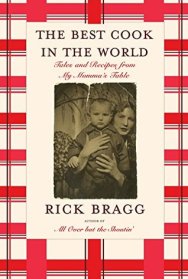
The Best Cook in the World: Tales from my Momma’s Table
© 2018 Rick Bragg
512 pages

bragg
“Good stuff always has a story,” she said.

 One of my New Years resolutions is to cook more, and that has unexpectedly introduced me to Rick Bragg,  a storyteller much favored by the reading public down here.   Bragg hails from Calhoun County, an area of the state rather different from my own – marked by the Appalachian foothills instead of wide-open cotton fields and belts of pine forest.  The Best Cook in the World is his attempt to capture some of his mother’s culinary magic into book form, if nothing else so that her recipes won’t be lost with time. But, he ruminates at the beginning, there’s a story in every recipe,  and so here he shares a few dozen recipes and prefaces each with a story that brings the dish to mind – whether it was the first recipe his grandmother ever learned (butter rolls),   pie recipes from a neighborly feud,  or turtle soup made most memorable when an old monster of the Coosa river was finally taken down.    The recipes include southern staples that are still around – ham,  black-eyed gravy – as well as more obscure ones, like a use for possum.   Despite the amount of recipes here, though, it’s more a work of folklore and family stories than a pure cookbook, one as rich in humor as it is in taste.   I’ll definitely be reading more of Bragg!  

Posted in Reviews | Tagged , , , , , , | 2 Comments

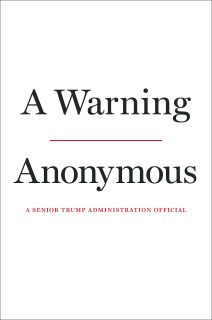
A Warning

A Warning
© 2019 A Senior Trump Administration Official
272 pages

awarning

In 2018, a disturbing op-ed ran in The New York Times declaring the existence of a secret band of White House staffers who were ‘working diligently’ to frustrate part of President Trump’s agenda and what they called his “worst inclinations”.   As relieving as it sounded that there were adults in the White House…they weren’t elected, and the idea of some convert cabal undermining Trump’s agenda played right into the president’s narrative about being at war with the DC establishment .    Now, a year later, the author of that same op-ed writes again to declare that the ‘resistance’ is crumbling inside, as the participant staffers have either left or lost the will.   Now, it’s up to Americans to evaluate the character and actions of the chief executive, and —  in November of this year — to render judgment.   A Warning presents the case against Donald Trump  to the American people.

What can the author say about Trump that hasn’t been said, and what behavior can they reveal that we haven’t born witness to already?   A Warning examines different aspects of Trump — his character, his  strengths and weaknesses in various roles as president, his personal and professional relationships — but in truth,  given that Trump makes no effort to hide his inner self, and the fact that we’ve had several books of this kind already (Fire and Fury and Fear) , we know what we’re going to find here.  An intellectually vacant lecher with the attention span and the temperament of a toddler,  who cannot be bothered to take any bit of his job seriously except exulting in the acclaim it gives him; a vulgar and reckless man who bullies staffers and world leaders alike,  whose only thought in any crisis is tending to his own vanity.   He is, in summation, the opposite of a leader, and a constitutional nightmare waiting to happen.

If the reader was not convinced by the review of Trump’s character — the author uses Cicero’s On Duties to evaluate the president by, so it’s particularly damning   —  there are also the practical considerations, like Trump’s economic ignorance (tariffs are taxes on Americans, not outside sellers), his willful destruction of relationships with the United States’ longstanding partners in Europe, and his bizarre courting of third-world thugs, among others.   Curiously, the rupture of the Iran deal, which destroyed American diplomatic credit, is not mentioned.   In the end, the two arguments come together: in a crisis, do we really want someone this distracted and petty, who has a record of bad policy decision, holding the reins?    While there are some decisions a critic could still cheer him for – – I wanted us out of the middle east in 2006 —   that can’t mean excusing him for willful ignorance and gross incompetence.

In the end….well, I don’t know how effective A Warning will be,  at a time when  the worse impulses of the human animal are so easily engorged and marshaled by social media.  It’s worth reading, though, just for a full  and focused appraisal of the strangest administration in US history.


Posted in Politics and Civic Interest, Reviews | Tagged , , | 6 Comments

Forward to 2020

Although I’ve never been much for New Year’s, save for enjoying a day off, I do appreciate the occasion it offers to look back on progress,  and to plan for the future.  As I’ve done the latter, already,  time for future planning!

Last year was overwhelmed by the Classics Club, as my quest to finish ahead of time meant putting aside most other themes and projects. This year, I’m keeping things mixed,  and unusually I’ve already got all my science  reading planned! I’m  toying with the idea of doing a “big read” in which I take on a larger work and share periodic updates from it – something like The Shahnameh or The Jewish Annotated New Testament, but we will see. That would definitely wait until I finish Brothers Karamazov! I’d also considered making 2020 the “Year of Beauty”, incorporating books on music,   architecture, dance, novels with moral themes, etc — as a counterbalance to the political ugliness we’ll all be saturated in as November creeps our way — but it feels a little too ambitious. I want to take a break from huge themes and just have a little fun.

My two IRL resolutions for 2020 are to cook more and to make further progress towards minimalism.   I donated 25 boxes of books to Goodwill over the course of 2019 (with another being filled presently!),  and during the  Christmas Day Massacre one of those boxes included numerous works by Isaac Asimov.  That’s a huge step for me, having previously been a deliberate Asimov collector, but I see no point in keeping so many of his science essay collections which I know I’ll never revisit.   The Robots-Empire-Foundation books and his mysteries are safe, of course.  I will continue to ‘shave close’, to quote Thoreau, until my collection brings me peace  and joy, rather than anxiety.    The big challenge in 2020 will be media, however, that oppressive pile of DVD and game discs  filling two bookcase shelves and spilling out onto the floor.  But I’m emboldened by Thoreau and feel prepared to truly put to rout all that is not life.  I have moral support coming up the pike, with The Gentle Art of Swedish Death Cleaning  on hold and soon to be in my possession.


So that’s me in 2020. Hope to see you all there!


Posted in General | 2 Comments

2019 Year in Review

Well,  dear readers,  it’s that time of year again — for appraising one year’s progress and getting ready for another year’s goals.  I’ve had a fantastic year in my personal life  — paying off my student loans,  making huge strides in moving towards minimalism, growing in responsibilities at work, learning to repair and upgrade my PC, trying horseback riding,  meeting a man I’ve admired for decades, and developing new friendships.   But what about the books?

I mentioned yesterday my neglect of the List O’ Books, so the stats below are based only on those books I reported on goodreads.

2020

Mmm, pie!     You can see the categorical breakdown there, but here are more statistics:

Nonfiction dominated fiction, with a 68% to  32% split. And what’s scary is that fiction was heavily augmented by the classics, almost all of which were novels!

Medium Breakdown
48% of my reading came from ebooks
41% came from physical (“real”) books. (Considering the classics were almost all ‘real books’, things do not bode well for the physical category in 2020.)
and 11% came from audiobooks.

And now….The Annual Wall of Text!

The classics marked 2019 like no other year before or since, as I made it my goal to read 20, in large part to finish my Classics Club Challenge a little early. I’m happy to say that I technically made that goal (19 scheduled, 1 early), and anticipate finishing Brothers Karamazov before the winter is out. I’m especially proud to have finished War and Peace , but two other classics of note were The Jungle (which I enjoyed, unexpectedly), and my re-read of The Grapes of Wrath, which was just as brilliant as I remembered from high school.

The downside of the Classics push was that it made it difficult to work on other hoped-for themes, like a celebration of Alabama history and culture that I’d planed to do in conjunction with the State’s bicentennial, celebrated in December 2019. Aside from local history, the only Alabama-focused book I managed was Steve Flowers’ Goats and Governors, which introduced me to some of Alabama’s more colorful public figures.

History in general is the bedrock of my reading any year, and often underpins other categories as well: my science and technology books often have a historical focus, like How the Internet Happened , one of my very favorites for the year. The Only Plane in the Sky follows closely on its heels, being an oral history of 9/11 — the best book on the day, bar none — and Code Girls , earlier in the year, was an eye-opening history of the growth of cryptography in WW2. American Gun was also fun.

Religion and philosophy was anemic for the second year running, with the only notable being Jack Donovan’s The Way of Men – a book I still haven’t reviewed, aside from a comment: “Imagine if Tyler Durden wrote a book….”

Science had a strong year, with fourteen books, although I didn’t quite finish my ‘science survey’ in which I read twelve books from twelve different areas of science: anthropology, usually a shoe-in, got left behind. The strongest contenders were She Has Her Mother’s Laugh, on the complexities of heredity; The Skeptic’s Guide to the Universe , the best volume on critical thinking I’ve yet encountered; The Hidden Life of Trees , an awe-inspiring volume; and The Ice at the End of the World, an interesting mix of adventure and science writing focused on Greenland’s ice sheets.

Technology and Society is a growing category for me as I continue to explore the ramifications of the digital world which we can now never escape This included both works of history, like a chronicle of Google’s rise to power, as well as titles exploring the consequences of digital addiction on society and our minds. Turkle’s Alone Together and Catherine Price’s How to Break Up With Your Phone were both noteworthy, and the latter has induced a few changes in my own phone habits.

Politics and Civic Interest had a strong year all around, with practically no weak entries. The most insightful, for me, was Romance of the Rails, a critical history of the past and future of rail transport in the US, but I also enjoyed Walkable City Rules: 101 Steps To Making Better Places. Foreign-policy wise, I especially enjoyed The Limits of Partnership, on the Russo-American relationship, as well as Our Time Has Come, on India’s growing role in global politics. Closer to history was The Gatekeepers, an appraisal of the importance of the White House Chief of Staff from Eisenhower on. My favorite, though, would be Carl Watner’s I Must Speak Out , a collection of voluntaryist writings covering both theory and practice. (A voluntaryist is a libertarian who’s been nursing both whiskey and an especially bitter grudge against the state.)

Society and Culture’s had a couple of highlights: Anthony Esolen’s In Defense of Boyhood, and Ben Sasse’s Why We Hate Each Other – and How to Heal .

Science fiction was strong in quality if not in number this year, as I explored more of Daniel Suarez and John Scalzi’s works. Suarez was impressive all around ( Freedom being the first) though the only new Scalzi work I really liked was Lock In and its sequel. I read some in Star Trek and Star Wars, but there were no standouts.

In historical fiction, which has lagged this year and last, I enjoyed the first few titles in Paul Fraser Collard’s Jack Lark series, about an infantryman-turned-office’ service in the Crimean and later wars.

I also read quite a bit in miscellaneous topics, from health to prepping; my last favorite was The Unthinkable by Amanda Ripley, on the psychology of disasters and survival.

All told, it was a good year — and I anticipate more and more varied reading in 2020 now that I’m largely free from the Classics challenge!

Posted in General | Tagged , | 16 Comments

Top Ten Favorite Books, 2019

  1.  Code Girls: The American Codebreakers who Helped Win WW2, Liza Mundy. Fun and informative, Code Girls follows the rapid growth of intelligence and crytography during WW2.   Absolutely fascinating!
  2. The Skeptic’s Guide to the Universe, Steven Novella et. al. The best one-volume handbook  on critical thinking, the successor of Sagan’s Demon-Haunted World.
  3. How the Internet Happened, from Netscape to the iPhone, Brian McCullough.   An incredibly fun nostalgic romp through the digital world as it developed.   I especially enjoyed the chapter on the rise of AOL,  being as attached to my AIM program as modern teens are to their social media apps.
  4. War and Peace, Leo Tolstoy.  I’m not just sticking it here to brag about reading it (okay, I am a little). I was honestly captivated by Andrei and Pierre’s separate but related growth as men, and of Tolstoy’s view of the war.
  5. I Must Speak Out: The Best of the Voluntaryist, Carl Watner.  Hard to describe this one without sounding crazy, but let’s just say it’s a collection of political essays..
    3f24a-sasse
  6. Them: Why We Hate Each Other (and How to Heal), Ben Sasse.    Politics has for years angered or depressed me ,  because so much is wrong and nothing seems liable to change in  good ways,    and Sasse’s book was a heartening reminder that there are people out there  who feel the same sense of alienation and are looking for a light out of the darkness.
  7. The Only Plane in the Sky: An Oral History of 9/11.    Ordinarily I resist putting December books on my best-of list, because they have an advantage in being recent. But Only Plane in my Sky made this list halfway through, displacing Dan Baum’s Gun Guys.     It’s an incomparable reliving of 9/11 through the eyes of a staggering variety of individuals   who experienced it —  as office workers,  taxi drivers, government employees,  firefighters,   astronauts, etc.  If you only ever read one book on 9/11, make it this one.  (If you read two, make the other The Looming Tower.)
    unthinkable
  8. The Unthinkable: Who Survives When Disaster Strikes and Why, Amanda Ripley.   Easily one of the most interesting books I’ve read all year, examining human behavior during crises like ship sinkings, terrorist attacks, etc.
  9. The Hidden Life of Trees, Peter Wohlleben. An eye-opening walk through the rich life of forests and their leafy members.
    4d819-omy
  10. Freedom, Daniel Suarez. (Kill Decision and Change Agent by the same author were also really good!)
Posted in General | 6 Comments

(Most Of) What I Read in 2019

(“Most” because I forgot to keep track, so this just has the stuff I remembered to put on Goodreads. )

Politics and Civic Interest
The Long Game: How Obama Defied Washington and Redefined America’s Place in the World, Derek Chollet
The Limits of Partnership: U.S.-Russian Relations in the 21st Century, Angela Stent
Our Time Has Come: How India is Making Its Place in the World, Alyssa Ayres
The Conservative Heart, Arthur C. Brooks
The Gatekeepers: How the White House Chiefs of Staff have Defined Every Presidency, Chris Whipple
Walkable City Rules: 101 Steps to Making Better Places, Jeff Speck
Romance of the Rails,  Randall O’Toole
I Must Speak Out: The Best of The Voluntaryist, 1982-1999, ed. Carl Watner
Junkyard Planet, Adam Minter
Rubbish: The Archaeology of Garbage, William Rathje

Science
She Has Her Mother’s Laugh: The Power, Perversions, and  Potential of Heredity, Carl Zimmer
Heavens on Earth: The Scientific Search for the Afterlife, Immortality, and  Utopia, Michael Shermer
The Skeptic’s Guide to the Universe,  Steven Novella et al
The Big Ones: How Natural Disasters Have Shaped Us, Lucy Jones
A Forest in the Clouds, John Fowler
The Rise and Fall of the Dinosaurs, Stephen Brusatte
What Einstein Told His Cook, Robert Wolke
The Cancer Chronicles, George Johnson
Seven Brief Lessons on Physics, Carlo Revelli
The Evolution of Everything, Matt Ridley
The Hidden Life of Trees, Peter Wohlleben
The Ice at the End of the World, John Gertner
Wonders of the Solar System, Brian Cox

History
The View from the Ground: Experiences of Civil War Soldiers,. ed. Aaron Sheehan-Dean
America’s Forgotten Architecture, the National Trust
Yesterday: Memories of Selma and her People, C.C. Grayson
The Other Side of Selma, R.B. “Dickie” Williams (Re-read — see also 2010 review)
Johnny Reb’s War: Battlefield and Home Front, David Williams
Tip of the Iceberg: My 3,000 Mile Journey Around Alaska, Mark Adams
Images of America: The USS Alabama,  Kent Whitaker
Of Goats and Governors: Alabama Politics , Steve Flowers
The Time Traveler’s Guide to Restoration Britain, Ian Mortimer
American Gun: A History of the US In Ten Firearms, Chris Kyle
To Rule the Waves: How the British Navy Shaped the Modern World, Arthur Herman
An Empire on the Edge: How Britain Came to Fight America, Nick Lane
Dealers of Lightning: XEROX, PARC, and the Dawn of the Computer Age,  Mark Hiltzik
American Detective: Behind the Scenes of Famous Criminal Investigations, Thomas Reppetto
The First Family, Mike Dash
The Hacker Crackdown, Bruce Sterling
Code Girls: The American Codebreakers Who Helped Win WW2, Liza Mundy
Sea Wolves: A History of the Vikings, Lars Brownworth
American Rifle, Alexander Rose
Hamburg: A Place Remembered
The Heritage of Perry County, Alabama
My Disillusionment in Russia, Emma Goldman
The Only Plane in the Sky: An Oral History of 9/11,Garrett Graff

Technology and Society
 In the Plex: How Google Thinks, Works, and Shapes Our Lives, Steven Levy
Everybody Lies: Big Data, New Data, and What the Internet Can Tell Us, Seth Stephens-Davodwitz
LikeWar: The Weaponization of Social Media P.W. Singer and Emerson T. Brooking
How the Internet Happened, from Netscape to the iPhone, Brian McCullough
Alone Together ,Sherry Turkle
India Connected, Rav Agrawal
Ten Arguments for Deleting Your Social Media Accounts Right Now,  Jaron Lanier
More than Human: Embracing the Promise of Biological Enhancement, Ramez Naam

Religion and Philosophy
Status Anxiety, Alain de Botton
Open Life: The Philosophy of Open Source, Hendrik Ingo
The Way of Men, Jack Donovan
The Catholic Gentleman: Living Authentic Manhood Today, Sam Guzman
My Plain Life: Walking my Belief, Scott Savage
The Lost Gospel of Mary,   Frederica Mathews-Greene

Classics and Literary
Invisible Man, Ralph Ellison
The Whale, or, Moby-Dick, Herman Melville
The Aeneid, trans. Robert Fitzgerald
The Conquest of Gaul,  Julius Caesar
Love Among the Ruins,  Walker Percy
The Moviegoer,  Walker Percy
The Swiss Family Robinson, Johann Wyss
Life on the Mississippi, Mark Twain
The Sun Also Rises, Ernest Hemingway
A Farewell to Arms, Ernest Hemingway
The Grapes of Wrath,  John Steinbeck
Catch-22, Joseph Heller
The Vicar of Wakefield,  Oliver Goldsmith
The Three Musketeers, Alexandre Dumas
The Decline and Fall of the Roman Empire: Book One, Edward Gibbon
The Histories, Herodotus
The Education of Henry Adams, Adams
The Federalist Papers,  various
The Jungle, Upton Sinclair
The Hunchback of Notre Dame,  Victor Hugo
A Lesson Before Dying, Ernest Gaines
War and Peace, Leo Tolstoy


Societyand Culture
Them: Why We Hate Each Other (and How to Heal),  Ben Sasse
Defending Boyhood, Anthony Esolen
From Here to Eternity: In Search of the Good Death, Caitlin Doughty
Gun Guys: A Road Trip, Dan Baum
Shutting Out the Sun, Michael Zielenziger

Arts and Entertainment
Prepare to Meet Thy Doom: And Other Gaming Stories, David Kushner
Difficult Men: Behind the Scenes of a Creative Revolution, Brett Martin

Health and Wellness
The Case Against Sugar, Gary Taubes
How to Break Up With Your Phone, Catherine Price
Faith Healers, James Randi
Drop Dead Healthy, A J Jacobs
The Courage to Start, John Bingham
Year of No Sugar, Eve Schaub

Sports and Outdoors
Giant Whitetails: A Lifetime of Lessons, Mark Drury
Whitetail Savvy: New Research and Observations about America’s Biggest Game Animal,  Leonard Lee Rue III

Skills and Readiness
How to Be Your own Bodyguard, Nick Hughes
Surviving Aggressive People, Shawn T Smith
The Unthinkable: Who Survives When Disaster Strikes and Why,  Amanda Ripley

Biography
Odd-Egg Editor, Kathryn Tucker Windham
Ghost in the Wires: My Adventures as the World’s Most Wanted Hacker,  Kevin Mitnick
Americanized:  Rebel without a Green Card, Sara Saedi
Lenten Lands: My Childhood with Joy Davidman and C.S. Lewis, Doug Gresham
Mockingbird Songs: My Friendship With Harper Lee, Wayne Flynt
Little Man: Meyer Lansky and the Gangster Life,   Robert Lacey

Mysteries and Thrillers
The Unpleasantness at Baskerville Hall, Chris Hall
The Great Bicycle Race Mystery, Gertrude Chandler Warner
Bicycle Mystery, GCW
Metropolis,  Phillip Karr
Needful Things, Stephen King
Hallowe’en Party, Agatha Christie

General Fiction
Becoming Mrs Lewis, Patti Callahan
Fight Club, Chuck Palahniuk
IRL, Jen Wang and Cory Doctorow
Athena: Grey-Eyed Goddess, George O’Connor
It’s Christmas!, Kathryn Windham Tucker

Science Fiction
Lock In,  John Scalzi
Head On, John Scalzi
Firefly: The Magnificent Nine, James Lovegrove
One Word Kill, Mark Lawrence
Limited Wish, Mark Lawrence
Change Agent, Daniel Suarez
Altered Carbon, Richard Morgan
Kill Decision, Daniel Suarez
Freedom, Daniel Suarez
The Android’s  Dream, John Scalzi

Star Trek and Star Wars
ST: Elusive Salvation, Dayton Ward
ST Enterprise: Tower of Babel, Christopher L Bennett
SW: Queen’s Shadow, E.K. Johnston
ST: Constellations, Marco Palmieri
ST: The Sky’s the Limit, ed. Marco Palmieri
ST: Spock vs Q, Cecelia Fannon
ST:  Live by the Code, Christopher L Bennett

Historical Fiction
Alice and the Assassin, R.J. Koreto
The Scarlet Thief, Paul Fraser Collard
War of the Wolf, Bernard Cornwell
Scarlet, Stephen Lawhead
The Maharajah’s General, Paul Fraser Collard
The Devil’s Assassin,  Paul Fraser Collard
The Lone Warrior, Paul Frasier Collard

Posted in General | Tagged , , | 6 Comments

“The Night Before Christmas: The Musical”

A few weeks ago I shared my admiration of Alma Deutscher, a German-English musical prodigy who’s been writing operas since she was  in elementary school.  I recently encountered this video of her singing with her little sister, ‘reciting’ the classic poem to music of her own creation.

Posted in General | Tagged | Leave a comment

Some voices from 9/11

Below follow some of the more poignant quotes from The Only Plane in the Sky.

onlyplane

Meanwhile, hundreds of feet below the impact zone, people were still going about their day. The World Trade Center complex was so massive that those in the underground shopping concourses didn’t feel the plane hit and did not realize something terrible had transpired until they saw others fleeing.

Duty

One of the firemen from Rescue 1 looked up and said, “We may not live through today.” We looked at him, and we looked at each other, and we said, “You’re right.” We took the time to shake each other’s hands and wish each other good luck and “Hope I’ll see you later,” which is especially poignant for me because we all had that acknowledgment that this might be our last day on earth and we went to work anyway.

At the Pentagon:
John Yates: It was pure black. You were in a black room, you didn’t know where you are. What’s the first thing you do? You put your hands out to try to find where you are. Everything I touched burned me.

Last Words:
Mostly, I just wanted to say I love you and I’m going to miss you. I don’t know if I’m going to get the chance to tell you that again.

Rick Rescorla, in a phone call to his wife, Susan: I don’t want you to cry. I have to evacuate my people now. If something happens to me, I want you to know that you made my life.

Inexplicable
Constance Labetti, accountant, Aon Corporation, South Tower, 99th floor: I would start to cry, and I’d start to tremble, and I heard my father’s voice. My father had been dead since 1985—and I heard his voice, clear as day, telling me that I was not going to die in this building. I straightened up and kept walking down the steps.

(My favorite part of this story — after Labetti escaped, the people she was with hugged and thanked her. She’d been saying the words she ‘heard’ from her late father and uncle, and inspired them to keep moving.)

Crisis
Andrew Kirtzman: It was pretty weird that here was the mayor and the entire leadership of the city, and they were as helpless as anyone walking down the street. As a citizen, it was pretty frightening that no one was in charge—or the person who is supposed to be in charge had no way of operating.

Rep. Porter Goss: There wasn’t any plan. You’ve now taken 535 of the most important people in the country and put them out on the lawn.

Pacing President
“Dave Wilkinson: He fought with us tooth and nail all day to go back to Washington. We basically refused to take him back. The way we look at it is that by federal law, the Secret Service has to protect the president. The wishes of that person that day are secondary to what the law expects of us. Theoretically, it’s not his call. It’s our call.”

United We Stand
At 1:00 the phone started ringing, people who want to come and help. I put the names of all these people in an Excel sheet and what it is that they wanted to do. They wanted to help dig out the people at the Pentagon. They wanted to secure the area themselves. They wanted to enlist to go and fight. I had a man who called and he said, “I am 80 years old. I still fit in my pilot uniform from World War II. I can still see. I can still hear. I have kept up with my training as a pilot. Tell whoever you can tell that I’m ready to report for duty.” That broke my heart, this 80-year-old man saying that.

I felt so proud that my community, the Hispanic community, were calling. Suddenly the phones were ringing and saying, “This is the country that we chose to come to. Nobody will destroy our country.” They would say, “I’m not legal in the United States. Do you think they will accept me to do volunteer work?”

John Feehery: I think it was [Rep.] Jennifer Blackburn Dunn who started breaking out in “God Bless America.”
Sen. Tom Daschle: It didn’t take long before everybody began singing along. It was probably the most beautiful part of the entire experience, totally unplanned, totally spontaneous. But probably more powerful than whatever the Speaker and I said. Rep. Dennis Hastert: I remember the chills going down my spine. I remember thinking, This country will be okay. We’ll stand shoulder to shoulder.

Perspective
He said, “I don’t know what the plan is, but I’m going to be the best husband, father, dad, son that I can be. That’s how I’m going to live my life.”

Posted in quotations | Tagged | 4 Comments

The Only Plane in the Sky

The Only Plane in the Sky: An Oral History of 9/11
© 2019 Garrett Graff
512 pages

onlyplane


If you ever only read one book about 9/11, make it The Only Plane in the Sky.   I have rarely been as absorbed by a book as this one.     It’s a book less masterfully written than edited, for the content here is not the author’s narrative, but rather the impressions, thoughts, and recollections of a staggering variety of Americans who lived through this day.   Through them, we  relieve the sleepy tedium of the day before, the brilliant clear morning that preceded the chaos, the first tremors of confusion,  and then we are thrown headlong into the abyss as everything goes to hell —  and then, finding other survivors, try to find our way out as  citizens and professionals alike turn into heroes.   We are in New York,  D.C,  Pennsylvania,  in orbit, at sea, in places very close and far removed.

As I read this, I felt a renewed sense of thankfulness that I was more sheltered from the day’s events as a student than I would be were they happen today.  We heard the announcement in school, we saw the towers fall on television —  and we sat with the cold dread, the anger, the sadness — but were not constantly exposed to the torrent of information and misinformation circulating throughout the day.   By the time we arrived home,   the picture of what had happened was clearer. But Only Plane superbly demonstrates how people close to the action were confronted with both the immediate horrors around them, and the fear of horrors to come.  When would the attacks end? Who was next?     Reading this, I was profoundly grateful, too, to encounter stories I’d never considered before:  I knew nothing of the Marriot Hotel, destroyed by the debris of the falling towers,   and I was surprised to learn that that Pentagon survived as well as it did because the doomed American-77 flight struck a recently reinforced wedge of the building. Had it hit somewhere else, one of the interviewees commented, the jet could have plowed a path clear through the building.

The stories of interest here are too many to number — seeing how clerks and functionaries in the government rallied to the challenge,   or  seeing the day through the eyes of astronauts or submarine crews who only learned of it 12 hours after the fact  — and they run the gamut of human emotions. I read this often with tears in my eyes, either in appreciation for the amazing nobility of people, or for sadness at loss.      It was fascinating, too, to see so many political figures who would be felled by scandals  and the like in the years to come, here performing admirably.    Even higher-ups whose actions in office I strongly despise here  cut a good figure — Cheney,   calmly managing the government’s backup plans while Bush,  eager to get back to D.C. but held back by the secret service, paces aboard a circling plane — Air Force One, the only plane in the sky.

I can only repeat itself: if you only read one 9/11 book, read this one.  It’s a masterpiece of remembrance.

Posted in history, Reviews | Tagged , , | 5 Comments

The Lost Gospel of Mary

The Lost Gospel of Mary:  The Mother of Jesus in Three Ancient Texts
© 2012 Frederica Mathewes-Green
178 pages

miriam


We are presently in the season of Advent,  an ideal time to take a look at a question of mine: how do the  Orthodox approach Mary?  I know she’s held in some regard in the Orthodox traditions, because I’ve heard an exquisitely beautiful canon devoted to her.  Frederica Mathews-Greene has been my guide to the Orthodox  before,  so I began this with great interest and was not disappointed. It is not a full book on Mary; instead,  it introduces three ‘texts’ — a Gospel of Mary, a 3rd century prayer, and a similarly ancient hymn —  that indicate that Marian devotion is not a not western Catholic novelty, but  rather part of the early Christian experience which later became exaggerated or ignored altogether by later  traditions.  Mathewes-Green  joins these materials together with historical and theological commentary,  after a clarifying introduction which reveals this Gospel was not “lost”, but simply unknown to the western church.

The Gospel of Mary has the most substance, so I’ll  render a quick precis:  Mary is born after her aging parents, remorseful about their lack of progeny, pledge any child born to God’s service.   Mary is born and enters the service of the Temple at age three,  working there until she nears puberty at which point the priests are commanded by God to summon the area’s widowers to the temple.  Joseph is among that number, and is barked by a dove to be her husband.  Although he has second thoughts when she confesses that’s she’s pregnant, a dream of God assures him that all is well, and he stands by her when the community  tries them for sin.  They survive the trial,  and enroute to Bethlehem for the tax business,  Mary gives birth in a cave.  Jesus is then hidden in an ox manger from  King Herod, who was warned that the king of the Jews had just been born. His cousin John the Baptist is hidden in a mountain, while John’s father is murdered for refusing to say anything.

There are several parallels in the Gospel of Mary to other stories  Christians would be familiar with; a midwife not believing Mary’s virginity until she’d personally tested  it with her hands recalls  Thomas’ doubt in the Resurrection stories, and  Frederica points out that a shrouded baby in a cave  carries far more meaning when the reader looks ahead to see that same body,  again shrouded, again in a cave some thirty-three years later.  As much as I value learning how old Mary’s place among Christian devotion is — regarding her with protective affection, then as an elder sister  — I also enjoyed Mathews-Green’s commentary in general.

I was thinking of accompanying this with Brad Pitre’s Jesus and the Jewish Roots of Mary, but  at the moment I’m more focused on Brothers Karamazov. Perhaps next year..


Posted in Reviews | Tagged , , , | 3 Comments