Of love languages, cunning critters, epic battles, and cows

Time for some mini-reviews!

Read but not reviewed in the last week or so have been:

  • The Heart of the 5 Love Languages, Gary Chapman
  • Are We Smart Enough to Know How Smart Animals Are? Frans de Waal
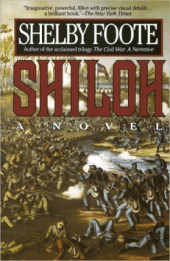
  • Shiloh: A Novel, Shelby Foote
  • The Secret Life of Cows, Rosamund Young

A young friend of mine often sings the praises of The 5 Love Languages,  and though I’m not married I wanted to check it out for myself.  I accidentally checked out this ebook instead, which is a summary of the book’s contents. I imagine it would be a helpful reminder to those who have read the book, but as it was it only offered me a peek at what I might expect to read later.  I’ll save further comments for when I read the actual love languages book!
smarts

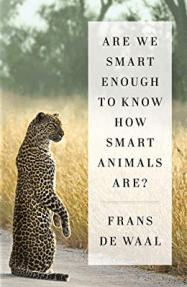
Next up, animal intelligence!  So, are we smart enough to know how smart animals are?   Probably not.  Frans de Waal, a primatologist whom I’ve read many times over the years,  reviews the limits of studies about animal intelligence and points out that we’ve often done it in very boneheaded ways —  trying to assess chimpanzees’ abilities to recognize faces by testing them on human faces, rather than chimpanzee faces, for instance.  When experiments are designed artfully and humanely,   animals from chimpanzees to corvids to octupii can show off their smarts. What’s important to note, though, is that animals have intelligence for their purposes;  a generic “intelligence” based on human presumptions is not what we should look for. (Quasi-related: Beautiful Minds: The Parallel Lives of Great Apes and Dolphins).
2battle

I followed this with Shelby Foote’s Shiloh, a work of historical fiction from a bonafide historian.  Foote was an eminent southern historian who created a three thousand history of the Civil War, and appeared in Ken Burn’s documentary on the same. I didn’t realize he’d written a novel, and had to investigate. Foote takes readers through the bloody spectacle by visiting various infantrymen and officers from both sides of the conflict,   with excerpts from letters included for flavor.  Not surprising from a historian is the level of visceral details, like the dew-soaked pants of the infantry forming their early morning line of battle.  But knowledge as a historian doesn’t necessarily translate to compelling characters or a fascinating story, so Foote is doubly gifted as an author — for hooking the reader with his characters and luring them into the fray is exactly what he does. (Related:  Jeff Shaara’s Blaze of Glory, also a Shiloh novel.)

cow4

Last and definitely least was The Secret Life of Cows, by Rosamond Young, a British cattle rancher who specializes in organic beef. I’d assumed from the title that the work would explore the mental, emotional, and social lives of cows, who I suspect are more fascinating that most people give them credit for.    The author opens with an essay lambasting CAFO practices, which she regards as criminally unethical and  the source of both inferior stock and inferior product, before sharing a series of stories about her cattle. These  border on fanciful, with cows having conversations and the like; it’s saturated in anthropomorphism, so much so that it leaves a skeptical reader wondering how to separate the wheat from the chaff. There’s much to be gleaned here about the distinctive personalities that cows have, but there’s also an awful lot of imagination. I left it disappointed.. Unfortunately, despite their role in human history,  cattle have not inspired many other books that might serve as competition.  Maybe I can bug my cowgirl friend to let me hang out with her when she’s doing fieldwork one day…  (RelatedCattle, an Informal Social History.)


Posted in historical fiction, Reviews, science | Tagged , , , , , | 4 Comments

Where the Crawdads Sing

Where the Crawdads Sing
© 2018 Delia Owens
368 pagesCrawdads

‘There are some who can live without wild things, and some who cannot.’”  – Aldous Leopold, The Sand County Almanac

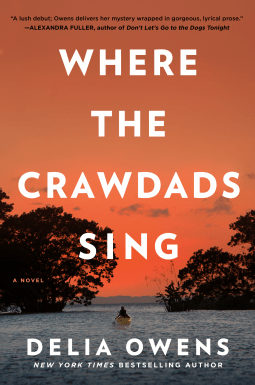
They called her the Marsh Girl. Abandoned in a decaying shack as a child and treated as trash by most of the village,   young Kya survives only through her understanding of the wetlands which surround her.  In them she finds not only sustenance – mussels and fish, some which she barters for other supplies – but also  shelter from the kids who delight in abusing her.   But more than that, the wetlands are a constant source of wonder for Kya, who fills her time drawing the life around her and collecting shells and feathers.    A rare few people will recognize her passion and potential, and try to nurture her – but others will seek, out of fear or greed, to abuse and destroy her.  Where the Crawdads Sing is a fascinating character novel delivered in rich prose that truly immerses the reader in both the marsh and the girl who grew up there.

I described Crawdads as a character novel, because Kya’s struggle to survive, and then to make something of her relationships with the marsh and with a few people around her, makes the novel – that, and its abounding references to wetland ecology.  Kya learns to read from The Sand County Almanac, a collection of essays on nature and conversation,   and her lifelong deep study of the marsh makes her  both the foremost expert in its flora and fauna, and an advocate for its conservation.  Both elements of the novel have their beauty;  the descriptions of the marshlands are the best I’ve ever read, and I found Kya a fascinating mix of wild and rational.   I was wholly invested in her story, never more so when she was accused and hunted for a mysterious death in the marsh.


Posted in Reviews | Tagged , , , , | 9 Comments

Men in Blue

Men in Blue (Badge of Honor #1)
© 1988 W.E.B. Griffin
356 pages

bage1

A buxom young reporter meets a fetching police captain at an out of the way diner, hoping for an illicit rendezvous. A half hour into their liaison,  the captain intervenes in an attempted holdup and is killed for his troubles.  Although the captain killed his assailant, her accomplice flees into the city and becomes the object of a manhunt.   Staff Inspector Peter Wohl is first to respond, and is asked by the higher-ups to Handle the Situation: obviously a married captain having an affair with a prominent news anchor is bound to be trouble.  So it is – at least for the anchor, the captain, and the anchor’s neighbor, who is found brutally murdered after the anchor’s role as a witness to the robbery-gone-wrong is exposed on TV.    Men in Blue  brings fascinating levels of detail, and some memorable characters,  to a cop drama that’s more dramatic in its focus on relationships than police investigation. 

 I’ve never read W.E.B. Griffin before, but he’s been compared favorably to Bernard Cornwell, a claim that bears investigating given my high regard for that spinner of action tales medieval and Napoleonic.   I can see some resemblance in the weight of details, as  Griffin here is happy to offer two pages of history on the rise of the .357 Magnum, and the creation of a certain forbidden cartridge that the deceased captain uses to defend himself.   Background information for both characters and important locales might take us back to when Herr Rickenbacher arrived in the United States from Bavaria.   Cornwell’s use of details is more overtly purposeful, though;   with Griffin, I’m not so sure.  It certainly adds to the novel –   believability and tension, for instance —  but can also be distracting when details are introduced and then never deliver to the plot.  Considering this is first in a series, however,  I don’t want to be quick to judge; the captain’s ammo may be exposed later on. 

I can’t deny enjoying Men in Blue despite the odd fact that there’s not a great deal of police investigation going on;   the police officers readily identify the killed robber and her accomplice, and he’s not tracked down but spotted on the street and then chased.  The gruesome murder of the anchor’s friend and neighbor  does involve a little legwork, but it’s mostly happening in the background as the staff  inspector and the woman he’s protecting fall in lust with one another and disappear into bedrooms, to the confusion of everyone at the police roundhouse and the news station. It’s character drama that’s front and center here, from  tensions between the news people and the cops, the fights between cops and brass, and naturally the affairs between the anchor and her  courting LEOs.   It was fun, but I wouldn‘t put this in the technical thriller category of Michael Connelly,    I’ll need to read more of Griffin to see what kind of author he really is, though; this one’s brevity and role as the intro book to a series might be giving me a distorted impression.  


Posted in Reviews | Tagged , , | 2 Comments

Why is Sex Fun?

Why is Sex Fun? The Evolution of Human Sexuality
© 1997 Jared Diamond
172 pages

whycoitus

Why is Sex Fun is a provocatively titled, slim volume on the evolution of human sexuality. Diamond never addresses the titular question, though,  instead  evaluating why  (1) humans are mostly monogamous, (2) why ovulation is a concealed process, and (3) why women’s reproductive systems have an automatic shutdown. Diamond argues that males and females have competing sexual interest, and that the pair-bond generally works to balance them  — giving males  some reasonable expectation that the kids they’re providing for are in fact theirs, and giving females support in term of material provision, for both her and the kids.  Male competition for  secure mates means that young children are often killed to make way for a dominating male after he claims a given female; Diamond suspects that hidden estrous  undermines this tendency in humans, by making it impossible for a male to dominate a female’s ovulation period.  Various males who have mated with a given woman can plausibly believe her kids are theirs, and have less incentive to kill them.  As to the final question, since labor is often deadly even to younger women, Diamond suspects that menopause is a way for the aging body to protect itself and focus energy on already-existing children. Why is Sex Fun would be of considerably more interest had it not been overtaken  by other, broader books on the science of sex, like The Queen’s Race Sex at Dawn, etc.   A lot of the information here has been re-presented in more modern works, in a less dry style, leaving Diamond’s the chief virtue of being short. 

Posted in Reviews, science | Tagged , , , | 5 Comments

Brains, cotton mills, and vanilla legal thrills

January is off to a solid reading start, largely because I’ve developed some ankle woes and my gym/hiking/cycling time has become extra reading time for three weeks running. I’m about to see an orthopedic specialist, though, so here’s hoping I can find out what’s ailing me!

Read but not reviewed in the past week were:

  • The Most They Ever Had, Rick Bragg
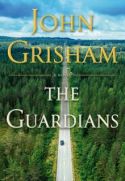
  • The Guardians, John Grisham
  • Welcome to Your Brain, Sandra Aamodt
guardians
First up was John Grisham’s The Guardians, which…well,  I can only echo my review of The Whistler. It’s a very vanilla legal thriller: perfectly enjoyable, perfectly forgettable.  The inclusion of a cabin cursed by voodoo adds an interesting flair to the endgame, but’s just a story about a lawyer trying to free people failed by systems that favor verdicts more than justice.   Did the lawyer have a name? Did his victims? Yes, but I’ll have forgotten them come this weekend.
bragg
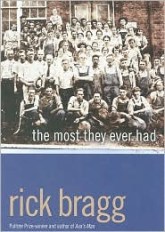
Next, and continuing with my exploration of Alabama humorist/storyteller Rick Bragg,  I considered his reflection of a mill village in Calhoun County, The Most they Ever Had.  For nearly a century, the textile mill provided for the economic health of its people, even as it destroyed their physical health. It was central to a fight for human dignity in the early 1930s, as the community was forced to strike against the feudal rule of a particularly foul boss, and for  decades thereafter the mill was one of the few places in Calhoun County where a working -class family could earn a decent living.  The book is not a formal history of the mill, though; instead, its history is learned through the lives of people who lived and worked at the mill their entire lives,  sometimes in pride and sometimes with regret; their stories, from organizing a union to losing an army,   flesh out the story of the mill until its closing.
braub
Lastly,  I kicked off this year’s science reading with Welcome to Your Brain, Sandra Aamodt’s survey  of all things grey matter.   Aamodt begins with a physical tour, lobe by lobe, before visiting aspects of the brain — memory,  emotion,  reason, changes with age, and so on.  Aamodt and Wang purposely try to correct popular misconceptions about the brain — that we only use 10%  of our minds, for instance, or that concussions are a reliable means of  incurring and recovering from amnesia.    As surveys go,  it’s broad and generally fascinating, but the amount of material to cover means that interested reads are only given an agonizing taste of many subjects.
Next week…..three of my science holds have just come in, and while I’ve taken care of the brain books, that leaves two outstanding — one on animal intelligence, the other on human sexuality. (Neither were on my science survey 2020 preview…)
Posted in Reviews, science | Tagged , , , , | 10 Comments

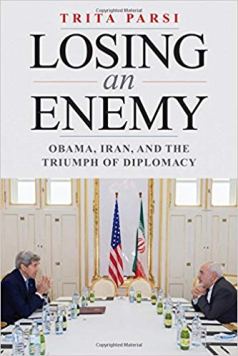
Losing an Enemy

Losing an Enemy: Obama, Iran, and the Triumph of Diplomacy
472 pages
© 2017 Trita Parsi

losing

Losing an Enemy is now a profoundly depressing book,  being an extensive history of an agreement that could have started erasing fifty years of bad blood between the Islamic Republic of Iran and the United States.  I say “could have”, because as of January 2020, that agreement is about as healthy as Qasem Soleimani.  How great a setback  his assassination proves to peace remains to be seen.   Losing an Enemy is a thorough review of how the Joint Plan of Action (“the Iran deal”)  triumphed over a half-century of enmity,  and over the particular stresses of the 21st century.  Those who persist in reading it — the sheer amount of dickering that the deal involved could test the most patient reader — will end with a better understanding of how much was at stake, how much was accomplished, and now —  how much has been lost thanks to the present administration’s  unique contempt for what it represents.

Parsi begins with a review of Iranian-American relations, which — while poisoned by the Iranian revolution and its aftermath —  declined precipitously in the 1990s when a rivalry began between Israel and Iran for regional domination following the collapse of the Soviet Union, and the destruction of the Iraqi army during the Gulf War.  Israel and Iran hadn’t been on friendly terms since the shah’s ouster,  but they had a common enemy in their hostile Arab neighbors, In the 1990s, however, Israel began developing better relations with its more immediate neighbors, and focusing its ire toward Iran – whose size, population, stability, and official contempt for Israel made it the tiny democracy’s most potent rival. Iran, similarly viewing Israel as its rival, sought to undermine the Israel-Arab peace efforts as best it could by funding groups like Hezbollah.  American involvement in those peace efforts, coupled with pressure from Israel and Saudi Arabia,   cooled any diplomatic interest in Iran. It became, in DC’s eyes, ever-more a pariah – so much so that George W. Bush included it in an axis of evil along with Iraq and North Korea.   Whatever material support or intelligence it lent toward the invasions of Afghanistan and Iraq,  Iran was a nation written off by the DC establishment.

That changed with the election of Barack Obama, who was determined to move the United States away from its ruinously expensive and distracting policies in the middle east – to better focus on responding on Asia’s boom  —  as well as to focus on engagement with the global community, moving away from the siege mentality DC had adopted during the Iraq war.  Obama’s dream of escaping  the graveyard of empires was effectively frustrated by the Arab spring, which demanded a response…but with Iran, at least, he was able to make some headway.  Obama’s efforts at re-engaging with Iran were slow to bear fruit, due in part to the civil war in Syria and its relation tensions,  but even after a failed fuel swap deal in 2010, a channel opened courtesy of the Sultan of Oman.    Safe from Saudi and Israel dissent, the framework of a deal began to emerge – the details to be painstakingly hammered out once the rest of the P5+1 were caught up.

The Joint Plan of Action happened because both those in DC and Tehran were looking for an escape from the on-ramp to war.  It was possible because of a handful of gifted, determined men –  two leaders who believed in diplomacy and the possibility of escaping the past. stellar support from both countries, (Javad Zarif, John Kerry, and William Burns), and Sultan Qaboos of Oman, who made himself a bridge for meeting in the middle.   Will circumstances ever realign to make such a thing possible again?

Despite the fact that the JPAC seems a dead agreement now, Losing an Enemy is worth reading — worth reading to understand the reality that Iranians and Americans have common interests, that there are people on both sides who want to make pursuing those interests together happens. It’s worth reading to know why we keep getting derailed – both the malign influence of the House of Saud and Israel,  and a healthy mix of obstinance and arrogance on the parts of both Tehran and DC.   But most of all it’s worth reading to better understand how deep Iran’s pride really is – how they were willing to pursue nuclear power not because it made financial sense, but because it asserted their independence – how they were willing to submit to a ruinous war, whether on Bush or Obama’s watch, to defend their pride.  Even as the DC sinks to the level of porcine ISIS, threatening the destruction of Iranian culture sites,  Javad Zarif pointed to the example of history, where Iran had been conquered by the likes of Alexander,  the Arabs, and still more – only to rise again and again.  There isn’t a word in Farsi, it seems, for “submit”.  The United States would do well to recognize that in Iran it faces not some pretend country like Afghanistan or Iraq, with arbitrary borders drawn by long-dead Brits and Frenchmen,  but a centuries-old nation with a long, rich history and which will not bow.

Related:
My “Losing an Enemy” notes on GoogleDocs


Posted in Politics and Civic Interest, Reviews | Tagged , , , , | 11 Comments

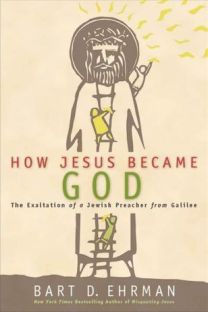
How Jesus Became God

How Jesus Became God: The Exhalation of a Jewish Preacher from Galilee
© 2014 Bart Ehrman
416 pages

jesus

When did the early followers of Jesus of Nazareth begin to regard him as not just a prophet worth following, but actually divine?   Bart Ehrman builds off his previous work investigating the historical Jesus to follow how his subject became regarded as God – and what that meant — in the decades and centuries that followed his time on Earth.   In pursuit of the question, Ehrman explores ancient beliefs about deity, and  the many arguments that early Christians had as they were working out what was true and what it meant.  

The real question to consider, posits Ehrman, is not when Jesus became God, but what Christians meant by calling him god.  While the western world of today regards deity as something absolute and other – either a thing is divine or it isn’t —    the Greco-Roman world of our own past understood divinity as a spectrum, with a chief god or source of being on one end, followed by smaller gods like the Olympians, and still minor deities and spirits until at the very end the deistic surveyor arrived at we mere mortals, with only a spark of divinity inside us. There were often cases where the divine and humans mixed more than usual, though; Zeus and others often took on mortal form, and often bore children who were half-divine.  Because gods were enmeshed in physical reality – Poseiden and the ocean,   Osiris and the Nile –there was no concept of a real divide between the worlds of the gods and of men.  

Most educated westerners will have some appreciation of the above, but lesser known is the presence of a divine spectrum in Judaism – which, despite its role in giving the west a singular, absolute being,   also had semi-divine creatures – angels, for instance,  of varying grades and who in early stories consorted with humans and gave birth to giants.  The king of Israel had an exalted role and divine titles, and was regarded as a chosen son of God. Still later traits of God  were regarded as having a distinct existence – most notably, Wisdom, which is outright worshiped in books like  The Wisdom of Jesus, son of Sirach, and The Book of Wisdom,  Jewish tradition also held that certain people, like Enoch and Elijah, and escaped death and been taken into heaven bodily.

After examining the Gospels and other period texts,   Ehrman believes that Jesus was best understood in his own time as an apocalyptic prophet, one who preached that the end of the world was at hand, that the long drama of good versus evil was about to be concluded in a decisive victory for good, led by the Messiah.   Although Jesus never publicly announced himself to be the Messiah, his disciples certainly believed this to be the case – and when they came to believe he was risen,   he began being viewed as not merely the chosen one, but divine —  favored by God and raised to heaven as his own son.  It was the belief in his resurrection that truly set Jesus apart from other prophets of the day.  

What this divinity meant fluctuated much in the first few decades, as early Christians were influenced by both Jewish and Roman culture, and Jesus’ growing meaning took strength from both.  Against the claims of the Roman god-emperor came another Son of God, one who many regarded as the living incarnation of God’s logos.   The belief that Jesus had been chosen and adopted by God as his own at some point grew into a belief that Jesus had been the anointed one from his conception on – and still later, that Jesus had existed, with God, prior to creation and that his birth had been an incarnation of a spirit which already existed. Ultimately, several church councils were needed to establish a  creed that permitted consensus, and by the first Council of Nicaea, it was firmly believed that Jesus was God – although creeds often created ground for new argument once the old one had been settled.

Both believers and nonbelievers will find much of interest here, though any book that has a chapter on the Trinity has to get into the  weeds a bit. Although Ehrman’s outlook is secular, he isn’t hostile towards Christians,  and emphasizes time and again that he’s only writing about known facts, not matters left to belief or interpretation.   His careful review of Biblical and other texts allows for a fuller appreciation of the world in which the early church formed, particularly the many debates about what it meant for Jesus to be both God and man.  

Posted in history, Reviews | Tagged , , , | Leave a comment

Science education meets anime

A friend of mine told me “You like biology, right? You have to watch Cells at Work on YouTube.  Now, this friend introduced me to StarCraft, so I respect his opinion.  I searched it up yesterday fully expecting a well-done and perhaps innovative documentary about the life of cells. What I found was….

Well, it almost has to speak for itself. Imagine an anime where the characters are human blood cells, their environment is the human body, and their enemies are bacteria!


These are the opening titles in Japanese, although halfway through the season there are also English ones. (That, or I’ve somehow learned Japanese through osmosis. I highly doubt this, however.)    The series on Netflix has English vocals, though the Japanese origin of the show still comes through in characters’ mannerism (bowing in apology, for instance) and the architecture.  I’ve never watched anime before, aside from a few episodes of Pokemon back in the day (before the Forever War, even), so for me this sudden exploration has double interest. I’m nine episodes in!

Posted in General | 3 Comments

Science, before and after

For the first time since I started doing a purposeful science survey, challenging myself to read from twelve different scientific disciplines, I didn’t quite make it last year.   I did, however, draw up a list of next year’s science prospects, some of which I already own.

What’s coming in 2020:
The Pluto Files (Local Astronomy), Why Does E = mc2 and Why Does it Matter (Astrophysics and Cosmology), Caesar’s Last Breath (Chemistry and Physics), DNA is Not Destiny (Biology), Aerial Geology (Geology), The Weather Machine (Weather and Climate), Spying on Whales (Flora and Fauna), Your Mind On Music or How Emotions are Made (Neurology and Psychology), Accessory to War: The Unspoken Alliance between Astrophysics and the Military (Science and Society), Suspicious Minds (Thinking Scientifically) and Behave: The Biology of Humans at Our Best and Worse (Anthropology). There’s also a wildcard category that I’ve not filled, which will serve natural history, history of science, or science and health.

What the list actually looks like in December 2020…well, we’ll have to see!

2019’s Science Survey

Previous years’ science surveys may be viewed here (2017) and here (2018).

Cosmology and Astrophysics
Seven Brief Lessons on Physics, Carlo Rovelli
Local Astronomy
The Wonders of the Solar System, Brian Cox
Geology
The Big Ones, Lucy Jones
Chemistry and Physics
What Einstein Told His Cook:  Kitchen Science Explained, Robert Wolke
Biology
She Has Her Mother’s Laugh, Carl Zimmer
Flora and Fauna
The Hidden Life of Trees, Peter Wohlleben

Anthropology
TheMoralAnimal– –  Owned but not managed in time. 

Neurology and Psychology
Spark: The Revolutionary New Science of Exercise and the Brain,  John Ratey
Weather and Climate
The Ice at the End of the World, Jon Gertner
Science and Society
Heavens on Earth, Michael Shermer
Thinking Scientifically
The Skeptic’s Guide to the Universe, Dr. Steven Novella et. al
Wildcard (History of Science,  Natural History, or Science and Health)
Survival of the  Sickest, Sharon Moalem
The Cancer Chronicles,  George Johnson

Posted in General, science | Tagged , | 4 Comments

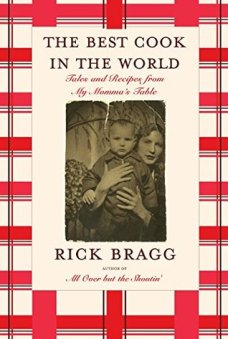
Appetizers from “The Best Cook in the World”

The following are quotations from The Best Cook in the World, which drew me in immediately with its humor and evocations of family dinners year past.  The book is a tribute to the author’s  mother,  consisting of some of her most memorable recipes, and the stories attached to them.    “Good stuff always has a story”, she said.

bragg
=======================================================
She never cooked from a written recipe of any kind, and never wrote down one of her own. She cooked with ghosts at her sure right hand, and you can believe that or not. The people who taught her the secrets of Southern, blue-collar cooking are all gone now, and they did not cook from a book, either; most of them did not even know how to read and write.

“Gettin’ old ain’t easy,” she told me, as she passed seventy-nine, “but it’s best not to try and fight it too much. You know how I live with bein’ old? I just don’t look in the mirror, ’cept when I part my hair.”

The past is where we go when we are helpless; the past, no matter what the psychiatrists say, can’t really hurt you much more than it already has, not like the future, which comes at you like a train around a blind curve.

You learn, if you live long enough down here, not to push too much against what these old, hardheaded people believe. If an old woman tells you there is magic in an iron pot, you ought not smile at that.

In a South that no longer seems to remember its heart, our food may be the best part left.

She knows her food is not the healthiest, yet her people live long, long lives, those not killed by gunfire, moonshine, or machines.

She believes a person learns to cook by stinging her hands red with okra, singeing her knuckles on a hot lid, and nicking her fingers on an ancient knife as she cuts up a chicken, because a whole chicken tastes better than one dissected in a plant and trucked in from Bogalusa. You learn by tasting and feeling and smelling and listening and remembering, and burning things now and then, and singing the right songs.

Electricity was, she concedes, also a fine idea. But she would like to meet the man who invented the telephone, she says, and smack him a good one.

She knew that affordable, simple Southern food had turned the corner to banality when she saw that a chain restaurant had introduced a barbecue sauce purportedly flavored with moonshine. Moonshine, as any Southerner not born at a cotillion knows, tastes like kerosene. Men did not drink moonshine for its bouquet, but because they wanted to dance in the dirt, howl at the moon, and marry their relations.

She does not cook chitlin’s, because she knows what God made them to do.

People like to talk about the emptiness of the great deserts or the endless plains or the frozen places, but a desolate dirt road in the mountain South, in a forest of black pines, can be one of the most lonesome places on earth. There is an almost unnerving dark in the tunnels of trees, where even people who have lived a lifetime here find themselves imagining the silliest things.

FIRST OFF, we might as well agree that three o’clock in the morning is a bad time to take a hog for a drive.

It was summer, and she had already snapped a mess of beans. (I will not live long enough to get into exactly what a mess is. When I asked my mother, first she said, a little irritated, “I don’t know, just enough.”)
THEY SAY a poor man makes the paper only twice in the Deep South, unless he breaks the law or plays football. The newspapers record the happenstance of his birth, and the inevitability of his death. If he was not an important man, or at least born to important people, it is unlikely that, either time, a great deal of ink was spilled. A lot of great men have lived and died down here inside a paragraph or two.
“Gravy,” Charlie Bundrum liked to say, “is a reason to live.”

I had not known, as I began this book, how often larceny would figure into the narrative of our recipes. It is a little sad, I suppose. I could wish that were not so, but I could also wish for a Duesenberg and would still be tooling around town in a Toyota.
Southerners love to put on airs as to their barbecue, and speak in utter disdain of anyone’s method that differs even slightly from their own. I have always found it amazing that such snobbery could exist inside a big ol’ boy in a Dale Earnhardt hat, a T-shirt from Panama City Beach, and an apron that trumpets NO ONE CAN BEAT OUR BUTTS. They will tell you that beef is not real barbecue, and will threaten to beat you like you stole somethin’ if you even mention a chicken.

=========================================================================

Posted in quotations | Tagged , | 2 Comments