My Disillusionment in Russia

My Disillusionment in Russia
© 1923 Emma Goldman
271 pages

goldman

“Is there any change in the world? Or is it all an eternal recurrence of man’s inhumanity to man?”    – Emma Goldman, 1921

In 1919, then-notorious anarchist Emma Goldman was exiled to still-revolutionary Russia, along with several other anarchists who had endorsed targeted assassins of those deemed political enemies  — a tactic they called “Propaganda of the Deed”,  but which today we’d understand more concisely as terrorism.   Goldman later realized that such violence generally backfired (see Red Emma Speaks), but in 1919,   she looked to the promise of revolution.    As the title indicates, however, she found in Russia not a hopeful future but a thing whose new terrors were rivaled only by the return of familiar elements from the Tsars.

My Disillusionment in Russia records her first year or so in Russia,  traveling between different cities and meeting luminaries of the age – including Peter Kropotkin,   Bertrand Russell, and Lenin.   Having spent time in Russia as a girl – emigrating to America when she was thirteen – she still retained a workable use of the language, and was able to speak with men and women at all strata of society.   Goldman eagerly sought out American emigres who had ventured to Russia to fight for their dream of the future, but she found many of them either crushed and disappointed, or – more foreboding – in prison.    At every turn she encountered starving wretches much abused by the State, while a new aristocracy had ensconced itself. Those with “pull”  did well for themselves – -getting choice appointments, free meal tickets without work,  etc.   Those without pull, or those who were ideological enemies of the State, could expect starvation, prison, exile,  or execution.  Some horrors came from intent, others from sheer incompetence: even a couple of years into the experiment, bureaucracy had grown so rapidly that getting anything done was virtually impossible.

At first, as Goldman talked to people and took in the sights before her, she excused it as being a consequence of the western blockade, or the war, or perhaps even the violent birth inevitable in a revolution.  Even seven months into her stay she was still holding on to some meager way to justify what was happening. By the time a year had  passed, however, and she’d seen the vigorous persecution of anarchists and the absolute hostility towards actual democracy, let alone free speech – Goldman could no longer view the Bolsheviks as anything other than the same enemy she’d railed against in America.   Most damning was their conviction that the ends justified all means.   In the end, she could only wonder:  is there anything to history, or is it merely a continual loop of man’s inhumanity to man?

Goldman makes for an especially fascinating critic of the Soviet state because she shares much of their contempt for say, religion and capitalism, while at the same time holding the State itself in condemnation.  For the future reader,  it’s astonishing to see that so many of the inevitable failures of the  soviet system ere present from the start: their inability to effectively manage an economy without market price, the stagnation owing from so little incentive to work (aside from the minimum as not to get shot),  the mere shifting of privilege from those with royal sanction to those with ideological sanction, etc.   The horrors, too – the gulags, the executions – were present from the beginning,  vouched for here Goldman just as they were by Solzhenitsyn’s research a few decades later, and documented in The Gulag Archipelago.

Personally, I’d love to one day write a comparative paper between Goldman and Ayn Rand, two anarchists with Russian pasts and with very different appreciations for the role of markets and property – -yet a similar exulting of the individual.



Posted in Reviews | Tagged , | 5 Comments

Rubbish!

Rubbish! The Archaeology of Garbage
© 1992 William Rathje and Cullen Murphy
250 pages

moo

Given that historians often use the contents of middens to glean information about societies which have long faded away, it’s only fair to see what our present landfills (tomorrow’s middens) have to say about us. Largely, they reveal how little we actually know. “The Garbage Project” both intercepted garbage on its way to transfer stations from various pots in the country, and literally conducted excavations in landfills, and it found much to contradict common knowledge. Biodegradables, for instance, don’t. They don’t degrade. This was initially thought to be because modern dumps are sealed against moisture, but there are examples of marginal degradation well before landfill cells became the norm. Also, many of the favored whipping boys for trash — plastic and diapers — don’t take up nearly the amount of space as people think. The lions of trash, going by the stuff that’s actually in the ground, is paper and construction materials. Throughout the book, there’s hints that studying garbage can tell us the truth about people who lie either to themselves or to surveyors: for instance, one Hispanic neighborhood reported that they almost never used prepared baby food, buuuuuuut the contents of their trash bins determined that was a lie. Amusingly, people across the board underestimate how much unhealthy food they eat, and over-report how much healthy food they eat. The book closes with “10 commandments”, urging people to concentrate on the real offenders (paper and construction materials), realize that there’s no approach to garbage that’s a real solution, that instead we need to use landfills, incineration, recycling, and source reduction in concert, etc. The commandments all very reasonable, sober, and not exciting in the least. They don’t even start with a terribly dramatic opener, like “I AM THE LORD THY GOD, WHO BROUGHT THEE OUT OF EGYPT…”

Bottom line: this informative, sometimes amusing, but often dry.

Related:
Waste and Want, Susan Strasser
Gone Tomorrow: The Hidden Life of Trash.  I’ve read this one, but can’t seem to find the review. Curious!
Picking Up:  On the Streets and in the Trucks with the Sanitation Department of New York City
Garbage Land: On the Secret  Trail of Garbage
Garbology: Our Dirty Love Affair with Trash

Junkyard Planet, Adam Minter

Posted in Politics and Civic Interest, Reviews | Tagged , | 11 Comments

Of stars and saints

Two also-reads in recent weeks have been Brian Cox’s Wonders of the Solar System and Kevin Vost’s 12 Life Lessons from St. Augustine.

coxOK

I’m familiar with Cox from his many appearances in Symphony of Science videos (a YouTube series in  which  clips from scientists are remixed with music on various themes, like “An Ode to the Brain”, or “The Poetry of Reality”), but have never read any of his work.   This volume is the  book version of a televised series,  I believe, rather like Cosmos or Civilisation’s book versions.       Although most books on the Solar System take a predictable approach (The Sun > the planets in sequence >   outer reaches including the Oort cloud and such),     Cox’s  tack does away with that. He begins with the Sun and connects the formation of the early solar system to the present behavior of Jupiter and Saturn and their many moons. Next,  Cox shifts to planetary science,  examining common processes and features of Earth and other planets. One  subsection of this is very similar to Cosmos’ episode “Heaven and Hell” as  Cox  compares Mars,  Venus, and Earth and the role of climate on each of their history.  The last section involves life on Earth.    Because this is adapted from a television series,  photography  features heavily, and Cox often uses pictures to compare features on Earth with those found on other planets.   The television show must have  been exciting to watch, because some of the photographs include Cox’s flight in a jet,  taking him nearly out of the atmosphere,  and visiting various desolate places on Earth that invite comparison to Mercury, Titan, etc.    This is definitely an enjoyable volume.  Next and last in the Science Survey will be a work on anthropology, but I can’t seem to find The Moral Animal, so I have to hope I stumble upon it, or that my hold for Behave: The Biology of Human Behavior  At Our Best and Worst comes in on time.

vostOK

Moving on to theology: 12 Life Lessons from St. Aquinas attracted my attention largely because of the author, whose works on Stoicism and the Seven Deadly Sins I’ve read before.  Here,  Vost adapts some lessons from Summa Theologica to share with a modern audience, but despite my affection for the author, I found it slightly disappointing.  Some of the chapters were superficial;  the twelfth chapter, for instance, bids readers to keep  Jesus central:  surely that’s a given for most readers interested in Aquinas?  There was substance here, though,  particularly the chapter that hooked me into buying this book in the first place, that on Acedia.  I’ve come to realize that Acedia, commonly translated as Sloth,  is misunderstood.  Vost builds on that, expounding on the fact that sloth is not laziness, but rather apathy – a neglect of the inner life,  particularly, but also of one’s duties.   Acedia strikes me as the polar opposite of mindfulness, and so it’s worth considering if a reader is interested in living mindfully  — and of course, its applicability is not limited to any religion or philosophy.    Although 12 Life Lessons from St. Aquinas has definite merit,  it’s not as substantial as one might expect from an author of Vost’s caliber, and drawing from the Summa as he does.

If astronomy and theology strike you as an interesting combination, keep an eye out for one of my reads for next year:   The Sun in the Church: Cathedrals as Observatories 

Posted in Reviews, science | Tagged , , , | 5 Comments

A Decade in Music

Marian recently posted a fascinating survey regarding the music we’ve listened to in the last ten years.     Considering how much I listen to music — constantly, unless I’m at work, sleeping, or reading —    it was a tough exercise to follow!

2010
“A Glorious Dawn”,  melodysheep

The wonder that is melodysheep shared a….Carl Sagan remix in late 2009, and while I’m not sure when I first listened to it, I was early to the party and have cherished every single thing melodysheep has released since then — even beyond his Symphony of Science videos,  which feature many scientists…even Stephen Hawking.   Melodysheep’s tribute to Robin Williams is a must-listen if you’re even the slightest fan of Robin.

2011
“Set Ourselves Free”, The Wild.

This is more of a “The Wild” entry. To be honest, I can’t recall the exact year I encountered them,   but 2011 feels about the right time.  The Wild are a…folk punk band, if that makes any sense at all, and in 2011 I was transitioning from from college leftist to…whatever I am now.     I still listen to The Wild even now, whereas if I listen to Evan Greer, it’s in the same mood that I might listen to mass choirs from my Pentecostal days — a reflective visit to the past.
2012

“Farewell to you, my chicks, soon you must fly alone
Flesh of my flesh, my future life, bone of my bone
May your wings be strong may your days be long safe be your journey
Each of you bears inside of you the gift of love
May it bring you light and warmth and the pleasure of giving
Eagerly savour each new day and the taste of its mouth
Never lose sight of the thrill and the joy of living.”

Bobby Horton’s Civil War and 19th century music albums introduced me to folk music, but after college I began exploring the British-American musical tradition in full.  Ewan MacColl’s “The Joy of Living”   is a more contemporary piece, but it speaks to me. It’s about a dying man who bids all that he loves — the mountains, his wife, his children — farewell.

2013
“For an Old Kentucky Anarchist”,   which…it’s hard to explain why I like this song so much.   It’s a story in music that touches on a lot of what I cherish.


“All I got’s my stories and this old guitar
My crops have all come and gone away
I got a head full of recipes enticin’ to the taste
And a likin’ to wake up and greet the day!
Got a bad back from raisin’ my children
From huggin’ my husband so tight
Hell, I never cared much for any government
I got my Jesus when  I feel the time was right
Singing, I’m the richest I’ll ever be
I embrace the world I have around me
So sing a dyin’ song and slap your knee,
Have a taste of true anarchy!”

2014 
“On the Rebound”, Floyd Cramer

In 2014, I bought An Education and watched it for the first time. It opens with this unforgettable piece, which introduced me to Cramer’s piano work in general.  An Education brimmed over with outstanding music; three other pieces I continually re-listen to are “A Sunday Kind of Love“, “Wrapped Around Your Little Finger“,  and “I’m Comin’ Home, Baby“.

2015 
“20th Century Man”, The Kinks

I was born in a welfare state /  ruled by bureaucracy
Controlled by civil servants / and people dressed in grey
Got no privacy / Got no liberty / coz’ the 20th century people
Took it all away from me

2016


“You don’t need no teeth for kissin’ gals or smokin’ cheap cigars!

My former sociology professor, knowing of my affection for Ed Abbey’s nonfiction,  introduced me to Russell’s “Ballad of Ed Abbey“, and Russell quickly became one of my favorite still-living artists.    “Tonight We Ride” and “Stealing Electricity” are my favorites.

2017 
“The Hippies and the Cowboys” , Cody Jinks

Yeah, the yuppies and the hipsters and the wannabe scene
That ain’t down home with   me —
I like $2 beers, I like $3 wells,
And some ol’ honky tonk bar I know by the smell
Some ol’ drunk on a bar stool on a Merle Haggard tune,
That’s my kind of room

I grew up on country music but stopped paying attention to new music somewhere in the 2000s, favoring instead ever-earlier artists like Merle Haggard and George Jones.  Cody Jinks made me realize there’s still guys out there whose country comes from the heart and has nothing to do with the dreck on the pop charts.  Jinks made me discover guys like Chris Stapleton, Aaron Lewis, and a few more.

2018

Whenever I introduce someone to Chloe Feoranzano, I use this piece because it’s her most technically challenging — I think. I’ve never played a woodwind so I have no real idea, but it sounds complex. I love love love Chloe’s style.

2019:

Have you been introduced to Alma Deutscher?  There she is, above,   playing a piece she created to set Goethe’s “Nähe des Geliebten”   to music — and singing it.  She was composing operas at age seven.

The finale from her opera, Cinderella.

BONUS:

I have probably listened to “May I Stand Unshaken”  a hundred times since April.


Am I to wander as a wayward son? Will the hunter be hunted by the smoking gun?

The piece plays during a pivotal moment of Red Dead Redemption 2, in which the main character has survived exile following a catastrophic mission gone bad, in which several of his friends died.   Long struggling with his conscience,   the ride to this music marks the moment in which Arthur starts to follow his convictions instead of the bidding of his  increasingly erratic  father-substitute, Dutch.

Posted in General | Tagged , | 6 Comments

War and Peace

War and Peace
pub. 1869 Leo Tolstoy
trans.  1957 Rosemary Edmunds
1444 pages

warandpeace

My word, what a book!   In the beginning, dear readers, I’ll confess that I anticipated failure. Tolstoy’s epic addressing the nature of history and war,  and the various dramas of peacetime — from the search for meaning to love to politics —  begins with numerous back to back parties in which the brave soul who has taken War and Peace on is  introduced to dozens of characters surveying one another at parties.  The topic on their lips is Bonaparte and war, for even now Russia is stirring to confront the Corsican upstart — although Napoleon’s fateful march into Russia is years away.   So many characters at once was overwhelming for me,   and I dragged my heels……but then, the duel!

My father chanced to see that I was reading War and Peace, and asked me what it was about.   It took me a few moments before I could ready any kind of sensible answer.  The biggest obvious drama is Bonaparte’s rise and fall; a man regarded as a hero even to young officers who are preparing to resist his war against Austria at  the behest of their Tsar will eventually find those same Russians burning their very homes to frustrate him.  The hook of the book for me was its personal dramas, however, as many of the characters grow throughout the span of the title, particularly young Pierre — an illegitimate son of a deceased noble, but one elevated into the nobility upon the passing of his father and the reading of his will.   Also much of note are Prince Andrei and young Natasha,  though Princess Maria is also worth paying attention to.  The characters we are introduced to in those parties changed though the book,  growing and falling and sometimes getting back up again. Some we viewed from a distance we grow to cherish; some who were initially charming grow hateful, and I personally did not mourn one particular man  in the least, nor his similarly malicious sister.   Tolstoy’s characters are alive, and they experience enough that they grow in response to those experiences; the depth of  the novel means it’s not  a single-track from perdition to redemption, a la Ebeneezer Scrooge.

But for Tolstoy, I think, the heart and soul of the book was history.  I don’t mean the war, but history itself.  Tolstoy is the utter opposite of a disengaged narrator; he’s frequently  in the text, talking to the reader and philosophizing. Tolstoy takes issues with both French and Russian narratives,  which portrayed the war as a series of definite actions that were themselves the results of strong deciders, men  like Bonaparte and the Tsar.    But this is rubbish, from the particulars to the general. I will leave the future reader of War and Peace to encounter Tolstoy’s  point by point rebuttals of battles covered here that receive extensive treatment in the histories,  but in general Tolstoy believes that history is far more mysterious than we can imagine — mysterious not because  of mysticism, but because the variables are so many.     The outcomes of battles depends, says Tolstoy, not on the  ground chosen or the size of the battalions, but the will and the many manifold decisions made by the thousands of individuals on the ground, as their decisions ring against the others and produce a resounding drama.  Tolstoy doesn’t just argue this to the reader, he portrays it happening in the text, so that  one Russian general’s plan is foiled by a man on the ground deciding these troops are in the wrong spot, and so he orders them somewhere else; in another area, a Russian charge that disrupts the French march is not ordered, but the result of young men with their dander up, who cannot resist the urge to charge against their hated enemy.   Historical events cannot be explained to the decisions of a few key men, any more than the motion of a locomotive can be attributed to its wheels moving.     Only consideration of all the players involved can deliver a real story of what happened.

Despite my initial concerns, it was not long at all before the novel had taken me, completely,. It’s a rare story that sets both the mind to thinking, and the heart to warming.   I am not surprised that those who read it often read it again.   I imagine I shall, if only to experience it through another translator to see if the effect is the same.    My copy’s translator rendered one character’s accent as a speech impediment, which provided unintended comic relief:

“Since the adv’sawies wefuse a weconcilation, may we not pwocede? Take your pistols, and at the word THWEE both of you advance.”

That chuckle aside, this really is a magnificent book. I hope to share some excerpts from it later in the week.

Next….AND LAST!!!!  …in the Classics Club is  The Brothers Karamazov.   

Posted in Reviews | Tagged , , , | 10 Comments

Junkyard Planet

Junkyard Planet: Travels in the Billion Dollar Trash Trade
© 2013 Adam Minter
304 pages

scrap

I once encountered a pair of supermarket clerks unloading cases of bottled water from their pallet jack to the shelves where the water awaits the public, and I commented to the pair that they must have to put out new cases fairly often, like once a week or so.  The pair gave me a look and said they bring out new cases three to four times a day.     Astonishingly, so it is with that unsightly pile of scrap facing the reader of Junkyard Planet.   Adam Minter is not out to convince you that there’s a problem to be solved, one that needs your attention. Far from it, in fact: that seemingly problematic pile of scrap is as transient as Wal-Mart’s cases of water;   here today and gone next week,  broken up and distributed across the globe,  where various classes of materials are put to use by an astonishing array of specialists and spur further development in less industrial countries.

Adam Minter is uniquely qualified for a book of this sort; he grew up in a scrapyard family, but left the family trade to pursue a career in journalism –  and followed that calling to China, where he lived for several years.  He opens with a history of scrapyard recycling in the United States, one that long predates the environmental movement of the 1970s. Early Americans had a far better motivator for recycling than idealism: they had need.  Prior to the maturation of industrial capitalism,  manufactured goods were preciously expensive;   they were diligently preserved, repaired,  or put to some other use once they were beyond mending.    (For a full popular history of how Americans went from reusing everything to throwing everything away, see Susan Strasser’s Waste and Want).     Sorting these goods and reducing them into re-usable elements was labor-intensive work, though, and as the cost of labor grew in the developed world,  the chief advantage of  producing with recycled materials over new ones — cost – disappeared.  Scrapping thus became more of an export business, with China as the main buyer.

Those who don’t know scrap may view the export of recyclables to Asia and elsewhere as one of privilege — the western world using China as its dump. But the Chinese are buying scrap,  not being paid a fee to take it away.  They want it — in fact, members of Chinese firms travel constantly from scrapyard to scrapyard, looking for specific categories of materials to send back home.   There,  what the average American consumer views as rubbish is transformed into infrastructure and skyscrapers, or even better – into new consumer goods.  There’s an entire global trade in this stuff:  the oil-rich gulf states have a similar relationship with India,  where it’s cheaper for them to ship rather than China.  (The United States sends some scrap to India, but it’s generally cheaper to send it China’s way given the constant cargo traffic;  ships are able to incorporate scrap deliveries into their backhauls.)  South America and Africa, too, participate.

What makes China special for this is  not just its cheap labor, but the fact that it has a rapacious hunger for scrap to fuel its own growth.   China’s people have not yet lost the use-it-up, wear-it-out mentality  that was chucked into the US’s landfills somewhere around the 1950s:   in cities, people actively bargain for and repurpose refuse, so that whatever goes in China’s own landfills or incinerators is truly trash.   There are also burgeoning markets for simply reusing goods which arrive from the United States:  an old CRT monitor is far more valuable when resold as part of a used computer setup  to a farmer just trying to learn one, than as scrap.   While some materials are melted down into their constituent parts, electronics are more likely to be mined for their processors and such.

Though a scrap man,  Minter doesn’t shy away from the downsides of China’s headlong embrace of recycling everything it can find a use for, especially plastics recycling.  The poor city which does the bulk of China’s plastic processing can boast of lung and circulatory diseases afflicting 80% of the population.  Over the years China’s ruling power has gotten more picky about the kinds of scrap it will accept, however, and Minter is optimistic that the future of recycling in China will grow cleaner.

Junkyard Planet is a fascinating look at a market which I  suspect few are aware of it, and while it wears a little repetitive,  ultimately it left me feeling….well, a little delighted.  Despite my hostility toward consumerism in general, I genuinely love and admire trade’s way of bringing people together, and Junkyard Planet demonstrates superbly how even what we  throw away conjoins the prosperity of each nation on its neighbor.    The reader isn’t quite off the hook, however: if you want your goods to participate in this glorious global scrap trade, you have to at least make an effort to recycle or get them to the scrapmen to begin with.


Posted in Politics and Civic Interest, Reviews | Tagged , , | 6 Comments

This and that

Well, good news and bad news. The good news is…my book buying ban is OVER, so I have five books on the way.   A few are for next year, but I may try a couple beforehand:

Rubbish: The Archaeology of Garbage
The Origin of Feces
The Secret Life of Cows
Good Reasons for Bad Feelings
Why We Are Here: Mobile and the Spirit of a Southern City
The Sun in the Church: Cathedrals as Solar Observatories

The bad news: my computer is in stasis at the moment, waiting for a new CPU cooler before it comes to life again.    My jet engine-like Coolermaster finally  wore itself out, so I’ve a new one on the way.   In the meantime….well, I’m still working on War and Peace, and hope to finish it before The Brothers Karamozov arrives in the post.      I’ve also finished a few books,  one of which doesn’t appear on goodreads.

First up was A Life Less Throwaway, which was fairly similar in theme to two books I mentioned last week, Tiny Homes and 101 Ways to Go Zero Waste.   The intent of A Life Less Throwaway is to convince readers to be more mindful about their purchases — to buy much less, in general,  to empty of their lives of purposeless things, and to buy only those things which are both useful and of such quality that they can be repaired and passed on to the next generation.     I followed that with Junkyard Planet, which I’m  preparing fuller comments for.

perrycounty

The two other books were Hamburg: A Place Remembered and The Heritage of Perry County, Alabama, two books inspired by complete coincidence. On Sunday I took part in Marion, Alabama’s  holiday bazaar / historic homes tour, and it was a beautiful day for a walking tour.    Although I’d been through Marion before, mostly on visits to the women’s college there (I was part of a science club that took several day-long trips to Judson to work in their lab), I’d never roamed the city properly.    On Tuesday, a writer from Indiana wrote to the library and asked if we had any books on Marion and Perry County, as she wanted to get some idea of what it was like there in the 1940s. I promised her to review some of our literature and report on some of the highlights.

Hamburg: A Place Remembered delivers a history of a place that no longer exists. I have often seen the sign in Perry County that directs travelers to  Hamburg, pointing at….the woods.  You might guess that the village was named after Hamburg, Germany, but that is only true in a roundabout sort of way.  The city founder was from  Württemberg, an independent German principality with no connection to the Prussian city,  but he’d settled in Hamburg, South Carolina along with many other Germans,  and honored his adopted home  by giving the Alabama village he settled its name.    Interestingly,   although Hamburg was a bustling farming town at one point,  another community called “Hamburg Station”  sprang up around the railroad, quite a few miles away but still in the county, and in the 20th century the residents of Hamburg surrendered their name to that community and began to call themselves Vilula, instead.  By that point it was rather moot, because the world wars had caused much of the population, especially the black population, to leave for opportunities in industrial cities.  By the 1960s,  the village faded into memory — though its former citizens often met at reunion parties.  Dallas County had its own German village,  Berlin, though it too died.  The shift in commercial and freight traffic from the river and  railroads to trucks was its doom.   I did a little work research on Berlin a few weeks back when we had a visitor from the real Berlin, who has made it his mission to visit all the places named Berlin in the world.

Moving on to The Heritage of Perry County,  this is part of a collection of similar works we have at the library that are collections of histories, family stories, photographs, etc.  giving a folk history of the county in question.  The Heritage of Perry County includes bits of a hand-written history we also possess of Perry County, including  little hand drawn depictions of residences’ homes, churches, and stores.  The introduction to the handwritten history hails it for focusing on the majority of residents —  “plain folk”, or  ordinary yeoman farmers, as opposed to plantation masters —  and their homes.  Most of the depictions are variants off of a common Southern pioneer template, the dogtrot.

What is a dogtrot?

20191205_145420 - Edited


20191205_145540 - Edited


As you can see,  both of these have a common beginning: two seperate rooms, each with its own fireplace, seperated by an open but roofed hallway. The purpose of the design was to funnel wind between the two rooms and provide a “breezeway”.    In these two examples, the owners of the house have made subsequent — but different — improvements on theirs.    Over time, the breezeway would be closed off, and a second story might be added.   At least one home built in this style still stands, albeit as part of Old Alabama Town in Montgomery, Al.    (OAT is two city blocks composed of homes and other structures from across the state which were brought there for preservation, and are arranged to appear like residential or working blocks.  It’s worth seeing if you ever visit Montgomery!)

reallife

A real-life dogtrot home at Old Alabama Town. Its breezeway is used as an entrance to the residential block.

Posted in history, Reviews | Tagged , , | 2 Comments

Sword of Kings

Sword of Kings
© 2019 Bernard Cornwell
334 pages

uhtred12
“Tighten the sail!” I shouted. The trap was sprung, and now the snake would discover how the wolf and the eagle fought.  p. 19

Uhtred of Bebbanburg has been fighting all of his life. A much-feared and much-respected lord of war,  he has earned a rest at his family lands in Northumbria. But the king  of the Anglo-Saxons lies on his deathbed,   the threat of civil war looms,  and someone is prowling Bebbanburg’s seas and killing her fisher-folk.   Clearly, there’s no rest for the weary.

Sword of Kings is twelfth in the Saxon Chronicles,   which have followed the fall of the seven Anglo-Saxon kingdoms to the Danes, and the resurgence of the English dream under the hands of King Alfred and his heirs — ever made possible by Uhtred.     Instead of yet another battle on land, Cornwell treats readers to a variety of settings here,     from naval action to covert action inside Lundene,  the  battleground between two possible heirs.    We see Uhtred in fine form here; despite his age,  he can still fight — though he’s far more vulnerable than he was in his thirties, and one point here he’s humbled as he has not been since Lords of the North, when he was sold into slavery.     Perhaps that’s no accident,   as slavery features throughout the novel, and it’s through his contempt for it that Uhtred  recruits some unusual followers.

It took me months to get into War of the Wolf, but I finished this one within a couple of days of first picking it up.   The Saxon stories have suffered a bit, I think, for there being so many of them — and even though they’re all “good”,   they tend to blur into one another. Sword of Kings will be more memorable, I  think!

Posted in historical fiction, Reviews | Tagged , , | 7 Comments

Sunshine Award

Sarah of All the Book Blog Names are Taken has gracefully nominated me for a Sunshine Blogger award, with the implication that I spread sunshine to the blogging community. Well, shucks.     There are questions that I’m meant to answer, and I’m also supposed to create my own questions and tag some people who I think spread sunshine, but I’m either lazy or a rebel, take your picture.  Thanks so much to Sarah, and here are my responses to her questions!

What genres do you prefer? Why?
I most like reading books that help me understand the way the world works, especially society – so I’m equally delighted by a book on infrastructure as by a novel that teaches me how lawyers might operate.  

What genres do you ? Why?
While I have no interest in romance books, I wouldn’t say I refuse them because they don’t even make it in the door.  What I refuse to read are political rants (books written as deliberately inflammatory, complete with a hostile title) or campaign books. My political reads tend to be on things that aren’t partisanized (foreign policy and city development stuff), or which   are so outrageous that neither party would agree with me (i.e. the anti-state stuff).

What is the easiest thing about blogging for you? The hardest?
It’s always easy to find books to read. The hardest is finding time to read everything I want before an interest in a given subject is overwhelmed by interest in something else!   

If you could become a character in a book, which book and why?
Oh, easy. Bertie Wooster.    I’m in 1920s London,  my flatmate is brilliant and does all the cooking and cleaning,  and I’m free to do whatever little thing pops in my head so long as one of my aunts isn’t trying to get me engaged or gainfully employed.   And if I’m being played by Hugh Laurie, I can even play the piano! 

If you could travel to any period in history,  which would it by and why?
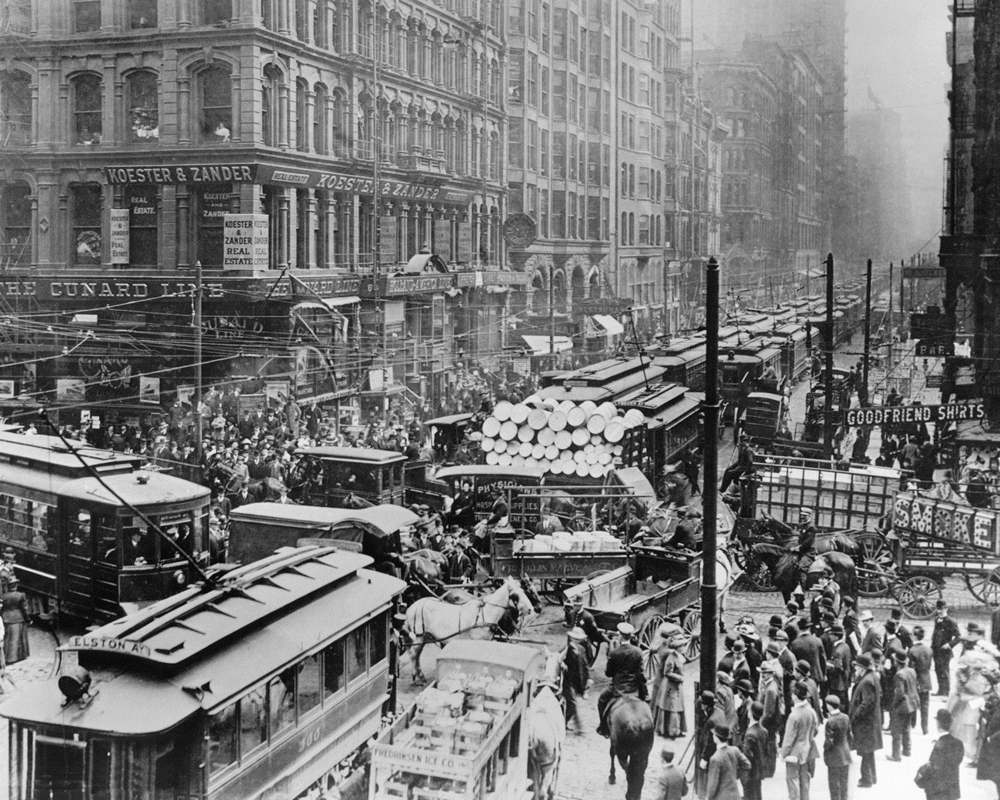
I’m deeply interested in the rise and constant re-creation of the city in the late Victorian period, so much so that one of the photographs in my  computer/writing area is a shot of a traffic jam on Chicago’s Randolph street in 1909.   That sounds about right.   

Do you ever DNF books? What makes you DNF?
I tend to be picky about the books I buy, so this doesn’t happen a lot.  For fiction, an uninteresting story or characters would do the trick; for nonfiction,  sloppy fact checking or an obnoxious style will put me off.     

Who are your favorite authors?
I’ve had many over the years. As a kid, it was Beverly Cleary, Bruce Coville, and R.L. Stine.  In middle and high school, I discovered Paul Zindel and S.E. Hinton.  Some of of my favorites since starting this blog have been Isaac Asimov, Bernard Cornwell,  Wendell Berry,  Anthony Esolen, and Bill Kauffman.    Jack London has been a constant from childhood on.  

How important is book cover quality to you?
Not very.  When shopping online, I use it to discriminate between professionally-published works and those which are self-published – not because  the indie stuff is necessarily bad, but there’s more quality control by default if a book has been submitted to publishers and run through the editors.  

Name a character you would want to be best friends, and why.
Jayber Crow, of the novel of that name; or Ducky,  from California Diaries. Both are good souls in slightly different ways – Ducky is far more outgoing and assertive, I think, than Jayber….who most of the time is content to keep  company with friends in the background.  

Name a character who would become your mortal enemy were your paths to cross IRL.
Obadiah Hakeswill.  I can’t remember  all of what he did in the Sharpe novels, but the only character I’ve hated more was Dolores Umbridge.  Cornwell made Hakeswill a frustrating object of hate, as he evaded Sharpe’s attempts to kill him time and again.  

Which authors would you invite to a dinner party?
Isaac Asimov, of course, because he knows enough about every thing to pull more than his weight in any conversation. (Asimov is my inspiration as a generalist!) Right next to him, I want G.K. Chesterton, because by god those two will love arguing with one another. (Asimov was very fond of Chesterton’s fiction,  and one of GKC’s Father Brown stories inspired  an Asimov Black Widower short.)    Bill Kauffman, the author I’d most like to have a beer with, has to be there.   At the…less loud end of the table, I could see C.S. Lewis, Anthony Esolen, and — ooh, Alain de Botton.   There’s probably room in the middle  for a couple of others.


Posted in General | 6 Comments

Tiny houses and zero waste

I’ve recently read two books which can be paired together nicely, so that’s what I’m doing.      Enter Tiny House Living and 101 Ways to Go Zero Waste.   

tinyhouse 

In the last few weeks I’ve been watching Tiny House Nation on Netflix, fascinated because my own ideal is a country cabin of probably under a thousand square feet. Tiny House Living visits people who have chosen to live in tiny homes to probe the why and how, before shifting to the reader and using similar case studies to offer tips for how interested persons can design tiny house and a life that can live within it. This includes legal considerations, since states and municipalities are surprisingly hostile toward the tiny-house experiment. The book didn’t have the technical information I was looking for (the various ways people approach plumbing and electricity, for instance), though I was able to glean some information from the case studies. Composting toilets seem to be the norm for these operations, and wood-burning stoves apparently popular despite the fact that they’re not sustainable in the least if many people in an area are using them. All told, the book was a fine addition to Tiny House Nation and the other media I’ve been pursuing, but not particularly memorable.

kellog

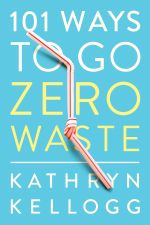
101 Ways to Go Zero Waste proved to be similar in spirit. At first glance, the book is merely a book-long list, with a lot of recipes that could be dismissed as filler were they not that point. If you can make your own cleaning products, you don’t have to keep buying them in disposable bottles! The idea behind zero waste is alter the linear economy – -the production, consumption, disposal model — so that, as much as possible, goods keep doing a loop-the-loop between production and consumption. There’s a complete book on that called Cradle to Cradle, I think, if you are interested. Anyway, a lot of the content is just green or organic living material on overdrive: Kellog calls for readers to abandon disposal products for reusable ones; kerchiefs over Kleenex, for instance, and offers alternatives and recipes for avoiding the need for disposables. More interestingly, however, she writes on the Reduce, Reuse, and Recycle philosophy and argues that those Rs are listed in that order for a reason: reducing our consumption is the most effective way we have to not contributing to the landfill problem, because recycling is far less efficacious then people think. Contaminated goods — a paper envelope with a cellophane ‘window’ for the address, or a paper plate with grease soaked into it — often compromise entire bales of products to be recycled, meaning those who are serious about recycling need to do due diligence and prepare their refuse accordingly. Otherwise, they might as well skip a step and chuck things into the garbage. Since Reducing is the most effective thing we can do, Kellog argues for do a veer toward minimalism and voluntary simplicity.    Although quite a bit of the content was irrelevant for me personally (those written about makeup and feminine products),   I strongly appreciated Kellog’s     inclusion of minimalism.

Both of these books to me speak to examining our lives,  realizing what within them adds the most value — that which isn’t throwaway, in either sentiment or substance — and then making time and space to enjoy them more by letting the rest go, as we can.


Posted in Reviews | Tagged , , , , , | 12 Comments