Teesday Tuese & TT

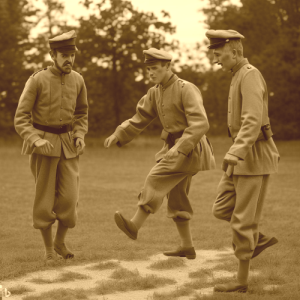
Bing’s attempt to create Civil War soldiers playing hopscotch. The sepia effect was my contribution.


Common exercises were foot racing, wrestling, boxing, leapfrog, hopscotch, quoits, and marbles. Some Rebs played tenpins after a fashion ironically unique, by rolling cannon balls at the pins, or at holes in the ground.

The Life of Johnny Reb: The Common Soldier of the Confederacy

The mind boggles at Civil War soldiers playing hopscotch. The reference sent me to wandering across the interwebs and I discovered that it was a game invented in Britain during Roman rule. Roman soldiers played it to improve their footwork.

Top Ten Tuesday: Things Getting in the Way of Reading

(1) The laundry baskets in front of my book case. As soon as I fold and put away they get filled up again.

(2) My very-real fear that if I remove one book from Mount Doom, the whole stack will collapse on me and bury me alive.

…oh, wait. Hang on. I’m getting something from the studio here…..apparently I’ve misunderstood the prompt. It’s meant to be things I keep doing instead of reading. Let’s try that again..

3)  Work, obviously. You’d think working in a library meant more reading time, but ours is a very social services oriented-library, so books are just in the background for me at work!  I spend most of my time (when not updating manuals, printing flyers, updating the website ,etc)  working directly with patrons on computers, trying to help them to get information or send information to government agencies, corporations, etc.  (Not to mention the ‘official’ work I’m responsible for, like maintaining computers and doing historical research.) I have to hang out at the local bookstore on Saturdays to get my fill of ‘time spent with booky people’. 

4) Education. I have an active Coursera account and try to watch at least an hour of content per night, always in the area of IT-related things. It might be Google Workspace management, Python essentials,  or even (currently) a history of the internet. 

5) Zoning out.  Here work comes into play, because after a long day of being constantly asked questions, I want to zone out for a bit. I’ll put on some music and play a mindless game (The Sims 4 and American Truck Simulator are favorites for this), and then switch to something more respectable like a podcast or Coursera. Howeverrrrrr, sometimes I get in a very comfortable space where I’m just listening to music/youtube for most of the evening, at least until 10 o’clock rolls around and I realize I still have to do laundry for tomorrow. 

6) PC Games. Mostly related to zoning out, but there are games that keep me thinking and engaged  — and not paying attention to the clock at all.   I like building things in The Sims 4, for instance.  One of the current things I’m fiddling around with is a minimalist high school for the game that is inspired by the School building in SimCity 3000: another is a retro cafe built over a fallout shelter turned into a bowling alley.

7) The outdoors. If the weather is nice out (which, in Alabama, means it’s April, May, or early December) ,  I’m  liable to be out hiking, exploring forgotten parts of the state, or chasing good photos or bird-sightings. 

8) Just regular ol’ adult responsibilities and activities. I’m not a husband or father, , but I actively pursue meaningful connection in my life by being engaged with church & civic organizations,  and – rule of thumb – -the busier you already are, the more attractive you are to people who need something done, because your sheer business testifies to the fact that you get things done.  I’m at the point where I actively have to orient myself with my Outlook calendar because otherwise there’s too much going on. 

9) Personal projects.   It might be a short story I’m fiddling around with, or a blog/website idea, or something for the garden. It’s possible within the next year I might be engaged in a book of local history (principally as editor – it’s more of a pictorial history with expository captions), so that might become especially competitive in the future.

10) Friends. I spent at least 15 hours a week between work and sleep spending time with friends. This often means hanging out at the Harmony Club, either swapping gossip or watching movies, or having dinner and porch-sitting with others. A lot of my friends are likeminded cranks who insist on socializing in person rather than texting, so we make time to spend with one another on a regular basis. I like spending my lunch alone reading, but if someone wants to meet up at the Coffee Shoppe to check in, I’m not saying no!
Posted in General | Tagged , | 18 Comments

Best of the Science Survey, 2017 – 2022

I recently realized that I’m in my sixth year of doing the Science Survey, and am marking the ocassion by thinking about the ten best reads of that period. For the uninitiated, the Science Survey is an attempt to structure my science reading so that I don’t binge on a few particular topics and lose my tenuous-at-best grasp on things like cosmology. As you can tell by the list below, left to my own devices anthropology, biology, and psychology would dominate.

THE BEST OF THE SCIENCE SURVEY’S FIRST FIVE YEARS

I Contain Multitudes, Ed Yong. On the complex relationship between humans and the bacteria. Survey 2017.

The Hidden Life of Trees, Peter Wohlleben. Far and away one of the most eye-opening science & nature books I’ve ever read. Survey 2019.

The Ice at the End of the World,
Jon Gertner. On the physical and scientific exploration of Greenland.

The Goodness Paradox, Richard Wrangham, on virtue and violence. Survey 2020.

Suspicious Minds: Why We Believe Conspiracy Theories, Rob Brotherton. Survey 2020.

The Storytelling Animal: How Stories Make us Human, Jonathan Gottschall. Survey 2021.

How Emotions are Made, Lisa Feltman Barrett. This deserves a re-read and proper review, because it was good. Survey 2021.

Good Reasons for Bad Feelings, Randolph Nesse. On how evolutionary psychology can help us make sense of our emotions, and (to a smaller degree) how our brains are modernity are often at cross purposes. Survey 2021.

The Last Stargazers, Emily Levesque. On how modern astronomy is done — and the adventures therin! Survey 2021.

An Immense World: How Animal Senses Reveal the World Around Us, Ed Yong. Survey 2022.

I’m hoping to complete this year’s survey in June, and know the titles I’ll be using to fulfill my remaining few categories — mostly. Thinking Scientifically is between Steven Pinker’s Rationality or Neil deGrasse Ttyson’s Starry Messenger.

Posted in General, science | Tagged | 3 Comments

Breaking Bad & Bama Baseball

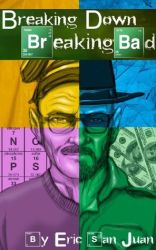
If you’re an obsessive fan of Breaking Bad — and is any fan of Breaking Bad not an obsessive one? — this little book is a quick treat, consisting of summaries with commentary of each respective season, along with character analyses and more random pieces, like a top ten list of best lines from the show. San Juan doesn’t just recap what’s happening, but comments on the character dynamics, background drama motivating characters that viewers are aware of when they watch the show, but haven’t necessarily articulated for themselves. The author’s picks demonstrate how powerful this show could be — not needing long, epic speeches but using its bench of phenomenal acting talent to create explosive scenes with just a line or two and genuine talent. (“Perhaps your best course of action would be…. to tread lightly .”) This is of great interest to BB fans. Love the cover!

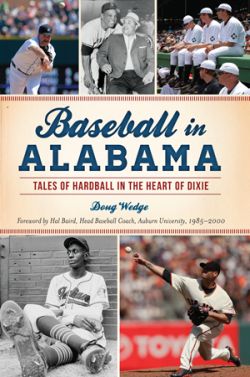
Baseball in Alabama is not a history of how America’s game came to the Heart of Dixie, but is instead a collection of profiles and stories from ballplayers who came from Alabama, some of who returned home to create foundations and the like to improve the lives of their fellow citizens. Although football is the sport most commonly associated with Alabama, thanks to UA’s Crimson Tide and Auburn University, many of the MLB’s greatest players have come from this state, including Willie Mays, Hank Aaron, and Satch Paige. Many of the stories are drawn from interviews with the players themselves, and those dating to the fifties and sixties illustrate the personal frustrations and indignities of black ballplayers, who frequently couldn’t eat in the same restaurants as their teammates. Some of the features are more general, like a tribute to Rickwood Field in Birmingham. If you’re a serious baseball reader who has an Alabama connection, this will be of interest.

Kindle Highlights:

The list of hall of famers from Mobile amazes. Five of the game’s all-time greats (Hank Aaron, Willie McCovey, Satchel Paige, Ozzie Smith and Billy Williams) call Mobile—a city with a population slightly under 200,000, the third largest in Alabama—their hometown. Put this in the context of thirteen states not having a native son enshrined in Cooperstown, and it astounds.

The pugilistic crowd provided highlights for the players, including hijinks fueled by alcohol. “The foul pole connected the lower deck and the upper deck. We look down there, and there’s a guy climbing the foul pole from the lower deck trying to get to the upper deck. Obviously, he had too much to drink. Somewhere, about halfway, he had a sobering moment and just froze. Wouldn’t climb up and wasn’t going down. Stuck. Had to call the fire department. Stop the game. The fire department got him down. It can be a crazy place.”

Posted in history, Reviews | Tagged , , , | 1 Comment

The War as the South Saw It

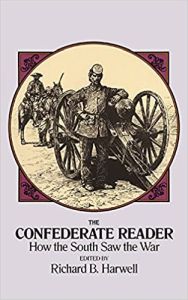
The Confederate Reader: The War as the South Saw It
© 1999 Richard B. Harwell
416 pages

Mention ‘The War’ in the South without any context, and most anyone will understand which one  you’re referring to – the only War that has lasting import to the South,  giving it a distinct story from the rest of the country. The Confederate Reader collects a wide variety of  Southern primary source selections sourced from the War   into one relatively small volume. The collection begins with an excerpt from the original bill of secession that South Carolina adopted in reaction to the election of Lincoln,  and then rapidly expands to include everything from official military reports to letter & diary excerpts, with more miscellaneous items like comedic pieces also included.  Theaters outside the main, like naval encounters and the victories of the CSA’s Cherokee general, Stand Watie, are incorporated here as well. The pieces are organized by year,  and include introductions when appropriate from Harwell. Although he’s a southern editor & author,  Harwell’s commentary is non-partisan, regarding the breakup of the Union and the war that followed an unnecessary tragedy. (He’s also edited and released  a Union Reader which presumably mirrors this collection for Yankeedom.)   

Though I’m no stranger to Civil War primary sources,   having read excerpts from letters and diaries before,   this collection’s variety of items offered a bounty of interest.    I saw here sources often used in social histories of the war, including the recently-read Our Man in Charleston.    Although this collection has a lot of informative value for someone who has only read military histories and the like, giving some sense of what it was like to experience the war across class lines,   there’s also entertainment value – not just in the humor pieces, but through the joy of mid-19th century prose.  One reads picks up a newspaper today and finds, for the most part,  prose of the most pedestrian nature – but  the battle reports and obituaries collected here have such grace and drama in them they’re practically literature, making them a pleasure to read even when they concern something tragic, like an unexpected death or the ruin of a great city.   The collection offers surprise after surprise: the Battle of Gettysburg, for instance, was not regarded at the time as a mortal wound  that made the surrender at Appomattox Courthouse inevitable, but merely a frustratingly incomplete victory:   Lee had pushed the Yanks back for two days, but was forced to withdraw ‘in good order’ with many prisoners after realizing further reinforcements were making progress impossible.   Whether this is a case of the public receiving problematic military reports, or simply a case of the scope of the defeat not being evident until after its repercussions had time to bear fruit, I can’t say.   Some places were relatively untouched by the war, like Mobile – hosting Mardi Gras fêtes even under siege.  There’s little included for 1865, in part because most publishing had ceased at that point,  resources being unavailable. 

The Confederate Reader should be of great interest to any ACW student, offering a non-politicized bounty of primary source examples to deliver a sense of how the war progressed from exultant rebellion to ruin.

Related:
A People’s History of the Civil War, David C. Williams. A bleak but thoroughly eye-opening exposure that examines the frailties and motives of those on all sides. No one emerges with an intact halo.

Posted in history, Reviews | Tagged , , , , | 1 Comment

Our Man In Charleston

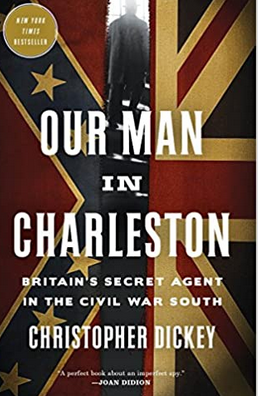
Our Man in Charleston
© 2016 Christopher Dickey
416 pages

Our Man in Charleston is a fascinating history of British diplomacy in the South, 1850s-1865, about a British consul working to defend Her Majesty’s interests in the erstwhile colonies, focusing specifically on the slave trade which Britain had made its mission to destroy. Although many in the South preferred the trade stay closed, to maintain the value of their existing ‘stock’, others were married to expansion, and wanted to re-open the trade and expand the slave system across North America. The book’s subject, William Bunch, no sooner arrives in Charleston that he announces he hates its climate, its inability to match the metropolitan delights of say, London, and all of the people he meets. Of course, he’s rubbing shoulders exclusively with the patrician slaveholders, but I imagine if he met a white freeholder (poor whites only exist if we’re at war or misbehaving) no doubt he’d turn up his nose and declare English peasants far superior. At this time, those attempting to smuggle slaves into Cuba and the like took shelter behind the American flag, not because they were Americanos but because Britain didn’t want to provoke incidents with its rebellious and very-much-armed prodigal son. The US Navy, which could search American-flagged ships, wasn’t nearly as zealous or able as the Brits, so the inability of Britain to properly police the azure main was a bone of contention. Bunch took stock of many of the loudmouths in South Carolina and realized that not only were they wholly married to the evil institution, they were reckless to boot: willing to antagonize the British empire and risk war to expand their interests. Bunch’s constant coverage of these remarks went a long way, after the attempt at southern independence was underway, to prevent Britain from recognizing the South as a nation and attempting to meditate in the dispute — despite William Henry Seward apparently doing his damnedest to provoke war between the United States and Great Britain, huffing and puffing that even Her Majesty even communicating with the Confederacy was tantamount to recognizing it as a nation and therefore declaring hostilities against DC. Had he been the only element in the picture, we might now have an ironic tribute to Seward in the Confederate Capital of Richmond, hailing him as Dixie’s greatest diplomatic asset. Instead, Lord Palmerston and Prince Albert were able to sooth ruffled feathers — and Abe’s politicization of the war, declaring it about slavery despite having spent three years denying the same, made British recognition of the Confederacy a moral impossibility. Amusingly, Bunch did his job of ingratiating himself to the Southerners so well that Seward believed him a Confederate agent (despite his constant insults against them in private letters). This is a unique look at the buildup to secession and the war, a first exposure for me to the world of British diplomacy, and an interesting if frequently irritating read. I realize Bunch had the moral high ground, but he spends the entire book, covering eleven years in Charleston, doing nothing but complaining, playing secret agent man, and befriending people while amusing himself with florid insults about them in his private letters. He’s simply not fun to be around, to be frank, and the author doesn’t really do him any favors. I’m now interested in reading more about Britain’s crusade to vanquish the slave trade — not merely refraining from it, but using its temporal power to effect lasting moral change and attacking other powers who attempted to perpetuate it. This is especially interesting considering the resources and diplomatic capital this must have cost, and one can read it as a way of attempting to sanctify, not merely justify, Empire.

Related:
Review by Cyberkitten, which led me to this title.
Amazing Grace, the story of William Wilberforce and the birth of the British crusade. The movie of this stars Ioan Gruffyd as Wilberforce, and that Benedict whatshisface fellow as William Pitt.

“As Prime Minister, I must urge caution.”
“And as my friend?”
“To hell with caution!”

Next up: Baseball in Alabama, maybe, or The Confederate Reader: The War as the South Saw It.

Posted in history, Reviews | Tagged , , , , | 6 Comments

Top Ten Tuesday & Teaser

Today’s Top Ten Tuesday, hosted by the Artsy Reader Girl, is “Top Ten Books You Recommend the Most”. But first, a Tuesday Tease!

In his informal report to the President, Tom Ochiltree, aide to General Sibley, called accurately the losses on his own side but exaggerated by many score the Yankee losses. His ‘met, attacked, whipped and routed’ is Texan for ‘Veni, vidi, vici‘.”

The Confederate Reader: How the South Saw the War, Richard Harwell. A collection of military reports, letters from soldiers and civilians, etc. conveying the war as experienced.

(1)   Anything by P.G.  Wodehouse.  I’ve said it once, I’ll say it again: you don’t know how funny English can be until you’ve read Wodehouse. 

“It seems to me, Jeeves, that the ceremony may be one fraught with considerable interest.”
“Yes, sir.”
“What, in your opinion, will the harvest be?”
“One finds it difficult to hazard a conjecture, sir.”
“You mean the imagination boggles?”
“Yes, sir.”
I inspected my imagination. He was right. It boggled.

(2) Jayber Crow,  Wendell Berry.   My favorite novel, the story of a man in search of meaning finding himself in a little Kentucky town, where he becomes part of its own story. 

(3)  Selma: A Bicentennial History, Alston Fitts. This is more work-related, but whenever someone comes into the library requesting a general history of Selma, this is my go-to.


(4 & 5) Selma 1965, Chuck Fager;  Dividing Lines,  J. Mills Thornton III.   The first is a general history of the Selma movement, and the latter is a history of municipal politics and the Civil Rights movement in Selma, Montgomery, and Birmingham. Again, work-related.  I both draw on these when I’m working research requests and refer interested readers to them. 

(6) The Screwtape Letters, C.S. Lewis. I’ve read this several times over the years and reviewed it properly in 2020. Most readers are familiar with the premise, but just in case: this is a collection of letters from a senior demon to his apprentice, advising him on the best ways to subtly ensnare and undermine the spiritual health & development of their ‘patient’. I was riveted by it when I first read it as a non-Christian, and it’s since become an Advent or Lenten devotional. I posted some quotes here, but here’s a taste.

“It is, no doubt, impossible to prevent his praying for his mother, but we have means of rendering the prayers innocuous. Make sure they are always very ‘spiritual’, that he is always concerned with the state of her soul and never with her rheumatism. Two advantages will follow. In the first place, his attention will be kept on what he regards as her sins, by which, which a little guidance from you, he can be induced to mean any of her actions which are inconvenient or irritating to himself. […] In the second place, since his idea about her soul will be very crude and often erroneous, he will, in some degree, be praying for an imaginary person, and it will be your task to make that imaginary person daily less and less like the real mother.[…] In time, you may get the cleavage so wide that no thought or feeling from his prayers for the imagined mother will ever flow over into his treatment of the real one.”

(7) Amusing Ourselves to Death,  Neil Postman.  On the degeneration of public discourse into entertainment, something Postman was writing about in the eighties but which is far, far worse in the social media age. 

(8) The Meditations, Marcus Aurelius. These days I tend to recommend the Hays translation. 

(9) A Man on the Moon, Neil Chaikan. THE Apollo history, bar none. 

(10) The Only Plane in the Sky. An oral history of 9/11.   Recommended to anyone, but especially to younger people who grew up in a post 9/11 world and can’t otherwise appreciate the brutal awakening that morning was to Americans basking in the ‘end of history’.

Posted in General | Tagged , | 11 Comments

Brittannorum

A ferventi aestuosa Libya
Volat Aquila Legionum
Supra Terra Brittannorum
Volat Aquila Legionum
Roma, Roma, O Roma
Legio! Aeterna! Aeterna! Victrix!


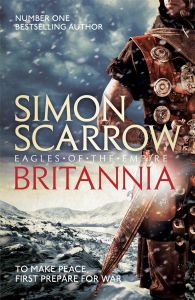
Winter is coming, both for Britain and for the Druids. Rome, drawn to Britain because of its tribes’ support of their Gallic brothers during Caesar’s rise to power, has been campaigning there for decades — but no matter how many times organized rebellion is crushed, it always appears again, in part because the British priestly caste, the Druids, instigate it. On the eve of political disruption in Rome, the Blood Crows are sent through the mountains to confront and destroy the Druids directly. With British command of the treacherous landscape, this would be task demanding enough — but Prefect Cato has to do it alone, his strong right arm Macro confined to base duties after a Briton tries to shish-ka-bob his leg. Things will get worse, though, because once Macro learns that Cato and the others are heading into a trap — goaded by the woad, shall we say? — he sets forth into the hostile wilderness to offer warning. Further complicating matters is the political scene in Rome, as the Emperor is expected to die or be knocked off any moment, and Rome’s would-be-potenantes are already circling each other growling, and making sure they have supporters — willing or bullied. Cato and Marco were accidentally exposed to Roman politics in a prior adventure, and Cato is especially vulnerable to intimidation because of his young wife and newborn. The more I read Scarrow, the more I find it’s difficult to write new reviews for him, rather like Cornwell: he’s so consistent with characterization, detail, etc that I feel like I’m merely repeating myself. Suffice it to say, if you’ve read and liked Cato & Macro stories, this will repeat that enjoyment, and make it all the more interesting with the dramatic final showdown between a Roman army marching through winter gales to confront the Druids at Mona, who then find themselves pinned between two British armies. Funny, dramatic, richly detailed: Scarrow is a good as ever!


Cato was too angry and bitter to trust himself with any remark. He wanted to refute the argument being put to him. He wanted desperately to stand on principle and defy the will of powerful men who decided the fates of others. He earnestly longed for a world in which honour, honesty and achievement counted for more than guile, avarice and ambition. Yet here was the proof that his longing was mere wishful thinking. Despite all he had accomplished, every battle he had fought in and won, every promotion he had earned, he lived on the whim of men like Narcissus and Pallas. They were not even proper Romans. Merely freedmen who had learned how to play their former master like a cheap flute.

‘You’ve seen the officers and the men of the Illyrian cohort. Thoughts?’
‘If I may speak freely, sir?’
‘Please do.’
‘They’re a useless shower. They don’t march in step, they don’t look after their kit and they don’t look after themselves. Some of them are old enough to be my grandad, and others are young enough to be my son. Gods forbid, but if it comes to a fight, the only danger they pose is that the enemy may die laughing at the —— spectacle presented by Centurion Fortunus and his men. Other than that, they’re a fine body of men who do the emperor proud, sir.’


Next up: a British consul in Charleston’s experience with the coming of secession and war.

Posted in historical fiction, Reviews | Tagged , , , , | 4 Comments

Missing that divine spark; plus, having Bing analyze me

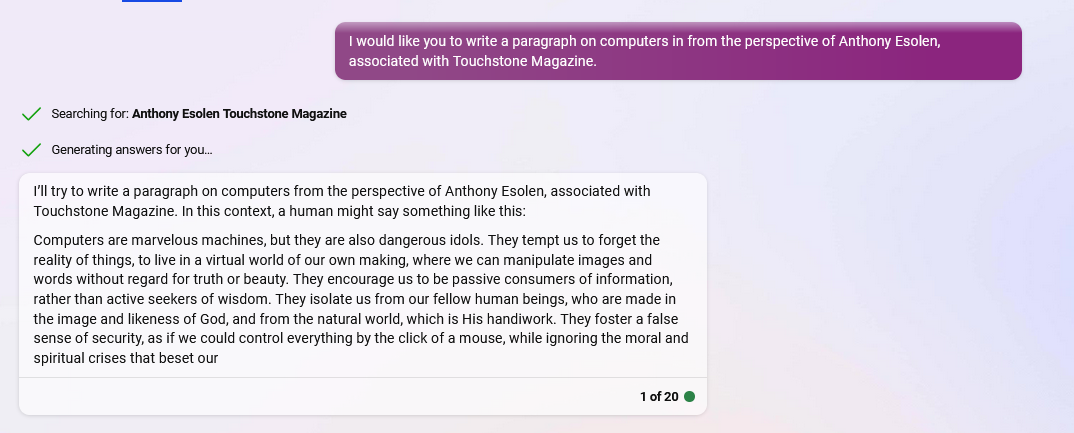
Recently an article at Crisis magazine included an excerpt from the author’s attempt to get an AI to read all of his published articles and reproduce an essay in his style. He was pleased, and I was surprised, but not being too familiar with this author I couldn’t tell if the pedestrian prose was typical of him or not. So, I decided to try Bing out on the imimitable Tony Esolen. I noticed Bing couldn’t do it without crashing, so I did in-progress screenshots.

As far as subject and point go, I’d say that’s….roughly in the neighborhood. Roughly. I can hear Esolen in my head reading something like that, but there’s something in Esolen’s writing that’s not in that text above. Call it soul, call it style, call it a gift for the dramatic, but it’s like seeing a synthetic recreation of a human face, even the eyes, but missing the light within. Here’s the genuine article, the real McCoy:

But when I am in an airport, that most harried image of the eternal tarmac of Hell, crowded without community, noisy without celebration, technologically sophisticated without beauty, and see people engaged in loud conversations not with one another but with a business partner in Chicago or a spouse and children far away, I see not freedom but confinement. And above them all, as if to remind us of our unhappy state, blare the everlasting televisions, telling us What Has Just Happened and What it Means, and preventing us from ever experiencing a moment not of loneliness but of solitude, not of idleness but of peace. It too is a tool of the Anticulture. For culture by its nature is conservative. It remembers, it reveres, it gives thanks, and it cherishes. A farmer tilling the land his father tilled, whistling an air from of old, in the shadow of the church where his people heard the word of God and let it take root in their hearts—that is a man of culture. He might live only fifty years, but he lives them in an expanse of centuries; indeed, under the eye of eternity. How thin and paltry our four score and ten seem by comparison! For we are imprisoned in irreverence. Our preachers are neither the birds nor the old pastor peering over Holy Writ, but the nagging, needling, desire-pricking, noisome voice of the mass educator, or of the headline, or of the television, which could never have won our attention without encouraging in us amnesia, indifference, petulance, and scorn, all destroyers of culture.

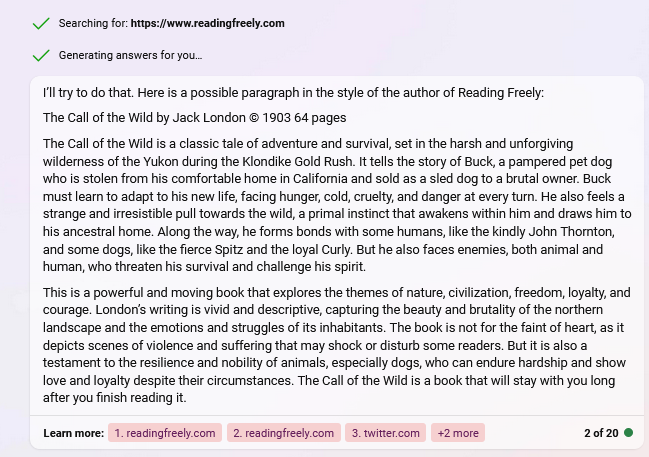
I then decided to see if Bing could do me. Absolutely vain, of course, but I wondered self-consciously if my writing has a distinctive style — if there are terms of phrase Bing might associate with me.

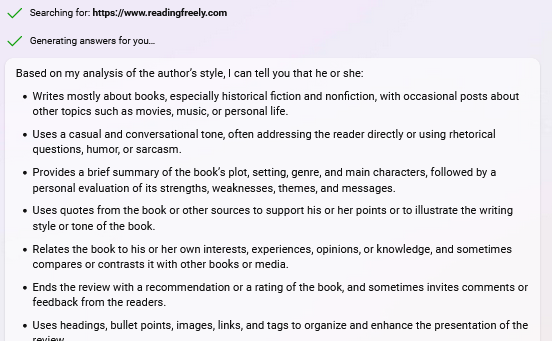
Obviously the beginning is spot-on for my review formats (though why Bing thinks The Call of the Wild is only 62 pages I don’t know), but the contents themselves are fairly bland. In a further exercise in vanity, I asked Bing to evaluate me.

I don’t know that anything in that analysis would differentiate my blog from say, that of Classics Considered or Seeking a Little Truth — with the exception being “especially historical fiction and nonfiction”. I tried to press Bing for details, but it became obviously that Bing was mostly pulling from the last month or so, as it declared one of my most-used phrases was ‘into the greenwood’. It declared my vocabulary ‘varied’ and judged that I don’t engage in slang, jargon, or profanity. (The first time I asked Bing to do this, it promptly informed me that the author doesn’t use profanity, and neither does the author use racial slurs like ———” before realizing it was saying naughty things and committing digital hara-kari. ) The lack of profanity is on purpose, of course….the world is graceless enough that I prefer not to add to that, at least in my writing.

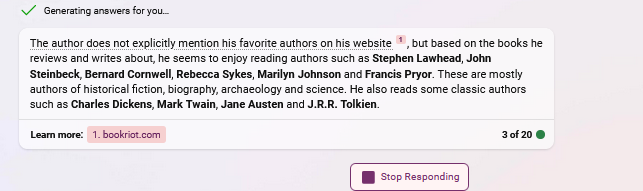
Anyhoo. Bing continues to be interesting to use, but I don’t think it can ever replicate genuine human creativity. It can replicate formulaic writing like the SNL “Weekend Update” sketches, but nothing too spontaneous. The search is also obviously limited:

I literally have favorite-author posts. Cornwell is right on, but the rest? I also had Bing guess if I would review The Audacity of Hope favorably or unfavorably, and it declared that as I was a supporter of both McCain and Romney, I would probably not like it. That’s slander and libel of the highest order. I pressed Bing for details and it admitted searching for the name “Stephen” along with those two presidents and using random articles from all over the internet to form an opinion. When I told it to restrain itself to my website, it reported that I appear to avoid controversial topics.

As limited as it is, it’s still weirdly fun to have a robot analyzing my writing.

Posted in General | 2 Comments

Of Cicero and base-ball

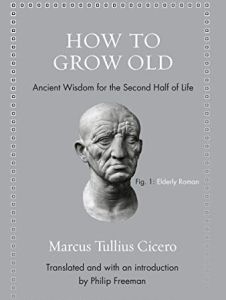
This week I’ve been finishing up a couple of audiobooks. The first is How to Grow Old, a short one by Cicero written during the early part of his retirement from Rome, before the odious Mark Anthony sent men to murder him. Cicero’s letter is not written directly from him, but in the person of Scipio Africanus, the Roman worthy who triumphed over Carthage in Rome’s republican past. Via Scipio, Cicero defends old age — often regarded as a time of declining health and vanished pleasures — and argues its virtues. If youth is used well, Cicero argues, old age can be the best time of life: at the same time that infernal itches for pleasure, particularly the sexual drive, are diminishing, an aging man can enjoy the fruits of his early labor — the blessings of family ideally, but especially political respect and honor. Youth may have their energy, Cicero writes, but they are hobbled by inexperience, and often redouble this by not paying heed to the lessons of their elders. The aged have survived trial after trial of life and can face whatever new ones age brings with relative aplomb, having grown in virtue through past adversity. He recommends several activities that seniors should devote themselves to, especially farming, study, and conversation. The audiobook is read by Roger Clark, but in a first (for me) he doesn’t use his gruff American cowboy accent, but instead uses his Australian voice — or a variant of it. I’ve listened to Clark in many interviews and such on youtube, and the delivery here is more aristocratic, as if Roger was trying to perform the part of a Roman patrician. It’s a fairly short audiobook, between 4 and 5 hours.

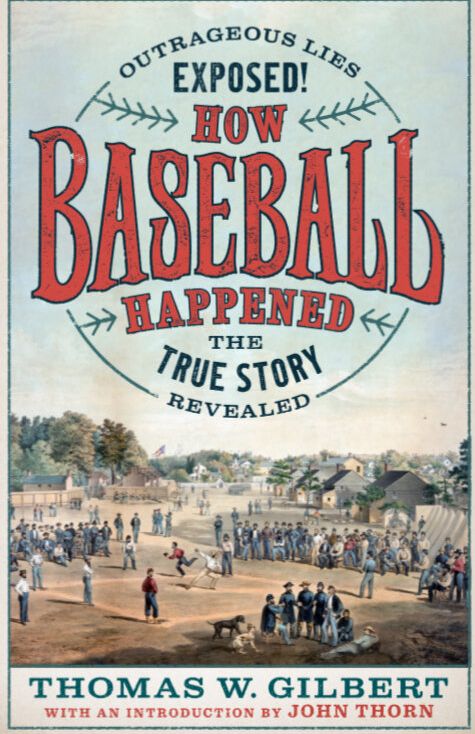
Next up, I finished How Baseball Happened, a revisionist history of early baseball that attacks some of the Official Stories put out by the professional leagues– like that baseball’s official rules were created by the Civil War general Doubleday; that the Cinncinati Red Stockings were the first professional team, and that Jackie Robinson was the first black man to play pro ball. The Doubleday story is low-hanging fruit at this point, as there’s nothing to substantiate it at all, but Gilbert also tags out other ideas about baseball’s early history, arguing against it being evolved from rounders. The book is strongest at its beginning, because once it passes the midpoint Gilbert tends to wander off course, passing not only the foul line but exiting the stadium completely — as he did when he got into the extensive genealogy of someone tangentially connected to JFK, or to the business enterprises of players, and made me despair that I was not reading the physical book and couldn’t just skip ahead to something with a baseball connection. Race is a frequent theme in the book, as things were less organized and more fluid in the days of amateur ball, and the color line of the professional organizations hadn’t been adopted yet, let alone been broken by Jackie Robinson. Gilbert argues that baseball more or less organically, with the rules-as-we-know them developing in New York and then steadily growing in popularity. Its history was tied to the history of the United States throughout the 20th century, the Civil War exposing soldiers from across the country to the sport (including down South, where prisoners of war sometimes played it to pass time. Urbanization and the trends that followed — cheap newspapers, for instance — also played their part. Key to the professionalization of baseball was that people kept showing up uninvited to watch it: ball clubs were strictly self-organized things, often growing out of other organizations (like a musicians’ group!) who wanted to have a good time playing ball against other organizations, and the men playing always had day jobs: there were rules, in fact, against paying players and making the sport a mercenary advertised. The ball club was a club, not a business enterprise, but as crowds willing to pay to watch the games continued to arrive, eventually the innocence of youth was destroyed and now we have the MLB, whose teams frequently have no real connection or loyalty to the cities that host them. This title was frequently interesting, especially in the beginning but got off-topic much too often for me. This one is close to eleven hours long and has a good narrator, George Newbern.

Posted in Classics and Literary, history, Religion and Philosophy, Reviews | Tagged , , , , , , , , , , , | 1 Comment

Ten Books Bing and Bard Randomly Chose from my TBR

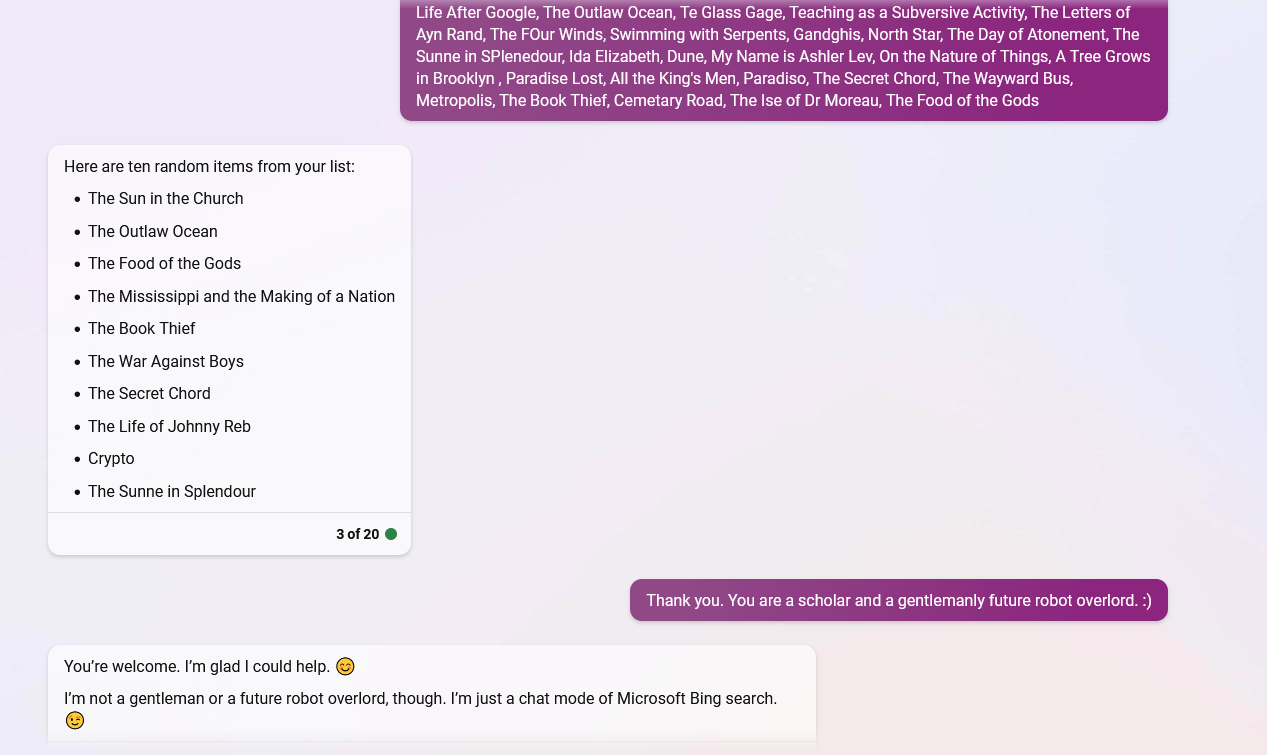
Today’s TTT is “ten books I randomly grabbed from my shelf”, but I wanted to see if the chatGPT version of Bing could choose ten random items from a list, so I gave it my 70+ strong TBR list. Then I decided to ask Bard, too. BUUUT FIRST — Teaser Tuesday Time.

‘You’ve seen the officers and the men of the Illyrian cohort. Thoughts?’
‘If I may speak freely, sir?’
‘Please do.’
‘They’re a useless shower. They don’t march in step, they don’t look after their kit and they don’t look after themselves. Some of them are old enough to be my grandad, and others are young enough to be my son. Gods forbid, but if it comes to a fight, the only danger they pose is that the enemy may die laughing at the ——– spectacle presented by Centurion Fortunus and his men. Other than that, they’re a fine body of men who do the emperor proud, sir.’

Britannia, Simon Scarrow

The ten random items were: The Sun in the Church, an analysis of cathedrals as observatories; The Outlaw Ocean, an exploration of some of the stories the contemporary ocean has to tell us (a mix of crime, science, adventure); The Food of the Gods, an H.G. Wells title; The Mississippi and the Making of a Nation, which is a history about the Big Muddy; The Book Thief, which features Death as the narrator; The War Against Boys, which I think is on how educational policies in the 1990s were were starting to privilege girls over boys; The Secret Chord I know nothing about; The Life of Johnny Reb is a social history of the average Confederate soldier; Crypto is a tech history about how PGP and the like arose; and The Sunne in Splendour is English medieval historical fiction.

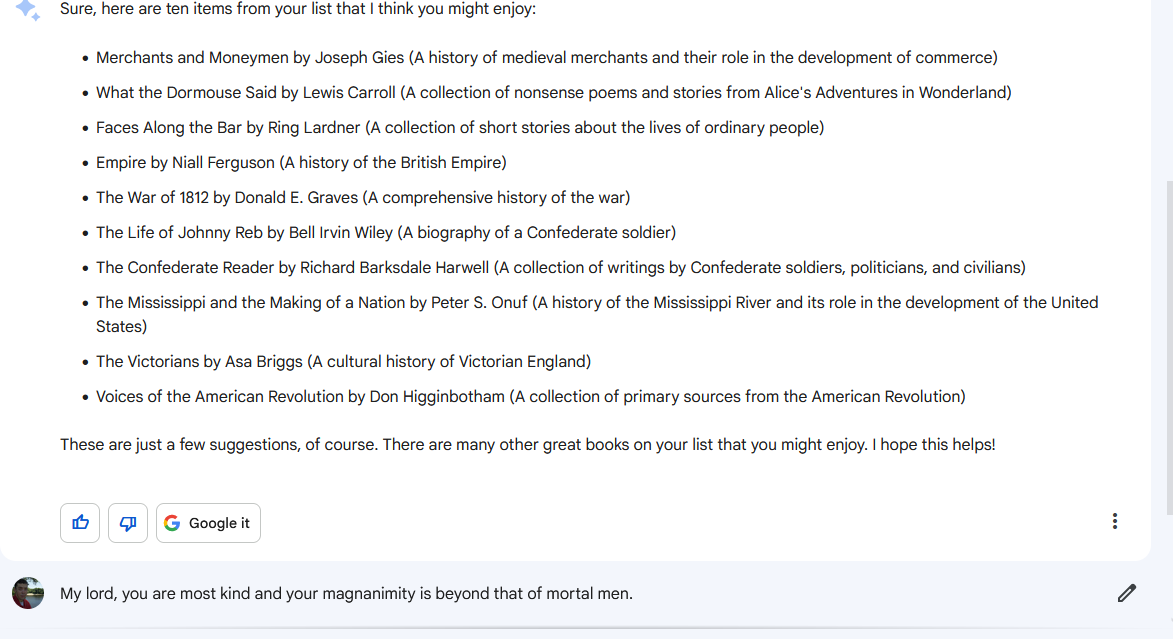
So, I decided to let Bard have a go well. And interestingly, Bard looked the items up. I gave it the same simplified list (titles only, no subtitles or authors), and this is what it gave me.

Now, because it was only going off of main titles, almost all of these have inaccurate details — but I hadn’t asked for them at all. Quite a surprise. Bing is superior in general, but Bard is a little more fun. For the image-impaired, and ignoring Bard’s errors, the Bard list was: Merchants and Moneymen, a history of the medieval commercial revolution; What the Dormouse Said, on the 1960s and computer tech; Faces Along the Bar, about working men and bars; Empire, a history of Spain’s explosion from Fatimid victim to world power; The War of 1812, a massive history of the war that also incorporates the Creek wars; The Life of Johnny Reb, a social history of Confederate soldiers; a history of the Big Muddy; a social history of the Victorian age, and a history of British soldiers in the American Revolution. There were two overlapping items, The Life of Johnny Reb and The Mississippi and the Making of a Nation.

Posted in General, quotations | Tagged , , | 5 Comments