Ever since 2021 I’ve set aside a week in July to celebrate human spaceflight, inspired by the lunar landing on July 20, 1969. I just realized it’s the 17th and my TBR pile has nothing spacey in it, so I’m just going to post a list of all the human spaceflight books I’ve covered to date, including those from last year’s Space Camp. I still might surprise myself by finding something before the month is out! These are in rough chronological order by subject covered.
This….book. I was twenty minutes late returning from lunch because of it, I burned a pizza because of it, I didn’t even notice the thunderstorm was over and it was safe to go in the pool I was housesitting because of it. It’s so absorbing and yet…GAH! Such a frustrating ending. Rowan Caine just saw the job of a lifetime: live-in nanny to four kids (three, really, one is at boarding school) at a generous salary. Sure, it’s in the middle of the boondocks, but the family is loaded and there’s no shortage of entertainment or landscape to gawk at. There is the matter of the family having run off the previous four nannies — within the span of a year –but Rowan is made of sterner stuff. No little hellions can get the better of her, she’s a Childcare Professional! From the start, it’s apparent that there’s something…..off about this place. The house is a jarring fusion of traditional architecture and gee-whiz modernism, complete with smart infrastructure that does everything from ordering food to offering live surveillance of everything but the bathrooms — and the kids are a mess. The toddler is a toddler, fine, but Ellie seems traumatized and Maddie is a manipulative little psycho. But there’s something spooky about the place, forboding even. There’s a poison garden on the premises (which Rowan is tricked by the kids into visiting), and a “closet door” that’s really a boarded-up entrance to an attic area that is “I would run away in terror right now if I were not responsible for feeding these brats”-level unsettling. Between the smarthome malfunctioning, the kids being psychological basketcases, and the constant Poltergeist-esque weirdness, this kept me riveted — and with one twist late in the book, I was primed for anything. I mean….you’ve got an isolated young woman who is living in constant stress, deprived by music, living in a house where inexplicable things are happening, and through all this there’s the fog of “Maybe this is a horror story and not just a thriller, maybe there are evil ghosts!“. And then…explosion on the pad, aborted takeoff, pick your metaphor. It’s just over all of a sudden, and not only is the ending anticlimactic, but it doesn’t resolve anything. There’s a lot right about this book — the way Ware frames it as being written from premise, the joint creepiness of the main character being surveilled by either a creepy boss or ghosts — but the ending just fizzled. I can’t say I wasn’t completely entertained, though!
Today’s topic is “ten things we loved about ________”. I’m not sure if it’s supposed to be about a single book or not, but I’m going to cheat and go with a series — specifically, the Harry Potter series.
Bur first, a tease…
<Jennifer to Beth> Aren’t you missing the point? Clark Kent doesn’t want to be famous. He doesn’t want people to look at him. If they really look at him, they’d see that he’s just Superman with glasses. Plus, he needs to be someplace like a newsroom, where he’s the first to hear big news. He can’t afford to read “Joker attacks moon” the next day in the newspaper. <Beth to Jennifer> You make an excellent point. Especially for someone who doesn’t know that Superman never fights the Joker.
“So, what if, instead of thinking about solving your whole life, you just think about adding additional good things. One at a time. Just let your pile of good things grow.” “This is investment advice, isn’t it? You’re personal-bank-ing me.” “It’s good advice,” she said. (Attachments, Rainbow Rowell)
So, ten things I loved about the Harry Potter series! I was a late-blooming Potterhead: I didn’t read the books until my early twenties, despite the fact that the first book was released when I was twelve (only a year older than Harry in Philosopher’s Stone) and I could have grown up with the series. By happy accident, I found the series just as Deathly Hallows was being released.
(1) The fonts & covers, at least in the American edition. I have three copies of Philosopher’s Stone: an American first edition, a British paperback with original art, and a German hardback version (Und der Stein der Weisen) Of them, I find the American font & layout the most attractive and charming.
(2) The humor. I think it was the humor that first drew me in — from Dumbledore leaving the children with a few more words (“Nitwit! Blubber! Oddment! Tweak!”) to the Marauder’s snark at Snape via the map, to Hermione’s “Oh, well spotted” response to Ron’s observation that she was a girl, this series had me consistently laughing despite the frequent dangers and teen drama. And that’s not even mentioning Gred and Forge!
(3) The coincidence of when I read it: I discovered Harry Potter just as I was escaping from a repressive sect and going to college to live my own life, so a new world was opening for Harry and I at the same time. When I visited campus for the first time and inspected my residence hall, I commented in my journal that “It’s not Gryffindor Tower, but it will do.”
(5) The Britishness. I know this is an odd thing, but as an American reader with no knowledge of British schools, learning about ‘houses’ and prefects and the like was just as interesting as learning about magic and the whole Voldemort backstory. There are just so many little elements like the Christmas crackers and the train snack trolley that I’ve never experienced which made the HP world new and interesting to me. I was so fascinated by the Quidditch depiction that I tried to get into English football, arbitrarily following Arsenal for a few weeks before deciding that watching soccer was not for me.
(6) The characters in general. This series has so many superb and often complex characters — including the thoroughably hatable Umbridge. I could easily do a TT list just on Rowling’s characters.
(7) This is really more of the movies, but the music & casting choices were fairly brilliant on the whole. The adaptations had their misfires (especially Goblet of Fire), but I enjoy returning to them time and again. It’s fun seeing the kids grow up.
(8) The depth of storytelling — complex figures like Snape, unsimple scenarios like poor Neville trying to stop The Power Trio and getting frozen for it, the details one notices after a second reading that suddenly make the story richer.
Lincoln thought he’d snagged a sweet new job as an IT security chief at a large newspaper, until he realized the job description was almost entirely about monitoring staff emails and activity flagged as violations of the company’s computer-use policy. Newspaper computers are for conducting serious newspaper business, not searching AltaVista, hunting for bargains on eBay, and gossiping! The idea of reading people’s emails makes Lincoln feel like a major creep, but two particular people whose emails are frequently flagged catch his interest: a film critic named Beth and her BFF Jennifer, a copy editor. Beth and Jennifer are hilarious and earnest, talking to each other about family and relationship issues. Even though he shouldn’t keep reading, Lincoln—at a dead space in his life—is charmed by their friendship and a bit smitten by Beth, despite having no idea who she is.
As the last year of the second millennium A.D. comes to an end, the exchange of letters pushes Lincoln toward some personal growth, especially after he realizes that the ‘cute guy’ Beth sometimes mentions in her emails is him. With a little wind added to his sails, Lincoln becomes more proactive in his life—he begins talking to more people and doing things like taking up a gym habit and attending concerts. As the months progress, Lincoln struggles between knowing he’s being a bit of a voyeur by reading these women’s personal letters and the delight he takes in ‘getting to know them.’ That’s part of the problem, though: Lincoln’s feelings for Beth grow more intense as he realizes she’s in a failing relationship and is actively interested in getting to know the aforementioned cute guy—himself. Ultimately, Lincoln will have to decide whether to confront her and come clean or run away.
As soon as I heard of this premise on Saturday, via a post at Bewitching Books, Ravenous Reads, I wanted to read it. Fortunately, I had access to an ebook copy and wolfed it down that very morning. The premise was interesting in itself, especially for an IT-adjacent fella whose first regular use of the Internet was in 1999, the very year this book is set. I have some doubts about the premise, in large part because, in my experience, guys who are as attractive as Beth says Lincoln is generally know it, but I liked the execution of the book in general. Lincoln’s technical eavesdropping is balanced a bit by the fact that Beth is actively stalking Lincoln without either of them knowing it, and Beth and Jennifer’s personal dramas and their responses struck me as well-developed. Jennifer is especially complicated. I knew the ending would be difficult—both deceit and truth would doom their relationship—but I think Rowell pulled it off as well as could be expected. Rowell evidently has written a few more books since then, so I’ll probably check them out—at least Eleanor and Park.
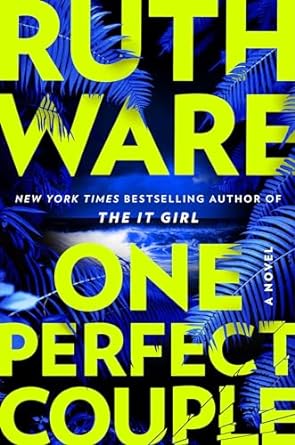
Lyla is a frustrated virologist in a relationship with an equally frustrated aspiring actor — so when Nico tells her they’ve been invited to join a new reality show called One Perfect Couple, she hesitantly accepts. A reality TV show doesn’t seem like the ideal way to shore up a struggling relationship, but a tropical island is a tropical island. Unfortunately, tropical islands have tropical storms, and one strikes the island as soon as the filming begins — destroying many of the island’s buildings and killing one of the contestants. Lyla and the others radio for help, but the device remains silent and the horizon empty of any rescuing ships — and as the days pass, desperation begins to sink in, with flaring tempers and the occasional death. Death? Yeahhhhh, there’s a murderer loose on the island.
I picked this up after having read and enjoyed Zero Days: I was told it was atypical for Ware’s other work, being a technical thriller, and wanted to see what her ‘usual’ stuff was like. If this is it, definitely expect more Ware, because I devoured it in only a few sittings. One Perfect Couple sets the stage with an interesting main character, a scientist whose job details are drawn directly from Ware’s husband’s. The tension quickly builds as Lyla and Nico get involved with the show, and the reader realizes that the organizers really don’t have a solid operation here: the crew is small, the equipment shoddy. The drama quickly ramps up when the storm hits and everything goes to hell, and before the sheer-surival panic has even lost its strength, things start going wrong and only one of the survivors can be the culprit. One Perfect Couple definitely succeeds at keeping good tension: the characters were generally sharp, at least the women — the men, save one, are fairly forgettable. Of course, given that Lyla spends more time with the female characters, they do get more space to grow. The one limitation is the villain, who is steadily telegraphed throughout the novel, to the point that the mystery is not in who the baddy is, but how to overcome them: it takes Lyla and the others to admit the obvious thing staring them in the face. The reality show setting was new for me, as I’ve only ever read nonfiction (and purely about Survivor) on the subject. All told, I enjoyed this enormously and will be reading more of Ware — The Turn of the Key, with a smarthome murder, seems a promising prospect.
Disney movies (and fairy tales in general) aren’t telling little girls that they ought to be literal princesses. They’re telling them to be the best possible versions of themselves.
Disney’s adaptations of classic fairy tale and folk stories like Cinderella have charmed girls across generations, but as the decades pass they’ve been subject to increasing criticism that the early princesses were passive sillyhearts lying around waiting to be rescued. Disney’s efforts to create more active princesses have been met with approval on release — see The Little Mermaid and Aladdin — only to be attacked in subsequent years. Well, stuff and nonsense, says Faith Moore: the early princesses were not passive or weak, and Disney’s recent attempts at making more empowered princesses have only succeeded in missing what makes princesses special: the inner beauty of character, not the ability to pole-vault. This is an interesting study of Disney’s attempts at creating modern stories from fairytales over the years, which I enjoyed despite not being the ideal audience for.
This probably goes without saying, but I’m not a Disney princess kind of guy. I enjoyed the movies as a kid, but despite my love of musicals, the only films I’ve rewatched over the years are The Lion King and Aladdin. I’ve seen none of the newer films, except for the live-action remakes of those same classics. Recently, though, I discovered a podcast called Storytime for Grownups, where the author of this book delves into classic literature. She’s currently doing a series comparing Jane Eyre to the classic story of “Beauty and the Beast”. I’ve enjoyed it enormously, so I was eager to give this book a shot.
Saving Cinderella covers every princess-ish movie from Snow White to Frozen, The author analyzes the characters, their growth, and the storytelling style. We start with Snow White, which is pure fairytale, with its characters functioning more as symbols than fully developed persons — especially the nameless Prince.The author argues that critics often misunderstand the early Disney movies’ essential nature, particularly the importance of symbols. Consider the dress in Cinderella: it isn’t merely a dress. Cinderella could have gone to the ball in one of her stepsisters’ dresses and looked perfectly pretty. However, the magical dress serves to bring her inner beauty—her kindness, resilience, etc.—to the surface, making it visible. There’s always enchantment in these stories, and symbols like The Woods as a place of transformation play into that. Ultimately, Disney’s princess stories are fundamentally about growing up and accepting one’s status and responsibilities as an adult — and specifically, Moore argues, accepting one’s development as a woman capable of entering into a mature, loving relationship and beginning a family. This isn’t the case for some of the princesses here, but (she argues) the story is so much the worse for that. Presumably some readers will harrumph and scream at the idea that the ideal end for every woman and man is to pair up, but there is a reason there are eight billion humans and a very healthy romance-book market despite the west’s modern cynicism about love. In addition to examining how each movie handles the fundamental “growing up” theme — its version of the hero’s journey — Moore also addresses each princess directly, defending and critiquing — sometimes both, in the case of Sleeping Beauty. Some examples: she points out that Arial gave her voice up to be human, not for a man, and that Belle did not try to “fix the Beast”, but rather inspired him to want to overcome his own beastliness (like Melvin in As Good as it Gets), etc. With many of the stories I’m not able to comment, having not read them, but I always appreciate someone going to bat for maligned and abused stories.
Highlights:
The song is not because of the chores, it’s in spite of them. The song allows Snow White to find some joy in a difficult and boring task. It’s what the British call “stiff upper lip.” She’s been handed a raw deal and she’s got two choices: she can whine, complain, and swoon (rather like a damsel in distress); or she can buck up and get on with doing what she has to do. And she chooses the latter.
All Disney princess narratives are about the transition from childhood to adulthood. As legendary Disney producer Don Hahn explained it, “Disney films are about growing up. They’re about that day in your life when you have to accept responsibility.”
There’s a reason the enchantress turned the prince into a beast instead of, say, a frog, or an object like his servants. He’s a beast because beasts are aggressive, strong, stubborn, powerful, and selfish — a beast holds within himself all the basest urges of men. The Beast has been transformed into what the prince was to begin with — a man, without a woman’s touch. Or, to put it another way, a man without a woman worth channeling those urges towards protecting, loving, and supporting.
All the Disney princesses who came before (with the possible exception of Pocahontas) were as courageous and strong as a man. They just weren’t courageous and strong like a man.
A Disney princess doesn’t need a man. In the case of the traditional fairy tale movies, she gets a man as a representation of her transition to adulthood. In the case of the Renaissance movies, her dreams are fully formed before she ever meets a man. A princess — a woman — wants a man because she wants love in her life, a family of her own, and the children that proceed from that love.
But they couldn’t subvert fairy tale symbolism because they didn’t understand it.
There is no doubt that Disney is on a path set by the princess critics. They are more concerned with their princesses’ external qualities — their race, their body type, their sexual orientation — than their inner beauty. But the thing that gives me hope — that should give us all hope — is that little girls aren’t buying it. They still gravitate towards the symbols and ideas that Disney princesses — and fairy tale princesses in general — have always offered.
Oh, the times! Oh, the morals! Marcus Tullius Cicero began his legal practice and subsequent political career in tempestuous times: the Roman Republic was actively failing, critically hit during the civil wars between Marius and Sulla, attempting to salvage itself thereafter, and then finally succumbing to Caesar and his nephew, the future Augustus. Lawless Republic examines Cicero’s legal career against the background, showing how Tully’s course cases demonstrate the attempt to short up law and legitimacy after the civil wars, and then demonstrate the failure of that (and the weaknesses in Cicero’s character) as he backs down from Caesar. The cases range from administrative abuse and widespread corruption to out-and-out murder on public highways. All of these featured have political implications, either by directly concerning the re-establishment of the rule of law, or because they involve political actors. Unfortunately, despite Cicero’s promising start in attempting to restore order, his zeal for the cause led him to act outside the law. This is most obvious in the case of Cataline, who was threatening rebellion and whose co-conspirators were executed without trial. Political actors trying to settle things by “any means necessary” spurred on more violence, culminating in the assassination of Julius Caesar, and a following war that would ultimately lead to the rise of Octavian, soon to be Emperor Augustus. At the end Cicero becomes a fence-sitter, trying to figure out which way the winds were blowing: ultimately, his association with Caesar’s assassins, in addition to his speeches against Marc Anthony, would lead to Cicero’s being murdered by agents of Anthony following a momentary truce between the two contenders for Caesar’s throne. Lawless Republic is an interesting look at the last years of the Republic, illustrating the power of Law and what happens when its awe is diminished by political manipulation. If the law is viewed as the mere application of power, and not obedience to an order that transcends men’s whims and politics, then the law of the jungle quickly establishes itself until a new force capable of inspiring awe establishes itself, like the imperial cult that rose from the civil law’s ruins.
Lawless Republic will be published in January 2025.
John Quincy Adams was the eldest son of John Adams, who followed the elder’s irascible devotion to principle and found himself an exile for it — after his support for a general embargo against European powers for continuing to harass American shipping and forcibly conscript American sailors, he lost his senate seat and was dispatched to the outer rim of western civilization: St. Petersburg. After a rough transit over — whereupon he learned that the Danish were just as bellicose as the Brits and French, seizing American shipping under the willfully-wrong belief that they were English. (The Brits added to the confusion by frequently running up the Stars and Stripes.) Over the next few years, the Adams would settle into their role as America’s voice in St. Petersburg, growing in the esteem of the Russian court even as trade traction was rough going in the constantly changing sea of Napoleonic politics. One moment Tsar Alexander and Napoleon are chummy, the next Napoleon is marching troops toward the border and Alexander is giving Portugal meaningful looks from across the room. The first half of this book is a little slow going — not for the quality of the writing, but for the fact that very little happens. St. Petersburg is iced in most of the year, and the action largely consists of John and Louisa trying to woo European officials — and to keep Alexander from more intimately wooing Louisa’s young sister Kitty Johnson. Evidently she set every red-blooded male’s heart a-flutter. I was surprised to learn that John Quincy was appointed to the Supreme Court, but turned it down despite his hopes of escaping cold, expensive St. Petersburg: the timing of it would force Louisa to possibly give birth at sea, not a chance he was willing to take given that she was frequently in poor health and prone to miscarriages. I was gladdened to see a man who has his priorities in line — family over pelf and place — but not surprised given the esteem I hold the Adams family in, generally. The anguished distance from family and the privations of their position — with infrequent and low pay — nevertheless allowed John and Louisa to build relationships with Europe’s diplomatic ranks, which bore fruit in giving Adams the gravitas and trust to negotiate the Treaty of Ghent, which ended the War of 1812 and ultimately secured American independence from George III. Although this volume isn’t without its deficiencies (particularly the constant reminders that they had no telephone or internet), it’s an interesting look into part of the early Republic I was otherwise oblivious to, and a heartening look back at a time when public service was literally service, often sacrificial, and not merely a way to build up one’s coffers or luxuriate in acclaim.
Highlights:
Writing was the key to being remembered in their generation. Photography didn’t exist in their heyday, much less the concept of video. They understood the sentiment behind Benjamin Franklin’s quip: “If you would not be forgotten, as soon as you are dead and rotten, either write things worth reading, or do things worth the writing.” John Quincy and Louisa Adams did both.
“But upon the stage of life, while conscience claps, let the world hiss! On the contrary if conscience disapproves, the loudest applauses of the world are of little value.” – John Adams
But we know how much the Moniteur is to be believed and certain deductions are to be made from whatever that contains.” “To be sure, people were very apt to publish as fact what they had an interest and a wish to believe,” John [Quincy] said to him.
“Again at the house with Mr. Adams to arrange books and papers—Slow work for he reads a page in every book that passes through his hands.”
Today’s TTT is a freebie, sort of: we’re directed to revisit topics from the past. I’m going to go full freebie and highlight Books I’ve Experienced Across Mediums. But first, teases:
“But upon the stage of life, while conscience claps, let the world hiss! On the contrary if conscience disapproves, the loudest applauses of the world are of little value.” (John Adams, as quoted in American Phoenix)
There are several books whose stories I’ve experienced in different ways.
(1) The Caves of Steel. I found a terrific audio drama on this while in college, completely by accident: it wasn’t a reading, but rather a performance of the text, complete with sound effects. I later read the book itself, which features a human from Earth and a robot named R. Daneel Olivaw investigating a murder. This was the beginning of Asimov’s Robots series.
(2) Jayber Crow, Wendell Berry. If I had to pick a favorite novel, I’d go with Jayber Crow: after reading this at the suggestion of The Art of Manliness, I later bought the audiobook version and frequently listen to a chapter or two of it while I’m playing a game.
(3) The Rise and Fall of Khan Noonien Singh, Greg Cox. I received an audio-drama based on the first book for Christmas decades ago, and later read the book series itself.
(4) Convenience Store Woman. I read this, noticed the Audible version was online for free, and gave it a listen.
(5) Ready Player One, Ernest Kline. I listened to this as an audiobook first, then read the book, then watch the movie. Wil Wheaton does a superb performance here, as always: the only problem was his reading the leaderboard stats.
(6) Mythos, Stephen Fry. I listened to this one off and on over a course of two years, sometimes reading from the print book as well. Fry’s delivery was stellar.
(7) Sense and Sensibility. After an abortive attempt at this, I watched the movie and then managed to read the book through.
(8) Dune, which I introduced myself to through graphic novels, then read the book properly and finished up with Dune, Pt 1.
(9) Do Androids Dream of Electric Sheep?, Phillip K. Dick. Read the book, watched Blade Runner. There are considerable differences in the stories, though.
(10) A Christmas Carol. In addition to reading the story itself, and watching at least four different dramatizations of it (Patrick Stewart’s is the best), I’ve also seen the play performed numerous times at the Alabama Shakespeare Company — and, and, I’ve listened to the audiobook version read by Patrick Stewart, complete with him doing the sound effects!
I’ve done a lot more book & movie combinations, and sporadically critique adaptations in my “Reads to Reels” series.
The Duke of Wellington is preparing to invade Spain , but there’s a little matter of prep work to do first. The Duke needs to separate French forces in northern and southern Spain, which means destroying a bridge deep behind its lines. There’s a guerilla leader in the area who may be of help, so Sharpe is dispatched with an artillery captain to make contact with the guerilla leader and then evaluate the forts protecting the bridge. Sharpe soon discovers that the guerilla leader is a vainglorious ass and worse — he’s more of an enemigo than an amigo. After things go sideways, Sharpe is rescued by his wife, the guerilla leader Teresa, and they begin preparing a plan to somehow disable three fortresses and utterly ruin a bridge. Sharpe’s Command is a fast-moving Napoleonic romp that takes readers back to where the series began, and what’s more, brings back favorite characters like Major Hogan and Teresa. Cornwell knows what he’s doing, bringing his usual strengths to bear: historical details, plenty of humor (dialogue, especially), sharp characters (pun not intended but not avoided), and a nice variety of action from sneaking about to general battle. Some in the BC fan group on facebook commented about some continuity issues with rank, but it’s been so long since I read Sharpe’s Gold and the early Iberian books I didn’t notice it, personally: at any rate, it certainly didn’t hurt the book for me. It was a fast, fun read, wholly consistent with Cornwell’s other books, and with two especially fun characters: a priest-turned warrior, and an eccentric artilleryman. Interestingly, this was published in April and another Sharpe book is coming in October.