
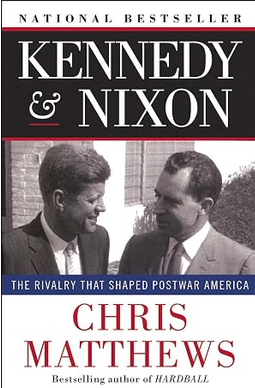
President Richard Nixon was a sweetie-pie who wrote letters so tender to Jackie Kennedy she cried, and she wrote him gracious letters back. The idea of Nixon being sweet and caring does not sit easily with modern readers, but that is one of the slow-blooming fruits of studying Nixon. What a piece of work is man — and what a piece of work was Nixon, this glowering political strategist whose fears and paranoias destroyed a career of absolute accomplishment. This lonely, distressed introvert who could beam like the Sun during a baseball game, who could exchange fire with the secret service — “The sonabitch is in here tying his shoes!” — and who could write lovely letters to a woman whose very soul was bleeding — he is the man we love to hate, and yet….he was a man, an enormously complicated man whose virtues and vices held hands and ushered him into history for good or ill. Kennedy and Nixon is a joint biography of two men who entered Congress together, who debated politics on train rides together, whose politics were not that different — and yet who were rivals. Yet they were more than rivals; Kennedy’s ease and charisma were envied by Nixon, and even as Nixon struggled against the Kennedy family for control of politics, he couldn’t help but admire Jack Kennedy. There was a delicious longing in Nixon to be more like Jack — to be loved, to have that ease with the people. This was quite the book.
This is not a book I would have read before this year, in large part because I regarded JFK as admirable mostly in his ability to make speeches, and I had no idea how interconnected the lives of these men were. Seeing teases of their relationship in other books, though — their debating on trains, their having offices across the hall from one another, their very similar Cold Warrior approaches and more ‘moderate’ domestic policies — intrigued me. American history typically treats Nixon as a villain, but the more I read him the more compelling he becomes. Yes, I can see his faults, his most grievous faults, and yet I keep finding a man who is unexpectedly gracious, unexpectedly courageous. He’s going to dominate this review, and I’m not sorry: JFK has no shortage of writers who lionize him, because he was genuinely inspirational. He was a war hero and a man who faced off against Khrushchev time and again and spurred America on to the moon — but part of me suspects his memory is so grand in the American imagination because he was shot, because he died young and tragically with a weeping wife trying to collect pieces of his skull from the back of a sedan. Dick Nixon didn’t get that opportunity, though he’s quoted in this book as alluding that he very well might have. Someone said that if so and so had done his TV make up in the first Nixon-JFK debate, he might be president; Nixon responded that he also might have been dead. Oswald, with his weird fetish for Castro’s Cuba, would have knocked off one Cold Warrior as easily as another.
Half the book covers Nixon and Kennedy’s rise together; Nixon outstrips Kennedy at first, but ultimately its JFK who comes from behind in his own private moonshot. What strikes me most is how really similar both men were as far as policies; they were close enough that they could swap sides when not in power. Nixon as Ike’s VP caught fire for Eisenhower not being aggressively enough anti-communist (he contemplated nuking Korea, people, what else do you want?), but once Nixon was just a lawyer it was he who could return fire against a JFK whose desire to stop Communism had to be tempered by responsibility. Where they differed almost seems a question of character: Kennedy was young, aspirational, inspiring — Nixon serious and glowering. When they began debating, Nixon was advised to “kill the assassin image” that resulted from his zealous prosecution of the suspected Communist traitor Alger Hiss: Nixon intentionally soft-pedaled on Kennedy, even agreeing with him — it didn’t help that Nixon genuinely admired and liked Jack. When Kennedy was struggling with severe back issues, Nixon told him that he could use Nixon’s ceremonial office just off the Senate, rather than having to struggle from his own office.
Ultimately, regard for the Kennedys’ charisma and political tactics would drive Nixon to poison his career: after being convinced that he’d been done in by dirty tricks, particularly potential mob influence in Chicago and the federal government spying on him on behalf of Kennedy, Nixon was increasingly willing to engage in dirty tricks of his own. That opened the road to Watergate and ruin. Even after Kennedy was shot, the Kennedys continued to haunt Nixon through RFK and then Ted Kennedy. A lot of the last quarter of this book focuses on Nixon’s increasing paranoia, linked to RFK and Ted’s aspirations, that the Beltway was out to get him. They were, but the means he chose to combat them were ultimately his undermining. One of the book’s more interesting elements is the inclusion of transcripts which show Nixon’s obsession with finding out how much the state had been spying on him — something that was in fact happening (this only recently revealed), and led to him making the decision to bug offices and entertain the idea of doing break-ins to find information that was being withheld from him.
This was a fascinating book to spend a few weeks with: it goes a long way to showing how wonderfully human Nixon was, but how sad his ejection from grace was. As a joint biography, it works wonderfully not because of the men’s rivalry, but because of the men. The book presents Nixon neither as hero nor villain, but as a profoundly human figure: ambitious, gracious, insecure, courageous, resentful, and often undone by his own fears. His fall from grace feels all the more tragic because his achievements were so substantial and his better qualities so evident. Kennedy remains the more naturally inspirational figure, but Nixon emerges as the more complicated—and perhaps more compelling—man.


No doubt inspired by your ongoing reading splurge… [grin] I picked up something you might find worthy…
America First – Roosevelt Vs Lindbergh in the Shadow of War by H W Brands.
Looks rather interesting and I’ll try to schedule it in later this year – although it might slip into early next year the way my ‘plans’ usually go!
HW Brands is supposed to be good. I’ve got one of his works on early American politicians who were prominent, but never quite made it to POTUS — men like Henry Clay.
Topic is definitely interesting, but I’d be surprised if Lindberg got a fair shake — Brands has done FDR books.
I’m planning on picking up a few more by Brands. I’m particularly interested in his book about the War of Independence and the fate of the Loyalists (which has always intrigued me). I’m aware that some went to Canada & others back to England but it’d be interesting to put a bit more meat on the bones.
I’m also hoping to read something in that vein!
‘Our First Civil War: Patriots and Loyalists in the American Revolution’ by H. W. Brands might be my next purchase………
That’s the one I’ve had my eye on!
If this is what power does to someone, I’d eschew it like pure poison.
Same! I realized when I was a teenager moderating forums that power and I were a poor match.
OT…. If you’re keeping one eye on British politics you might have noticed that Andy Burnham just *crushed* the vote in his by-election which probably means he’s on track to running against Keir Starmer & might even beat him for PM. That’ll mean we would have had SEVEN PMs in 10 years – one every 18 months since Brexit…. What’s the opposite of **stability** again….? [lol]
The UK’s rules concerning general collections are a bit woolly to me..doesn’t he have at least a year or so before he has to call for one?
I think its THREE years until the next General election. The ‘rule’ is that a government lasts UP TO/no longer than 5 years… although a General election can be called anytime really. Teresa May called a ‘snap election’ thinking she could increase her majority but actually LOST seats and made a bad situation worse! Technically (before that rule was passed) a party can stay in power as long as it has the votes/bodies in Parliament to survive any proposed vote of no confidence.
This won’t be a General though. Burnham won his local election (he got more votes than *everyone* else combined apparently, plus he doubled the Labour majority in that constituency!!) which means he’ll be an MP (he was previously the Mayor of Greater Manchester).
IF there is a challenge to Keir Starmer as PM then Burnham can throw his hat in the ring and then its up to Labour MPs to vote on it. If Burnham wins the vote he becomes Prime Minister until the next General election. Essentially it all comes down to if Labour MPs believe that Starmer or Burnham can defeat Reform in 3 years (if they haven’t imploded by then) when a General election is called.
Breaking news says Starmer is resigning!
Unlikely just now. He’ll need to know for *certain* that the votes are against him and then he’ll ‘resign’ for “the good of the country”. We’re probably a week or more away from that yet. LOTS of political maneuvering to go first!