
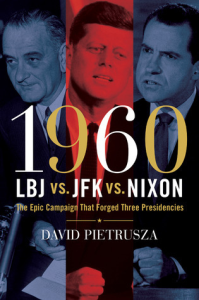
As the Eisenhower administration began drawing to a close and a new decade loomed, America had a choice: stay the course, or shake things up? Although JFK would claim in his 1961 inaugural that the torch had been passed to a new generation, in truth his three successors were all from an older one. Two of those men vied with him in 1960, the race of which is plumbed in depth here. It covers not only JFK, LBJ, and Nixon, but also men like Hubert Humphrey, Adlai Stevenson, and Nelson Rockefeller, with varying degrees of details. While it gets into the weeds of JFK canvassing precinct by precinct, readers also experience the campaign through the culture, and the events of 1960 that shaped it — like the new role played by television, or Frank Sinatra’s love of Kennedy that took him off the campaign trail when he realized his mob buddies might present bad optics for Jack.Political wonks will love the detail, but casual readers should be warned that the early history, focusing on Kennedy working the primaries, is a bit of a slog with all the personalities involved.
Given how many books I’ve read recently that touched on the 1960 election, I was fairly familiar with the book’s broad topic going in. I was wholly unfamiliar with men like Stevenson and Rockefeller, though, and enjoyed my introduction, though Rockefeller and Nixon’s eventual VP pick Henry Cabot Lodge both impaired Nixon to varying degrees. (Lodge promised a black cabinet member at the same time that Nixon and JFK were trying to court both the Southern establishment and the black vote — a very fine needle to thread!). I was impressed by JFK as a campaigner; though his father’s money gave him considerable advantages, both in advertising and in mobility (JFK had a private plane, allowing him to blitz across the state while his frustrated competitors were stuck motoring through often awful roads and worse weather), the young prince was determined to connect with the people. He made a joke of his monied status rather than trying to be something he wasn’t, and his charisma allowed him to woo rough West Virginia miners as readily as he did squealing teenage girls in New York. Kennedy’s status as a Catholic (however nominal) is a recurring issue here, as the US was still a very Protestant nation suspicious of political Catholicism; part of Kennedy’s challenge was to sideline the ‘religious issue’, and one way was to use the well-practiced policy of accusing anyone who dislikes their candidate of being a bigot/sexist/racist/etc. The religious issue could also be used for laughs: when Harry Truman said that Nixon voters could go to Hell, JFK wired him and commented that he’d rather not raise ‘the religious issue’.
Another recurring part of this book is JFK trying to win over the older Democratic establishment, particularly Eleanor Roosevelt and Harry Truman; Roosevelt much preferred older candidates, and Truman appears to have only voted for Kennedy because he claimed Nixon had called him a Communist. (In other books, I’ve seen Nixon being critical of Truman’s administration for being soft on communism, and even claim that Truman had fellow travelers in his Cabinet.) The book also includes well known campaign events like the first TV debate, in which Nixon appeared pale and sweaty — this didn’t just owe to makeup, though. Nixon had only recently gotten out of the hospital and then run himself ragged doing a driving campaign, whereas JFK had deliberately taken days off to rest and prepare.
Nixon had an ostensibly easier time of campaigning; he didn’t have to bother with a primary battle, and had the ‘advantage’ of being the incumbent. Eisenhower wasn’t an enthusiastic campaigner for his would-be successor, at least not until late in the campaign when the Kennedy clan mocked him for bringing in Ike as a last resort. Being the quasi-incumbent also had its disadvantages; while their policies don’t appear to me have differed much, Kennedy presented a young, fresh face against Nixon’s more tired one. One element about Nixon that I still don’t understand is why he was so actively disliked by the media and establishment : they act as though he was the devil incarnate when at this point in his career he’d done nothing dodgy. Different books suggest it was Nixon going after Alger Hiss, a member of the DC set, but that doesn’t quite satisfy me. Was he a tough campaigner? Sure, but so were the Kennedy boys — mailing anti-Catholic ads to Catholic households to get out the Catholic vote. As the author remarks, it wasn’t as though Nixon and Kennedy were that different as politicians, but JFK wore it better. He made politics feel idealistic even if his means were not, whereas Nixon and Johnson were more transparent in being manipulators of a political machine.
1960: JFK vs LBJ vs Nixon was a thorough history of a campaign that would strongly shape American history — putting JFK and then LBJ into the White House, and stirring up the energy that would develop into the Bay of Pigs, the Moon Shot, and Vietnam. It was a time when much was changing, including the role of primaries in national elections. This was a largely entertaining take on that election, though more casual readers may be overwhelmed by its detail.
As a sidenote: I was very much amused by how many people regarded RJK as a condescending jerk, even people who worked for him.
Quotations
“Joe Kennedy,” recalled Thomas P. “Tip” O’Neill, who would succeed JFK in that same congressional seat, “spent $300,000 on that race which was six times what I spent in a very tough congressional campaign . . . six years later.” A frustrated Mike Neville pinned a ten-dollar bill to his shirt pocket and dubbed it his Kennedy campaign button.
JFK proposed to be no timeserver, no mere Eisenhower caretaker or Stevenson pontificator. He would be the action hero of politics, the embodiment of an up-and-coming generation, too impatient for power and, yes, glory, to wait any longer in line. In the process, he would transform the nation’s politics. “America’s politics,” Norman Mailer would write in an article for Esquire in 1960, “would now be America’s favorite movie.”
And, yet, how many of the premier politicians of that era proved much better, more principled? Perhaps a Taft or a Humphrey. Certainly not an LBJ careening from left to right to left again with each change of his constituencies. And certainly not JFK, who remarked, quite frankly and quite obviously, “We were interested not so much in the ideas of politics as in the mechanics of the whole thing.” No, it wasn’t Dick Nixon’s ideological “flexibility” that separated him from his peers—it was his pronounced lack of charm in displaying that flexibility.
Once asked to reply to a British journalist’s comment that her surly husband appeared “like a Sioux brave about to take a scalp,” RFK’s wife (and mother of his eleven children) Ethel responded with a touch of humor—and truth: “Why should I, since he generally is about to be?”
And RFK remained very much a fanatically loyal McCarthyite—if not to the crusade, at least to the crusader. When Joe McCarthy died in May 1957, a distraught Bobby shuttered his Senate office for an hour. “I want to do this,” he wept. “It was the only time I had ever seen tears in his eyes,” recalled Bobby’s personal secretary.
“You can trample all over [Jack] and the next day he’s there for you with loving arms. But Bobby’s my boy,” boasted Joe to Tip O’Neill. “When Bobby hates you, you stay hated.”
While a father struggled to pay for a daughter’s wedding, favored son Jack Kennedy had everything bought for him. “I got a wire from my father:” he informed audiences. “‘Dear Jack: Don’t buy another vote, I’ll be damned if I’ll pay for a landslide.’” Hubert Humphrey wasn’t laughing.
“Did you hear the news?” a mocking LBJ inquired of Minnesota Republican congressman Walter Judd, himself a medical doctor. “What news?” “Jack’s pediatricians have just given him a clean bill of health!”
“Ninety per cent of this press corps,” contended Chicago Tribune correspondent Willard Edwards, “which ranged between 50 and 100 at various periods in the campaign, were all-out supporters of Kennedy. They were not only opposed to Nixon, they were outspoken in their hatred and contempt of him . . . it was loud and open.
Aided by H. R. Haldeman and John Ehrlichman and a new recruit to his inner circle, Henry Kissinger, Richard Nixon moved to shut down John Kennedy’s Vietnam War but not Lyndon Johnson’s Great Society (“We get the action,” crowed GOP liberal Hugh Scott, “and the conservatives get the rhetoric”).
That last one elicited some bitter laughter from me — boy, that’s one thing that’s never changed.


Pingback: 1932: Franklin and Adolf | Reading Freely