
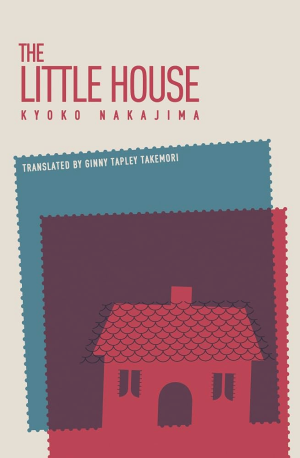
The Little House is a strange, lovely, sad little novel. Our narrator, for the most part, is an aging and retired housemaid named Taki. “Housemaid” is not quite the right word for her, as she operated in a time when ‘maids’ were more like personal attendants and their mistress’s right hand. Taki, in her twilight years, has earned a little money selling a book of housekeeping tips – but this is not that kind of book, she says. It is instead her looking back from the close of life to a time when she was at her happiest, her heart at its most content: late 1930s & early 1940s Japan.
“Uhhhh,” the contemporary reader might say. “When World War 2 was starting?” One of the common themes of this book is how generations experience history differently. Taki’s nephew Takeshi, who keeps reading Taki’s notes, cannot fathom that she viewed Tokyo as light-hearted in the same months that saw the military effectively taking over the government, but for Taki that was something happening in the capital. A few government officials had gotten into trouble with the military? She needed to give the little master his treatment, for he had polio and was still trying to rebuild strength in his legs. She needed to go to the market to get vegetables for dinner tonight, and then she and the Mistress could enjoy tea. Taki’s life is consumed with the domestic: this is first and foremost a novel about the intense bond between a woman and her mistress Tokiko — a bond so intense that Taki will contemplate actions to protect Tokiko even if it hurts their relationship.
This bond begins developing before the war, in the ‘halcyon days’ of the 1930s when Tokiko’s husband’s business is booming. All is not cherry blossoms and warm sake, though: Tokiko’s son, Kyo, is stricken with polio and loses the use of his legs for a few years. As much as it pains Taki to see the boy she’s coming to love as her own son hurt so, it does mean that she’s not dismissed the way she might’ve once the household’s only child had gotten into elementary school. She grows ever closer to the family, even sitting with them at dinner. While this is not a novel about the war, the war does intrude on their lives — threatening Taki with marriage (Japan wants women making babies or making munitions, one or the other), and then taking away a young friend of the family who Tokiko is especially and perhaps indelicately attached to. Licit and illicit attachments surround Tokiko, as she is a woman who inspires people to fall in love with her. But ‘fall in love’ is a tricky phrase, one we tend to associate only with erotic or romantic love. The relationships here are more complex. The cultural framing is also very different, with intense attachments forming that are neither platonic nor romantic but something else entirely. Taki is captivated by her mistress, but what that captivation means is left to the reader — as even her nephew, who published her private notes posthumously, is not sure.
The challenge with a little book like this is that it is difficult to talk about the story and its impact without spoiling anything, but when I started reading it I found myself unable to do anything else; my read of this was interrupted only by the need to sleep. I loved Taki’s bond with Tokiko, and her desire to save her mistress from making a mistake even if it might strain their trust. The story was compelling in and of itself – two women with an intense bond experiencing Japan’s drift into war and destruction, a friendship tested by one woman’s love for someone she could not possess – but adding to the interest is the fact that we are reading something that the ‘author’ chose not to publish herself. Her story is not completed or told by her: some facts we only learn at the end when Taki’s nephew shares what he has learned. It is a sweet story of love in the ruins — a compelling, but haunting one.
Quotations
There’s no need for more books saying the same thing: one is enough. That in itself is a lesson in economy.
She would often say that some of the girls she’d been at school with now lived in a much higher class of residential development and others were renting somewhat grander houses than hers, but if you look above yourself there’s no end to it. She was just happy to own a house that suited her.
The toy business was booming, with military toys such as fighter planes that flew around and around, and figurines of the Three Human Bombs—the brave soldiers who sacrificed their lives in the siege of Shanghai—fairly flying off the shelves, and Japan-made Kewpie dolls were selling well abroad, too.
I can’t wait to see what a fantastic specimen Shirley Temple will blossom into. It’s all down to good nutrition, you know. If we Japanese focus on nutrition to produce beautiful women, we can catch them up. It sounds like a line from the movie Priest of Darkness, but if you only eat whitebait and fried tofu, the bits that should curve out don’t curve out, and the bits that should curve in don’t curve in. You have to eat beefsteak. And fried in butter, to boot. Add two or three drops of soy sauce. That’s the sort of nutrition we need.
‘I never heard about that, Nan, are you sure it’s true? I keep saying this, but you really shouldn’t go making things up, you know,’ he said, lecturing me as always. That’s what happens when you try telling people the truth.
The stupidest type of maid is the one who burns something she shouldn’t burn. The average type of maid is the one who burns something when she is told to do so. And an excellent maid is the one who can judge for herself without being told when to burn something that her Master, out of his own weakness, can’t bring himself to burn, and then when she is scolded for it, apologizes for having done something wrong.’
It’s late, so I’ll stop writing for today. Whatever I write now will no longer be secret, since Takeshi is also reading this. In other words, I have a reader. Meanwhile, that young editor may get back in touch. In which case I might let her read it, too. I think I should consider this carefully.
What on earth was torturing an elderly woman like that, her face crumpled as she wept, full of regret for her memories?


