
Me: Thank you so much!
Stephen Fry, reading The Odyssey: AND THEY THREW THE INFANT FROM THE WALLS OF THE CITY ONTO THE ROCKS BELOW
Me: …have a good day! (speeds away)
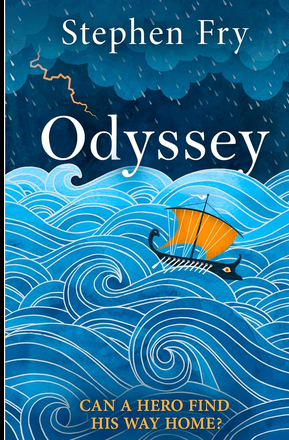
A couple of years ago I read Stephen Fry’s Mythos, his attempt to bring together some of the primordial Greek mythological characters into one narrative; he followed it with Heroes, Troy, and finally Odyssey. The recent release of an Odyssey movie put the old story into my head, and I found myself listening to it through much of July. Stephen Fry’s collection is not simply a modern retelling of The Odyssey itself; following Fry’s previous syntheses, it brings together other Greek stories that are set in the immediate aftermath of the Trojan War. The King of Ithaca, in fact, does not arrive until halfway through. Fry’s collection, however, expands rather than diminishes the contents; and given his delivery and digressions, created an excellent product altogether
One would think that The Odyssey is about cunning Oydyse — (“Why do they always use that word? Why not imaginative, or creative?”) — is about imaginative and creative Odysseus’ journey home from Troy. This is a journey made a lot longer than it needed to be for the same reason the Hebrews spent 40 years walking around in the desert on a trip that should have taken them two weeks: contempt of the gods. Man’s relationship with the gods is a major plot engine here, beginning with the sack of a temple in Troy and escalating rapidly after Odysseus, unable to restrain his pride, tells the dread Cyclops Polyphemus who it is who blinded him: ODYSSEUS, KING OF ITHACA! The God of the Sea Poseidon doesn’t care that his boy was guilty of holding humans hostage and eating them; no, he only cares that Odysseus blinded his progeny and exposed the giant’s idiocy. (“No man has injured me! No man has tortured me!”) Similarly, Helios doesn’t care a whit if Odysseus’ men were trapped on his island for weeks at a time and ate through their stores; they did a little beach BBQ with his cows after being threatened with starvation, and that is enough to kill everyone except for Odysseus who was too busy working on the ship to eat. It is only after Odysseus learns humility — literally disguising himself as a beggar with grey-eyed Athena’s help — that he can finally come home.
While Odysseus does show up halfway through, though, Fry maintains his approach of aggregating different Greek stories and telling them together along shared narrative lines; so here, we get stories based on the aftermath of the Trojan war, like Agamemnon’s awkward family situation (“awkward” being a word which here means “Agamemnon sacrificed his daughter, so now his wife and other daughter are going to throw a net around him and stab him to death in the tub”), as well as Pious Aeneas’s journey to Carthage and ensuing drama that eventually leads him to conquering Italy and all that. Amusingly, Fry shifts to Roman names for the gods during his Aeneadic sojourn, and here employs one of the digressions that make his narratives especially interesting. Fry loves to take sidebars to point out how words emerged from the gods, for instance, or to explore just what exactly the lotus flowers might’ve been that so encumbered Odysseus and his men– in the Aeneas chapter, he compares the Greek and Roman gods. The different names are not merely names: Athena falls from a place of preeminence in Greek myths to barely holding her own as a minor goddess as Minerva. Ares, however, rises so much under the Roman reign that he gets his own month — March, when the winter thaw allows armies to go to war once again.
I will admit that my appreciation of this was doubled because I was watching films and listening to podcasts based on the Odyssey at the same time, so Fry’s information supported my interpretation of them and gained value at the same time. I have not read Homer’s original Odyssey in ages — perhaps not since I read it and The Illiad to prove to a girl who praised a romantic rival as ‘sophisticated’ that I was moreso — so I can’t judge with too much accuracy how close Fry’s interpretation of the original is. I was surprised by his Odysseus being haunted by his mistakes which cost so many lives; the new Oydessy as well as The Return lean heavily into his grief, so it’s interesting that it might not be as novel an approach as I thought. At any rate, the teenage girl I pursued when I, too, was a teenager had something else in mind other than reading world literature when she said sophisticated. (It meant wearing stylish clothes and being smug/charming, I have concluded in retrospect.) Fry’s renditions of the stories were compelling, as he leaned into his excellent ability with diverse voices, and I especially enjoyed the digressions.
I am now listening to him read Troy, which again dives into backstories to dense that Fry admits at the beginning: if you have followed me, reader, then I am in awe of you. Considering how much time I’ve spent listening to Agamemnon’s genealogy, I understand.
Related:
Well, my memory is rubbish. I read and reviewed The Odyssey back in 2014. And The Illiad in 2011!
A Thousand Ships, Natalie Haynes
The Penelopiad, Margaret Atwood


I just saw this in a pile of Ancient World books next to my bed last night. I’ll get to it ‘eventually’…. [lol]
That is why it is wise to turn down your radio, or pause any audio books 🙂
But then what kind of wild stories would that leave the clerks left to tell?!
You’re too kind. Let them entertain themselves 😉
Pingback: The Best of Teaser Tuesday, Oct ’25-’26 | Reading Freely