
I’m the sun in the sky
Imma Franklin D. Roosevelt
I’mma million-dollars, s’long
as I’ve got a snap in my finger
Got a rhythm in my walk
Got the devil to pay
I’m livin’ in a great big way!
(“Livin’ in a Great Big Way”, Louis Prima)
When I began working on this project in earnest a year ago, I knew then that FDR was going to be…interesting. I’ve mentioned before that I was a World War 2 nut in high school: this translated, via the impressionability of youth, into being an FDR nut. There is an enormous passage in William Manchester’s The Glory and the Dream that is basically a paean to FDR, and in high school I copied it down. For me, too, FDR was a singular figure: he is the only president whose monuments I have visited (I have gone to Warm Springs and stared mournfully at the bed where he died, after admiring his enormous collection of walking sticks.) My impression of him began changing in college, shaken by learning about Japanese internment and his betrayal of Eleanor, and then after I moved more toward Austrian economics and libertarian political philosophy, I couldn’t help but be critical — and yet at the same time, teenage me still lives in little crevices of my brain, and when he sees FDR he wants to take off his hat and cheer. Over the years my criticisms of FDR have not even been partisan; sometimes they come from ordinary, human grounds, like his haughty dismissal of Hoover, and his overall patrician dismissal of others. And yet — as a boy I memorized his First Inaugural, and his speech to Congress after the Japanese assaulted Pearl Harbor, and his voice rings in my mind’s ears and sometimes pops up in my writing. With that said, let us sit down by the fireplace and listen to Franklin Delano Roosevelt for a spell.
First impressions: I knew FDR was rich, but I didn’t realize how ridiculously privileged he was. In the South, it’s possible for someone to be considered wealthy despite being hard-up — we call it ‘family money’ — but the Roosevelts were so well-heeled they could open a shoe store called OOPS ALL HEELS. When Franklin and Eleanor married, their annual income from trust funds gave them the equivalent of a quarter-million annual ‘salary’, but their lifestyle was so extravagant they still needed supplements from Franklin’s mother Sara, who gave him still more money after he quit being a lawyer to pursue public service and she decided he needed a supplement. There is something to be said for those who want for nothing but still have a desire to serve, I suppose — noblesse oblige and all that. Not much attention is given to FDR’s tenure as governor of New York, which was astonishingly short. I thought the old boy had served his time, then decided to pursue the presidency: instead, he was more like Nixon, pursuing the gubernatorial seat to position himself for higher office. Fortunately for him, Black Thursday, the Great Depression, and the Army’s attack on veterans squatting in DC and demanding money happened all at the same time, and nothing short of being caught with a live boy or a dead girl in bed could stop Roosevelt from winning the election.
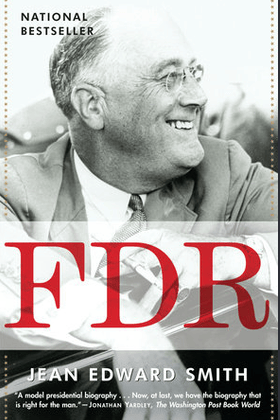
I think what has made FDR’s name in history is not his ‘bold, persistent experimentation’ during the Great Depression, but rather his leadership during World War 2. Or more specifically, his leadership before World War 2, when Hitler and Japan were treating the global map like their own private game of Risk, and most of America had zero interest all in getting involved. Per Smith, Roosevelt did not want to get involved: he was exhausted after eight years in office, doubted to Eleanor and others if he could continue, but saw that he had no choice. There were no worthies waiting to take his place in the ranks; so he persisted. Smith believes Roosevelt’s aim was to help Europe defend itself as best it could, not get involved directly: it was Japan who made the decision to enroll America in World War 2, and Hitler’s decision to declare war on the US short-circuited any debate on balancing Europe vs Asia. Had Hitler not declared war, a largely disinterested American public could have easily gone full-in on Asia and ended Japan’s day in the sun earlier. (Then again, I’m sure some could argue that it was the pressure of fighting a two-front war that forced the US to go whole-hog on World War 2, and made total victory possible in the first place. Pearl Harbor and the Axis declarations made World War 2 a vanquish-or-perish zero sum game.)
Despite its girth, Smith’s FDR rolls along fairly quickly; he mentions but does not dwell on FDR’s romantic indiscretions. I was struck by the obviousness of his impending death in the 1944 election, though: I observed this in McCullough’s Truman. Everyone in Washington was seeing FDR fade in real time — but he was viewed as the only option despite having blood pressure that was insane. His ‘low’ numbers far exceeded optimums, and his high numbers put us into the realm of “How are you even still alive?” (Election Day 1944: 260/155.) Smith’s FDR is also more charitable of the FDR/Al Smith relationship: while Shlaes had Al resenting FDR ignoring him after taking high office, Smith’s sees them as remaining close. That’s an interesting discrepancy. I read this volume largely for completion’s sake — No Ordinary Time was too closely focused on World War 2 to count as a proper biography — but it was enjoyable enough, and I can see Jean Edward Smith coming around again. I’d considered reading his treatment of Eisenhower before going with Age of Eisenhower.


