
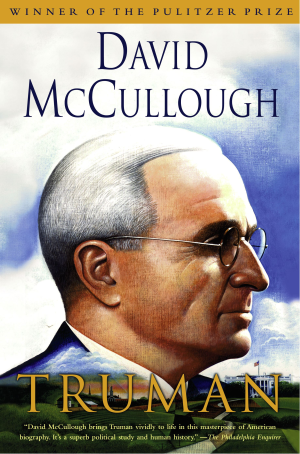
A new reader to this blog might ask, “SC, after cheerfully dismissing president after president with 200-page biographies from the American Presidents series, why did you decide to read a twelve hundred page treatment of Harry S. Truman?” There are two reasons. One, David McCullough. McCullough’s work on John Adams completely revolutionized my appreciation of the president; Mr. A has become one of my absolute favorite historic personalities, let alone presidents, and I’ve enjoyed McCullough in general. Secondly, Truman is interesting in himself: he was tapped as vice president because he was the least objectionable possibility, and he was forced into the big show after only a few months serving as vice president – and then asked to drop the Bomb, and to deal with the Soviet Union who had decided that the endgame of World War 2 was an excellent opportunity to recreate the Russian Empire, with secretary-generals and ugly uniforms instead of the tsar and fun ones. As huge as it is, Truman is eminently readable and exposes readers to a lot of detail about the game of politics, from county commissioners paving roads to deciding who would succeed Truman and carry on the legacy of the New Deal.
“If Harry Truman can be president, anyone can be president! Hell, my next door neighbor could be president!” Such was exclaimed after Truman succeeded Roosevelt after FDR’s death early into his fourth and final term in office. A common theme of this book is of Truman as Everyman – thoroughly middle class, forthright and plain-speaking. No one who heard Truman talk would refer to him as ‘melodious’ the way they did of FDR. But Truman was a hard worker, and more – a fighter. A scrapper. We meet Truman as the son of a struggling farm, who inherits his father’s labors both in the field and then in local politics. Truman’s intelligence and reputation as a thorough worker caught the attention of the local Who’s Who, and he soon landed himself a position as a county judge – or rather commissioner – and achieved success in bringing more paved roads to his county. The outbreak of World War 1 took young Harry away from the farm, never to return again; when he returned, he would work first in business and then in politics, relying on the local machine to propel him further. Truman, however, was not a machine-man despite what he owed to them: once in office, he refused to give out contracts and such to those who were affiliated with the machine on anything less than merit, and his integrity provoked admiration rather than retaliation. Truman would eventually pursue politics into the Senate itself, and achieve acclaim chairing a committee to monitor defense spending. There, his reputation would be enough that when FDR was looking for another VP placeholder, he was deemed acceptable given that the other candidates inspired partisan rejection. The new vice president was just getting used to the office when he was informed he’d inherited a new one – and all the problems of the world.
Thus Harry Truman – farmer, haberdasher, hardworking politician – suddenly became President, and at the worst possible time. World War 2 was ending. Truman was about to learn about the Bomb, and was forced to decide whether he should use it: he had to look to the Russians, who didn’t know him and didn’t respect him. Heck, Churchill didn’t trust or respect Truman, why would Stalin? And so the average Joe suddenly began dealing with decisions that would impact not only Americans of his generation, but people the world over. How much to push back against the Soviets? How much presidential authority to exercise here, or there? Can we defend South Korea against the Chi-Coms and their Russian allies without provoking World War 3?
The amount of issues that beset Truman in his first term would send most ordinary men running for the hills, but Truman liked the fight and was particularly concerned that his kept going. He didn’t want someone like Robert Taft in office – Taft didn’t believe in the international systems FDR had in mind and that Truman was carrying forward. The Republicans chose Eisenhower, a man Truman personally admired – and had even approached as a potential Democrat – but who he did not think had the chops to go head to head with Stalin, et al in international affairs. I think Eisenhower’s record demonstrates otherwise, as he and Nixon were both more internationalist than Truman gave them credit for. (He did not, however, forgive them for tacitly supporting those who claimed his administration had “lost” China or been penetrated by Commies.)
It’s not hard not to like Harry Truman, though this biography didn’t make me an Admirer of him the way McCullough’s treatment of Adams did. I do admire Truman in many ways, I just wouldn’t go to bat for him the way I will with Adams. Part of the interest in Truman is how he never stopped being Harry S. Truman even when he was Mr. President; he’d have his Army buddies visit him, slapping him on the back and calling him Harry, but then retreat into a room with Dean Acheson to make decisions changing world history. If he was changed at all, I think his office simply made him more serious and dutiful – he seems to have avoided being dyed with the imperial dye, and died as he lived – Harry S. Truman, an ordinary man who lived an extraordinary life.
Quotations
Looking at Truman, Churchill said slowly, “The last time you and I sat
across the conference table was at Potsdam, Mr. President.” Truman nodded.
“I must confess, sir,” Churchill went on, “I held you in very low regard
then. I loathed your taking the place of Franklin Roosevelt.” He paused. “I
misjudged you badly. Since that time, you more than any other man, have
saved Western civilization.”“They want us to play Russian roulette with the foreign policy of the United States—with all the chambers of the pistol loaded.”
“I never gave ’em Hell! I gave ’em the Truth and they just THOUGHT it was Hell!”
On St. Patrick’s Day, he wrote again to tell Acheson he was thinking still
about the relationship between history and government. “Our tribal instinct
has not been eliminated by science and invention. We, as individuals, haven’t
caught up physically or ethically with the atomic age. Will we?”Hearing that the Democratic Party, at Kennedy’s suggestion, was going to put on a $l,000-a-plate dinner, Truman was appalled. “If as and when that happens we’ll just quit being democrats with a little d.” Nobody had consulted him on the matter. “To hell with these millionaires at the head of things.”


Pingback: FDR | Reading Freely