
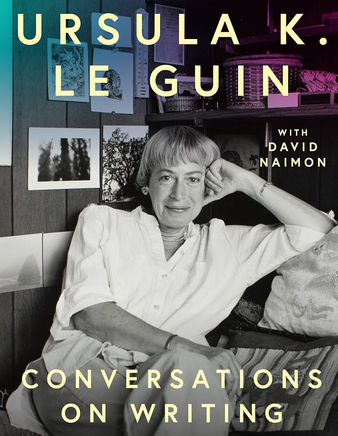
Conversations on Writing, featuring interviews between Ursula le Guin & David Naimon, is possibly wasted on someone who has read so little of her. Having just read a le Guin novel, though, immediately followed by a collection of pieces in which C.S. Lewis wrote about writing, I was interested in seeing what le Guin had to say about the craft. Being so unfamiliar with her corpus, though, allowed for surprises: she wrote poetry, for instance, and thought very seriously about it as an art in its own right, comparing haiku to the quatrains she was far more comfortable writing in. The book is a written version of three interviews le Guin gave to Naimon, which were really more prolonged discussions on writing: any small talk or fluff is removed. Interestingly, le Guin urges writers to practice writing without adverbs or adjectives to force themselves to improve the rest; CS Lewis also thought that heavy use of these works also weakened the general muscles of the craft. Le Guin appears to be both a philosopher and an author, as she’s very reflective. That’s much of what led me to her in the first place, when someone shared her thoughts on how the digital world distorts our sense of reality. Le Guin appears to have fought hard for a greater place for women in SF: she mentions several times her resentment that C.J. Cherryh is largely forgotten despite several awards, while a male contemporary of hers, William Gibson, was lionized: I had no idea who C.J. Cherryh even was, so….point made. (though, Gibson was one of the pioneers of cyberpunk: would Cherryh be more known had she done something similar, instead of just being good? I don’t know enough about her writing to speculate.) Her principles led to a moment of amusement for me: she refused an award because the governing body had removed one author on suspicion of being a commie, and then Naimon added, “So they gave the award instead to Isaac Asimov, a Cold warrior”. The thought of Asimov – a liberal New Yorker – being cast as a Cold warrior alongside Bob Heinlein was hilarious. I enjoyed the conversations on the whole, though, and it’s lead to me shopping around for Cherryh.
Language is something we emit and we have to learn it at a certain period or we can’t. Language is strange.
Because science—not just Copernicus, most science—moves us away from the center of things. Because we aren’t. You find out how unimaginably old the Earth is and you feel sort of dethroned. Many people can’t bear it. They hate it. It makes them feel alienated. That’s the pity of it. If they could get into it, science could give them a much deeper sense of identification with all these marvelous processes that are going on all around us all the time, that we are part of. All of us.


