
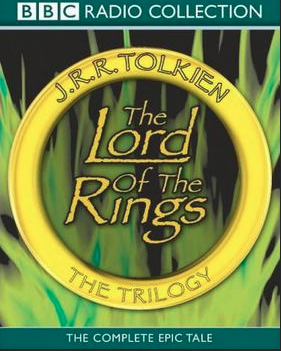
I have been meaning to revisit the realms of the Shire and Rivendell and Gondor for some years now,, but recently an older friend of mine announced his intention to begin his annual walk with Frodo on October 1st. “I’m going alone,” he said. Straightening my pack, I said “Of course you are – and I’m coming too!” I, however, tried a slightly different path – that of the audio adaptation.
As it happened, early in the spring during a big audiobook binge (I was dogsitting a lot and was spending at least an hour a day on the road), I’d begun a version of The Hobbit and listened to most of it, stopping because I was tiring of the dwarves’ voices and because I’d just encountered the Midnight Library of Baseball and needed to listen to every single one of its eighty past episodes. Because this version of The Hobbit was adapted for use by NPR, its voice acting was American, which struck me as unusual. One of the dwarves, I think I recall, sounded like he was from Appalachia. There’s also singing, but the most salient thing about this production was how viscerally distressing its Smaug was. There are two schools of thought: you can make your dragon Jeremy Irons, or you can make him disgusting. NPR went with disgusting.
The BBC’s radio adaptation of LOTR was quite a different beast, and a wonderful one. Because my comments for all three adaptations will be largely the same, I’m offering only the one general one. The cast is properly British, as a work intended to be a mythos for England ought to be. There’s a good variety of regional accents, and the voice actors themselves are a solid bench of talent. My only quibble was with Aragorn, whose actor was a little too…frilly for me. He has a dramatic rasp and a subtle affect that I have heard associated with British royalty before, but it does not make me think Aragorn, King of Gondor, Isildur’s Heir. Gandalf, Frodo, and Sam were so well chosen, though, that I must overwhelmingly give the voicework an A.
What really gathers laurels, though, is the music. Each third of the production had a signature, at least for me: the happiness of Fellowship, epitomized in Frodo’s absurd song about a cow jumping over the moon; the Song of the Ents, produced by a bass choir that’s so epic and manly it could convince anyone in Bag-end to take up the sword, and the fascinating choice to render some narration and exposition in Return of the King…via opera. It works! Music is present throughout the work, doing right reverence by Tolkien himself who planted the saga with songs. We get ominous chanting, bard songs, lore-drops, mournful ballads, and celebrations. What a magnificent artist Tolkien was, to have composed such verses and integrated them with a prose story that was already rich in itself. The hardest volume to listen to is Return of the King, because there are so many baddies – and the Orcs and Nazgul all sound hideous and dreadful – and because our protagonists are weary, exhausted, and soul-sick. I think some added narration to tell us what’s happening could have been useful during action-heavy parts: I would have no idea what Smeagol did at the end without having read the books already and watched the films, because the only notice we get is Smeagol yelling about HISSS PRECCCIOUSSSSSS and then Frodo missing a finger.
These adaptations were a very pleasant way to spend car rides and frighten restaurant clerks at the drive-through. And a final thought: when I read LOTR the first time it was for the story, but this time I noticed the writing. That’s the great flaw with audiobooks, I can’t highlight them and I don’t want to pull off the side of the road to write quotes down. I shall have to return to the printed source.


