
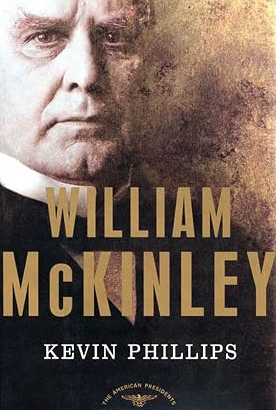
After three days of trying to make progress in Robert Merry’s William McKinley, trying in vain to see the subject through a multiple of well-tailored fat man smoking cigars and blocking my way to their chosen man to guide America into the 20th century. I gave up. Kevin Phillips had a far more accessible route to McKinley, and he’s also author of The Cousins War which I’ve been wanting to try. Phillips is indeed accessible, but his biography of McKinley is unusual. It runs not strictly by the clock, but rather by subject – examining McKinley’s rise in the Republican party, his stances on tariffs and monetary policy, his foreign policy, and then his life in retrospect after he’d gotten shot and TR succeeded him.
That “after he’d gotten shot” reference is exactly the way Phillips handles McKinley’s assassination herein; it’s incidental, almost off-stage if McKinley’s boots weren’t still sticking onto the platform. That said, Phillips’ treatment of McKinley’s life manages to provide usable context: he explains why silver/gold had become such an issue at that time (silver mines were performing wildly and threatening to undermine the silver/gold exchange, but different groups of people would profit or hurt) and points out that the United States getting involved in the Philippines was a little more complex than DC building an empire by shooting Spain and looting its corpse. The sudden rise of Germany, and its interest in the Philippines and Haiti, pushed Anglo-American interests together. If we didn’t get the Philippines, the reasoning went, the Germans or the Japanese would get them instead – and we intend on being good stewards, not dictators. Phillips goes on to point out that Cuba was set free, and Puerto Rico/the Philippines given large measures of local democracy, with the Philippines already marked for independence when the Japanese rolled in for some adobo.
Phillips is very interested in interrogating earlier treatments of McKinley, particularly those who would push him out of the limelight for TR. It was McKinley who carefully built a broad base of support so stout that he managed to break the eastern machine’s dominance of conventions: he was hailed as the RNC’s delegate on the first ballot, not something ol’ Abe himself managed. While there’s practically nothing on McKinley as a youngster, judging by my Merry experience that seems to be commonplace: we see him as a lawyer who quickly rises through political ranks until he’s the creme de la creme and Blaine – who was always the bridesmaid and never the bride at presidential conventions and elections – is left grumbling in the corner.
I still have my Merry biography and will be continuing in it, now I hope with more ease given that I’m not pushing forward in total ignorance. Judging by both Phillips and Merry, McKinley appears to have been a genuinely good man — someone sincerely kind, and devoted to his chronically ill wife Ida.


