
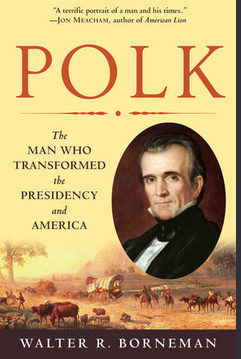
Note to readers: there will be two or three president reviews this week, but I solemnly promise I am reading other things. I actually began revisiting another YA title from my youth this weekend, while at the same time starting to read another volume of Caro.
Polk is an interesting figure among the presidents, for he’s easily one of the most consequential executives DC has ever had, and yet most Americans probably could not name him. He’s also unusual in that he came into office promising to serve one term, and one term only, intending to accomplish four things and being able to leave office having done them. Borneman calls him the most assertive wielder of executive authority in the pre-Civil War period – quite a trick considering his mentor was Andrew Jackson!
While Polk fulfills its role as a biography, it focuses in large part on the Mexican war, with a great deal of focus at quarrelling generals who appear to have viewed themselves as politicians and future office-holders rather than simple military men. Their political ties, appallingly, appear to have altered how they generaled, with armistices being arranged on the field to the frustration of Polk’s larger designs. They were large indeed: Mexico, and the question of Oregon. While the United States’s northern border was fixed early on through a treaty with Great Britain, the annexation of Texas was bound to create problems with ol’ Mexico. These were not problems Polk necessarily wanted to avoid, any more than Bismarck wanted to avoid problems with Austria and Denmark when forging the German Empire from the iron kingdom of Prussia.
As has happened with a few other books during this project, here I encountered mostly Polk the politician rather than Polk the man, and I suspect I would have enjoyed this more had I read it when I was in my 1840s-1850s season a year ago. As it was it felt distinctly like I was reading this to say “I read it”. That feels unfair to Polk, who did do what he set out to do, including reducing the tariff. That’s far more important than it sounds, because South Carolina threatened nullification or secession on tariff policy until Andrew Jackson went abusive-boyfriend on it. (One thing I have learned from this president project: tariffs are a big deal.) The Mexican War is also very much his, because one of his frustrations were Whig generals who kept signing armistices when Polk had not yet exacted what he wanted from Mexico: recognition of having conquered California, and a firm settlement on the southern border at the Rio Grande.
Well, so goes Jas. Polk.
Quotations
“In the fall of 1812, Sam Polk determined to send his almost-seventeen-year-old son to Philadelphia to receive the care of Dr. Philip Syng Physick, later known as ‘the father of American surgery.’”
“Meanwhile, because the legislature rarely met for longer than a month, Polk was able to complete his legal studies with Grundy and gain admission to the state bar when the circuit court convened at Columbia in June 1820. The Polk clan surely celebrated, and Sam Polk even provided his son with his first case by managing to be arrested for public fighting.”
“These land issues, and other issues such as banking reforms, frequently found Polk opposing the position of his legal mentor, Felix Grundy. When Grundy’s normally persuasive oral arguments were stymied by the parliamentary maneuvers and debating skills of his one-time student, he was heard to mutter: ‘I have been preparing a club here with which my own head is to be broken.'”
“The Washington that James K. Polk rode into late in the fall of 1825 was barely more than a quiet little village. The two dominant structures were the White House and the Capitol, each much smaller than future additions would render them. In between, both sides of Pennsylvania Avenue held a variety of boardinghouses, hotels, stables, and shops. Few members among the 48 senators and 213 congressmen could afford to maintain private dwellings, particularly because sessions of Congress tended to run only from early December to March or April. Most members roomed in boardinghouses and joined together in collegial ‘messes’ to procure their meals. Along with other Tennessee representatives, Polk took a room and joined a mess at Benjamin Burch’s house on Capitol Hill.”
“To quell the rush to dinner from the reception area on her first evening as mistress of the house, Sarah ordered the Marine Corps band to play ‘Hail to the Chief’ and turn a would-be stampede into a regal procession. By the end of her White House years, that old Scottish anthem—’Hail to the chief who in triumph advances’—would become the traditional announcement to clear the way for the president.”
“The point as it relates to James K. Polk is this: all the fears that the Whigs had voiced about Old Hickory being a military chieftain and exercising dictatorial powers had proven unfounded. The truth is that by the time Jackson sat in the White House, the temperament of his earlier years had moderated. He may have threatened to hang John Calhoun over the nullification crisis, but even Old Hickory backed off when it came to the attempts of his administration to acquire Texas. His protégé, however, pulled no such punches.”
“Let the President answer the interrogatories I proposed,” Lincoln said dramatically, as if he were back in an Illinois courtroom. “Let him answer fully, fairly, and candidly. Let him answer with facts and not with arguments. Let him remember he sits where Washington sat, and so remembering, let him answer as Washington would answer.”
“Allow the President to invade a neighboring nation, whenever he shall deem it necessary to repel an invasion,” Lincoln lectured Herndon, “and you allow him to do so, whenever he may choose to say he deems it necessary for such purpose—and you allow him to make war at pleasure.


