
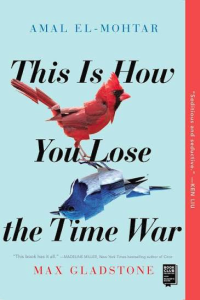
Recently I finished This is How You Lose the Time War, a ‘literary SF’ title that was definitely not my cup of tea. The book is a mix of narrative and letters as two agents from opposing organizations – the Machine and the Garden, let’s say – fight each other across time. The development appears to involve a multiverse, with different timelines or ‘strands’, which made me wonder why they were fighting at all. If making changes in a timeline just creates different variants, what’s the point? Strictly speaking, the agents are not direct antagonists: it’s just that they’re operating at cross purposes, their respective organizations wanting different outcomes, and occasionally they have to undo the other’s work or sabotage them, etc. The two protagonists are fairly nebulous, by my reckoning; they’re called Red and Blue and may be posthuman entities, at least Red, though they still appear to have some biological aspects like eating. They bound all across time, and evidently caused the Apollo I disaster because “some causes need sacrifices”. At some point they start exchanging letters back and forth, taunting and then talking, and fall in love. I found the romance bit difficult to take seriously given how abstract their personalities appear to be. I never bought them as people, let alone people in love. Her made it realistic, at least, but one party was human and ‘just our imagin-aation” can do a lot of work. The letters were fun to read, especially once the protagonists were comfortable enough to start giving each other nicknames with literary flourishes. The ending is compelling, however.
Catching up on a few SciFiMonth2026 prompts/challenges!
“November 4th, Stellar Crew”
This one involves picking various people from SF to form a stellar crew, but I’d rather not – in part because crews often work because of their chemistry. Captain Mal Reynolds would not get along with most anyone in the Federation, because if he was in the Star Trek universe, he’d fly for the Maquis! (That’s a fanfic I’d kind of like to write…the Enterprise and the Serenity meeting, and Mal regarding the Federation as nothing but the Alliance in colorful pajamas.)
“November 5th: Timey-Wimey”
One of my very first SF titles ever was H.G. Wells’ “The Time Machine”, or rather the Great Illustrated Classics version of it; I have vivid memories of the illustrations in it, and regarded with dread its visit to a far-future Earth where the Sun has swollen into a red giant. Although I rather like the idea of going back in time to visit things that are gone – I love games like Mafia and Red Dead Redemption 2 that allow the player to explore an immersive past environment – time travel does not come up a lot for me in fiction because it can get so paradoxical and headache-inducing. One of my favorite works published in the last 20 years was time-oriented, though: 11/22/63, King’s novel of a man who finds a portal to one moment in 1958 and purposes to use it to stop the Kennedy assassination. While the Kennedy plot had a great deal of interest (principally because ‘the past is obdurant’ and resists being changed), King’s worldbuilding was so immersive it felt like reading historical fiction, and the Jake/Sadie relationship remains one of my favorites in fiction.
“November 6: Woo, Stars“
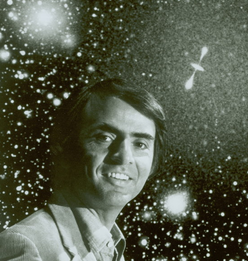
Rather than hunting for book covers with stars, I’d like to retell a story of Carl Sagan’s. He grew up in Brooklyn, with parents who supported his natural interest in science and technology by taking him to the world’s fair, where he was mesmerized by the technology on display. He would walk the streets in wonder, staring at the stars, and speculated that they must be very far away – “Maybe even across the river,” he joked as an adult. He went to the library, and when he asked for a book on stars, they presented him …..stories of celebrities! It took a little explaining, but he was finally able to get the astronomy information he was after and went on to become a prominent astronomer who participated in early studies of Venus, and thereafter became The Science Communicator. Oddly, at the time he was looked down on by many scientists who viewed the idea of speculating about science out loud, in public, as unseemly. I’m fairly certain he tells that story about the wrong stars in this CSICOP conference speech. Somehow it’s not dated, as we’re still obsessed with UFOs….and that obsession appears to be increasing, somehow.
le Guin possibly coming up on Monday!


