
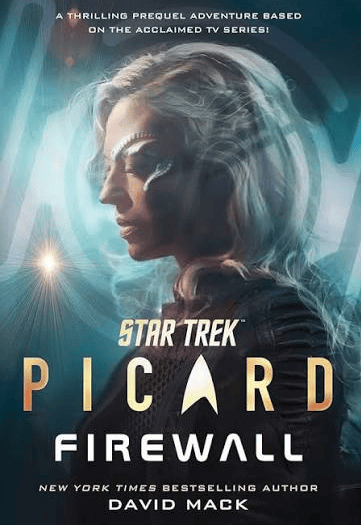
Seven of Nine isn’t doing too well. The return of Voyager to the Alpha Quadrant allowed her crewmates to be reunited with their families, but for Seven it meant the loss of hers. For four years she had served on Voyager, worn the uniform of Starfleet, and had the captain’s ear and trust — but now the Federation rejects her as a citizen and Starfleet denies her application to the Academy. To them, she’s Borg, and in this bleak Kurtztrek Federation, she’s a potential hostile agent and scarcely more human than a synth. Angry, lonely, and alienated, she begins drifting through the Alpha Quadrant, working one odd job after another — until she’s approached by an agent of the Federation Security Agency, who offers her a deal. Infiltrate the vigilante group known as the Fenris Rangers, and they’ll arrange things so that her Federation citizenship is restored and she’s given an open door into Starfleet. So begins Firewall, an action-thriller given the heavy job of bridging Voyager’s Seven with the Seven of Picard; it provides plenty of action, but is only nominally successful with bridging the two versions of Seven.
I bought Firewall as soon as it came out, because David Mack is the king of Treklit for me — there’s a reason he was given the Destiny trilogy, and the grand finale to the Mirror Universe books, and the Section 31 duology — and I love the character Seven of Nine. I suspect my fascination with the ex-drone trying to regain her humanity is why I liked Shelli so much. I have dragged my heels on reading it, though, because I hate the ST PIC setting. ST PIC ‘built’ on premises that Paramount/Skydance are now distancing themselves from(the Abramsverse story of Romulus being threatened by its sun going supernova, and the Federation having to help it evacuate despite it being THE ROMULAN STAR EMPIRE WITH A BLOODY FLEET OF SHIPS). It added (1) androids becoming a mainstream technology, (2) said androids or synths becoming a slave-labor class and (3) said slaves rebelling and making the Federation very suspicious of doing anything anywhere anytime. I’ve watched a fair bit of PIC, most of the first and third seasons, but I despise its setting. Firewall does nothing to redeem the setting for me, as its Federation and Starfleet are not recognizable as those institutions in Voyager. They’re less inspired, less idealistic, and far more ridden with 21st century faults — not a mark to strive towards, but one to recognize and sigh at in the mirror, like a fat man after Thanksgiving dinner.
The clearest example of this in Firewall is Starfleet’s attitude toward the Fenris Rangers: they originated as a private security firm engaged by various governments in the Querlis sector, very near the Romulan Neutral Zone: when said governments collapsed, the Rangers kept trying to keep the peace. Now, despite their being a fairly Starfleety group (they’re ethnically diverse with a mission grounded in morality and ethics), Starfleet views them as highly problematic vigilantes while ignoring a cruel dictator who deliberately messes up the climate on one planet to genocide its population. Starfleet is not perfect; it can be self-serving, it can be flawed, it can be short-sighted. But even if it wanted to ignore the dictator’s actions, why is it so hot and bothered about the Rangers? Simply because they operate under the color of law?
The entire premise of the story aside, I largely enjoyed Firewall because of its focus on Seven. Mack begins the book with the challenging task of making our cold, logical Seven of Voyager and the “She’s human but has funny piercings” Seven of Picard one and the same. He succeeds to various degrees: when Seven begins working with the Rangers, she gets a lot of pushback for her wordiness from her partner, pushback she wouldn’t have gotten from the Voyager crew who are forced by Federation culture to accept everyone’s quirks as perfectly OK. (Unless they’re Vulcan, in which case it’s allowed to call them a green-blooded hobgoblin or a real freakasaurus.) By the end of the novel she’s talking a little less like Data and Tuvok. She’s also much more emotional, having been traumatized at multiple points throughout the novel by witnessing genocide, nearly dying, witnessing friends die, etc.
The weakest part of her characterization was her apparent sudden change in sexuality: ST PIC has Seven in a relationship with a woman, and I’d assumed that Firewall would try to address Seven waking up to feelings of attraction for women. Instead, we open with her hanging out at a queer club, having already acknowledged that shift in herself. It makes her getting involved in a relationship later in the novel far less interesting because she’s not trying to figure out what it means. Considering how interesting that kind of character development could have been, an accomplished author sidestepping it is weird. Maybe that was a creative ‘choice’ imposed on him from above, but it does nothing to change my largely negative take on post-Relaunch Treklit. So much of the emotional life has been drained out of incredibly complex characters, and there are no serious stakes because nothing can violate the frequently-uninspired writing of the nu-Trek shows.
My mourning and grognarding aside, I did enjoy this book: I started reading it at lunch and finished it after work. It’s just not what a “David Mack writes Seven of Nine” story could have been, and given his prior strengths, especially in character drama, I think it has to be because he was forced to write with creative constraints. Starfleet’s animus against the Rangers exists in ST PIC, so they have to be stupid here, as well. There were highlights, particularly the recurring role played by Janeway: Mack gets their quasi-mother/daughter relationship right, and I liked getting a look at what Janeway is up to in this timeline, even if it is just sitting at a desk being done with bureaucracy.
I think it’s safe to say I am done trying ST PIC books. Last Best Hope was a bomb for me despite coming from another author I like, and if Mack can’t make PIC books work it can’t be done.
Quotations
“Your agency drafted this agreement. If you or your superiors had wished it to be simple and succinct, you could have written it with an eye for clarity and brevity. I take no responsibility for the delay created by your legal department’s penchant for verbosity.”
“I trust you see no irony in the complexity of your retort?”
Once in a while, some starship designer would try something different, like putting officers’ bunks in a pass-through corridor for no good reason, or berthing enlisted crew in a starship’s secondary hull near the antimatter, without any clear path to the escape pods, but such “innovations” tended to be short-lived, as did the unfortunate souls forced to endure them. (The crew of the Cerritos feel seen!)


