
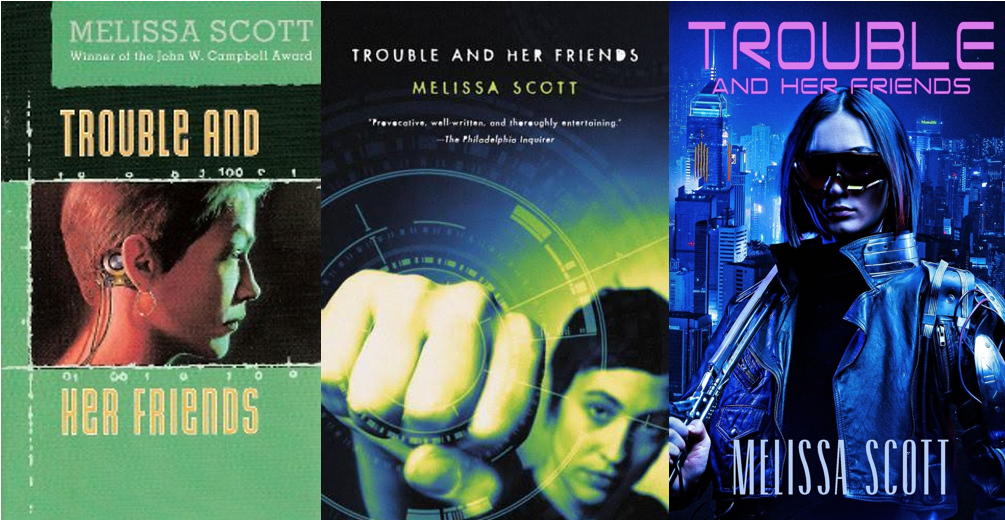
Cerise has got trouble, my friends, right here in Seaside Haven! She’s woken up to find her girlfriend and partner in crime Trouble gone, along with said partner’s netrunning equipment. They had been arguing over whether to take a job attacking a massive corporation with considerable cybersecurity, and evidently in light of new legislation that greatly cracks down on Netwalkers and crackers, Trouble decided to fly the coop. Heartbroken and confused, Cerise adapts to the new reality: she goes straight, taking a corporate job and trying not to draw attention to the fact that she’s “on the wire,” that she has a neural implant that allows her to physically perceive the data of cyberspace. (Different kinds of data can feel or smell differently, and she can be ‘touched’.) But a few years later, her corporation is breached by someone calling themselves Trouble, and their code bears a strong resemblance to her vanished partner’s. Is Trouble back?
Trouble and Her Friends is an interesting bit of cyberpunk, written in the early 1990s before the World Wide Web took over the internet. Its vision of cyberspace appears to have been partially inspired by the BBSs of the net’s early years. Characters refer to cyberspace as “the nets” and use nodes to transport their ‘icons,’ or virtual selves, from place to place. Cerise, now a high-level security authority at the company, makes it her mission to seek out “Trouble.” She has her doubts that this is really her Trouble: sure, a lot of the code is the same, but this person is running their mouth, and they’ve made inelegant (hell, ugly) changes to the code. Trouble was surgical; her code was clean. This stuff has messy seams showing all over the place. What Cerise doesn’t know is that Trouble, who’d also gone straight and has been working as a sysadmin for an artists’ co-op, is seeking out this new “Trouble” too. They’re using her tools and her name, and being dumb about it. The Treasury department is snooping around asking questions, and that’s led to Trouble being fired by the co-op: even if she’s innocent, they don’t want to be connected to someone wanted by the Feds. Eventually their paths cross.
I was interested in this first because of the cyberpunk connection, but especially because it was an early attempt to envision cyberspace. I was fascinated by Gibson’s and Vinge’s interpretations, and Scott’s has its charms, too. Where Gibson’s Case can transition from cyberspace to meatspace with all the effort of changing trains of thought, for Scott’s characters there’s very much a sense of “going online” and entering a different state altogether, like sleep. They’re physically connected to their equipment, which can lead to vulnerability given that their physical bodies are relaxed, possibly even prone. At one point, Trouble is in this book’s equivalent of a smuggler’s planet, a city that exists in both the physical and virtual realms and serves as a dark-net market, and she learns the authorities are onto her and watching her motel room. She can’t go back to it, and so she’s working without a “net.”
I quickly grew to enjoy the characters, though. Trouble and Cerise are both memorable women, particularly Trouble with her trenchcoat. They’re both badasses in their way: Cerise is the more aggressive about her skills, but Trouble has the bigger reputation. They’re joint protagonists, with an interesting relationship. It’s also a very 1990s book: despite being set in a future with neural implants and weaponized lasers, the characters still use multiple disks (yes, with a K) in their computer operations, and the social mores are close to the world of 1990, in that gay characters are out but still heavily stigmatized.
Scott appears to have a lengthy bibliography, and I’m already looking at one of her books that appears to have a virtual reality like that of The Oasis, Burning Bright. If I read more, I suppose I’ll find out if the occasional sex scenes (there are two short ones here) are a feature of her writing. That’s definitely not my cup of tea, but it was a marginal part of a fun story.


