
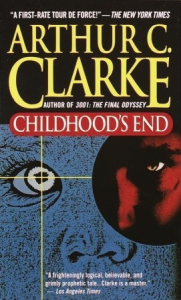
It is the eve of humanity’s real rise to the stars: the nuclear-powered rocketship Columbia stands ready for launch. From now on, the future will be different. Only suddenly the sky is filled not with the roaring of a rocket, but an ominous array of alien starships. Humanity’s reign on Earth is over; the Overlords have arrived. Such is the beginning of Childhood’s End, a fascinating novel by one of the legends of science fiction. It was one that was engrossing to read, but ends in a grim fashion.
Fortunately for us, the Overlords are fairly mild tyrants. They don’t appear to enact taxation, they don’t demand sons for their armies, and they leave the crops uncircled and the cows unmolested. They appear to be watching us, and will occasionally pop in to say “Don’t do that!”, as when they see people hunting only for sport. They also share knowledge, so humans actually begin flourishing materially under their reign. It’s just the oddness of the aliens never appearing: occasionally they broadcast, and one human is occasionally invited to go aboard their ship, where he sits in an empty room and talks to a figure he cannot see. Eventually, after several generations have grown up accustomed to the Overlords, they do show themselves – and they look…diabolical. This is not entirely a coincidence, and I refer again to the ending.
Writing about the end without spoiling it is something of a challenge, so I’m going to retreat into abstraction and say the book gets progressively more conceptual as it goes on. Clarke has an interesting forward in the edition I read in which he acknowledges that he was much more open to ‘woo’ in the 1950s – concepts like parapsychology, ESP, and so on. One of the book’s characters has an avid interest in these concepts, and interestingly, so do the Overlords. Despite outstripping humanity in technological and scientific comprehension of the universe, this to them is a complete blind spot: whatever “it” is, they don’t understand ‘it’. I mention this not as a curiosity, but because it leads into the end of the novel: the It is real, and it has a role in humanity’s future destiny.
This was an interesting novel, very different from what I’ve read of Clarke so far but engaging. I was particularly struck by how humanity atrophies during its “golden age”: because the Overlords provide all knowledge needed for a comfortable, happy existence, humanity ceases to be striving man – homo viviator – and instead becomes a placid consumer-creature, sinking into a torpor of creature comforts and ready entertainment. In the novel some people reject this and try to create a new society on an island they call Athens, one that rejects some of the aliens’ comforts and forces people to become engaged in their lives again. Unfortunately for them, the novel’s culmination is very near at that point. But, it reminded me of an episode of Star Trek in which Kirk and company find a world in which the people live a comfortable but empty existence serving a machine called Vaal: Kirk, offended by their servility, promptly destroys Vaal to free the humans so that they can live again.
So marks my return to Clarke properly; I am still hoping to read Rendezvous with Rama this month.


