
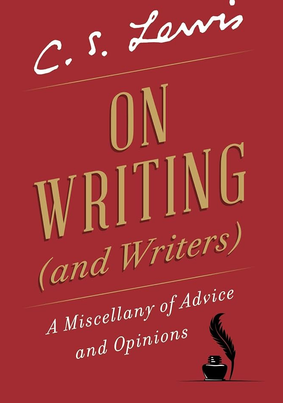
While I always jump at anything Lewis-related, when I saw On Writing (and Writers), I was especially interested, as lately I’ve become consumed by writing short fiction. A story written to meet a friend’s challenge developed a life of its own, becoming a series of character dramas set in a small Southern river town. Working on this series, and particularly its characters, has become something of an obsession with me: there have been many evenings the last year where where I just scribble, scribble, scribbled until after midnight. I have found joy in it – and thanks to On Writing I know now that Lewis experienced something similar. On Writing is a collection of essays, quotes, and excerpts addressing writing, words, and authors. It draws on some sources familiar to Lewisians, like Other Worlds and his letters, but also includes more unexpected pieces like his contributions to magazines or letters to editors not included in his letters proper.
For me, reading Lewis is generally like settling in with a friend and talking for a good long while, especially when reading his essays. This took that pleasure and combined it with complementary loves of literature and writing for something of a trifecta. There’s a good range of material here, from Lewis writing to his father and his friend Arthur about what he’s reading at the front, to full-length book reviews. Lewis adored the Fellowship of the Ring, though I wonder what his reactions were like when Tolkien shared bits at Inklings meetups. Lewis was a man of strong opinions; he derided “The Wasteland” as ‘infernal poetry’, and regarded T.H. White’s Arthur books as utter vandalism of the mythos, rather the same way Tolkien despised Disney’s Snow White. Lewis and Tolkien were men drunk with storytelling and mythos.
I rather enjoyed Lewis’ writing on the craft itself. A bit of advice he repeated was to write for the ears, not just the eye. Read your writing aloud and see how it flows, how it sings. He favored precision and simplicity in language, and warned writers against contributing to ‘verbicide’ by overusing some words and cheaping their meaning. (He’d be horrified at what we’ve done to love and fascism.) Save the high-octane words for when you need them. Interestingly, Lewis doesn’t appear to have been a fan of literary property: all writers are continually drawing on one another, he says, contributing to and drawing from a common well.
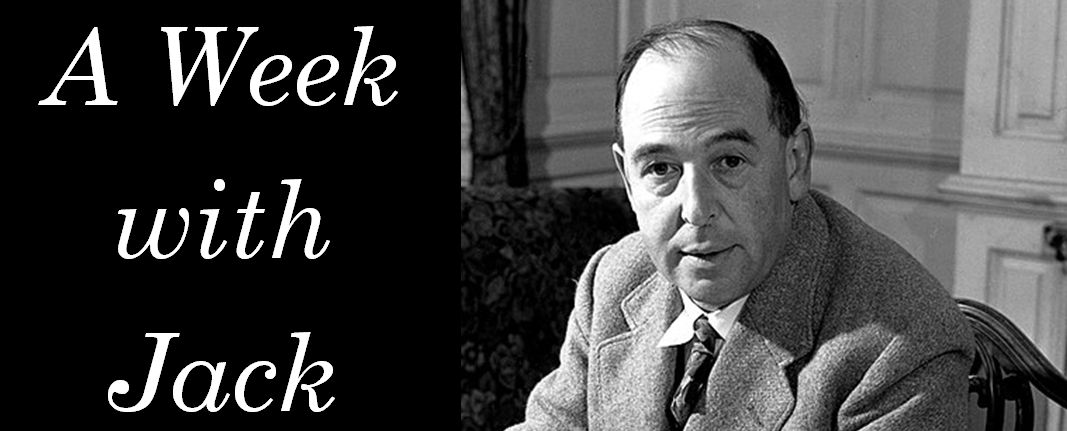
Always pleasant to spend some time with Jack. I’m hoping to read God in the Dock and re-read The Great Divorce this week, but we shall see. I’m currently reading a Becky Chambers book, and if I can manage a Heinlein before month’s end, I’ll have done everything I alleged I meant to do at the start of SciFiMonth. This is so staggeringly unprecedented that even I am surprised. Then we’re sailing into Advent!
Quotations
For every thought can be expressed in a number of different ways: and style is the art of expressing a given thought in the most beautiful words and rhythms of words. For instance, a man might say, “When the constellations which appear at early morning joined in musical exercises and the angelic spirits loudly testified to their satisfaction.” Expressing exactly the same thought, the Authorized [King James] Version says, “When the morning stars sang together and all the sons of God shouted for joy.” Thus by the power of style, what was nonsense becomes ineffably beautiful.
And I’m impenitent about dindle. You saw at once what it meant and so I’ve added a lovely word to your vocabulary. Why do you object?
Ink is a deadly drug. One wants to write. I cannot shake off the addiction.
And, when ideas come flowing upon me, so great is the desire of framing them into words, words into sentences, and sentences into meter, that the inability to do so is no light affliction.
In the author’s mind there bubbles up every now and then the material for a story. For me it invariably begins with mental pictures. This ferment leads to nothing unless it is accompanied with the longing for a form: verse or prose, short story, novel, play, or whatnot. When these two things click you have the author’s impulse complete. It is now a thing inside him pawing to get out. He longs to see that bubbling stuff pouring into that form as the cook longs to see the new jam pouring into the clean jam jar. This nags him all day long and gets in the way of his work and his sleep and his meals. It’s like being in love.
Let me now apply this to my own fairy tales. Some people seem to think that I began by asking myself how I could say something about Christianity to children; then fixed on the fairy tale as an instrument; then collected information about child psychology and decided what age group I’d write for; then drew up a list of basic Christian truths and hammered out “allegories” to embody them. This is all pure moonshine. I couldn’t write in that way at all. Everything began with images: a faun carrying an umbrella, a queen on a sledge, a magnificent lion. At first there wasn’t even anything Christian about them; that element pushed itself in of its own accord. It was part of the bubbling.
I now enjoy Tolstoy and Jane Austen and Trollope as well as fairy tales and I call that growth: if I had had to lose the fairy tales in order to acquire the novelists, I would not say that I had grown but only that I had changed. A tree grows because it adds rings: a train doesn’t grow by leaving one station behind and puffing on to the next.
The editor has asked me to tell you how I came to write The Lion, the Witch, and the Wardrobe. I will try, but you must not believe all that authors tell you about how they wrote their books. This is not because they mean to tell lies. It is because a man writing a story is too excited about the story itself to sit back and notice how he is doing it.
I don’t know where the Lion came from or why He came. But once He was there He pulled the whole story together, and soon He pulled the six other Narnian stories in after Him.
The first business of a story is to be a good story. When our Lord made a wheel in the carpenter shop, depend upon it, it was first and foremost a good wheel. Don’t try to “bring in” specifically Christian bits: if God wants you to serve Him in that way (He may not: there are different vocations), you will find it coming in of its own accord.
You waste on calling me liar and hypocrite, time you ought to have spent on refuting my position. Even if your main purpose was to gratify resentment, you have gone about it the wrong way. Any man would much rather be called names than proved wrong.


