
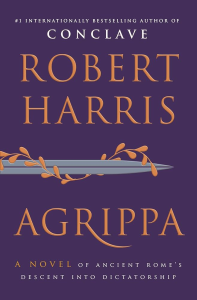
When one looks at Octavius/Augustus’ victories, one finds Marcus Agrippa standing immediately behind the emperor, no doubt casing the room and looking for errant senators who want to cry, “Speak, hands, for me!” and engage in some unconstructive criticism of the Emperor. I was most made aware of this when reading The War that Made the Roman Empire, concerning the battle royale between Octavian and Marc Anthony. Robert Harris’ Agrippa focuses the spotlight on Octavian’s right-hand-man and relative by marriage, letting us see how an adolescent friendship turned into a relationship that forged an empire. Robert Harris is an old favorite of mine, with a bench of diverse thrillers to his credit and easy familiarity with the late Republic, and yet despite the presence of nitro and glycerine, this book didn’t explode for me. It was perfectly enjoyable, but I’m used to Harris being excellent.
We meet Marcus Agrippa when he encounters a young boy being bullied, and Agrippa intervenes; the boy is Octavian, and he was being beaten up because his uncle Julius Caesar had just been a naughty boy and crossed the Rubicon River with troops, in violation of Rome’s orders. Rome had had a recent issue with generals marching on Rome with troops and quite a few people literally lost their heads during the dictatorship of Sulla which followed. (Actually, they lost quite a bit: Sulla realized that looting people was an easy fundraising scheme. This continues to work in our day, but generally with less murder and almost no heads on pikes.) Agrippa and Octavian become fast friends, and considering that Octavian is a favorite nephew of Rome’s new master, Agrippa’s career prospects are bright so long as no harm befalls Cae- oh, dear. Octavian turns disaster into triumph, however, and Agrippa zooms along in his wake – not passively following his old friend, but actively helping him make their fortune. Harris incorporates some battles in this, but not nearly as many as I would suspect: it’s largely about Agrippa navigating his complex loyalty to Caesar (the name he gives Octavian after the real Caesar is assassinated). Caesar can make him one of the most powerful men in Rome, yes, but Caesar will also casually demand he divorce his beloved wife to marry into Caesar’s family. One aspect of Agrippa I did not know about was that he was engaged in a great many building projects in Rome – aqueducts and the like – and Harris’ version of him was prouder of those than his battles.
This was enjoyable and informative; it runs through territory I consider myself familiar with. I didn’t actively dislike anything and yet I’m so used to Harris plumbing new terrain, making the familiar exciting again somehow, that when I finished this I was slightly disappointed. It’s like coming to see Babe Ruth hit homers and instead he bunts. The play chosen is good, it works, Babe gets on base, but it doesn’t make you stand up and cheer, waving your hat around.


