
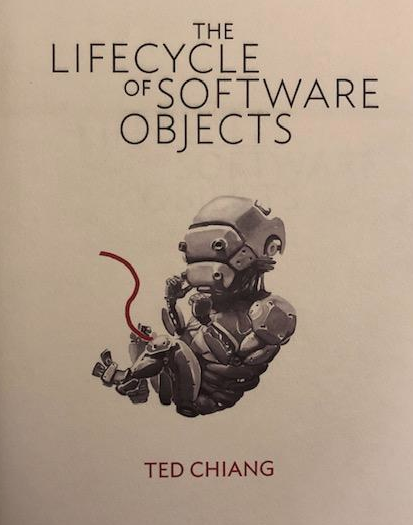
The Lifecycle of Software Objects is one of the more interesting SF books I’ve read in recent years, and until the last ten percent or so it was headed toward a rare five-star review. That’s how fascinating I found it. LSO is in part about emergent intelligence: its plot is centered on ‘digients’, who were originally considered as something like an intelligent virtual pet or a software toy. The digients are purposefully kawaii, resembling cute animals or anime characters, presumably to encourage attachment to them. Digients’ intelligence grows over time, rather like a small child’s; they need active attention from their human owners to help them develop. Unfortunately for the digients, time marches on and humans lost interest in their toys, and ‘suspended’ them. An AI consciousness” capable of being ported to a real-world body is simply put on hold, a sleep without rest. A small community of the original users, including those who had made livings training the digients, have held on to theirs — but that becomes increasingly difficult as the digients continue to mature as sentient beings while the digital world they were originally created for is phased out. The users are left to look for ways to port the digients to the ‘new’ digital world that is taking over, but the money involved is considerable, and at the same time they are wrestling with questions of sentience and responsibility. While some of the issues in this book have been raised before — our responsibility toward created artificial lifeforms has been on the table since Frankenstein at the very least — what made this book fascinating for me was the discussion on how intelligence is fundamentally social, that the digients needed interaction with one another and with humans to properly develop. I found that an interesting concept to think about, and enjoyed seeing the various AI personalities emerge throughout this novella. There was a bit at the end that really put me off, though, when the digients’ owners are approached by a company that creates sexbots and we get some debate about that particular industry. Very squicky all around. I’ll definitely be looking for Chiang in future.
Quotations
FROM: Zoe Armstrong
You won’t believe what my Natasha did today! We were at the playground, and another digient hurt himself when he fell and was crying. Natasha gave him a hug to make him feel better, and I praised her to high heaven. Next thing I know, she pushes over another digient to make him cry, hugs him, and looks to me for praise!They’re blind to a simple truth: complex minds can’t develop on their own. If they could, feral children would be like any other. And minds don’t grow the way weeds do, flourishing under indifferent attention; otherwise all children in orphanages would thrive. For a mind to even approach its full potential, it needs cultivation by other minds.
The adolescents who dominate these communities seem unconcerned with the fact that the digients aren’t human, treating them as just another kind of online friend they are unlikely to meet in person.The adolescents who dominate these communities seem unconcerned with the fact that the digients aren’t human, treating them as just another kind of online friend they are unlikely to meet in person.
“I’ve got to hand it to you for sticking with Jax for so long. What you’ve achieved is impressive.” He makes it sound like she’s built the world’s largest toothpick sculpture.
“Talk about a risky investment. You’re showing us a handful of teenagers and asking us to pay for their education in the hopes that when they’re adults, they’ll found a nation that will produce geniuses.
The idea of love with no strings attached is as much a fantasy as what Binary Desire is selling. Loving someone means making sacrifices for them


Interesting. I picked up an AI book in my Indie shop earlier in the week I’ll be adding to a small stack to be read on the subject (early-ish) next year:
‘The Alignment Problem – How Can Artificial Intelligence Learn Human Values’ by Brian Christian.
I’ve heard some devs are trying to use an organized moral system …an AI religion. One of my potentials for this month involves a man who tries to create a robot that incorporates Asimov’s three laws, but it goes..very differently than he expected.