
While I’ll finish The Age of Eisenhower today and could wrap up Stephen Fry’s Odyssey tomorrow,, reviews for either before August are unlikely. So, let’s wrap up July in books! We travel ever deeper into the oppressive heatsink of July, where the lows fall in the mid-70s (~24 C) and the highs….the highs do not contemplate thinking about. A friend of mine who is being wooed by the University of Alabama as a professor traveled from Colorado to Alabama recently, and found that I did not exaggerate the Great Sticky Siege. “At least you’re seeing us at our worst,” I joked, lying. August will be worse. Professionally, I kicked off the month attending the annual Alabama Mosaic / Alabama Digital Preservation Network meeting in Montgomery. It’s always nice to spend the day with fellow archivists & techies. ADPN is something of a pioneer in their network structure, which is fitting: Alabama has the nation’s oldest government archives, and that includes the National Archives. People make their jokes about Alabama, but we always have our surprises.
Challenges…
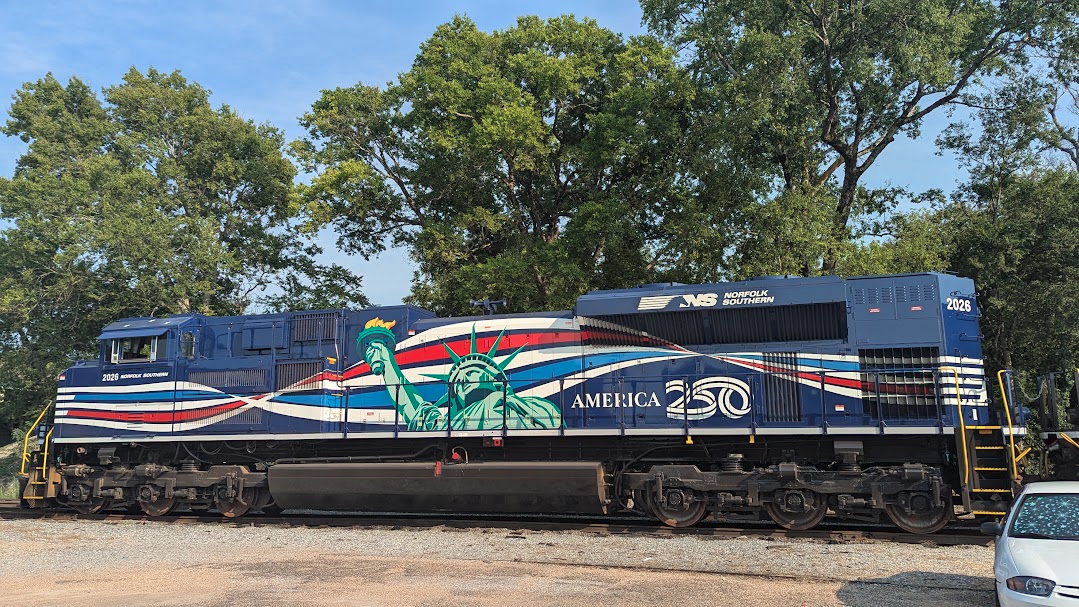
America @ 250: Another strong month, as I took down Woodrow Wilson, Warren Harding, and Dwight Eisenhower. (Thirteen dead presidents remaining!) Complete failure on Classics Club, Science Survey, etc. I got into an unexpected Greek mood at the end of the month because of Odyssey. On a brighter spot, I did finally read a supplemental text for my Bible in a Year project.
New Acquisitions
After Christendom, Michael Warren Davis. I was going to wait for used copies of this to get cheaper, or for a Kindle sale, but then someone posted an excerpt of MWD writing about smartphones as an impediment to spiritual life, and of course I went after that like a dog after a steak.
Rome and Persia, Adrian Goldsworthy. This one has been on the interest list for a while, and I spotted it on sale.
Lost in Curiosity. Some hope for the science survey! This book, oddly enough, was a $2 preorder. I’ve never seen a Kindle sale for a book that’s yet to be released.
Odyssey, written and read by Stephen Fry. Almost done with it.
Coming up in August

Sweating. Suffering. Science? I’m pondering another visit to Pensacola, or at least the Gulf, in September (Morgan Wade is playing in Mobile!), but that’s a ways off.
Non-book Commonplace Entries
Once, in the confessional at St. Patrick’s Cathedral in New York, I got into an argument with the priest hearing my confession, telling him that such-and-such was a sin, according to the Catechism. You don’t expect to have to do that. My Catholic friend Kale Zelden likes to say, ironically, “We are all Protestants now.” What he means is that nearly everybody in the modern West — Catholics and otherwise — defers to individual conscience to determine right and wrong. Is he wrong? – Rod Dreher, “Authority, Modernity, and Church Disintegration“.
Traditionally, the answer [to the cause of the Library of Alexandria’s destruction] was believed to be war. […] But contemporary historians tend to dismiss the importance of these dramatic incidents in favor of a more mundane cause of death: negligence. Maintaining the collection was an enormous expense. Humidity, mice, and insects slowly ate away at the papyrus scrolls. Scribes had to continually copy old texts before they deteriorated and became illegible. Eventually, the challenges of maintaining the library became greater than the will to preserve it. “It is not that the disappearance of a library led to a dark age, nor that its survival would have improved those ages,” the classics scholar Roger Bagnall has written. The fact that the library was allowed to die showed that the dark age had already arrived. – “The End of Reading is Here“, Rose Horowitch
We must live in this world, and honor the best of it, as Milton himself did, while not ascribing to it anything final or consummate. The world itself will no longer honor its own best; that work of piety devolves upon us. We must preserve our sanity, not easy to do when both the content and the delivery of the news are apt to unravel the brain and wither the soul. We ought to do those sweet earthly things that the world has forgotten or traduced: to sing good songs, to play music; to fall in love, to marry, to have children; to read good books; to visit our neighbors’ houses and invite them into ours; to learn again to celebrate holy days and even to dress accordingly; to recover lost prayers; to be human. – Anthony Esolen, “Pride & Incorrigibility”, Touchstone.
If St. Thomas Aquinas engaged with opposing views as many online Catholics do today, his Summa Theologica would be about 100 pages. It would consist of lines like, “Atheists reject God only because they can’t keep their pants on” and “Anyone who disobeys the pope is a prideful loser,” after which he’d move on to the next subject. Fortunately, instead the Angelic Doctor sought to understand as deeply as possible the actual point of view of those he was debating. He wanted to be able to explain those arguments as well as he could explain his own. Only then did he refute them in detail, and always without questioning the motives of those who held opposing views. This should be our model, but sadly it’s not. – “Arguing like St. Thomas Aquinas“, Eric Sammons. Crisis magazine.
All art is, more or less, an exercise in mythmaking. – Jack Donovan, “You Are and Must Be a Man of Your Age“.
Homer’s real insight, though, is that disorder in the soul never stays private. “From Ithaca to Paradise“, Gavin Ashenden
Jordan Peterson treats religion as a technology for transmitting wisdom across generations. This is the most sophisticated version of modernity’s error: we cannot imagine that religion might be true, only that it might be useful. – Laura London
The only three things I want to grow these days are children, plants, and personal holiness. To hell with the rest of it. – Dr. Alan Harrellson, The Pipe Cottage
[T]he writing of the novel upended a lot of things, and that story was one of them. I’ve said many times that this novel felt like it wrote itself through me, in a way nothing else ever quite has. The religious aspect of the tale was one element that seemed to grow without my watering it. – Paul Kingsnorth, “The Wake: Questions and Answers“.
All of this is an application of Adam Mastroianni’s deep insight that you cannot reach the brain through the ears. Being told something, reading something in a book, hearing a lecture, is nothing like what happens to our understanding when we experience it in our own lives. – Russ Roberts, “Will We Ever Learn?”


Good luck surviving August!
May the Freon be with us!
(and also with you)
I’m a Freon Level 4 user. I studied for decades!
Earlier this year, I took my tests for Level 5, but I couldn’t afford to keep the Freon Flowing. So I guess I”m stuck here 😀