February 2024 in Review

February continued 2024’s atypicalness, with fiction continuing to outstrip nonfiction by a healthy margin. Granted, I was in bed for over a week, meaning novels, comedy sketches, and soup were my fare instead of histories, lectures, and fajitas, and even after I returned to work I was still resorting to easier reading. Nonfiction is warming up, though, and I imagine it’s going to put fiction’s outfielders to work.

Lenten Fare:
The Lies of Our Time, Anthony Esolen

Science Survey:
The Hidden Life of Deer: Lessons from the Natural World, Elizabeth Marshall Thomas
The Royal Society and the Invention of Modern Science, Adrian Tinniswood
In the Company of Trees, Andrea Fereshsteh

Classics Club:
A Good Man is Hard to Find and Other Stories, Flannery O’Connor

Reading Dixie:
A Good Man is Hard to Find and Other Stories, Flannery O’Connor
The World’s Largest Man, Harrison Scott Key
Twain’s Feast, Nick Offerman.

TBR Cleanup:
Dark Age Ahead, Jane Jacobs. A brief look at some worrying trends in contemporary society: though now twenty years dated, 
Live from New York: The Uncensored History of Saturday Night Live

The Unreviewed: 
– The Lies of Our Time, Anthony Esolen. At this point I need to do a “Anthony Esolen Week” in which I post nothing but reviews for his books which I’ve read but not reviewed properly.
– Dark Age Ahead, Jane Jacobs. Will try to post a blurb on this.
– Twain’s Feast, Nick Offerman. Offerman, better known as Ron Swanson,  uses a menu from one of Mark Twain’s parties with his friends to host his own party with a similar menu, using the foodstuffs as a means to examine different areas of American life and history — racism, ecology, etc. Some of the foodstuffs like prairie chickens were hard to come by, and others were surprises for Offerman’s Hollywood friends: I can’t imagine Wanda Sykes ever predicted she’d eat racoon from a gourmet chef. Definitely worth trying if you’re a serious Twain fan: I had no idea how varied his life was, and now realize I need to look into a Twain biography. I had this hazy notion of him working as a river pilot and then deciding writing stories was more fun than the constant stress and anticipation of drowning or dying in a boiler explosion.
+ One more that actually has a scheduled review for Reasons Yet to Be Revealed. Tune in Monday, March 25 to catch on.

New Acquisitions
Lies of Our Time, Anthony Esolen. Released end of 2023.
The Atlas of Beauty: Women of the World in 500 Portraits. Physical, used. On my interest list since reading Humans of New York.
Bad Therapy: Why the Kids Aren’t Growing Up, Abigail Schrier. (Preorder, delivered yesterday. Reading now.)

Coming up in March
The usual suspects, plus Lent and a theme week at the close.

Posted in General, Reviews | Tagged , , | Leave a comment

Movie Watch: February

Favorites in bold, rewatches excepting.

GROUNDHOG DAAAAAAAAAAAAAAAAAAAAAAY!, 1993.  This is possibly my very favorite movie, its only competition being Philadelphia Story with Jimmy Stewart, Cary Grant, and Katherine Hepburn.  Bill Murray plays a jerk of a reporter who finds himself repeating the same day over and over again. Eventually he learns to love and be lovely. 

Team America: World Police, 2004.  A parody of supermarionation action/spy series like Thunderbirds,  which simultaneously ridicules both post 9/11 jingoism and Hollywood liberals.  Unexpectedly obscene in parts.

5 Card Stud, 1968. A card cheat is lynched after being exposed at a poker game, and soon thereafter the men involved begin dying.  Completely by coincidence, a preacher dressed in black who decorates his church with a “Vengeance is mine, sayeth the Lord; I shall Repay” sign appears.  Who could it possibly be?  Solid acting from Dean Martin and Robert Mitchum.

The Babe, 1992.   John Goodman plays Babe Ruth,  a little boy in a big man’s body, who loved partying and loved playing ball.  It’s fun, and is largely honest about Ruth’s hedonism, though when he arrives holding a baby for his wife to adopt, the film doesn’t mention that said baby was his from one of his other liaisons.

“Aren’t you going to give Ruth credit for anything?!”
“….He run OK for a fat man.”

Cobb, 1994.    Tommy Lee Jones is wonderfully manic as Ty Cobb,  as defamatory as the movie is.  The facts of the movie are absolute trash, but  Jones is just hilarious driving through a blizzard chugging whisky and ramming the car in front of him, or going crazy at a casino because he spots the cigarette girl he was sweet on (well, randy for)  standing next to another man.  The drama of the movie is interesting –  TLJ-Cobb struggling with his inner doubts while preaching his greatness,   the libelous Al Stump  torn between hatred and grudging admiration.  When I go to Georgia to listen to Morgan Wade do an acoustic set in April, I plan on visiting Cobb’s museum to pay respects to the Georgia Peach.

Black Orpheus, 1959.   A woman arrives in Rio to celebrate Carnival, being stalked by someone who wants to murder her. She falls in love with a trolley driver/guitar player who promptly ditches his axe-crazy fiance to be with her, but then  – well, it’s based on a Greek tragedy, so use your imagination. Lots and lots and lots and lots of dancing. Seriously,  even more dancing than West Side Story

A Man Called Ove, 2016. A widower is intent on killing himself and rejoining his wife, but keeps being interrupted by the bloody neighbors who can’t back up a car properly, don’t know how to bleed a radiator, and  keep putting metal in the glass recycling bin. Idiots!  Heartwarming story that I’ve read the novel of (and watched the American adaptation of), about a man who manages to find meaning his life beyond mourning and self-absorption.   Although the American movie is easier to get into given the language barrier, I think Ove works much better as a drama – in part because it doesn’t assume the viewer is an idiot who needs every plot thing explained to them.

Bicycle Thieves, 1948.  A man struggling to keep his family fed just found a job that requires a bicycle. His bicycle is stolen. Pathos ensues. Wonderful acting, especially from his son. Set in postwar Italy. 

Kill Bill Vol 1, 2003. Uma Thurman kills over a hundred people in a quest to Kill Bill. She has not yet killed Bill.  Great music. Lots of cartoonish blood.  Interesting incorporation of Japanese animation to bridge scenes or explore backstory.  

Hoffa, 1992.  Jack Nicholson is Jimmy Hoffa,  the man who made the Teamsters union and who was ultimately undone by business dealings with the mob.  Great movie.   My favorite scene is Hoffa berating RFK, of course, but I also loved the shot of Hoffa being taken to jail,  the cop car threading its way through an unbroken tunnel of commercial trucks, their drivers cheering and lending moral to support to Jimmy. 

Warning: so much language.
“Guy needs his brudder elected president of the United States to get a job, yer a joke. You wouda been a bond salesman somewheres. […] You don’t impress me, and yer office don’t impress me, and your FAMILY don’t impress me. Buncha rum-runnmers. “

It appalls some of my friends that I have Hoffa’s tirade memorized. For the record, I’ve watched actual Hoffa-v-Bond Salesman footage, and it’s eerie how close Jack Nicholson got in the dramatization of this show. I love Pacino, but Nicholson was the perfect Hoffa, and even Jimmy’s son said so.

Coffy, 1973.  Pam Grier plays a nurse whose sister’s life has been destroyed by drugs  so she poses as a call girl to find the men who sold her said drug  – and murder them.  Tasteless in its gratuitous nudity and violence, but  entertaining.  One of the first ‘blaxploitation’ movies.

“What kind of animal do you take me for? No, I didn’t kill him — but I did kidnap his wife!!
– one of these four guys. (Language.)

Coaine Cowboys Reloaded, 2006. A documentary about the rise of the Miami drug trade. Unexpectedly funny because of Trump and Steven Ogg’s doppelgangers. 

Fever Pitch, 2005. A man with a perfectly acceptable passion for the Red Sox has his commitment to the team challenged by Drew Barrymore, but she eventually sees reason. The curse of the Bambino is broken.

I will pause my contempt for Jimmy Fallon to enjoy this scene. SO GOOD! SO GOOD! SO GOOD!


42, 2013. Biopic of Jackie Robinson, who was the first black man to play in the major leagues.  Human dignity, baseball, Harrison Ford– what’s not to love?  There’s even a train.

Fever Pitch, 1997. Colin Firth has an obsession with Arsenal FC that he only begins to realize might be filling the void that is an otherwise meaningless life after he gets entangled in the bedsheets (and a relationship) with a new coworker, played by Ruth Gemmell. This was a better movie than the American, even without the Red Sox, because the drama is more serious and intense. Jimmy Fallon is never believable as a fanboy who grows up, being Jimmy Fallon, whereas in Colin Firth’s arguments with his friend you can see he’s actually arguing with himself, trying to convince himself to sort out his priorities.

Raising Arizona, 1987. Nicholas Cage is a repeat-offender c-shop robber whose cop wife Ed can’t have a baby. So they steal one. There are complications.

Posted in General | Tagged | 2 Comments

How To Stay Married

On an ordinary day, a book called How to Stay Married would have never broached my radar, given the dismal marriage prospects of eccentric librarians, but as it happened one of my favorite authors mentioned Harrison Scott Key last week and commented that this was a shift from Key’s usual “funny” books: it was, instead, his attempt to live and grow through the horror and sorrow of marital infidelity. The cowritten memoir –for the wandering wife has her own chapter — is a compelling mixture of humor and gut-wrenching despair, with little threads of commentary about other things like church woven in, as well as deeper insights about human nature that could be lifted from Solzhenitsyn. That’s part of the reason a bachelor like myself can read and be moved by this book, so much so that I imagine it will be on the year’s top ten list.

How to Stay Married doesn’t follow a simple construction, though it’s cohesive and very effective in how events are presented: believe me when I say that his not writing about their wedding until the last quarter of the book makes perfect sense once a reader is deep in the story. This is not a book that presents Key as a martyr: indeed, as he and Lauren begin their initial approach at restoring their union, he takes a hard look at himself and confesses the way he suspects he has failed as a person and as a husband. I mentioned when reading The World’s Largest Man that there were already premonitions of their faltering union, and Key delves into the mutual exercise in papering-over tension that he and his wife both engaged in for years. In brief, her background gave her a lot of emotional baggage going in, and he was too consumed by his work and too quick to revert to jokes to realize the growing sickness in their marriage. When the mask finally dropped, he reeled with which instincts to follow — fight, flight, or freeze, and found support in an intimate group of friends who helped him discern what was best for all parties, particularly their three girls. The struggle for reconciliation is not a simple one: both make it clear they were wandering in the darkness of their own souls and occasionally being beaten up by monsters along the way, but through stubbornness and grace — they found a place to grow again.

Being an outsider to Wendell Berry’s country of marriage, there’s a lot in this I can only appreciate at a theoretical level. Key’s painful memoir — he began writing the day she told him, as writing is the way he processes both the world within him and without him — drives home what a radical institution marriage is in the present world. Not for nothing does traditional Christian theology regard marriage as the proto-church, for it involves a total dying to self, and we witness and experience that death throughout this. Not that it’s a book clouded in darkness: it’s often hilarious, sometimes in a gallows humor kind of way. That combination of joy and sorrow, of despair and hope, is constant here, the two legs striding along and carrying the reader along. Even without being married there is enormous merit in Harrison’s observations as he tries to find his way, supported by his friends and his and his wife’s family: he recognizes Solzhenitsyn’s truth about the line between good and evil running between every human heart, for instance, and recognizes too the importance of communal connection, the perils of self-idolization which both he and his wife pursued, finding themselves in a self-made hell. Both Harrison and Lauren’s best and worst selves slug it out throughout this work, and it was heartening to see people volunteering themselves to go through pain because they knew it would spare their daughters, or because their still-obdurate love for the other kept them pushing forward despite the temptation of easy escape, the open doors shining with light but leading to nothingness.

This is one of those books I’m going to remember, and will plan on visiting Key’s other works.

Selected Quotations

Posted in Religion and Philosophy, Reviews, Society and Culture | Tagged , , , | 2 Comments

Selections from “How to Stay Married”

Harrison Scott Key’s How to Stay Married will, presumably, make the year’s top ten list for me, despite the fact that the closest I’ve come to being married is being confused with someone’s fiance. It’s the story of a marriage, and an affair, and….an affair that came back, and of mercy and self-loathing and all kinds of things. Simultaneously funny and wretching all at the same time, and written with consent (and assistance) by the architect of the affair.

SELECTED QUOTES

It is early afternoon. She holds a McDonald’s Coke. I would like to be holding a bucket of wine, but this seems bad form for our first session of marriage counseling. She is here and I am here but we are not here together.

What happened was, my wife for a billion years—the mother of our three daughters, a woman who’s spent just about every Sunday of her life in a church—snuck off and found herself a boyfriend. Not cool. Her boyfriend, I mean. He has a decorative seashell collection and can’t even grow a beard. I am not making this up.

Books cannot grant you vengeance against your wife’s lover. That’s what baseball bats are for.

I spent mornings trying to write a book, and we spent nights trying to make a baby. We made three people before I made a single book

When it comes to her interior life, she gives nothing away. You want to know how I feel? Just ask. You’ll wish you hadn’t. Ask me how things are going, and thirty minutes later you’re just hoping for an aneurysm so I’ll stop. I have to be funny just so people won’t run away when they see me coming, and many still do.

It would take me years to understand this, but the understanding began in that church hallway, that a good person is a temporary and imaginary creature, as make-believe as unicorns and fire-breathing cows, because the best of us are often the worst, full of proud and viperous snakes, believing ourselves gods. The dragons did not just live in history and myth. They lived inside me.

Some churches, they sign you up for the faith before you even have a chance to think it through, but in our church, it was DIY Jesus. You had to compare your life to the various rules and guidelines of the handbook, discern exactly how you’d effed things up, and then, once you were fully aware of your effedness, step forward during the altar call in front of everybody and politely request to be dunked. If you didn’t want to, well, fine. Burn in hell if you want. It’s a free country.

Growing up, I was taught to say my prayers at bedtime: If I die before I wake, I pray the Lord my soul to take. You have to admire a religion that has the balls to remind children they might die in the night.

 I’ve prayed for my wife more than just about anyone else, because God says to pray for your enemies, and marriage can sometimes be a war of attrition and one of siege, sometimes cold, occasionally hot. But at the prayer breakfast, I could not pray the prayers I needed to pray, even though I knew Lauren was already drifting away from me. I hoped God could hear those prayers trying to break free of my heart, tight as a gorilla fist. Maybe that’s all prayer is: wanting to pray and hoping God sees you wanting. And that’s when I let go.

Love is never a bad call. It might seem impossible. It might even seem silly when every atom in your body screams for blood. But how else, other than with love, can a broken thing be made whole again?

I once attempted to flirt with her our freshman year of college, complimenting her sandals before class. She didn’t respond, just glared at me with a scowl that would’ve liquefied helium, for which I repaid her many years later by marrying into her family and sitting next to her every Thanksgiving.

In grad school, I was dumped by a seminary student, who explained that God did not want us to be together.
“Did God tell you this?” I said.
“Yes.”
“Does he have a deep voice, like Barry White? I’ve always wondered.”

You can’t help but laugh at these people, who behave exactly like people. When Adam and Eve break the rules and eat the fruit and their eyes are opened and human history begins and God shows up and asks if they did the One Thing He Asked Them Not to Do, Adam, the first man, paterfamilias of all humankind, the archetype for every loving husband in human history, rats out his wife and disappears into the shrubbery.

Was I so strong as my father, my grandfather, to refuse bitterness?

Did Chad deserve mercy? Is it possible to express mercy with a pitching wedge to the skull? How does one walk humbly while dragging a dead body into a gully?

When you get to the end of hope, comedy is all you have left.

We talked for a good two hours about everything: the sad state of matrimony today, their marriages, mine. Jason asked me not to shoot myself.
“I’m not sure it’s me I want to shoot.”
“Don’t bang your secretary,” Soren said.
“I don’t have a secretary.”
“Good.”

“I think I’m going to start seeing other women,” I said to my best friend, Mark, one day, over the phone, updating him on the magical adventure of my marital separation.
“Are you sure that’s a good idea?”
“No. But I need some way to get Lauren off my mind.”
“Have you tried alcoholism?”

No one really talks about marriage struggles. Not Christians. Not the real struggles. Sex, pain, anger, loneliness. Not a word. You’d think they would. Christians love to talk about sin and struggle, but we look past the many nightmares of marriage like an army of the blind.

If you want to stay married, the first thing you’re going to need is to be insane. Because staying married is insane. Getting married is not. Getting married is fun. In the weeks and months before the wedding, you’re in passionate love with this glorious gift of a human: the ring, the announcement, the engagement photos where you hold hands and close your eyes and lean in and touch your foreheads together like a pair of telepathic freaks, that part is fun. Staying married is not fun. Staying married is like being kicked repeatedly in the head by a mule who loves you, and the mule is God.

Parents are like arms. You can swing it with one but two work best and three would be weird.

People who don’t have children don’t know that they’re missing the pleasure of watching a concert where half of the children appear never to have heard of music at all.

Who are we? What is our duty to each other in this nasty and brutish life?

One of my favorites, Alain de Botton, once wrote, “Compatibility is an achievement of love; it must not be its precondition.” That is marriage, in the end: two of you, being you, warring against the worst parts of you, making space for the best to grow, and learning to see that some parts of your spouse are not your favorite, and letting those parts be anyway. Hating those parts is no grounds for divorce. The only thing worth divorcing, in most cases, is the hatred itself, and your inborn desire to shape the world to your will like some kind of Marvel villain.

They hug us. They feed us. We feed them. They feed our children and we feed theirs and they feed Gary when we’re out of town and when they’re out of town, we feed their cats. All we’re doing is feeding each other, basically, with hymns and prayers and sermons thrown in there to remind us why.

The human heart is a terrain that cannot be mapped by reason alone. Virtue cannot solve the riddle of marriage. All I really know is this: the most powerful force in the universe is love and the strangest is forgiveness. I will never fully understand either but then I still don’t know exactly how elevators work and I enjoy elevators all the time.

Posted in quotations | Tagged , , | 5 Comments

Live, from New York — It’s SATURDAY NIGHT!

At the end of 2022, a friend of mine discovered that his former roommate had left a boxed set of SNL’s first five seasons — or at least, season two of the same. He was a teenager when SNL first aired and grew up it, and offered to introduce me to it, since I’d never seen anything of SNL. I was immediately smitten by Jane Curtin and Gilda Radner, and became fond of the Weekend Update routine. After plowing through season 2, I found a full boxed set on eBay, and we subsequently finished seasons one through four, my friend explaining the various seventies references and jokes that would have gone over my head entirely. I bought this volume to learn more about the early years of the show, though it covers everything up to the early 2000s. The subtitle is important, because lines from interviews constitute nearly the whole of the book, so there’s no narrative beyond what the interviewees contribute themselves. That largely works, though it does create some frustrating gaps: for instance, they mention Gerald Ford’s cameo in passing, but not how that happened. Still, the interviewees are largely good at delivering the general story of how things happened. I was surprised to learn that the show was created just to fill up space after Carson pulled permission to air his reruns on late Saturday nights: interesting that something so creative and culturally significant originated as an airwave band-aid. I imagine this book is of great interest to serious fans of the show, but once we’d left the era of the Not Ready for Prime Time Players, mostly what kept me powering through was recognizing names that gained more fame later on, sometimes in part because of the exposure the show gave them. Although Lorne Michaels created the show with the intention of using unknowns, later showrunners purposely hired comics who already had an audience, though this could trap the show into depending on one or two particular people instead of a strong ensemble, with severe consequences if they left. Learning how the show worked — or didn’t, sometimes — was interesting, as were the lives of the cast and writers, and the office politics. I was not surprised to learn that drug and alcohol abuse were rampant, though not everyone partook: Jane Curtin was as straight-edge as her character in “Weekend Update”. More than once, hosts took the stage and conducted the show under heavy influence. My favorite factoid was learning that Dan Akroyd and John Belushi bought a building with a ground-story bar, and after the show they’d just go there and hang out with friends: this was an incredibly cool incidence given that I watched the show in a ground-story bar space that served as a private spot for socializing. This was a fun-enough volume, though I imagine I would have enjoyed it more consistently if I’d seen the show beyond the original cast. (And technically, I still haven’t finished it….once I have, no more new Gilda.) My exposure to the show outside of these DVDs has just been ocassional clips, which don’t communicate the full experience of the show — the sometimes strange, sometimes awesome music, gags like having a monster ‘attack’ the studio audience, that sort of thing. Jim Breuer’s “Joe Pesci Show” is a favorite from later years, especially the clip where John Goodman is somehow pulling off a Robert de Niro impersonation despite weighing twice again as much.

Posted in history, Reviews | Tagged , , , , , | Leave a comment

Top Ten Tuesday

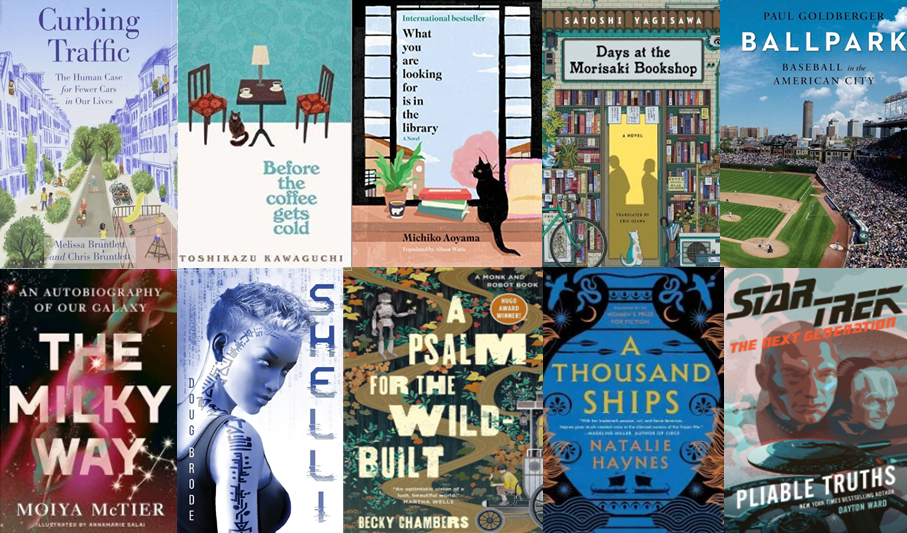
Today’s treble-T is covers with things found in nature, so off to the science shelves I go. Et voila!

Time for Tuesday teases!

I have changed the names of many characters in this book, because most of those people own guns.

Boredom, I knew, was a dangerous thing. For some children, it led to experiments with sex, and drugs, and alcohol, and lighting one another on fire, sometimes with the alcohol. For some of us, the never-ending rural ennui led to destructive habits with literature.

The World’s Largest Man, Harrison Scott Key

[Washington Park’s] prime tenant was a team with the wonderful designation of the Brooklyn Bridegrooms, so named because several of its members chose to marry shortly after the team was formed.

After several years of suffering, the team’s marketing officials tried to make the most of the situation by offering “Croix de Candlestick” pins to fans who stayed through the rare extra inning night games, which showed a snow-capped version of the team’s monogram and had the Latin motto Veni, Vidi, Vixi (slightly changed to “I came, I saw, I survived”). 

Ballpark: Baseball in the American City, Paul Goldberger

Genesis never disappoints, crammed as it is with nudity, murder, and many delicious set pieces involving nudity and murder in addition to DIY boatbuilding instructions.

You can’t help but laugh at these people, who behave exactly like people. When Adam and Eve break the rules and eat the fruit and their eyes are opened and human history begins and God shows up and asks if they did the One Thing He Asked Them Not to Do, Adam, the first man, paterfamilias of all humankind, the archetype for every loving husband in human history, rats out his wife and disappears into the shrubbery.

How To Stay Married, Harrison Scott Key

Posted in General | Tagged , | 10 Comments

Lovers and Other Strangers

Where is this place, this retroland of glamour and sleaze? Where are these tenebrous backrooms and beachfronts vivid with bunting? Not of our time, surely, yet the details of their composition — a provative pose, a yearning expression, a cigarette held just so — are certainly of our world, a kind of limo where past and present elide, a dance to the music outside of time.

Perhaps twenty years ago now, while looking for modded content for The Sims*, a painting to place in game caught my eye. It was of a man and woman at a train station, the man in a somber grey suit and the woman in a bright red dress, their embrace ending a long separation. It was called “Back Where You Belong“, and led to my becoming a fan of Jack Vettriano, a miner who taught himself to paint. A print of that painting and another, “Lazy Hazy Days” now decorate my bedroom, and until very recently (when I hung a print of Grant Wood’s “Spring in Town”) he was the only artist to be featured there. Lovers and Other Strangers collects a hundred of Vettriano’s paintings into a single volume, prefacing them with a biography of the artist, and commentary on his work. There are a few other collections like this on Amazon, all with a theme: another is “A Man’s World” and focuses just on male subjects. This particular collection, as the name hints, is marked chiefly by the ‘torments of romance’, and so incorporates some of my favorite pieces like the aforementioned, plus “Dance Me to the End of Love”, “The Singing Butler”, etc. I’ve included a collage of some of my favorite pieces collected in this volume below, and as you can see Vettriano’s paintings all have a historic setting — though he’s not limited to a particular timeframe. In addition to his characters’ dress, which speaks to past eras like the 1940s, Vettriano’s backgrounds also add to the nostalgic feel, given the frequency of settings like train stations, booming factories, and cozy cafes that have been replaced in modern America by fields of asphalt, the rustbelt, and remarkably ugly fast food chains whose decor says one thing only: give us your money and get out. Romance, love, and even eroticism are a strong part of Vettriano’s work; while he doesn’t paint couples exclusively (many of his works have a sole male or female character, or depict casual socialization between groups of men, etc), they’re arguably his most memorable — sometimes for the beauty, sometimes for the pathos. There’s palpable emotion in a lot of his work, like sorrow, heartbreak, and wistfulness along with the joy and warmth of other paintings. One thing I noticed in studying the gallery in this book is how often there’s a voyeur-type figure in the paintings — spotted in a mirror, hovering in the background. Given the intimate moments we’re witnessing, like a man smoking a cigarette in bed, a letter dangling from his hand and despair on his face — I wonder if that figure is meant to be the viewer, in some way. I’m glad to have stumbled on a copy of this, as there were a few in here that I haven’t seen before despite actively following Vettriano and plotting to fill my entire living space with prints of his work for twenty years.

* Fun fact: things came round full circle, as I made a “Back Where You Belong” painting to include in houses for The Sims 4.

For frights and giggles, here was an early experiment of mine with Bing Image Creator, attempting to recreate “Back Where You Belong” with Frank Sinatra and Amy Winehouse.

Posted in Reviews | Tagged , | 2 Comments

The World’s Largest Man

When Harrison Scott Key was young, his father opted to uproot the family from Memphis and moved to an old farmstead out in the country – -the reason being, a boy needed to grow up outdoors doing things. Harrison did indeed growing up doing those things — attacking the dirt with a shovel in a pretense of farming, sitting in the woods freezing and sneakily reading a book while he was meant to be watching for deer with an intent of obtaining supper — but always felt a bit uncomfortable doing it, like he’d slipped the left boot onto his right foot. He’d rather be grocery shopping with his mom, honestly; that was the kind of hunt he excelled at. The Largest Man in the World is Key’s memoir of growing up as someone who didn’t quite understand his father, and who was not himself understood; the memoir follows him into his own adulthood, as he became a father to girls and developed a newfound appreciation for his own father’s befuddlement. Rod Dreher, a writer from Louisiana, referred to Key’s book as “the greatest, funniest, and tenderest evocations of Southern culture that ever was”, and while I won’t go that far (Rick Bragg and Sean Dietrich, anyone?), this book did keep me laughing all day. Part of it is his frequent absurd exaggerations, which nonetheless capture the peculiarities of growing up in the south; any story worth tellin’ is worth exaggeratin’, as they day. As a teenager listening to the patter around the family table, I often wish I had a recorder to capture the unique way deep-country people talked; not the accents, but the expressions and cadence. That’s also part of the magic here, especially at the beginning. Although the book is definitely funny, it’s not a ‘comic’ book in the way of Lewis Gizzard or someone similar; Key deals with serious themes like racism, people trying to understand one another, and marital issues as well. The latter were hard to read about knowing that Key has recently published a book called How to Stay Married, in which (with his wife’s permission) he reflects on the long night of the soul he and his wife went through after he discovered that she was having an affair.

This funny thing happens when people ask where I’m from, especially when I’m at academic conferences, where people are so often from uninteresting places. “Mississippi,” I say. “Oh, wow!” they say. I can tell they’ve never seen a real live racist before, or at the very least someone who’s related to a racist, or has seen one in the wild. It’s exciting for them. They want to tweet it. They want to write a memoir about it.

For my tenth birthday, Pop presented me with a Remington 12-gauge pump. “This gun right here can kill a grown man,” he said, which made it sound like we’d been trying to kill grown men for many years without success.

I do believe in the power of Jesus and rifles, but to keep things interesting, I also believe in the power of NPR and the scientific method. It is not easy explaining all this to educated people at cocktail parties, so instead I tell them that it was basically just like Faulkner described it, meaning that my state is too impoverished to afford punctuation, that I have seen children go without a comma for years, that I’ve seen some families save their whole lives for a semicolon.

Boredom, I knew, was a dangerous thing. For some children, it led to experiments with sex, and drugs, and alcohol, and lighting one another on fire, sometimes with the alcohol. For some of us, the never-ending rural ennui led to destructive habits with literature.

I enjoy talking about hunting about as much as I enjoy talking about new technologies in women’s hosiery, but I have very few subjects that I can discuss with my father, and those subjects are: Football, Weather, Money, Children, Children Today, Beating Children Today, and Hunting.

The camp house was no gentleman’s hideaway. It was a double-wide trailer, dog pens, a grand old Confederate flag that looked like it had been chewed by aphids and a pack of abused coyotes, the smell of old blood and rotting carcasses; it might have been a kind of romantic hideaway, if you had kidnapped your lover and planned on turning her hide into a lamp.

Out there, the beauty and the violence were all mixed up. Like the time I saw the many-pointed buck swimming across the Coldwater River one January day, perhaps the most sublime scene I have ever witnessed, and how my cousin steered his boat that way so he could stab it in the neck with a knife. It would not have been my first inclination to engage the creature in such brutal gang warfare, but then, I assumed that this was what you did in Mississippi, perhaps because there were so few actual gangs.

It was pretty clear that fights were over dignity and honor and women, and since I had no dignity or honor or women, I felt safe. Nobody had any reason to want to hit me. Then I learned that some people will hit you for no reason at all.

Mom came staggering up from a darkened corridor. “You done had a cigarette,” Pop said. “I can smell it.” “Kiss my butt,” she said. “It’d be a lot to kiss,” Pop said. These were my role models.

n the eighties, when the prevailing wisdom was that American cities were full of gangs, drugs, homeless people who raped joggers, joggers who raped the homeless, and Satanists who sat around sacrificing children and playing Dungeons & Dragons, the narrative of many a film was “moving out to the country” to get away from all the danger. But we knew what the movies did not: that the country was much worse. We had no Satanists, but we did have tractors and hay balers, which I am pretty sure killed more children during that same period than Satan ever could.

My wife was a riddle. I think all women are. Men are not riddles, even the smart ones. We are independent clauses, such as: “I like meat.” “Water feel good.” But a woman is a sentence eighty yards long with no commas, a cryptogram, a Finnegans Wake, and a man is holding the book, and he is trying to read it, and he is confused. “Women are funny,” Pop said, on the phone. “They sure are,” I said.

Posted in Reviews | Tagged , , , , , , | 2 Comments

Neo Cab

This is going to be an unusual review, because Neo Cab isn’t a book. It’s a visual novel that people experience as a video game, a novel set in a dystopia that touches on so many topics — corporatocracy, the multiverse, free will, the way social media reduces people to shallow performance artists — that as soon as I finished, I began replaying it to see what characters and threads I’d missed on my first run. The setup is simple: we open on a gig cab driver named Lina approaching the city of Los Ojos from the countryside, reflecting on the change she’s about to make in her life. An old friend of hers named Savvy, who she had a fight with some time in the past and has not seen since, has just invited Lina to stay with her in the city, and it seems like an opportunity not only to restore their friendship but to make a little coin. Almost immediately, though, Savvy disappears, and as Lina desperately works the streets in her cab trying to earn money to meet the necessities — energy for her car, a place to sleep for the night — she also begins asking questions, trying to figure out what Savvy was involved with and what might’ve happened. The story is nonlinear, evolving as the character chooses different fares for the night, and has different conversations with passengers. They’re a capricious lot, and even fares who seem to like Lina may leave her a three-star review or worse if the conversation doesn’t go a way that pleases them — but conversations that please the fare don’t necessarily bring Lina any closer to the truth. I haven’t re-played the game enough to know if reaching a resolution is inevitable, but in every instance I’ve tried the clues start turning up soon enough. I was personally surprised by how absorbing the story and the characters were: I honestly felt invested in what happened in their fates. The environment is very cyberpunk, of course, from the neon-saturated city to the soundtrack — and the main story is about a group of activists trying to take on a huge corporate behemoth. Lina will get involved with this as she tries to find out what’s happened with Savvy, though their relationship is more important to the exact ending one gets than the player’s decisions to take on Capra. This isn’t Tech Support Error Unknown where the player’s role as a tech troubleshooter makes them choose between hacktivists, the corporation, and the police. There’s also the disturbing amount of bio-tech and human augmentation, from people having holoscreen surrounding their heads to one girl living in a mechsuit to protect her from the elements. Although the ending is a little rushed, between the writing and the aesthetics Neo Cab is unforgettable and cool.

Posted in Reviews | Tagged , , , | 4 Comments

The Royal Society

Over ten years ago I devoured a history of science series by Ray Spangenburg and Diane Kit Moser that played a large part establishing my basic adult understanding of science. While reading it, I was particularly fascinated by the role that the Royal Society played in the scientific revolution, and it has remained an object of interest ever since. The Royal Society is a very brief history of the titular institution, from its beginnings as an informal gathering of ‘natural philosophers’ and continuing to the present day. Its quite readable, but lamentably short: scarcely over a hundred and twenty pages, in fact, because there’s a hefty appendix with biographies of some of the Society’s more notable Fellows. The Society’s early decades are easily the most interesting, given the period of science they capture: this was an era where amateurs could make significant contributions to scientific fields, when polymaths and generalists predominated instead of hyper-specialists. The best minds of Europe were beginning to unravel some of the most fundamental secrets of nature, laying the foundation for the industrial revolution, modernity, and the conquest of humanity by its own devices. The Society was part of this, publishing papers and funding expeditions across the world — or, badgering ship captains to bring them something interesting. Although some women had connections to the society, presenting lectures and even receiving medals, not until after 1945 when corporations and the like were banned from discriminating on the basis of six were women admitted as Fellows of the society. Although I enjoyed this as a light history of the Society, Bill Bryson’s edited collection of essays on the Society’s influence, Seeing Further, is more substantive.

Posted in history, Reviews, science | Tagged , , , | 2 Comments