
Ya know we used to be mad love
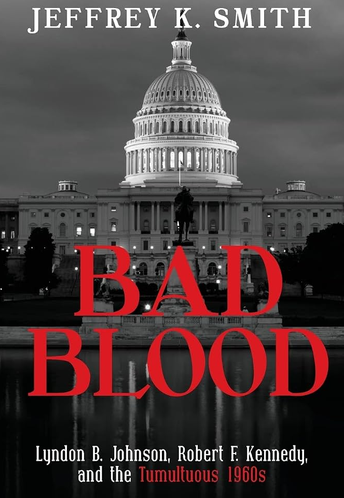
When LBJ mentioned that Joe Kennedy’s son Robert would be excellent at leading something like NASA, RFK recorded this in his diary. The master of the Senate thought he had potential! Only a few years later, however, RFK and LBJ would stare at each other in contempt, and when LBJ inherited the Presidency following JFK’s assassination, his brother would stand down rather than serve long a man he hated. Bad Blood is the story of how Johnson and Kennedy’s relationship turned into a summer squall, black and crackling with lightning. The book is preceded by a note from the author that he feels endnotes and footnotes impede truly narrative history, but having immersed myself in presidential politics for the last two months, I saw nothing untoward — and the narrative was a cracking good read.
I rather looked forward to this book, because its stars are two men whom I dislike — but about whom I wanted to learn more. Bad Blood allowed me to start learning about LBJ and RFK without diving into a full biography, and made me intrigued about both men. LBJ was essentially a career politician: he came from a family of Texas politicos, and after a brief stint at teaching moved into the family racket himself. He developed ‘leadership’ skills early, bossing his younger siblings around, and would only grow in manipulative acumen as the years progressed. While he wasn’t exactly born into poverty, it was still a hardscrabble life. Bobby Kennedy, on the other hand, was born with a titanium spoon in his mouth — but was overshadowed by his brothers. He was the family runt, the one destined to be forgotten. It was one of his brothers, JFK, who would bring RFK and LBJ together — and make them antagonists.
After Joseph Kennedy Jr died in an experimental mission in World War 2 (flying a plane packed with explosives, with the intent of bailing out so that the plane could then be remotely-steered as a guided missile), JFK assumed the responsibility of being the family’s political face. The don of the Kennedy clan, Joe Sr, pitched the idea to LBJ of running for president and taking Jack with him as VP — but LBJ had no interest in throwing away money and energy challenging Eisenhower. By the time LBJ was ready to run for the White House, he and Jack were direct competitors — and LBJ was a hard campaigner. Smith writes that RFK was offended by LBJ not wanting to run with JFK in ’56, and outraged by LBJ’s attacks on the Kennedys during the primaries. A young idealist, he also didn’t like brother Jack contemplating bringing LBJ on as his running mate, even if LBJ would bring the South with him. LBJ was both cunning and crude, and RFK didn’t have JFK’s easy ability to work with those who differed from him. I’ve gotten the sense from other books and especially from this one that RFK had a hard personality: he wasn’t at ease with people the way his brothers were, and definitely not a natural politician. Although he’d win a senate seat — with LBJ’s help — he struggled there in a way that JFK and Ted simply didn’t. Once JFK was shot, LBJ inherited his presidency — and, Smith argues, entered into a contest with RFK over JFK’s legacy. RFK had been the number two man in DC, with LBJ sidelined despite being vice president, but on November 23, 1963, he was as Jimmy Hoffa said, “Just another lawyer”. As LBJ settled into power, RFK became more of an open critic of him, particularly on Vietnam– and while they met cordially, their relationship never had time to heal before RFK met his own end at an assassin’s bullet.
This was a riveting, fascinating, but sad read. I regard LBJ as the most vile human specimen to ever sit in the Oval Office, a man who was obsessed with his genitalia who loved physically humiliating others by forcing them to meet with him while he was on the toilet & so on — and as a libertarian I am of course against his engorgement of the federal government, good intentions or no. This book left me with the impression that his concern for the poor was sincere, however, not simply politically useful, and we’re allowed to see the poisoned flower of Vietnam burst into bloom and then completely destroy Johnson’s presidency and arguably the man himself. There’s such a sad irony that LBJ and RFK were both driven by concern for the poor, but could not tame their egos — more in RFK’s case, surprisingly — enough to realize that. RFK did bounce the idea of running as LBJ’s vice president in the ’64 election, but LBJ had no interest in running alongside a man who was a persistent critic and scold. (RFK would become more critical of LBJ’s Vietnam policy as more troops were committed.) And there’s the sadness of RFK, too — a man whose humanity is allowed to emerge after he was broken by his brother’s death. While in my other reading he is consistently a jerk — to use polite language- – after JFK’s death he appears to become more …human. And just as he’s starting to find himself, some human turdlet inflicted the shock and anguish of murder on the Kennedys yet again.
Bad Blood was unexpectedly illuminating. More RFK to come…
Quotes:
LBJ’s long-time aide and future Texas Governor, John Connally, described his mentor’s powerful personality: “There is no adjective in the dictionary to describe him. He was cruel and kind, generous and greedy, sensitive and insensitive, crafty and naïve, ruthless and thoughtful, simple in many ways, yet extremely complex, caring and totally not caring. He could overwhelm people with kindness and turn around and be cruel and petty towards those same people. He knew how to use people in politics the way nobody else could that I know of. As a matter of fact, it would take every adjective in the dictionary to describe him.”
In late August, Jackie Kennedy began hemorrhaging, and was rushed to the hospital. An emergency C-section was performed, but the baby girl was stillborn. Meanwhile, Jack was on a private yacht, thousands of miles away, enjoying the company of other women. When he received the tragic news, JFK initially refused to end his vacation and return home to his wife. Two days later, Senator George Smathers, who had accompanied Jack on the pleasure cruise, convinced the seemingly insensitive and uncaring husband to return home: “You’d better haul your ass back to your wife, if you ever want to run for President.”
On March 15, 1958, JFK addressed the annual Gridiron Dinner in Washington D.C., and joked about his political future: “I dreamed about 1960 the other night, and told Stuart Symington and Lyndon Johnson about it yesterday. I told them how the Lord came into my bedroom, anointing my head, and said, ‘John Kennedy, I hereby anoint you President of the United States.’ Stu Symington said, ‘that’s strange, Jack, because I had a similar dream last night, in which the Lord anointed me President of the United States and outer space.’ Then Lyndon Johnson said, ‘that’s very interesting, gentlemen, because I, too, had a similar dream last night, and I don’t remember anointing either one of you!’”
Jackie Kennedy was refreshingly honest: “I think it’s so unjust of people to be against Jack because he’s a Catholic. He’s such a poor Catholic. Now, if it was Bobby, I could understand it.”
On Inauguration Day, a photographer for United Press International, who had known RFK for many years, jokingly asked: “Well, Bobby, what are we supposed to call you now? Is it Bobby, or Attorney General, or General, or Sir?” “Just call me son of a bitch, because that’s what everybody else is going to be doing,” Bobby replied.
In the weeks following JFK’s assassination, RFK exhibited a dark sense of humor. On one occasion, Bobby asked a friend: “Been to any good funerals, lately? I don’t like to let too many days go by without a funeral.”
While the credibility gap ultimately exposed LBJ’s duplicity to the world, those who observed him closely (advisers, fellow politicians, and reporters) had long been aware of his propensity to stretch the truth. Some of the lies were harmless—such as his preference for bourbon (like all good Texans), when he really drank scotch. Other falsehoods achieved whopper status—LBJ claimed his uncle fought at the Alamo, and that he had earned his Silver Star for “helping shoot down twenty Zeros.” Editing a speechwriter’s draft, LBJ scratched out the name Socrates in a quotation, and replaced it with “my Granddaddy.”
“A man can fight if he can see daylight down the road, somewhere. But, there ain’t no daylight in Vietnam. There’s not a bit.”
Kennedy made light of his campaign’s strengths, in a conversation with Ted Sorensen: “I’m the only candidate who has ever united business and labor, Southerners, party bosses, and intellectuals. They’re all against me.”
“It must be quite something to land at an airport named for your brother,” the newsman opined. “I wish it was still called Idlewild,” RFK softly replied.
In New York City, Jackie Kennedy was awakened by a telephone call from her brother-in-law, Stas Radziwill: “Jackie? How’s Bobby?” “He’s fine, terrific. You heard that he won California by (with) 53 percent, didn’t you?” the former First Lady replied, having retired for the evening, after RFK was projected the winner in the primary contest. “But Jackie, he’s been shot. It happened just a few minutes ago,” Radziwill informed her. “No! It can’t have happened!” Jackie exclaimed, realizing that her shocking premonitions about RFK’s fate had come to fruition, “No! It can’t have happened!”
Related:
“Why Don’t You Like Me?” Woody Harrelson’s LBJ confronts RFK in the Oval Office.


Pingback: Top Ten Books on Autumn 2026’s TBR | Reading Freely