
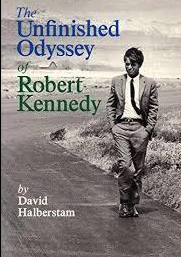
David Halberstam was already a seasoned reporter when he began covering RFK’s fatal 1968 bid for the presidency. The bid itself was almost dead on arrival; RFK dragged his feet on deciding, and continually probed those around him as to whether or not he should. “No,” said the party leadership, “Wait until 1972.” LBJ still had a second full potential term to look forward to, after all, and going in 1972 would allow for a lot more groundwork than a scant few weeks RFK was giving himself before the primary season opened. RFK decided to go for it, regardless: LBJ was sinking the US deeper into the mire of Vietnam, and while Eugene McCarthy was vying for the Democratic nomination on that point alone, RFK didn’t think McCarthy had any platform besides escaping Vietnam. Unfinished Odyssey is a history of that campaign.
If I’d known the scope of the book was so narrow, I probably wouldn’t have bothered, but I’m newly curious about RFK and I’ve enjoyed Halberstam’s baseball books before. I’m interested in RFK the man — particularly the man who worked and cried for Joe McCarthy, who criticized LBJ’s Great Society for simply throwing money at problems, and yet who remains an icon of liberalism– rather than the campaigner. The book has the virtue of showing RFK in his final days, as he would be gunned down immediately after winning the California primaries, and has some additional interest in that the author was directly involved in following it. Halberstam in fact writes about himself sometimes, especially in Indiana when he and the other reporters were bored by the rubes and complained about everything from the restaurants to the accommodations. The book is presumably intended for the RFK devotee who wants to read about “Bobby’s Last Campaign”, as Halberstam doesn’t bother giving any introduction or background to RFK himself until the last third of the book where he’s reflecting on what RFK meant to him, then and now. An interesting title, but again not one I would’ve bothered with had I not recognized the author and been generally curious about its principle subject. Although a lot of this is just about the art of electioneering, we do get to see RFK’s personality at times — in particular, his genuine curiosity about, and interest in, the lower classes that DC loves to ignore.
I must admit he’s growing on me a bit.
Quotations
A well-known columnist once asked for a copy of his speech. “What do you care?” [Gene] McCarthy asked back, “You’ve never accurately reported my speeches before.”
Part of it was that he was a Kennedy, which meant that everything was bigger than life. He could not be judged like other men; more had been given to him, more was expected of him, and more would be doubted about him.
Another kid asked a belligerent question, a question filled with hate spilling over so that in the end one forgot what the question was about and remembered only the hatred and the edge and the bitterness. Kennedy, a little tired, answered, “What we need in this country is to cut down the belligerence. If we let this hatred and emotion control our lives, we’re lost.”
Bright, upper-middle-class kids, children of affluence, they believed in the doctrines of the New Left, that if a society is wrong you can do anything you want to redress it, and if someone says something you don’t like, you can drown him out and deprive him of his speech. It was an ugly hour, for one sensed that it would get worse, that this was not going to be the last such evening in American life.
Then he descended to acknowledge his victory, to talk about the violence and the divisiveness, and to let a nation discover in his death what it had never understood or believed about him during his life.


