
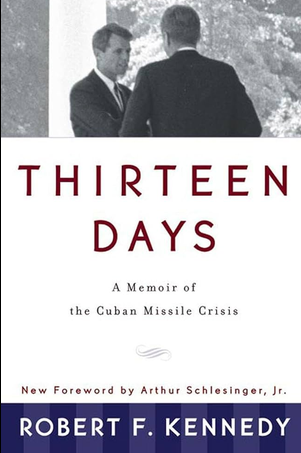
The Cuban Missile Crisis is the closest time the Cold War came to turning into a hot war, and (presumably) a global holocaust. RFK served the President most immediately not as his attorney general, but his confidant and advisor. Thirteen Days is a memoir — in part — of the crisis from a man who was embedded in it almost as long as the president himself. RFK was one of the first people notified by the president about the new intelligence, and his closest confidant during the crisis. The book isn’t just a record of RFK’s memories, though, but contains his views on important lessons from it. RFK stresses how the United States acted within the framework of international cooperation, for instance: JFK had enlisted the support of the entire Organization of American States, which added weight to his protestations about nuclear missiles in Cuba. He also stresses how JFK labored to understand events as they might be interpreted within the Kremlin: with humanity itself at stake, he could not afford any ‘my way or the highway’ thinking. The book was not in a finished state when it was published following RFK’s assassination: RFK had intended to add to his memories of the two weeks a reflection on ethics in the nuclear age. in place of that, Richard Neustadt and Graham Allison offer their own reflection on what the Crisis meant, the futility of nuclear war, and the role of the Constitution in immediate crises like this. It’s a very short work (~100 pages or so), and best read knowing something about the context of the era, but I wanted to experience RFK as an author.
Quotations
My belief when I went to Havana was that we had over-dramatized the danger. After all, Nikita Khrushchev, the Soviet leader, was well aware that the United States had conventional superiority in the Caribbean and nuclear superiority overall. As a rational man, he would never have launched a suicidal war. This complacent view did not survive the conference. Going to war is not necessarily a rational process. – from the preface by Arthur Scheislinger Jr
Keep strong, if possible. In any case, keep cool. Have unlimited patience. Never corner an opponent and always assist him to save his face. Put yourself in his shoes—so as to see things through his eyes. Avoid self-righteousness like the devil—nothing is so self-blinding.” – Basil Hart. From the preface.
Each one of us was being asked to make a recommendation which would affect the future of all mankind, a recommendation which, if wrong and if accepted, could mean the destruction of the human race. That kind of pressure does strange things to a human being, even to brilliant, self- confident, mature, experienced men. For some it brings out characteristics and strengths that perhaps even they never knew they had, and for others the pressure is too overwhelming.
“It isn’t the first step that concerns me,” [President Kennedy] said, “but both sides escalating to the fourth and fifth step—and we don’t go to the sixth because there is no one around to do so. We must remind ourselves we are embarking on a very hazardous course.”
Opinion, even fact itself, can best be judged by conflict, by debate. There is an important element missing when there is unanimity of viewpoint. Yet that not only can happen; it frequently does when the recommendations are being given to the President of the United States. His office creates such respect and awe that it has almost a cowering effect on men. Frequently I saw advisers adapt their opinions to what they believed President Kennedy and, later, President Johnson wished to hear.
We had virtual unanimity at the time of the Bay of Pigs. At least, if any officials in the highest ranks of government were opposed, they did not speak out. Thereafter, I suggested there be a devil’s advocate to give an opposite opinion if none was pressed.
While I was there, [President Kennedy] placed telephone calls to former Presidents Truman and Eisenhower. As I was leaving, he said, making reference to Abraham Lincoln, “This is the night I should go to the theater.”
THE FINAL LESSON of the Cuban missile crisis is the importance of placing ourselves in the other country’s shoes. During the crisis, President Kennedy spent more time trying to determine the effect of a particular course of action on Khrushchev or the Russians than on any other phase of what he was doing. What guided all his deliberations was an effort not to disgrace Khrushchev, not to humiliate the Soviet Union, not to have them feel they would have to escalate their response because their national security or national interests so committed them.
As mentioned before, Barbara Tuchman’s The Guns of August had made a great impression on the President. “I am not going to follow a course which will allow anyone to write a comparable book about this time, The Missiles of October,” he said to me that Saturday night, October 26. “If anybody is around to write after this, they are going to understand that we made every effort to find peace and every effort to give our adversary room to move. I am not going to push the Russians an inch beyond what is necessary.”
“The fourteen people involved [in Ex-Comm] were very significant…. If six of them had been President of the U.S., I think that the world might have been blown up.”


The Cuban Missile Crisis could very well have been *IT* for our civilisation if not our species and I can’t help but be drawn to it. This insider take has been on my ‘interest list’ for a while. Its a pity that he never got the chance to finish it.
It is! He strikes me as a very thoughtful person.