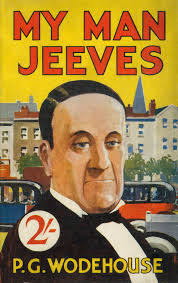
My Man Jeeves

My Man Jeeves
© 1919 P.G. Wodehouse
132 pages
“There’s only one thing to do,” I said.
“What’s that?”
“Leave it to Jeeves.”

What ho, readers all!   My Man Jeeves renews my acquaintance with young Bertie Wooster, exemplar of the aristocracy in decline.  Bertie has loads of money and no sense in the least, but is saved from the worst of his foibles by the ever-present Jeeves, he of the unrivaled brilliance.  The work gathers a handful of Bertie-and-Jeeves stories,  ranging from the whimsical to the inane.  There are also a couple of stories about Reggie Pepper, a  character who was a prototype for Bertie, and is just about as thick but lacks a Jeeves to see him through.   If he survives, let alone triumphs, it is only through that bit of wisdom that God preserves fools.  The premise is the same in this as in other collections; either Bertie himself, his aunts, or his friends have gotten him into a fix, and Jeeves must contrive to find a way out of it.  Plots thicken, Jeeves stirs, Bertie’s out of the soup and into his recliner to enjoy a whiskey and soda and contemplate the wonder that is his man Jeeves.

In this collection, his friends are typically the culprits.  One notable exception is the arrival at his American apartment of one of his dreaded Aunt Agatha’s friends. She is on a tour of American prisons and wants Bertie to take care of her intensely repressed son, Wilmot. No sooner has mummy dearest run off on business than has Wilmost escaped the apartment to engage as much sordid revelry as he can. This is his one chance to accumulate a storied and sinful past, and he’s intent on making the most of it. It’s up to Bertie to keep him from ruining his health with all-night binge drinking and partying, so naturally the ward winds up in prison. There’s often an element of backfire here;  Jeeves suggests, for instance, that if friend Corky wants his uncle to approve of his girlfriend, that they arrange to impress said uncle with the young lady’s authorship of a book on said uncle’s favorite subject – not expecting the uncle to be so taken with her that he  marries her.  The Reggie stories are all backfire  While Bertie’s scrapes and Jeeves’ ingenuity are fun reading in themselves, as I’ve noted in prior volumes, part of the fun of reading Wodehouse is the writing.  Bertie is an eccentric character and an enthusiastic narrator,  the sort who manages to make sitting in a  chair fun to read about. He’s like laughing gas, nonsensical and with a contagious effect.

“Lady Malvern was a hearty, happy, healthy, overpowering sort of dashed female, not so very tall but making up for it by measuring about six feet from the O.P. to the Prompt Side. She fitted into my biggest arm-chair as if it had been built round her by someone who knew they were wearing arm-chairs tight about the hips that season.”


Here, in a sentence, is part of what makes Bertie a ball to read. There’s such energy to his narrative, the way he slings out descriptive fun with a healthy sampling of odd slang, some of it assuredly made up on the spot.  There is no one funnier to read out loud than P.G. Wodehouse, especially if you do it in a Hugh-Laurie-as-Wooster voice.  Even more giggles are to be had from Bertie’s interactions with Jeeves, who reins in his employer’s questionable fashion choices and is often allowed to destroy an offensive article as a reward. While Bertie professes to resent being dominated sartorially by his valet,  Jeeves is such a master at getting Bertie and company out of trouble, getting rid of pink ties and colorful sports jackets are a small price to pay.  If your interest is piqued, My Man Jeeves is available online for free via Gutenberg,  or through Amazon. 

Posted in Reviews | Tagged , , , | 2 Comments

Frodo’s Journey

Frodo’s Journey: The Hidden Meaning of the Lord of the Rings
© 2015 Joseph Pearce
158 pages

Noting that Tolkien’s Lord of the Ring trilogy is rich with symbolism is rather akin to observing that the Pacific Ocean is big. The description is accurate, but weightless. Frodo’s Journey examines much of its symbolism in detail, chiefly elaborating on Tolkien’s observation that it was, “of course, a deeply religious work”. The religion is present not in the trappings of a Church, as with Asimov’s Foundation series, but in the epic’s core story of grace against evil.   Pearce informs his argument by studying the details of the story in the context of Tolkien’s mythic background, drawing from the Simarillion. Although his focus is on Tolkien’s Christian symbolism, Pearce also touches lightly on Tolkien’s love for the language and lore of pre-Norman England.

In the Simarillion, Pearce writes, Tolkien establishes a celestial atmosphere not unlike the Christian one. There is one central deity, the Iluvatar, who creates the Cosmos by conducting music. One heavenly musician refuses to play in harmony, and is struck down to Middle-Earth, but is told that no matter how much discord he attempts to introduce,  the grand master will always restore harmony..  Central to the story of the Lord of the Rings is, of course, the Ring, which is far different from the ring of The Hobbit. There it was a mysterious but powerfully helpful object;  in the Ring trilogy, it dominates the minds and hearts of those who wear it, and exposes them to attack by dark forces.   The ring, writes Pearce, is Sin – not only is it burdensome, but taking it on distances the wearer from the good world which was divinely created, and makes them more visible to the Dark Lord – Sauron,  Morgoth’s chief servant.  The coup de Grace:   according to Return of the King,  the ring was destroyed on March 25, the same day that Catholic tradition maintains was the date of the historic crucifixion.  The whole story has the stamp of Providence on it, writes Pearce, for Gandalf muses that Bilbo was meant find the Ring, so that it might be destroyed.  Although Pearce’s brief work shines a light on many of Tolkien’s other little allusions – the Charlemagne-like crowning of Aragon, the linguistic fun Tolkien has with the “far-seeing” stones that dispirit Sauron’s enemies and have the same etymological structure in Elvish as Television and Fernsehen do in English and German,   the Christian connection is the most broadly developed.

This meaning is not nearly as overt as C.S. Lewis’ own Narnian chronicles,  in which the Christ-figure Aslan announced to the children that he was known by another name in their world, but it definitely registers.  Being as Tolkien was a practicing Catholic, some degree of the inspiration could have been accidental, like the Mary-like veneration of Galadriel, but the use of dates has the stamp of deliberation.  For the Fellowship to have started out on December 25 (by Tolkien’s appendix) and triumphed on the same date of the first Good Friday makes clear that Tolkien was paying homage at the very least.   While this is my first foray in reading books about the Ring trilogy, it won’t be the last, and I’m eager to see if other authors share or differ from Pearce. I’m sure the trilogy has tremendous depths to plumb!

Posted in Reviews | Tagged , , , , , , | 2 Comments

The Invisible Man

The Invisible Man
© 1897 H,G, Wells
149 pages

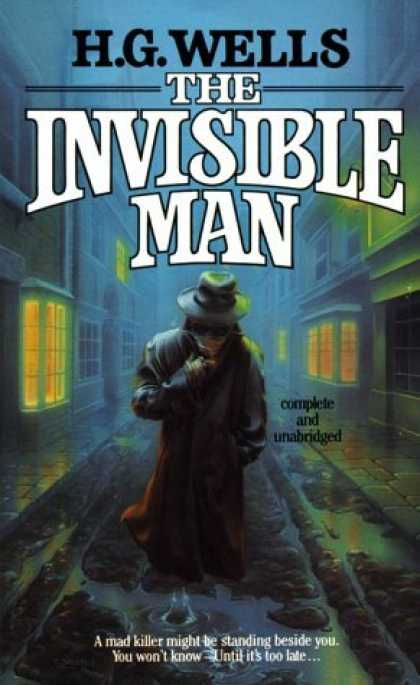
The Invisible Man opens with the arrival of a Mysterious Stranger to a country inn. He is covered from head to toe, and remains so even after he takes a room. The townsfolk don’t know what to make of the irritable visitor who insists on wearing gloves, a hat, and goggles indoors, and peevishness only intensifies their curiosity. That, and the fact that his luggage consisted of a small library and an enormous set of chemical apparatus.  The more time he spends with them the more suspicious he seems, and those who keep trying to get a feel for the man notice…curiosities. For instance, once his sleeve seemed to be empty, yet it moved in a way that would be impossible for an amputee’s.  Driven to frustration by their constant prodding, the visitor reveals that he is, in fact, an Invisible Man. From there, the plot is one of spectacle, siege, and violence as the Man lashes out in desperation. The other villages think the people in the first hamlet are lunatics, but soon the “madness” spreads as he moves. His every encounter results in contemptuous treatment of the terrified people he meets, followed  by attempts to subdue people with inexplicable force. It turns out that the English winter is not the best time to embark on an experiment in invisibility.  Invisible he may be, but he still still needs clothing and food — and both expose him.   Eventually the Man is cornered when he attempts to enlist the help of a university colleague. That man, Kemp, listens to his story but can’t help but notice that the Invisible Man seems to be the one instigating all of the trouble. He is especially bothered by the Man’s account of nicking a man’s goods….from his very house. This is England, you transparent lout, don’t you know a man’s home is his castle?  When the Man reveals that he wants to inflict a profitable Reign of Terror on England, that’s the last straw.  A trap is sprung, the man is caught, and when he dies the electro-chemical process he exposed himself to wears off to reveal him.  That’s that.

The Invisible Man is curious, as compared to the other Wells novels I’ve read. It drops the reader right into the middle of the character’s story, and doesn’t consist of any thoughtful narration. In recapping the story, I’ve attempted to be as sympathetic as I can, attempting to frame him as a man driven to desperation by the miserable condition he inadvertently cast himself into.  It’s a bit of a stretch, though, because the Invisible Man is a grump from page one, as though the invisibility simply escalated his own disdain and short temper. His intelligence is all technical; he doesn’t have the least bit of tact or strategy in his head.  A Reign of Terror in England? Sounds awfully French.   I don’t know if Wells was aware of the old Greek story about a ring that makes the wearer invisible and quickly immoral, but the lesson certainly applies to our fellow here.

This is a fast story, with the feel of horror.. The Invisible Man is more a monster to be feared than a man to be awed by or pitied.

Posted in Reviews, science fiction | Tagged , , , | 5 Comments

Lord of the Flies

Lord of the Flies
© 1954 William Golding
156 pages

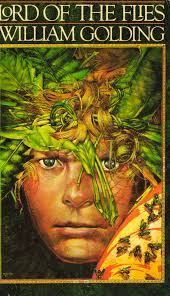
A group of boys marooned on a tiny Pacific Island must work together, battling the elements and one another. If they don’t adapt, they’ll be voted off the island — or thrown off.   It’s not Survivor, it’s Lord of the Flies.  You know the story, of course.  A plane crash dumps a score or so of boys onto an island,  an attempt at restoring civilized order is made, but it falls apart in tribalism and bloodshed.  In taking a group of creme de la creme school children, some of them literally choir boys, and placing them in an idyllic setting that leads only to chaos and death, Golding offers not an adventure story but a reflection human nature.

The island not only abounds in food, but is predator-free. Coconuts, fresh water, and timber for making shelter are everywhere for the taking. Despite this, the boys become increasingly psychologically stressed, a plight made worse by the ambitions of one to become the next Chief.  This idyllic bloodshed directly repudiates the myth of the noble savage, though, maintaining that there is something dark and irrational within man that will devour society from within if it is not tamed.  Yet there is something irrational outside in this story, something that makes it a near-fantasy, because the boys are haunted by some Beast that attacks from the sea, from the trees, from the air. It’s not simply a parachuted corpse they dread; at one point the Beast directly taunts one of the boys, and another time they enact murder under some sort of a mass delusion that one of their number is the Beast.  What keeps the boys together as long as they were is the proud memory of being English, and therefore devoted to good order and setting things aright.   The intelligent thing to do, maintains their leader Ralph, is to maintain a signal fire — but the fun thing to do, the thing that enchants the senses and drives the boys to madness, is putting on war-paint and hunting pigs. The madness and chant of the hunt will so consume the boys that murder joins them on the island, though they are saved from destruction by Her Majesty’s Ship, the Deus ex Machina.

This is a grim little story, of course, but a welcome rebuttal to those who today believe everything would be peachy-keen if it weren’t for this politician or that program or lack thereof.  The ‘beast’ isn’t so mild that it can be drawn out of the sea with a hook.

Posted in Reviews | Tagged , , , , , , | 8 Comments

Reads to Reels: Great Expectations

“Hallo! Here’s a church. Let’s go in. Hallo! Here’s some gloves. Let’s put `em on! Hallo! Here’s Ms. Skiffins. Let’s have a wedding!” 
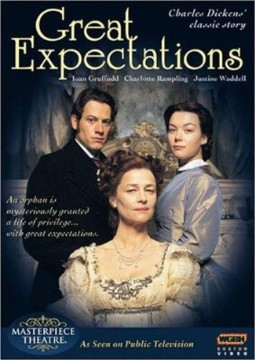
I’ve never done a reels this close on the heels to a read before, but there’s no waiting with a movie that stars Ioan Gruffud and Ian McDiarmid! As soon as I discovered my library had this, I wanted to watch it, and waited only until I had finished the final pages of the book to begin.  This version is a 1999 television miniseries, but I thought it was marvelous.  Having just finished the book yesterday, of course, I caught a lot of the alterations made to the book.  A lot of frankly tedious scenes are dispatched with single lines here while characters are moving to action to action, and the attempted escape exit of Pip’s Mysterious Patron is simplified nicely.  The Masterpiece host informed me at the end of the movie that there were two endings to Dickens’ novel; the original had Estella married off to someone else, and a second ending left the matter of Pip and her relationship more ambiguous. The movie plays to the idea of the second ending, though in a far more spiriting way: the final shot is of Pip and Estella playing cards in a now-restored Satis house, not as lovers but together still. 
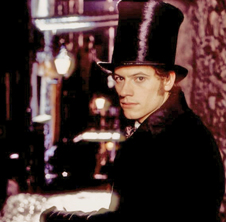
 Casting was on the whole superbly done, with the exception being Miss Haversham.  Yes, that’s her on the cover, looking considerably less deathly than she’s described in the book. She looks more appropriately corpselike in the actual film, but was too lively for the part.  Ian McDiarmid’s casting as the lawyer Jaggers makes him absolutely sinister in retrospect, since the modern viewer is half expecting him to give a menacing smile and send Pip off on some murderous mission involving a sabre.  I know Gruffud from the Horatio Hornblower movies, and here he looks and sounds very much like good ol’ Horry. He starts the film off affecting a brogue, but once he begins his education as a gentleman he reverts to RP. (Hearing Gruffud speak with anything less is jarring, especially when he did an American accent in Fantastic Four.)   As a curiosity, I’m tolerably sure the fellow who plays Wemmick (Jaggers’ clerk and a friend to Pip) played the traitor Wolfe in the A&E movies, shot around the same time. He was a sterling addition here.  

Good pacing, excellent actors, nice music — the only fly in the soup here is that midway through, Masterpeice SPOILS THE MOVIE’S ENDING! It’s a television miniseries, consisting of two episodes, and midway through they stick in the preview trailer for the second half. The trailer actually gives away the patron’s identity long before he appears in the movie properly.  I am astonished that PBS created a trailer that completely wrecks the twist,  and doubly so that they stuck it into the middle of the film. If you watch it with someone who’s never seen the film, you’ll need to fast forward through that bit.  Otherwise, it’s a winner.

Posted in Reviews | Tagged | 2 Comments

Great Expectations

Great Expectations
© 1861 Charles Dickens
544 pages

Pause you who read this, and think for a moment of the long chain of iron or gold, of thorns or flowers, that would never have bound you, but for the formation of the first link on one memorable day.

A chance encounter with a desperate and threatening convict in the dark marshes near his home, followed by an inexplicable invitation to a reclusive spinster’s home, creates for young Pip an unexpected adolescence.  Pip is an orphan, a boy who lives with his weary and frequently abusive sister and her ironmonger-with-a-heart-of-gold husband, Joe.  The two events are not as random as they appear, with connections that will be exposed throughout this story of Pip’s young life as he grows into a twenty-something with a lot of mistakes behind him.  More overtly pivotal is a third event, the arrival of a lawyer who announces to Pip that someone, somewhere, has taken an interest in him with the intention of making him into a gentleman. There is more to being gentle, however, than having money.

When I think of Dickens, I think of dirt — of miserable hovels, filthy laborers,  dark streets filled with muck and offal, grimy oil lamps whose meager light masks even more despairing conditions. Great Expectations provides that amply, though not in the places to be expected. One of the more harrowing settings is the interior of a great house, Satis, which has been closed to the light and left to decay after a woman’s heartbreak. When Pip meets the woman, Miss Havisham, she is much aged, more through anguish than time.  She is a woman utterly consumed by her grief, literally living in it: jilted by a fiance decades ago, she continues to wear a tattered bridal dress and lives in a room featuring the rotting remnant of her bridal feast. She proves to be a pivotal figure for Pip, not because she is the author of his (mis)fortune, but because she introduces him to someone who will be: her adopted daughter, Estella.  Estella she has raised to be the ruin of men, a siren whose rocky core breaks their hearts like flimsy ships. Pip, is literally starstruck and will spend the entire book pining for her — accepting a mysterious fortune and reforming his manners and expectations to please her. For her, he will leave his sister and dear brother-in-law Joe behind; he will forget them entirely, ashamed of their tiny house and the dirty forge, their rough hands and woeful habit of referring to knaves as jacks within the card deck.

For all his being enraptured by Estella — who, to her credit, does attempt to warn him off repeatedly —  Pip’s eyes are not so clouded that he doesn’t come to realize the mistakes he is making. Eventually the person who has been providing him this mysterious fortune appears, and there are complications — creditors and men waiting at the gallows, desperate attempts at escape and plans foiled.  Pip will have to be rescued by some of the people he has left behind, and this time is properly ashamed — not of them, but of his own cretinous behavior.  The ending doesn’t have the resolution I would expect — a man rescued, the girl gotten —  but it’s truer for that, given that every thing has its cost.  Great Expectations was an utterly riveting story. I approached it with dread, having started it last year and then fallen off the track, but this year I couldn’t put it down. I was ever surprised by Dickens’ humor. I expect his work to be Very Serious dramas about the plight of orphans and the poor and such, but there’s giggle-bits everywhere, from the characters to the narration. There’s even a fart joke. (For shame, Dickens!) One bit of whimsy is a character directly and consistently referring to his senile father as The Aged Parent.  Expectations brims over with remarkable characters, most notably the haunted Havisham and  the extraordinary Magwitch,   Although I still have my sentimental attachment to A Christmas Carol, Expectations definitely deserves its status as Dickens’ best.  Well over a century and a half after its publication, the story still resonates.

Posted in Reviews | Tagged , , , , , | 8 Comments

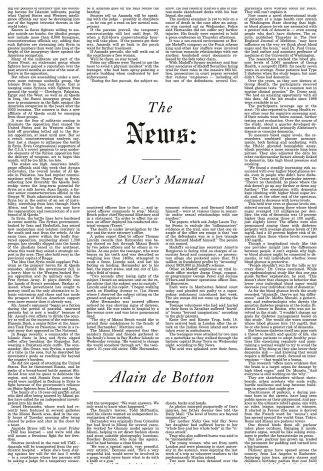
The News

The News: A User’s Manual
© 2014 Alain de Botton
272 pages

The news more than any other modern institution has taken the role of shaping a nation’s collective consciousness, but  what shape does that leave us in? Alain de Botton’s The News:  A User’s Manual invites readers to think critically about the way consuming news through papers, the television, and online distorts our perception of ourselves and the nation in which we live, and ends with suggestions on how to  make the news more meaningful. His intent is not to awaken anyone to media conspiracies, but to stir the reader’s soul, to spark an interest in human flourishing which has undergirded virtually everything else de Botton has written. This is more than anything a work of practical philosophy.

How can the news have a philosophy?  Modern media outlets like to stress that they are unbiased reporting; they provide Facts, not idealism.   Sure they do, and to what end? In a similar work, Neil Postman asked the reader,  in view of their time spent watching and worrying about the news, what they intended to do about plague in Africa, wars in the middle east, and national inflation. The answer was, of course, absolutely nothing. There’s nothing we can do about such things, and to devote energy to considering them just turns us into distracted stress-heaps.  The news-generating organizations claim to simply report what happens, but there is a bias in the selection of the facts: the ones they choose are those most liable to snag attention, either because they portend doom or because they’re utterly horrific. We might listen to the global news to feel connected to the human cosmopolis, but how effective in that goal is listening to the daily toll of scandal and disasters, really?  We are numbed by the barrage of purposeless facts, distracted – in  Postman’s words, amused to death.

No point is made in stories about politics or disaster to connect them to our lives, to craft a story that we will respond to.  Even photographs are stupfyingly functional, included more as proof that the news article isn’t pure fiction. But the photograph of a Syrian man weeping as he holds his son, killed amid civil war, delivers far more emotional resonance than an article by even the most talented author.  De Botton imagines redesigning newspapers along themes of human interest,  . This is not some eccentric notion solely about the news that de Botton has; in Religion for Atheists he imagined redesigning museums to feature art about various themes of import (a Hall of Charity, for instance), and has written books like The Architecture of Happiness and  The Art of Travel, ever with an eye for how to increase human flourishing.  As with the suggestion about redesigning museums, it is difficult to imagine any media executive putting this advice to work.  It requires thoughtful imagination to create an article about city council meetings  that connects with greater discussion of the merits and limitations of democratic government, still more to use a report on some robbery-suicide  as part of a conversation on how to further public morality in a secular age.  In the marketplace of news consumption, where every paper and blog are hawking their wares as loudly and as brashly as they can, the odds are dim.   It’s not impossible: consider Humane Pursuits, a blog that focuses its articles on fulfillment, hope, charity, and creativity, but HP reflects once a month at best.

Alain de Botton is a marvelous perceiver of things, deeply introspective and always unexpectedly funny.   The value in reading The News, which is at is says a user’s manual, is that is opens eyes to the wearisome triviality burped up by the news. He never addresses the barrage of news and updates from television and our smartphones, and his ideals for some purposeful recrafting of the news would be even harder to apply to them.  His essential criticism, however, that news in its present form is ‘bad’ for us, dispiriting if swallowed unthinkingly,  applies across mediums.

Posted in Reviews | Tagged , , | Leave a comment

Read of England 2016

WHAN that Aprille with his shoures soote
The droghte  of Marche hath perced to the roote,..
(The Canterbury Tales, Chaucer)

It’s April, everyone, and that means it’s time for this year’s tribute to merrie old England, in which I read even more about England than I normally do.  I enjoyed last year’s experiment so well that I’m going to repeat it with gusto. April (the 23rd of which is St. George’s Day) is hereby devoted wholly to England — English history, English literature, books about English culture and personalities.   Now, last year I got a touch carried away with English history, so I’m going to try to fall more on the side of literature this month.  What to expect?  Well, a venerable classic, along with a little more P.G. Wodehouse, who is not venerable in the least. (He is, however, awfully fun.) Expect a history of England by an English-type, and perhaps even some commentary on Shakespeare.   I’m actually off to a head start, having already read The Return of the King,  Bill Bryson’s The Road to Little Dribbling, and Evelyn Waugh’s Brideshead Revisited.  Perhaps I’ll read one of H.G. Well’s more obscure novels, just to mix things up.  Dickens is a shoe-in, because I’ve been working on one of his  all this week, and later in the month I intend to read The English Resistance: The Underground War Against the Normans, per a suggestion from Cyberkitten.

Annnnnnnnnnnnd we’re off! 

Posted in General | 5 Comments

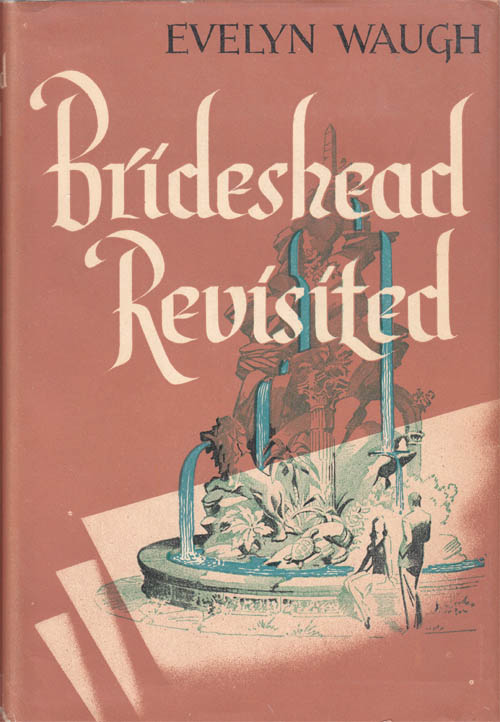
Brideshead Revisited

Brideshead Revisited: The Secular and Profane Memories of Captain Charles Ryder
© 1945 Evelyn Waugh
350 pages

My theme is memory, that winged host that soared about me one grey morning of war-time. These memories, which are my life–for we possess nothing certainly except the past–were always with me.

Some time ago after finishing off a season of Downton Abby, I queried Goodreads:  is there a Downtonesque book?  Its readers recommended, among others, Bridehead Revisited. After learning about it, of course,   I seemed to hear it mentioned incessantly and decided to give it a try.  Glad am I that I did, because Brideshead proved to be one of the most beautifully written novels I’ve ever taken on.  It is a sad, wistful novel, one man’s recollection of his time spent with a noble family in decline, provoked when his battalion is ordered to take over their home during the Second World War and he realizes he has tread this ground before.   Brideshead is a love story, but without the kind of resolution expected of one. The tale is saturated in beauty; characters linger over rich meals and fragrant brandies,   and bare their souls in sunlit salons and gilded smoking rooms.  The sensuality would please a Dorian Gray.  It helps that the narrator, Charles Ryder, is a painter of architecture and relishes it for its timelessness, a created work that combines the efforts of generations.

Beauty was the main attraction of Ryder to the Marchmain family, exhibited strikingly in the person of Ryder’s friend Sebastian and his sister Julia.  The Marchmains are the main source of interest to the reader, beside the writing, for Ryder himself has only a superficial presence.  Religion permeates the book, as the Marchmains are Catholics; their religion creates an identity for them as ‘others’ within England.  The religious sense is innate, not outwardly pious. The main characters describe one another as half-heathen,  even at their most cavalier there is a seriousness to their foibles, a sense of wonder. They may act merrily cynical, but there  are convictions at the root of their characters that have the ability to produce fruit at the right moment.  A sense of grace ties the two halves of this book together, separated even as they are by years. A tale of one character’s slide into alcoholism, to his family’s grief, and another tale of discovered love, are woven together by it.  While much of the story is sad, most of the characters find relief for their private burdens, and Waugh cuts the emotional intensity with comic scenes and descriptions.  Some of it borders on silly,  other mingles the laughs with some woe, like the description of a father greeting his son with “the usual air of mild regret”. There are surely depths to the story that can’t be plumbed in one read alone, but there will be others, for Waugh’s writing here, bordering on the lyrical, is beautifully arresting itself.

=================== EXCERPTS ===============

“Two wives despaired of him,’ he said. ‘When he got engaged to Sylvia, she made it a condition that he should take the cure at Zurich. And it worked. He came back in three months a different man. And he hasn’t touched a drop since, even though Sylvia walked out on him.’
‘Why did she do that?’
“Well, poor Charlie got rather a bore when he stopped drinking. But that’s not really the point of the story.”

More even than the work of the great architects, I loved buildings that grew silently with the centuries, catching and keeping the best of each generation, while time curbed the artist’s pride and the Philistine’s vulgarity, and repaired the clumsiness of the dull workman.

The trouble with modern education is you never know how ignorant people are. With anyone over fifty you can be fairly confident what’s been taught and what’s been left out. But these young people have such an intelligent, knowledgeable surface, and then the crust suddenly breaks and you look down into depths of confusion you didn’t know existed.

“Light one for me, will you?”
It was the first time in my life that anyone had asked  this of me, and as I took the cigarette from my lips and put it in hers I caught a thin bat’s squeak of sexuality, inaudible to any but me.

“Oh, Mummy, must I see him? There’ll be a scene if I do.”
“Nonsense, Julia, you twist that poor man round your finger.”
So Julia went into the library and came out an hour later engaged to be married.

Related:
The Picture of Dorian Grey, Oscar Wilde.
A Seperate Peace, John Knowles

Posted in Reviews | Tagged , , , , , , | 7 Comments

When Gourmands Write Fiction

I rejoiced in the Burgundy. How can I describe it? The Pathetic Fallacy resounds in all our praise of wine. For centuries every language has been strained to define its beauty, and has produced only wild conceits or the stock epithets of the trade. This Burgundy seemed to me, then, serene and triumphant, a reminder that the world was an older and better place than Rex knew, that mankind in its long passion had learned another wisdom than his. By chance I met this same wine again, lunching with my wine merchant in St. James’s Street, in the first autumn of the war; it had softened and faded in the intervening years, but it still spoke in the pure, authentic accent of its prime and, that day at Paillard’s with Rex Motttram years before, it whispered faintly, but in the same lapidary phrase, the same words of hope.

p. 175, Brideshead Revisited. Evelyn Waugh.

Posted in quotations | Tagged , , | Leave a comment