
A “Nine Books I’ll Never Forget” meme is going around. Considering how much I have read in the course of my life — close to three thousand books on this blog alone — that’s a daunting challenge, so consider this list only tentative. It lacks any CS Lewis, which horrifies me, and I know there are other books whose influence is so great I can’t even step back and contemplate properly.
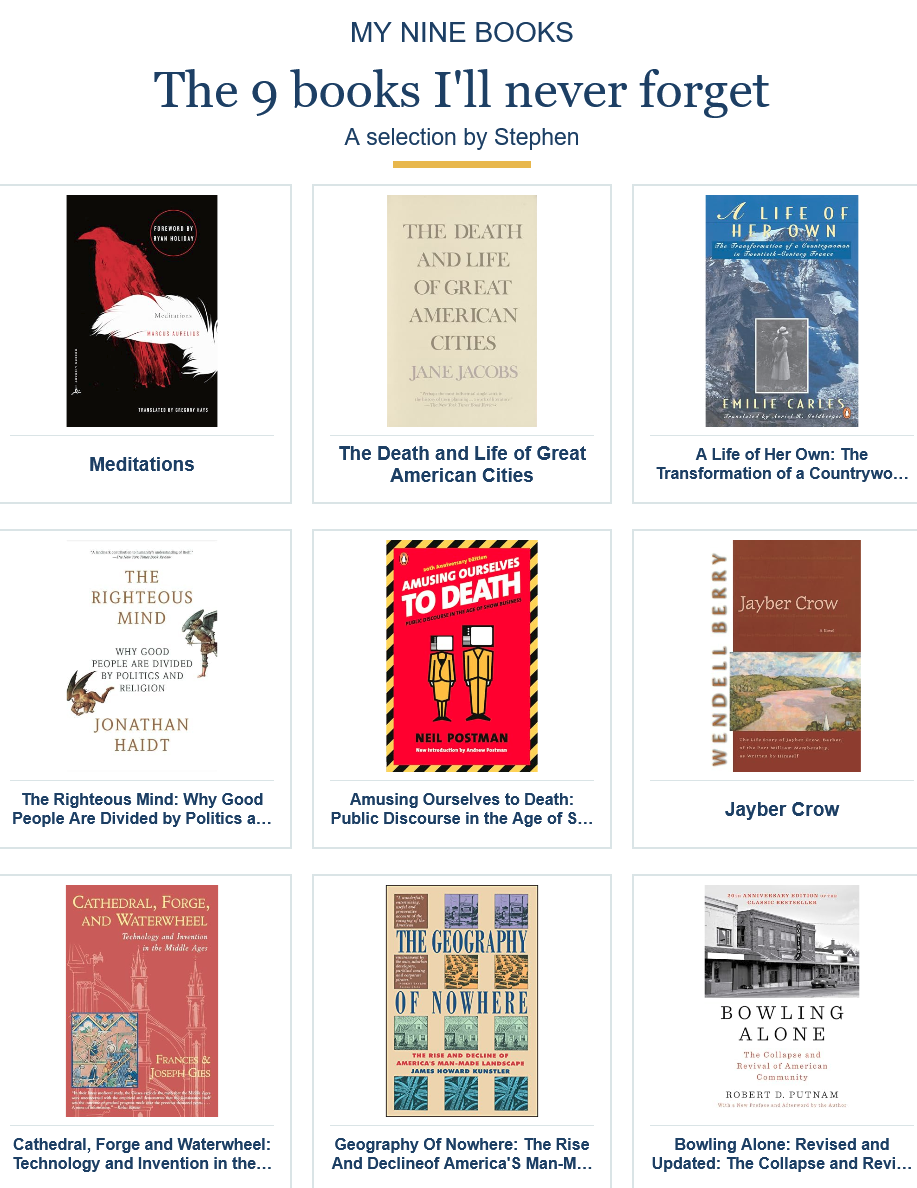
.
Probably no surprises here for people who read me often, but I’ll try to precis each:
- The Meditations by Marcus Aurelius introduced me to Stoicism, which has been a bedrock of my spiritual-philosophical life for nearly 20 years now.
- Death and Life of Great American Cities by Jane Jacobs was reccommended to me on urbanism grounds, but it introduced me to the concept of emergent order and one sentence in it completely changed my life
- A Life of Her Own by Emile Carles was a pivotal part of my political evolution, though I’m sure I’d argue with it now. It’s the memoir of a teacher in a rural French village who was disillusioned by the state, religion, etc, and taught her students to think critically. We see the First and Second World Wars unfold through her eyes. This was my introduction to ‘democratic’ leftism, as I associated leftist/Marxist thought only with authoritarianism. It led to me reading deeply into the left for a few years, but at an oblique; I like to joke I went so far left I popped into right field with Ayn Rand and Russell Kirk
- The Righteous Mind is a hard book to summarize, in large part because it covers so much ground. One of its core subjects is morality, which the author explores from philosophy to natural history.
- Amusing Ourselves to Death is really a Neil Postman stand-in: I couldn’t decide between this and Technopoly. I remember reading Postman in the university library and copying long passages into a commonplace book & journal that I subsequently lost in a move, a loss that disappointed me so much I fell away from keeping a journal. Postman is the reason I didn’t have a smartphone until 2018, because he made me think about how technology shapes us and society
- Jayber Crow was my introduction to all things Berry, and Berrian thought is a cosmos into itself.
- Cathedral, Forge, and Waterwheel overturned the ‘chronological snobbery’ I’d inherited from textbooks and began my interest in the Medieval epoch’s intellectual life
- The Geography of Nowhere. Oh, where to begin with Jim Kunstler? Geography is a history and scathing critique of American urbanism since 1945. It made me think about why I was fascinated by cities; it gave me a vocabulary to understand why I found prewar cities fascinating and postwar cities utterly without interest; it led me to exploring more of Kunstler and starting to think about energy, food, and transportation infrastructure and policy.
- Bowling Alone was one of the many books I read in that oh-so pivotal year of 2013 when my worldview was shifting from college’s ideological purity to my present conflicted mess. It gave me the concept of society as an organic thing, not simply an abstraction — and like other organic things, it needed to be fed and protected lest it wither and die.


