Takedown

Star Trek TNG: Takedown
© 2015 John Jackson Miller
369 pages
takedown
“Captain, permission to speak freely? You’re a good egg.”
“…I’m not sure how to respond to that.”

I spotted this title at a surplus-goods store a few years back, and couldn’t help be flabbergasted by the premise. Admiral Riker, leading a flotilla of ships against Federation outposts —   against Captains Ezri Dax and Jean Luc Picard? Where on earth did that come from? What huge twists and turns in previous novels had I missed?  ….turns out,  Takedown is largely self-contained, almost an episodic throwback to the old numbered novels.  It’s a definite page turner with an out of left field premise, one that starts when members of the Khitomer Accords (Feds, Cardies, Ferengi, Klingons) and the Typhon Pact (Romulans, Gorn, and  a few other villains) receive invitations to a space station in the middle of nowhere. When the meeting is over, each of the delegates — including Admiral Riker — are acting….a little odd, and within a few hours they’re all zipping across the Alpha and Beta Quadrants, destroying communications arrays — including those of their allies, and seemingly working in concert —  while the six powers grope in darkness and wonder: what the hell?

That question was on my mind for most of the story,  which I would have devoured in one sitting  were it not for the fact that  my body mutinied and insisted I go to sleep.  The mystery of what happened to the diplomats, and why they’re suddenly obsessed with destroying  arrays that have no conceivable military purpose (some of them are deep space telescopes, probing the cosmos beyond any known powers), drives  the story, particularly abroad the Aventine. Captain Dax is a little confused when Admiral Riker transfers his flag to her ship, moreso when he isolates himself in the holodeck, and finally has to push back when Riker declares that the greatest threat to the Federation which now exists ….is a Ferengi relay station.   Once Picard and the Enterprise enter the picture,   we learn more — but ultimately, it proves to be one of those “Now that you’ve foiled me I’ll reveal my entire plan” resolutions,   which I don’t particularly care for.

Takedown is a fun story, but not one to take seriously: there’s no character growth, and I’ve never seen the events here referenced in other novels.     Its author, John Jackson Miller, is a new name for me in Treklit — and as bizarre as this story is, I enjoyed his use of humor. It helps, of course, that we get to visit both the Aventine and the Enterprise:   I’m particularly fond of the Aventine crew, having grown fond of novels including them over the years. It was nice to see the real Picard in Treklit, not that tired imitation from Kurzman’s rubbish pile.

No spoilers, but if you’re a student of TNG episodes. this may ring a bell…

 

howdy

Posted in Reviews | Tagged , , , | 10 Comments

An Elegant Defense

An Elegant Defense: The Extraordinary New Science of the Immune System
© 2019  Matt Ritchel
488 pages

elegantdefense

Back in January, long before the pandemic was on my mind (or anyone else’s outside of China),  I watched a charming and educational series called Cells at Work!, an anime about the human body — and specifically,  the immune system.    My interest ignited, I looked for something that might shed more light on the impressive complexity of the immune system, and (mostly) found it in An Elegant Defense.    Richtel’s work takes us through the history of how we came to understand the immune system, and what medical researcher’s struggles with modern foes like cancer and AIDS have taught us.  Although the book is often too breezy and disjointed for me, its subject is of considerable interest, and I found it worth the while.

My earliest conception of the immune system was terribly exciting: in fourth grade, I learned that my body was host to a little army, that when invaded by germs or such, would take to the field and drive the enemy away.      Exciting — but simplistic. In reality, Ritchel writes, the immune system is more of a bouncer at a very lively bar;   it’s there to keep the peace,    destroying troublemakers without disrupting the other guests. But there’s not just one bouncer, but several of them, and they can both collaborate or step on the other’s toes: our bodies have several “first lines of defense”,   not one integrated hierarchy.     But those bouncers can also act like warrior cops,  causing more trouble than they prevent —    sometimes destroying the body in an effort to destroy their prey.  To this end, there are natural safeguards, like specialist T-cells that regulate their brethren, or even  self-destruct switches that particularly pervasive diseases like cancer can use to their own advantage.   Ritchel guides us herky-jerky through the various players —  T-cells, B-cells, dendrites,  and a host of others that I remembered from Cells at Work! — while at the same time using medical research cases to show how our struggles to understand the immune system are offering us possible answers in the fight against cancer.   One interesting case involves injecting T-cells with DNA from HIV —   HIV’s anti-B cell weaponry — and  then setting those T-cells loose on cancerous B-cells.   It’s fascinating that we’ve come so far that we can manipulate the body this way,  but I was also pleased to see that Ritchel includes information on how our immune systems are dependent on bacteria within us — bacteria that not only  fight rival invaders for food and space, but trigger the formation of specialist cells in our bodies that can go to work rooting out malfactors.  As much biology as I’ve read,  learning that there are parts of our body that go unrealized unless they’re in communication with outside bacteria makes my mind boggle at how deeply interwoven the strands of life are.

This is a fascinating, deeply relevant book — but it has its irritants.  The author likes to keep introducing  new players and trains of thought, then jumping away to something else, then jumping back, and so on and so forth. It’s wearisome, especially when the jumps are always prefaced with trying-to-be-cool hooks like “And it all started with a werewolf.”*   This becomes less of a problem 2/3rds into the book, because everything that can be introduced has been, and now it’s just a question of bringing all the threads together —  using the medical cases of four people to sum up the past and future of immunology.     While this title certainly isn’t in the competition for ‘best popular science ever’,   those who want to learn more about the immune system will be largely well served by it.

[*] This is referring to lupus.

Related:
Why We Get Sick: The New Science of Darwinian Medicine,  Randolph Nesse
The Cancer Chronicles:  Unlocking Medicine’s Deepest Mystery,  George Johnson
10% Human: How Your Body’s Microbes Hold the Key to Health and Happiness,  Alanna Collen
I Contain Multitudes: The Microbes Within Us and a Grander View of Life, Ed Yong


Posted in Reviews, science | Tagged , , , | 6 Comments

Scaling Mount Doom: August 2020

At the end of July I hit on an idea for reconciling my growing TBR Pile of Doom with my  intractable hunger for more books:  for every four TBR books I read, I’d allow myself to buy one book.  In hopes of keeping myself driven, I’m going to take a page from Sarah’s book and do a monthly face-the-verdict, though not one as numbers-oriented as hers.   I made….definite progress in August, reading TBR material almost exclusively.

soprepared

TBR Titles Read in August:
The Architecture of Happiness, Alain de Botton. Purchased 2018.
How Dante Can Save Your Life,  Rod Dreher. Purchased 2019.
American Illiad: The Story of the Civil War, Charles Roland. Library discard.
The Left, The Right, and the State, Lew Rockwell. Purchased 2018.
Reluctant Witnesses: Children’s Voices from the Civil War,  Emmy E. Werner. Library discard.
The Great Ron Paul: The Scott Horton Interviews, 2004-2019, Scott Horton. Purchased 2019.
This Republic of Suffering: Death and the Civil War, Drew Gilpin Faust. Library discard, picked up in 2018.
To the Ends of the Universe, Isaac Asimov. Library discard; acquired 2016.
Go Directly to Jail: The Criminializaton of Almost Everything, ed. Gene Healy. Purchased ~2015.  Re-read for a review.

TBR Scheduled for September:
The Coddling of the American Mind, Jonathan Haidt and Greg Lukianoff. Purchased 2019.
The School Revolution, Ron Paul.    Gift from a friend in 2018.

Reward Books Purchased:
Obey Little, Resist Much: Remembering Ed Abbey, ed. James Hepworth
The Putin Interviews, Oliver Stone

I had to hit the ground running in August, because in September I have the Brothers Karamazov to finish — my deadline is September 21st, the date I accepted the Classics Club challenge. If  I don’t make it, I’m not sure what will happen —  an attack of disappointed English teachers?   — but I don’t want to tempt fate.

Posted in General | Tagged | 2 Comments

Go Directly to Jail

Go Directly to Jail: The Criminalization of Almost Everything
© 2004 ed. Gene Healy
194 pages

godirectly

What good are laws so numerous they cannot be known, or so opaque they cannot be understood?  James Madison knew enough to ask that question. Modern legislators and regulators do not.   In Go Directly to Jail,   Gene Healy collects several pieces criticizing the  eye-opening expansion of federal crimes in the last quarter of the 20th century, and the deleterious effects of this expansion on American governance and society alike.  The articles are abbreviated versions of longer policy papers, and  while they’re detailed reading they’re not necessarily dry – the most challenging of them is the piece on HIPPA violations.

“Don’t make a federal case out of it” used to mean something – a warning not to exaggerate something’s importance.  But federal crimes no longer concern themselves with important things:  more often than not, they concern trivialities,   which they treat as important.  Federal crimes multiply exponentially by the year,  driven by regulatory agencies which fund themselves partially through fines – who thus have every incentive to create new offenses they can bill for, creating less a system of justice and more an organized structure for looting. Four areas are considered in the included essays: the environment,  healthcare, gun control, and Federal sentencing guidelines.   Each article has unique lessons ; overzealous criminalization of HIPPA ‘violations’ distorts medical practice, for instance, by pushing doctors into larger collectives for protection, and skewing their prescriptions towards what’s legally safe rather than what’s needed.

More important are the general lessons. Destroyed completely are the basic conceits of Anglo-American common law: that for something to be a crime,   there must have been both bad intent and bad action.  To the modern state, intent is irrelevant; actual harm is irrelevant.  What matter is:   is there a rule you’ve broken that we can exploit to the hilt? In some of the case studies here, a man who cleared an area of industrial debris, then began  filling in pits in the landscape to level it it, was fined and imprisoned for polluting. (Toxic leachants are fine; but dirt, by god, dirt is just too much.)

A  state run by a multitude of laws that no one can fully understand, or even know that they’re violating, is essentially lawless. If people  have no reliable way to tell what’s illegal and what’s not,   and if they are tarred with the same brush as rapists and murders for bookkeeping or legalistic mistakes,  why should they take the law seriously? We effectively live in a Dolores Umbridge legal system, supported only by those empowered by it:  lobbyists, lawyers, and bureacrats.  The law’s moral power, which is far more important than the threat of enforcement (an awake conscience is a more forbidding presence than any state), is undermined completely by an unnavigable legal system with harsh reprisals for innocent mistakes.

This is an infuriating collection of pieces, presumably much dated by now, and I suspect the trend has gone towards more criminalization instead of less — although some progress is being made on the marijuana front at the state level, at least.  The highly focused aspects of several of its pieces might  make casual readers spook and run: I’ve had this book five years or so and even now that I’ve fully read it, the healthcare chapter still has parts a little beyond my ken.  This is an important aspect of understanding DC’s police state, though, especially in the wake of these police-inflicted homicides– the persons being killed are often swept up under odious charges like selling loose cigarettes.

Related:
You Have the Right to Remain Innocent, James Duane. A lawyer’s take on the same problem, with his own solution: don’t talk to the cops, ever. Ever.  Ever.


Posted in Politics and Civic Interest, Reviews | Tagged , | 3 Comments

The Little Way of Ruthie Leming

The Little Way of Ruthie Leming: A Southern Girl, A Small Town, and the Secret of a Good Life
© 2013 Rod Dreher
292 pages

ruthie

What is a meaningful life, but one lived in close connection with others?     Journalist Rod Dreher was forced to consider this when he endured a family tragedy: his little sister Ruthie at age 40, was diagnosed with lung cancer despite having never smoked.  Compared to him, she was the perfect child:   she fit into her family and her community like a hand in a glove, and her life was the very image of wholesome: married to her high school sweetheart (a fireman) , mom of three bright, happy, girls, and beloved of her students.    Dreher, meanwhile, was the black sheep of the family —  always yearning for more, and anxious to leave the family place behind. And yet when he returned home to be with Ruthie,  he witnessed the love that she had invested in people over the years bear fruit, the community rallying around her, supporting her family in its darkest hour.   This story of an ordinary woman with an extraordinary impact on those around her thus becomes an argument for people devoting themselves to what matters: the people around them, not abstractions.

The Little Way is a heartbreaking and beautiful story, but it’s harder for me to review it because I know now that it’s only part the story: I know that it continued in How Dante Can Save Your Life, because Dreher was not able to recapture the life his sister had led when he moved back home to reintegrate himself into the family & local community. Interestingly, though, Little Way  offers a forewarning — to Rod himself, though perhaps he didn’t grasp it at the time. When having a heart-to-heart with his father, Rod learned that the old man —  whose commitment to the family place, the local community, and the family itself was total and absolute — regretted  having not pushed the boundaries in his own youth,    regretted letting himself be pushed onto one track when his talents beckoned him down another.   Dreher here realizes his father had made an idol of family — but this is exactly what Dreher struggles with later,  what Dante helps him realize.    However important that lesson, it’s this middle of the story that still speaks to many.   We are a nation of increasingly lonely, depressed, and anxious people — and this is no accident, because year by year we become ever-more absorbed into ourselves….or into the the role we think we play in some abstract political drama, nevermind the lack of any real work we put into our local places.  Health is membership; belonging.

Although I’m sure this was a difficult story for Dreher to tell, I’m grateful that he did: his sister is a powerful witness for the virtues of a simple, ordinary life, lived in love.


Posted in Reviews | Tagged , , , | 2 Comments

Wisdom Wednesday: The Little Way

Inspired by recently reading The Little Way of Ruthie Leming, I’m sharing some related excerpts from one of my favorites, Bill Kauffman.

” [Walt Whitman] understood that any healthy political or social movement has to begin, has to have its heart and soul, at the grass roots. In Kansas, not on K Street.

“And it has to be based in love. Love not of some remote abstraction, some phantasm that exists only on the television screen—Ford Truck commercials and Lee Greenwood songs—but love of near things, things you can really know and experience. The love of a place and its people: their food, their games, their literature, their music, their smiles.

“I am a localist, a regionalist. To me, the glory of America comes not from its weaponry or wars or a mass culture that is equal parts stupidity, vulgarity, and cynical cupidity—one part ‘The View,’ one part Miley Cyrus, and a dollop of Rush Limbaugh—rather, it is in the flowering of our regions, our local cultures. Our vitality is in the little places—city neighborhoods, town squares—the places that mean nothing to those who run this country but that give us our pith, our meaning.”  – Bill Kauffman, “Love is the Answer to Empire

““The Little Way. That is what we seek. That — contrary to the ethic of personal parking spaces, of the dollar-sign god — is the American way. Dorothy Day kept to that little way, and that is why we honor her. She understood that if small is not beautiful, at least it is always human.”  – Bill Kauffman, Look Homeward, America!

Posted in quotations | Tagged , | Leave a comment

An Antidote to Chaos

12 Rules for Life: An Antidote to Chaos
© 2018 Jordan Peterson
402 pages

12rules

Life is pain. We can surrender to it — or we can make it meaningful. Clinical psychologist Jordan Peterson here offers a prescription to those facing the abyss, or even sinking into it, with twelve rules whose simple expression belies their more complex meanings.  Peterson’s philosophy draws from human tradition and the natural world alike,  and as expressed here it seeks to help readers understand the  ongoing drama between order and chaos in society and our souls, and to find a way of coping meaningfully.

On their face, the rules seem simple enough ordinances: “Stand up straight”, “Speak the truth — or at least, don’t lie”.  But there are those that, on the surface, seem odd to include: “Don’t disturb children who are skateboarding”.     Why is that a priority?  As it happens, however, each rule is just the sunlight flashing off an iceberg; it gets your attention and makes the underlying thoughts memorable, for under each rule is an essay on some aspect of the human condition. These essays provide considerable school for thought, and draw on human literature (especially Russian classics and the Bible), philosophy, and evolutionary history. The first rule, for instance, telling readers to “stand up straight”, is an introduction to Peterson’s thinking and urging readers to take responsibility for their lives — to take themselves seriously, to view the human struggle as a battle they are engaged in, as a battle they have a part in.  His explication of this involves a digression on the social dynamics of lobsters, and relating psychology which has a helpful side lesson: those who act defeated perpetuate their own misery and isolation.   The rule about not disturbing skateboarding children addresses more social concerns,  of our steadily creating childish creatures who are adult only in age;   constantly robbed of danger, challenge, or trouble, and so denied any opportunity to grow as persons.

I’ve found Peterson personally fascinating in the years since I’ve known his name and been familiarizing myself with his work, in part because his philosophy defies easy categorization. Take religion, for instance:  Peterson’s often uses Biblical stories in his themes, as he considers our self-hatred via the downfall of Cain, who killed his brother Abel.  Although Peterson unquestionably takes the meaning of religious stories seriously,   especially that of the Crucifixion — Peterson’s advocacy of responsibility sees Jesus’ death as the pinnacle of responsibility, of someone meeting not only his suffering head on, but those of the world’s —  this isn’t a book of Christian apologetics, and in interviews Peterson states that his own coming-to-terms with Christianity and God is less about fact-claims and more about what it means to live as if God exists.  He chooses to, in part because we must be oriented toward something if we are not drift aimlessly.

I found 12 Rules for Life  absolutely invigorating, with much to appreciate —   from his call for personal integrity to the the approach of living in triage. None of us are in ideal situations;  even those born into wealth, good looks, and optimal health will face their dragons.  I think Peterson has especially salient appeal to those who read him while enduring long nights of the soul, who are struggling with depression and nihilism and need something — a handhold in the dark, a glimpse of light — to  base their efforts to escape it on.   I believe it was Bacon who remarked that some books are to be tasted, some to be swallowed, and others to be chewed and digested.  12 Rules for Life is definitely the latter for me.

Related:
Marian’s three-part review and followup

Posted in Reviews | Tagged , , | 7 Comments

Of stars and saints (again)

(“Again” because last year I had a similar post called ‘Of stars and saints‘.)

Recently I’ve finished two books which were aimed at more youthful audiences (middle/high school, not sure), so I’m presenting them together.

notagoodcover

The first is Hands of Mercy: The Story of Sister-Nurses in the Civil War, which covers the service of various orders of nuns throughout the war, as they  ministered to the dying, the dead, and those innocents caught in the crossfire.  One of my earlier ACW books aroused my interest in the role that nuns played on the battlefield; I was especially struck by how they served both sides faithfully, and were greatly admired by the mostly-Protestant armies for their commitment to aide despite the fact that they were often in real danger — and sometimes perished.  Hands of Mercy proved an enjoyable introduction to their story, though it has no  references and is of very limited use to the adult reader.


universeAsimov’s To the Ends of the Universe simply takes on astronomy and cosmology, and I read this to complete my science survey for 2020: I’ve been missing cosmology since June, and this is…close enough.  First published in 1967, it’s an overview how humanity’s appreciation of the Cosmos has continued to grow — both our understanding of the outside universe, as we slowly realized  our planet is one in a multitude within a galaxy, which itself is only one of a multitude of galaxies —  and of the forces that shape the world around us.    I imagine it’s badly dated in a lot of the particulars, considering how much of physics has changed in the 20th century. One interesting quirk of the book is Asimov’s usage of ‘eon’  to mean ‘billion’; I’ve never seen that before!
Posted in Reviews, science | Tagged , , , , | 2 Comments

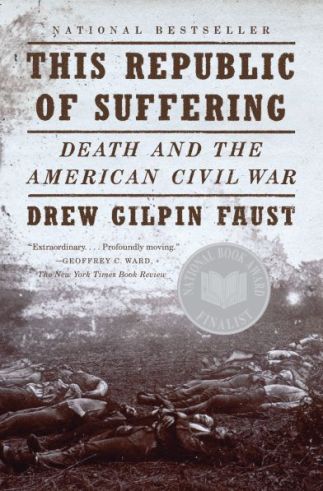
This Republic of Suffering

This Republic of Suffering:  Death and the American Civil War
© 2008 Drew Gilpin Faust
401 pages


death


Oft in dreams I see thee lying
On some battle-plain
Lonely, wounded, even dying —
Calling, but in vain

Weeping sad and lonely
Hopes and fears, how vain
When this cruel war is over —
Hoping that we’ll meet again.


(“Weeping Sad and Lonely“, a song sung across the lines with such fervor that some camp commanders banned it.)

No other war has had the outsized role on American history as the ‘war for the union’, as it was called at the time.  Hundreds of thousands died, still more were wounded, and not a house was without its mourners — especially in the South, where as many as 3/4ths of the men might be off,  the yeomen reaping the bloody whirlwind that the planters had sown.   This Republic of Suffering surveys how the enormous death rates in the war were handled — emotionally, logistically, etc —  across the continent.  It’s dark reading, to be sure, but draws from so much of Civil War societies that I think it an essential part of anyone’s efforts to understand the war and its role.

Gilpin begins with the act of dying itself;  Victorian Americans were far more intimate with dying than we are today; not only was disease a more pervasive threat, but people generally died at home, in the presence of loved ones, and their expiration was fraught with theological meaning.  All wanted to die a ‘good death’, to surrender peacefully to their Maker and not go out fighting and resisting the judgment of eternity.   Death was often sudden and inexplicable in the war;  a sudden ambush, a stray artillery shell, might sweep from the Earth young soldiers who thought themselves removed from danger.  To die without having made one’s peace was a fearsome thing, and letters written home — either from the dying soldiers, or from their comrades in arms who took the sad duty of informing survivors of their boy’s demise —  sought to assure those reading that the victim had accepted Death gracefully — and gone to a better place.

More disturbing than the thought of dying without preparing for the same was the act of killing — for most soldiers were taught that to kill was a mortal sin,  and many struggled to take life–  especially given that distances were often close enough that soldiers could directly link their firing a musket with another man’s death. Once the killing started, however, for many it became a routine, or even pleasurable. Some shrunk from violence, some embraced it, and bloodlust was far more likely to erupt when warring soldiers were of different ethnicity:  southern soldiers and freedmen-in-arms were especially savage toward one another.  The war unleashed a lot of casual violence;  Sherman’s army is depicted here as shooting an old man on a mule who wouldn’t move off the road, and we learn of ‘contraband camps’ where escaping slaves were  penned in by the Union army, sometimes to die of exposure and neglect. I’d never heard of these before reading Reluctant Witnesses earlier in the week, though some  camps seem to have been better than others.   Although ministers earnestly tried to help bereaving communities find meaning in their losses, those who worked directly with the dead — soldiers, gravediggers, grave registration units, doctors, etc–  were subjected to so much of it that they had to become dead and unmoved by the losses they were witness to.

There’s no shortage of interest in this book for someone who wishes to understand the Civil War experience, but especially intriuging for literary types is the content on Walt Whitman and Ambrose Bierce. I’ve not encountered much of Whitman’s poetry, but I left this incredibly impressed by Whitman as a man; he regularly visited wounded soldiers to offer them gifts and comfort, and volunteered in hospitals as an assistant.   Bierce’s inability to escape the memories of the dead and dying influenced his writing — though we are told, by soldiers and nurses alike, that  the horror of a battlefield is beyond words, defying the richness of human vocabulary. It cannot be captured, nor can it be forgotten.  There are also chapters of more mundane interest, like the growth of the government as it had to respond to new challenges – creating an organized approach to assaying and burying the dead, as well as paying pensions to the survivors of the slaughtered.

This Republic of Suffering is sad, but essential, reading.


Posted in history, Reviews | Tagged , , | 3 Comments

The Great Ron Paul

The Great Ron Paul: The Scott Horton Interviews, 2004-2019
© 2019 ed. Scott Horton
315 pages

opal
Selected quotes

Who is Ron Paul?    That question was on posters across my university campus in 2008, and I couldn’t help but be curious.   A social democrat at the time, I appreciated his foreign policy and unequivocal stand on civil liberties, but was otherwise disinterested.   I’ve grown to appreciate him considerably more over the years, but I bought this particular collection because my robust appreciation for Scott Horton, the voice in the wilderness.

A few years back I heard an interview with Horton on American foreign policy, and I’ve followed his work avidly ever since.  Scott has been doggedly reporting on foreign policy misadventures since 2003,  with thousands of recorded interviews at his website.  One of the few politicians Scott admires is Ron Paul,  who for years was a lone beacon of resistance in DC, continually trying  call attention to DC’s destructive and wasteful foreign policy, as well as its destructive and wasteful policies at home.  Although he’s since retired from politics,  Paul remains an important figure in the libertarian movement, having inspired many young people, and he continues to comment on the news via his daily Liberty Report.   The Great Ron Paul collects his interviews with Scott Horton from the onset of the Iraq invasion through to the present year. In this collection, Horton and Paul cover foreign policy, the financial meltdown of 2007-2008,  the Obama administration’s successes and failures, and respond to the goings- on of the day, usually with a connection to their respective interests.

Horton and Paul both have their pet subjects: Horton’s is foreign policy, and Paul’s is monetary policy. One of those, frankly, is a lot easier for me to get excited about (I read fewer books on monetary policy than I do astrophysics),   so I’m glad there’s a back and forth here between the two leading topics.   DC’s distortionate role on money and markets is absolutely worth understanding:  the Fed’s ability to print money at  will allows it to wage war across the globe for decades, evading pushback by making the financial consequences another generation’s to bear. Although I’ve enjoyed Paul’s perspective when I’ve heard interviews with him, I’ve not read much of his writing before, beyond The Revolution (2008), and so was able to gain a new appreciation for him as not only one of few men in Congress who stood on principle, but as someone genuinely interested in working with ‘the other side’. Paul frequently partnered with Dennis Kucinich, for instance,   and maintains that if Liberty is to prevail, a genuine revolution in thinking would be required, influencing the policies of both halves of the RepuliCrat party.   Concerned about the poor and homeless, Democrats? Go after occupational licensing laws and legislation  that smothers  every housing option but “Single family detached McMansion”.  Support sound-money measures that would stop inflation from devouring the income of the least of us. Republicans concerned about fiscal responsibility?   …okay, nevermind. Republicans concerned about  security threats? Stop creating legions of bin Ladens in  multi-trillion dollar debacles started to prevent future Hitlers.  This reaching both sides is especially important to me because I came into libertarianism via the left — after realizing that the government simply could not do what it said it could do, and in its labors to try, it only made matters worse or made itself a vehicle for cronyism.

Although I already appreciated both of these men,  reading this collection was a solid reminder of why — and  my appreciation for Horton especially grew after I learned that he used to run an pirate radio station where he worked with members of the left to share information about DC’s chronic foreign policy fiascos.   His speech on alternative media was one of my favorite pieces, lambasting the Clinton-Bush consensus that perverted free trade into cronyism, and self-determination into constant invasions and management of people abroad.  This same speech pointed out how twitter, google, facebook,  and the other social media giants are silencing criticism on the left and right.   Instead of being  an information network that can take us anywhere, the internet is turning into another corrupt cul-de-sac, ending in a familiar place: enthrallment to the State,   worshiped by socialists on the left and the tribal nationalists on the right.   These two are an interesting pair — the grandfatherly Ozzie-Nelson -like Ron, and the youthful rebel Horton — but their commitment to communication, not condemnation, makes them much easier to recommend to people than someone like Lew Rockwell, who writes on the warpath.


P.S.: Ron Paul’s 85th birthday was yesterday,  something I didn’t realize until after I’d finished the book. Nice coincidence, that!

Related:
Fool’s Errand: Time to End the War in Afghanistan, Scott Horton. Excellent history of the Afghan boondoggle.

Posted in Politics and Civic Interest, Reviews | Tagged , , , | 3 Comments