Selections from 40 interviews across 15 years on liberty & empire


opal
Review of book

“We’ve had lots of Coast Guard members in the Persian Gulf, because they’re over there protecting terminals and things. If we’re thinking about the responsibility of the federal government protecting us, why wouldn’t we have the Coast Guard in the Gulf of Mexico around our ports, checking on unusual things? I think that the emphasis should be, are we protecting our country or are we policing the world?”

“We should concentrate on freedom, not only because it’s morally correct that government shouldn’t be telling us how to live our lives, and we don’t have a right to tell other countries how to live, but for the very practical reasons that if you want peace and prosperity, you have to vote for liberty.”.

“When I talk to groups, both conservative and liberal groups, I always acknowledge and say, ‘You may well disagree with me on this. But I’m going to win the argument. Not so much that I’m going to convert my colleagues here in the Congress about the foreign policy, but we’re going to run out of money.’ Eventually, empires just collapse, as did the Soviet system. They collapse because they can’t economically be supported, and finally, they just run out of wealth. That’s what will happen to us.”.

Horton: Well, and that is sort of a common symptom of empires, right? As more power gets centered in the executive branch, the congressmen know that really their power comes from being close to the president, rather than standing their own ground against him?

Paul:  The fact that some of these candidates will be able to raise $100 million to run their campaigns tells you that as far as companies are concerned it’s a good investment. A Halliburton has a lot of incentive to pump in money to the campaign. What about a drug company who gets monopoly control over sale of drugs? They must think it’s a good investment as well. There are many companies involved in the military-industrial complex. The real evil isn’t the spending of somebody’s own money to help a candidate. The real evil is the fact that the government is so big and has so much to auction off, and there is such an incentive and there are so many benefits by being friendly to the people who are in power, that government is bought on a continuous basis.

They try to separate them into two factions. One is the foreign policy and one is domestic policy. I argue that you can’t separate the two. So if you want more money in our economy and the retired people to take care of themselves, and you have a free market, you want less war and less spending overseas.

We need to look at what we do from the perspective of what would happen if somebody did it to us.

Posted in quotations | Tagged , | 1 Comment

Wisdom Wednesday: To Live Deliberately


hdt

“I went to the woods because I wished to live deliberately, to front only the essential facts of life, and see if I could not learn what it had to teach, and not, when I came to die, discover that I had not lived. I did not wish to live what was not life, living is so dear; nor did I wish to practise resignation, unless it was quite necessary. I wanted to live deep and suck out all the marrow of life, to live so sturdily and Spartan-like as to put to rout all that was not life, to cut a broad swath and shave close, to drive life into a corner, and reduce it to its lowest terms.”


This quotation, more than any other, speaks to the way I try to live my life — mindfully,  simply,   longing  and looking for meaning —  fearful of the prospect that I might drift into merely existing, being carried away by the current of popular distractions and momentary obsessions.  It’s why I aspire to voluntary simplicity, why my Saturdays are often spent contemplating what else I can let go of  and surrender to thrift shops the next day, why I weigh my interest in meaningful hobbies against the amount of time I’d have to spend working to afford them.   I hope one day to be able to say “I did it. I found the balance”,     to die as neither a mindless consumer-creature nor a lonely, inward-fallen philosophical recluse like Thoreau.


Posted in quotations | Tagged , , | Leave a comment

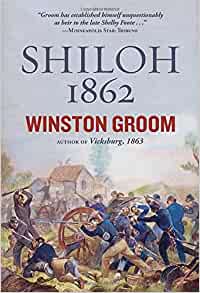
Shiloh 1862

Shiloh 1862
© 2012 Winston Groom
448 pages

shiloh

Although I’ve been aware of the small Winston Groom collection of Civil War books in my home library for years, I’ve never thought to read them because I invariably associate Groom with Forrest Gump; not exactly the expected pedegree for an historian. But Friday afternoon I made a snap decision to visit the Shiloh battlefield, and Groom’s  Shiloh 1862 seemed the best guide available.   The book proved a pleasant surprise, with extensive background information and much drawing-from first hand resources. That’ll learn me to judge a book by its author, I suppose!

Shiloh 1862 proved extremely readable; it’s narrative-driven popular history, with lots of human interest stories (sourced from diaries of the time) and biographies of some of the more prominent generals.  Groom first explores the background of the battle itself — why it was fought, and where. The ‘why’ begins before the conflict even starts, with Groom chronicling the sectional conflicts within the States , particularly the growing sense in the South that the north was out to ruin it with tariffs and attacks on the plantation-slavery system that controlled southern politics.   Groom notes that in April 1862, the war was not quite a year old, and many still thought one good battle would end the conflict,  as if it were a duel for honor, and the parties might retire once shots had been discharged.   The Federal army in the west had  already been successful in undermining the long-term success of the Confederacy by April 1862, in  establishing control of the Tennessee River and sending the Confederate army in retreat from Kentucky as a consequence. Now,   using the river, the Federal army moved to invade the deep south itself —  by landing in southwestern Tennessee, 20 miles from a prominent rail intersection in Mississippi. A strike against the rails in Corinth would sever the South’s only complete east-west line, and make it easier for the Federal army to establish control of the Mississippi river, splitting the Confederacy in two.  The Confederate army in the west moved to crush the growing Federal force before it grew larger and fortified.    Thus the armies converged on the plains and hills around Pittsburg Landing, a site chosen by he Federals because the undulating terrain and marshy areas that greatly restricted avenues of attack. Perhaps because the terrain itself was so forboding, the Federal army’s masters did not bother to fortify — and they didn’t take seriously hints that the southerners were on the move.

The Confederate army, led by General Albert Sidney Johnson,  aimed to strike hard and fast at the dozing Yanks, to push them away from their river-lifeline and into the swamps.  Weather and logistical hiccoughs bogged the army down, though, by at least a full day – a ‘fatal’ delay, Groom notes for reasons we later understand.  The terrain made it difficult to maintain reliable communications, and once a Union patrol encountered the marching force at Farley Field and the battle commenced,  Johnston was forcibly reminded of Napoleon’s maxim: no plan survives contact with the enemy.  The Confederates had intended  to maximize pressure on the Union left, driving them away from the river — but through miscommunication, instead devoted most of their resources to the Union right.  Once a massive artillery battery finally broke the Union center — after six hours of stolid defense by midwestern farmboys —  the Federal army was pushed into a tight circle around the  landing —  and there, across the water in the late afternoon,  were reinforcements from General Buell — and back at the hornet’s nest,  the Confederate general lay dying. His successor, General Beauregard, believed the Yankees whipped — and, also believing that Buell had marched to Decatur (185 miles away), he was content to call it a day.  The next morning.  the enlarged and reinvigorated Union army launched a punishing counterattack that saw the Confederates pull back from their previous day’s gains.  After two days of hard fighting, all that had been accomplished were thousands of deaths – – nearly 24,000 casualties.

Groom captures the chaos and desperation of the military aspect, but it’s not the only part of the story. He also covers the battle’s effects on the people who lived around the landing, the farmers whose livelihoods and homes were destroyed, whose children were at risk.  So much firepower was active across those woods and plains that there was seemingly no safe place to be; one wounded man, trying to limp to the rear to be tended to, return to his captain and pled: “Cap, give me a rifle. This blamed battle ain’t got a rear!”.   Another young soldier, helping his best friend off the field, was shocked to discover when they found shelter that his soon-to-perish friend had been  shot seven times. A prevailing theme is that of confusion,  which started as the armies tried to get into place and worsened as the action started:  men fought in regiments that were not theirs, and  often times officers would command makeshift brigades of whatever troops happened to be in the vicinity. The Hornet’s Nest defenders were a makeshift bunch: one Union participant wasn’t even a combatant, but in the initial southern move he’d been separated from  his father — leading an Ohio unit —  and the young musician quickly had to pick up a musket and fight for his life alongside men he’d never seen before.   Perhaps no story captures the confusion better than one Union officer seeking out a major and pleading with him for direction —  where are our men, where do we go — only to hear the major’s soft reply and realize: he was a Confederate officer,  just as dazed and at a loss as his ‘enemy’.  (This early, Confederate uniforms were varied and sometimes confusing: blue state militia uniforms might be mistaken as Federal uniforms, and get them fired on. One sad instance of that appears here, when regiments from Arkansas and Louisiana attacked one another.)

A joy to read despite its brutal subject, Shiloh 1862 has been a lesson for me in several ways. I’ll have to look into more of Groom’s work if my ACW mood persists!  I actually read part of this book on the battlefield itself, though my progress in the book rarely aligned with my progress touring.


Posted in history, Reviews | Tagged , , | 10 Comments

Reading on the Road: Shiloh’s Bloody Hill

shiloh003
The world was suddenly out of kilter, as though the beauty of the bright Tennessee sunrise was merely a prelude to death, and that nature, with all her morning splendor, was mocking mankind’s folly.” – Winston Groom, Shiloh 1862.

During my Friday lunch hour, I had a wild idea: why not visit the battlefield of Shiloh?  Like….tomorrow?    I’d wanted to travel there in April because of the anniversary of the battle, but with COVID that wasn’t an option.   An hour later I had booked a room in northern Alabama, an hour from the site, and after a half hour for research and fifteen minutes to pack, I’d taken off work the rest of the day and was on my way. Amazingly,   the only thing I forgot was binoculars.

shilohchurch

Replica of the church “Shiloh” for which the battle is named

I used to immerse myself obsessively in the Civil War,  not only reading books about it, but watching movies like Shenandoah, Gettysburg, and The Blue and the Grey — to name three favorites —  playing games,  collecting music of the era,  and  always managed to work in a request to visit a Civil War object of interest during our family vacations….whether that was Vicksburg on our Texas trip, or Andersonville on our tour of Georgia.   This was the first time I’d gotten to visit a preserved battlefield, however, and it was a sobering experience with a few pleasant surprises.

shiloh27

I cannot speak highly enough of the park’s commitment to helping the public understand the battle — from the excellent movie played in the visitor’s center, to the stellar lecturer-guides,  to the signs. The  understanding I’ve gleaned is this:   Shiloh was part of a Union effort in the west to divide the Confederacy in two, connected to its campaign to control the Mississippi river. The area around Pittsburg Landing  on the Tennessee river   was ideal for amassing troops, with plenty of cleared areas for camps  and drilling,  a bountiful supply of water, and terrain that ensured any enemy would have to approach from one direction.  Twenty miles south lay Corinth, and there a convergence of southern rail lines that, if destroyed, would help break  the western and southern halves of the Confederacy.

ladning

Former river landing

The Confederacy,  which was already losing control of the Tennessee river,  needed to destroy the growing Union army before it became unstoppable.  On Sunday morning, April 6,  General Albert.S. Johnston launched an attack on the  dozing Union lines. His initial plan was to push the Union away from the river landing and towards the swamps to their back…which would disrupt them further and turn retreat into a rout.   A Union patrol encountered the Confederate army far earlier than expected,  and as the battle developed the Union was pushed into a tight circle around  Pittsburg Landing, instead of being manipulated away from it.  Although the Confederates believed that the battle was over,  with only some mopping-up action needed, overnight General Buell’s troops reinforced Grant via the landing  and launched a punishing counterattack which left both armies exactly where they were the day before….only now, 24,000 men were dead on the field, including General Johnson, who perished mid-afternoon on the first day.    The battle around Shiloh church was the first massive conflict of the war, one that presaged the horrors to follow at Antietam, Gettysburg,  and Cold Harbor  — and more men died in these two days  than had died in all previous American wars combined. A common theme repeated in literature is how awful and confusing the battle was for those who fought in it: it was common for people to become separated from their regiments, for  officers to command strangers.

shiloh017
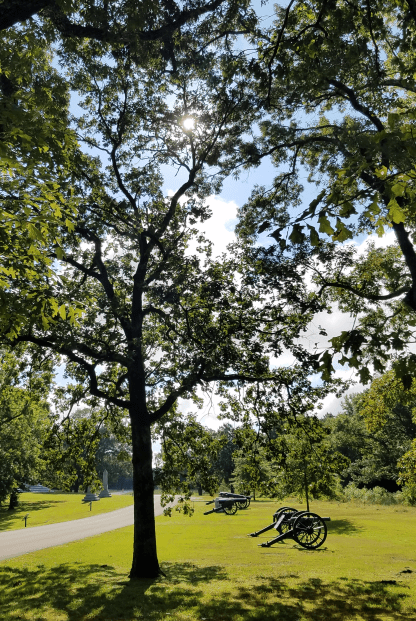
Part of the largest battery of artillery ever assembled on the North American continent until that time  — aimed at the Hornet’s Nest, the Union center.

deer

Although I’d gone to see the battlefield, also included in the park is a hiking trail leading to some mounds left by a Mississippi-culture tribe. The mounds are also directly accessible  by road, but then you miss the chance to see deer!

shilohview

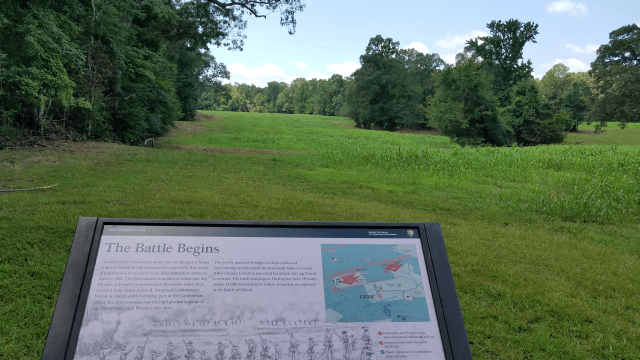
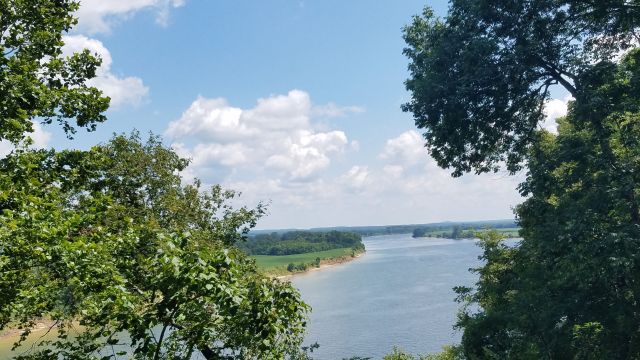
The view from the mounds is compelling, too.   I was absolutely impressed by the park’s staff and upkeep — they even cut paths of grass shorter for those who want to trek out to the edges of fields to look at monuments .The park is massive, and not every feature of it is obvious from the roadside: when I visited monuments at the far end of Duncan Field, for instance, I moved to the treeline to try to imagine what it might have looked like, 150+ years ago — and I spied a mossy path leading to another monument, out of sight in the woods!

iowa

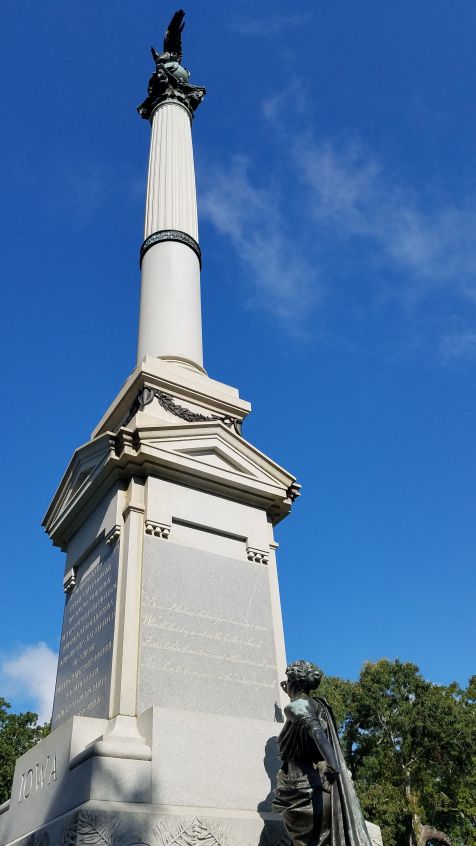
Iowa’s monument was far and away my favorite, mostly for this touch.


morbid

They memorialized their dead with the thing that killed them — a minieball.

thedead


Posted in General | Tagged , , | Leave a comment

American Illiad | Reluctant Voices

As part of my attempts to scale Mount TBR,  I read two smaller works on the Civil War this week. They may be later joined by This Republic of Suffering,  a survey of the war’s unprecedented death toll and its postwar consequences.


americanilliad

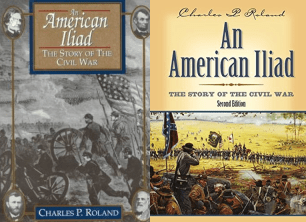
American Iliad was one of the texts assigned to my US History freshman course, though not one I purchased — my copy of this is a library discard.   Having encountered it, I can see why my professor assigned it; it’s an extremely readable survey of the war, which manages to be concise despite including sections on the war’s background, the political & social scene of the South & Union during the war,  and so on.   I was pleasantly surprised by both its impartiality and the fact that it still managed (despite its brevity) to introduce new-to-me material —  on the abusive way freedmen were treated, for instance, sometimes being press-ganged into Union army units.

old

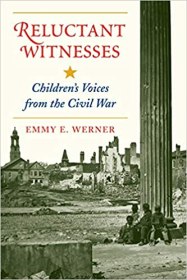
Reluctant Voices was another library discard, and reviews the American Civil War experience as lived through various minors who were exposed to its horrors. These include boy soldiers — both children serving as drummer boys, or young teenagers who fudged their ages to take up arms —  as well as numerous civilians.   Although the titular focus of the book was of children’s reactions to what they saw unfolding around them, for the most part I would have been hard-pressed to separate this from a narrative history of the war from civilian perspectives —  in part, I suspect, because 19th century adolescents were forced by the circumstances of their society to mature far more quickly than their counterparts of today.  I’m glad I snatched this title up on its way out of the library, as in addition to the narrative which follows the general course of the war, there are special sections on the siege of Vicksburg, and the grisly spectacle of Andersonville:  although I’m familiar with its sad story, I had no idea there were such young soldiers contained within its death-filled walls.  The work is a valuable read for readers who want to experience something of the home front, made especially poignant through the letters of children who dearly missed their fathers and brothers,  and as a reminder that the hell unleashed by war often visits those who had no say about being involved — like  the children who were killed during the siege of Vicksburg, for instance.

More to come on the war….I paid a visit to Shiloh over the weekend, touring its battlefield, and I took with me Winston Groom’s Shiloh 1862 to help understand the ground before me.

Posted in history, Reviews | Tagged , | 5 Comments

Selections from “How Dante Can Save Your Life”

chartres
Review of Book

Great art speaks with wisdom and authority to what is eternal in the human condition.

The presence of God radiated from the Chartres cathedral so powerfully that it even pierced the dark wood into which I had retreated to escape my father, whom I loved and hated and could not quit. I knew God was there; I had experienced him in that old church. As long as I held Chartres in my imagination, there was hope.

There is no exile quite like being a stranger in the midst of your own family.

The spiral design symbolizes how we fall into the depths of sin and how we may ascend out of them. Few of us lose our soul in a single moment. To become captive to sin typically requires slowly circling around vice, descending a bit more each time, barely perceiving our descent, until finally we arrive at the bottom: circling only around ourselves, prisoners to the ego.

Living to serve others is usually a virtue. But if the worth of your life depends on the judgment of others—your parents, your spouse, your children, your employer, anybody—then it becomes a vice. When you cannot live without the approval of others, you grant them power that they do not have a right to have, and may not even want. Worse, you expect more of them than they can give.

Thinking of sin as law-breaking, as many of us do, disguises the way it works on our hearts and minds, and keeps us from dealing with it effectively. Here’s a better model: Think of love as light, and sin as gravity, a force that bends light. The stronger the gravitational field, the farther love will fall from its mark. Hell is a black hole, where the light of love goes to die. Your goal in life: to put as much distance between your heart and the black hole’s deadly gravity field as you can. Passing too close to it will make even your most sincere acts of love land far from their intended destination.

I knew now that we condemn ourselves to misery not so much because of what we hate but because of what we love and the way we love. This gave me a new way to think of sin and brokenness, both in myself and in others.

Whatever idol you worship—and all of us, religious or not, are tempted by idolatry—the ultimate idol you worship is yourself. No discerning reader gets out of Dante’s inferno without having had at least one soul-shaking encounter with their ugliest self.

You start by separating your thoughts and desires from your self. Your thoughts and desires are not the same thing as you and only define you if you let them. Thoughts and desires that assault us and tempt us to do the wrong thing are called, in Greek, logismoi.

“To expect too much is to have a sentimental view of life and this is a softness that ends in bitterness,” Flannery O’Connor wrote.

.

Posted in quotations, Religion and Philosophy | Tagged , , | 4 Comments

How Dante Can Save Your Life

How Dante Can Save Your Life: The Life-Changing Wisdom of History’s Greatest Poem
© 2015 Rod Dreher
322 pages

dante
Selected Quotations

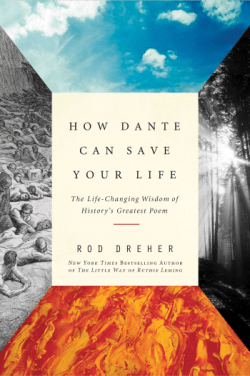
How Dante Can Save Your Life is one man’s account of how that Renaissance poet’s epic  tale of a man who had lost his way helped him survive  the darkest time in his life.  By way of offering thanks, and reflecting on his journey, Dreher guides readers through Dante’s Divine Comedy,   recounting both his and the Commedia’s narrator’s journeys. It’s a profoundly intimate encounter with poetry  that moved me like few other books.

For Dreher, this is an incredibly personal book;  he encountered  the Commedia during an intensely troubled time in his life, and his six-month slow read of the trilogy (Inferno, Purgatorio, Paradiso)  happened in tandem with counseling from his priest and a clinical psychologist.  The story begins with Dreher’s family background — his status as the odd, bookish duck  in a family of  rural traditionalists (“bayou Confucians”) who could not understand young Rod’s  attraction to the big city, his aversion to hunting, and so on.  Torn between love for his folks — especially his father — and their constant rejection of him,  Dreher tried to escape the conflict by moving away.  But when his sibling-rival Ruthie was stricken with lung cancer at age 40,  Dreher was moved by how deeply invested his sister had been in the life of her local community — and inspired by it.  There was meaning to be found in the little way of Ruthie Leming.  But if he’d expected to be welcomed home like the prodigal son,  one who had at last embraced Starhill, he found only pain:  despite actively trying to be involved in the lives of his  sister’s kids, and to reconnect with his parents,   the meaningful connections he longed for remained absent — and he remained the family outsider.  The stress and pain of this triggered his dormant Epstein-Barr syndrome, and for two years he was nearly an invalid.  Enter Dante.

Slowly studying Dante — in conjunction with frequent conversations with a priest and his counselor — granted Dante the vision to understand what had gone wrong in his life.  Traveling through the downward spiral of the Inferno,  sin by sin, Dreher examined his own conscience and found it wanting. He saw himself reflected in the lives of those in the pit, and ultimately realized that he had made his family into the god of his life, expecting more out of those relationships than they could bear. He realized that sin can be found in loving the right things too much, or in  — just as it can be found in loving the wrong things at all.    Ultimately,  although Dreher doesn’t realize his heart’s desire — to suddenly experience the fullness of southern small-town community like Ruthie —   his extensive immersion in Dante and the related spiritual studies finally allowed him to find peace —  and make peace with his father.

For me, Dreher is an incredibly sympathetic figure  — he and I were both the otherworldy freaks in our southern clans, and both tried to come back home only to realize there were some distances that can’t be closed.  Like him, I encountered this book at a time when I needed it, though for different reasons.  I was frequently and deeply moved by Dreher’s writing here, because his relationship with his family is so complicated  — a mutual mix of love and conflict–  and because of the depth of his soul-searching to find some answers.   It’s less a guide to Dante, though, and more of one man sharing his experience with the literature; the parts that spoke most strongly to him were Inferno and Purgatorio.   It’s inspired me to add both of the latter book to my “Classics Club Strikes Back” list, for whenever I do a new CC challenge.

One to remember!


Posted in Religion and Philosophy, Reviews | Tagged , , , , , , , , | 8 Comments

Wisdom Wednesday: Merlin’s Advice

Well, it was bound to happen. I forgot to schedule a Wisdom Wednesday.  I blame  the library’s very odd Monday,  in which we were sent running from the building a half-hour into our workday by noxious fumes coming through the AC system.  On the urging of the fire department, we closed for the day so our HVAC people could replace some part that had gone afoul, and the air could be refreshed.   I couldn’t complain about a day off, but it has disrupted my mental calendar.   This quote comes from Goodreads;  someone sent me a friend request and I discovered this quote in their profile. I must read the sourced book!

koenig

“The best thing for being sad,” replied Merlin, beginning to puff and blow, “is to learn something. That’s the only thing that never fails. You may grow old and trembling in your anatomies, you may lie awake at night listening to the disorder of your veins, you may miss your only love, you may see the world about you devastated by evil lunatics, or know your honour trampled in the sewers of baser minds. There is only one thing for it then — to learn. Learn why the world wags and what wags it. That is the only thing which the mind can never exhaust, never alienate, never be tortured by, never fear or distrust, and never dream of regretting. Learning is the only thing for you. Look what a lot of things there are to learn.”

-T.H. White, The Once and Future King

Posted in quotations | Tagged | 6 Comments

The Left, The Right, and The State

The Left, The Right, and the State
© 2009 Lew Rockwell
556 pages

lew
“Society is held together not by a state but by the cooperative daily actions of its members.”

Who’s up for six hundred pages of essays on politics and economics? I read this over the course of half a year,  owing to its size, its nature as a large set of independent pieces, and  the common tattoo being drummed out throughout the collection.  The book  brings together Rockwell’s views on American politics, from the late eighties through to the 2008 election  with Clinton and George W.’s admins attracting the most content.   Such a massive collection of material defies summation, but I’ll give it the old college try.

Lew Rockwell has been active in political and economic circles at least since the seventies, co-founding the Mises Institute alongside Murray Rothbard, the father of anarcho-capitalism.  I’m familiar with Rockwell through his frequent appearances on the Tom Woods show, and so for the most part there were few surprises here, content-wise. Rockwell is a welcome and consistent voice — if sometimes an overly acidulous one —  haranguing the state for its wars, its abuse of civil liberties, its bullying of its people, its manipulation of the money, etc.   Rockwell is as I mentioned consistent, sometimes astonishingly so:  his essay written on September 12, 2001, was particularly  impressive:   here we were with a massive gaping wound in the American heart, and Rockwell says: stay calm. Don’t let the pain and righteous anger of this time carry us away into making a costly mistake in the middle east. The alterations of the American state after 9/11, its final corruption through the Patriot Act, the explosion of warrant-less surveillance, etc,  were the events that began waking me up to the dangers of the modern state — and Rockwell saw them coming. He  also writes — in 2003 — on the potential for mischief with oil prices because of Bush & Cheney’s interests in the industry.  Not all of the content is political, though; one essay concerns Y2K and the banks, and I found the essays on historic events I remembered from the nineties on to be especially interesting, prompting me to think on how I interpreted those events then and now.

Many of the essays are Rockwell riffing off of contemporary events, or using them to argue a more pressing point. When Clinton complained that his private life was being invaded by the press, quick on the scent of the Lewinsky scandal,  Rockwell chuckles in a fit of schadenfreud and points out the ways that DC has invaded the private lives of everyone.   In another example, he discusses subsidiarity and secession amid the Soviet Union’s breakup, promoting the latter as self-determination. In other sections, he moves away from current-events contemporary to write more generally:  reviewing the works of various economists,or discussing the role of inflation in economic busts, and the perverse effects of war on the economy. By far the weakest section is that on the environment; Rockwell dismisses conservation and hazard containment altogether, regarding progress and industrial  growth as absolute goods.  Although environmentalism and libertarianism are often at loggerheads over the heavy-handed ways that environmental legislation is handled,  there are perfectly plausible arguments to be made for environmental concerns from the libertarian camp. The first time I saw Rockwell in person, for instance, I was attending the 2015 conference of Young Americans for Liberty, and several of the booths selling books outside were from green libertarian groups.  Rockwell’s stance in this is so strident and narrow that it undermines credibility.

Despite this, Rockwell’s collection of writings here  was worth plowing through over the last few months. In the beginning, I  appreciated the view that libertarian-leaning individuals who work with the government to help it function better by introducing some ersatz market measure —  school vouchers, say, or social security privatization — do the cause of liberty a disservice by making it the handmaiden of its enemy. Liberty, he writes early and emphasizes throughout, is not a public policy. It is the end of public policy.  Despite being familiar with and sympathetic to many of Rockwell’s viewpoints, I also delighting finding a lot of content here that challenged me, like Rockwell’s defense of planned obsolescence.  I still don’t like planned obsolescence,   but it’s good to consider the arguments for or against a thing.  The collection could have used some tighter editing,  at least in the beginning.

In the balance, this collection was worth reading for me — but I was trying to coax someone into Liberty’s camp I’d use something less bellicose.  There’s a lot of good content here,   and some lamentable blind spots.


Posted in Politics and Civic Interest, Reviews | Tagged , , , | 6 Comments

Top Ten Tuesday: Books I Loved But Didn’t Review

This week’s TTT …books we read, loved, but didn’t review.

The Death and Life of Great American Cities,   Jane Jacobs. This book  completely revolutionized my worldview before I made halfway through. One day I’ll make some meager attempt at reviewing it, but it won’t be sufficient.

Unnatural Selection: How We are Changing Life, Gene By Gene,  Emily Monosson.  Captivating survey of how nature is adapting to some of humanity’s worst behaviors.  Cautious grounds for optimism that nature will continue to survive despite its badly-behaving tenants.

The Age of Absurdity: Why Modern Life Makes it Hard to be Happy, Michael Foley.  I was introduced to this by Cyberkitten, and read it in 2011 It’s at my bedside. I’ve read it three times over the years and am no closer to finding an approach to reviewing it that I like — and I like the book too much to simply dismiss it with an also-read mention.

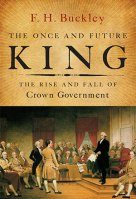
The Once and Future King, F.H. Buckley. On the rebirth of one-man rule in the United States,  the United Kingdom,  and the commonwealth countries. Fascinating comparative legal review. I have a review of it long-written, but I keep meaning to re-read the book to fine-tune my thoughts about it.

braveneworld

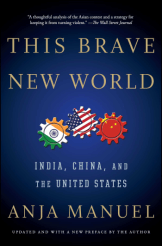
Brave New World: India, China, and the United States,  Anja Manuel. I often cite it but have yet to re-read it for a review. Manuel evaluates the progress and growing influence of India and China in the 21st century, and argues that the US should chart a course that favors neither power over the other.

ordnung

The Roots of American Order, Russell Kirk. My first encounter with Kirk was his The Conservative Mind,   which I found thought provoking —  I’ve since read several of Kirk’s work, Order among them, but this is the most memorable. Kirk examines the philosophical and moral underpinnings of American governance; Judaism and Stoicism were two of the sources  considered, as I remember.

wayofmen

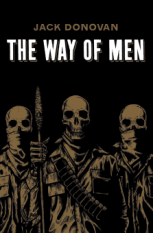
The Way of Men, Jack Donovan.   Imagine if Tyler Durden wrote a book …

omni

The Evolution of Everything, Matt Ridley.  On emergent order.  It’s a deep-topic, and I don’t know that I could do it justice.

market

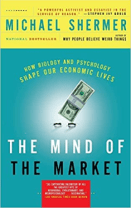
The Mind of the Market, Michael Shermer. I read this in 2018, but I must have been distracted — I didn’t even remember to add it to that year’s “What I Read” list!

brain

The Tell Tale Brain, V.S. Ramachandran.  Ramachandran’s Phantoms in the Brain (read 2006) was one of the first science books to blow my mind, and I was eager to read this one. Despite finishing it soon after release, though, I never got around to reviewing it!

There is hope for these books to be reviewed: over the years, Happy City, Surprised by Joy, and The Cult of the Presidency are all titles which languished unreviewed for years until I did right by them.

Posted in Reviews | 17 Comments