Top Ten Tuesday: Books I Loved But Didn’t Review

This week’s TTT …books we read, loved, but didn’t review.
The Death and Life of Great American Cities,   Jane Jacobs. This book  completely revolutionized my worldview before I made halfway through. One day I’ll make some meager attempt at reviewing it, but it won’t be sufficient.

Unnatural Selection: How We are Changing Life, Gene By Gene,  Emily Monosson.  Captivating survey of how nature is adapting to some of humanity’s worst behaviors.  Cautious grounds for optimism that nature will continue to survive despite its badly-behaving tenants.

The Age of Absurdity: Why Modern Life Makes it Hard to be Happy, Michael Foley.  I was introduced to this by Cyberkitten, and read it in 2011 It’s at my bedside. I’ve read it three times over the years and am no closer to finding an approach to reviewing it that I like — and I like the book too much to simply dismiss it with an also-read mention.
The Once and Future King, F.H. Buckley. On the rebirth of one-man rule in the United States,  the United Kingdom,  and the commonwealth countries. Fascinating comparative legal review. I have a review of it long-written, but I keep meaning to re-read the book to fine-tune my thoughts about it.
braveneworld

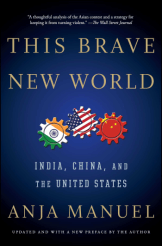
Brave New World: India, China, and the United States,  Anja Manuel. I often cite it but have yet to re-read it for a review. Manuel evaluates the progress and growing influence of India and China in the 21st century, and argues that the US should chart a course that favors neither power over the other.

ordnung

The Roots of American Order, Russell Kirk. My first encounter with Kirk was his The Conservative Mind,   which I found thought provoking —  I’ve since read several of Kirk’s work, Order among them, but this is the most memorable. Kirk examines the philosophical and moral underpinnings of American governance; Judaism and Stoicism were two of the sources  considered, as I remember.
wayofmen

The Way of Men, Jack Donovan.   Imagine if Tyler Durden wrote a book …

omni

The Evolution of Everything, Matt Ridley.  On emergent order.  It’s a deep-topic, and I don’t know that I could do it justice.
market

The Mind of the Market, Michael Shermer. I read this in 2018, but I must have been distracted — I didn’t even remember to add it to that year’s “What I Read” list!

brain

The Tell Tale Brain, V.S. Ramachandran.  Ramachandran’s Phantoms in the Brain (read 2006) was one of the first science books to blow my mind, and I was eager to read this one. Despite finishing it soon after release, though, I never got around to reviewing it!

There is hope for these books to be reviewed: over the years, Happy City, Surprised by Joy, and The Cult of the Presidency are all titles which languished unreviewed for years until I did right by them.
Posted in Reviews | 17 Comments

COVID has infected my gaming

Between the corona chill and the sweltering heat outside, I haven’t been doing much out-and-abouting with friends  —  I had a close circle who I was seeing every weekend, but  now it’s more of a every two-weeks kind of thing because people go in and out of isolation.  So…I turn to games.

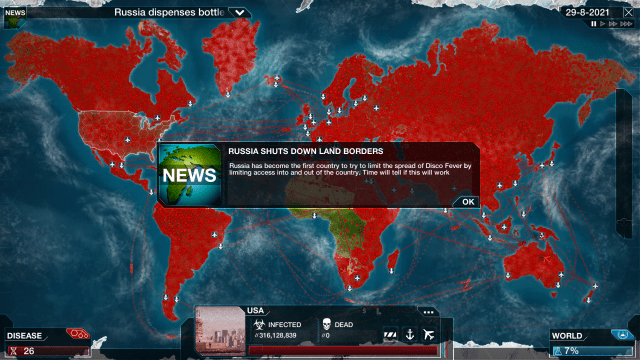
A few weeks back I picked up Plague, Inc which allows players to create a disease (beginning with the basic bacteria/viral/parasite variants, before getting into more esoteric ones like prions, and then fanciful ones like alien mind-worms and a zombie plague),  and  nurture it to destroy humanity.  The player chooses a country for Patient Zero, and then it spreads based on various factors —   traffic in and out of the country, climate, etc.  As the plague spreads,  it racks up DNA points which can be spent on new abilities. What I most appreciate about this game is that every disease has a different profile and so requires a different strategy.  I’ve yet to beat all the levels: the Zombie scenario thwarts me again and again, although I’ve found an approach that should work with a little RNG luck.  The zombie level is an odd duck, because in addition to the usual disease stuff, the player is also a zombie general, continually resurrecting bodies from the field and sending them forth to invade healthy countries. It has all the frenzy of a game of Red Alert 2!

killjoys

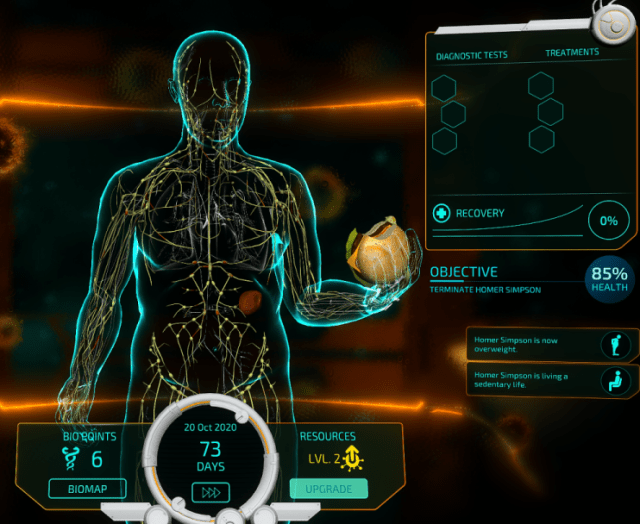
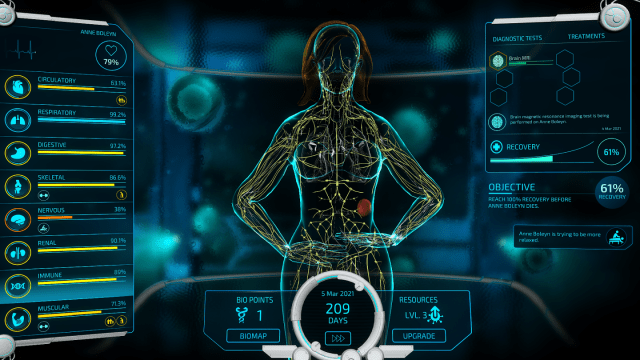
More recently, tonight, I started playing Bio, Inc. This game allows the player to choose Life or Death;   in the Life campaign, they are a doctor analyzing a patient’s symptoms,  running tests based on given symptoms, then treating diseases if the tests establish the need. They can also urge the patient to adopt better lifestyle choices, like exercise or mindfulness practices.   In the Death campaign, they play as…Satan or something, trying to kill the same poor patient by methodically targeting his or her systems one by one.   I love the puzzle aspect of the game, and the graphics are quite well done — the beating heart, the pulsating lungs, etc.  What I don’t like is the..game-y ness of it.  If the player choses Life, it doesn’t matter if they figure out what the disease is quickly, because there’s an AI playing “Death”, and they will continue  inflicting new ones on the patient until a timer runs out.  This may not be true in all game modes, though.

anneyouwench

Anne Boleyn was a mess here. She turned out to be  an anorexic with ovarian cancer, and she didn’t help matters while picking up a smoking habit under treatment.

homer

Testing out the Death campaign.  I slowly undermined Homer’s health with insomnia, kidney issues, diabetes,  and a few minor sundries. It took a long time for him to go to the doctor, and by that time I had enough of this game’s equivalent of DNA points to give him both lung cancer and leukemia while the doctor was busy with the other stuff.


Posted in General | Tagged , | 2 Comments

Progress report of sorts

A few weeks back, I read an article from Leo Babauta, of Zen Habits,  which  offered readers both an observation and a challenge:

You can go to the latest memes and viral videos (which are fun!) … or you can find a text and study it.

You can get caught up in frustration with how others are acting during this crisis … or you can practice opening in compassion, with compassion meditations.

This is a great opportunity to deepen into mindfulness and practice, to learn to face head-on the uncertainty and fears that arise in us, and to connect to the humanity going through this rather than disconnect from them.

We’re all monastics now — how will we use this time?

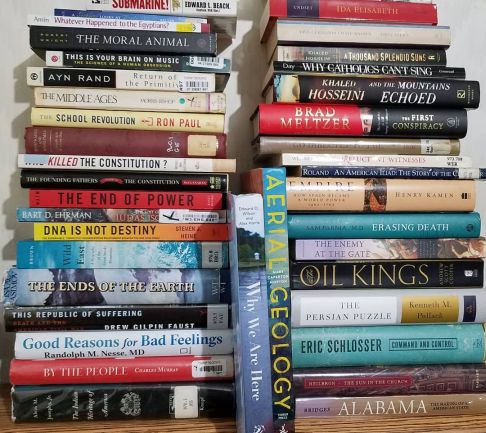
I haven’t had the same corona experience as most;  our library team has shrunk over the corona period because of retirements and the like,   so those who remain are working more hours and covering more responsibilities.  Nevertheless, I’ve been trying to use my off time productively, in a mindful way — if only to keep my mind from dwelling on the problems of corona (isolation, loneliness,  restlessness, etc).     Following my morning coffee, on Saturdays I usually give my living space a good shellacking,  working to reduce books, clothes, and physical media.  One of my smaller campaigns within the broader minimizing mission is to destroy Mount Doom — as I affectionately call the towering mass of books in my bedroom.

soprepared
Shot taken in April. Some of these titles have since been read (or in the case of Submarine! & The Middle Ages, donated)

At the end of July I drew up a little schedule called “Scaling Mt. Doom”,  with its objective being to read at least two TBR books per month. As I did with the classics club (speaking of, I really should get to Brothers K), I’ve been trying to pair them based on some shared attribute.   August’s scheduled reads are The Architecture of Happiness and How Dante Can Save Your Life, both being about meaning;  September will feature two books related to education, October has two titles of German history,  etc.  It’s still a work in progress because I haven’t determined my Nov and Dec reads, though I think The Ends of the Earth, with its focus on the North and South poles, would be an amusing one for December.

Away from Mount Doom,  my biggest literary goal for this year was to read 20 science books, which I  accomplished much earlier than expected. I’m still one book shy for my science survey, though I have a title in mind for it.  I wondered in June if I might make 30 science books this year, but Mt. Doom is a more important goal.

Here’s hoping we start escaping this corona business before 2021 starts.  Losing spring and summer to it is bad enough, but there will be riots in the South if SEC football is cancelled…and I don’t want to think about Christmas’ prospects.


Posted in General | 4 Comments

The Architecture of Happiness

The Architecture of Happiness
© 2006 Alain de Botton
280 pages

de botton

I never thought much about the meaning of architecture until attending a lecture by James Howard Kunstler, given at my university in autumn 2008, entitled “Peak Oil and the Suburban Fiasco”, or something like that.  In that lecture, and in his book The Geography of Nowhere which I later read,  Kunstler stressed among other things the importance of a sense of place, and the role our building and street design can play on nor only our own sense of well-being, but our national fate:

kunstler

A land full of places that are not worth caring about will soon be a nation and a way of life that is not worth defending,


In my review of The Geography of Nowhere, I commented that it had me ‘itching’ to read The Architecture of Happiness.  I knew de Botton from The Consolations of Philosophy, one of my very favorite books,   and I’ve read much of him since. He is an extremely art-ful writer,   who can make the mundane seem utterly captivating — who can throw,  with pen and ink, new light onto an object and make it seem sublime.  I expected great things of The Architecture of Happiness and was not disappointed in the author’s usual thoughtfulness, his explorations  into the human condition and illuminated by the buildings around us.

He opens with an apology for the subject,  because who cares about architecture?  That question is a new one, for  the built environment  was a subject of considerable importance to seemingly every age but our own. The Greeks, for instance, regarded its study in equal importance to politics and personal virtue.   The Christian and Islamic worlds both recognized the importance of both architecture and public design  in making the material world reflect the ethereal —  they knew how to use buildings to draw the mind to God and elevate the spirit. Somehow, though, in the last century we have become self-conscious about making things beautiful, or indeed — even caring if they are.   The Architecture of Happiness therefore addresses the role of beauty in human welfare, not merely how beauty is expressed in our constructs.

de Botton muses that perhaps not everyone shares the same levels of sensitivity to beauty. Perhaps we need to have entered into ‘dialogue with pain’  to realize its value — to be able to realize that a beautiful thing hints at happiness which is the exception to our experience.  Our personal interactions with a building, a room, or an object frequently appear here. In the beginning, de Botton observes that a messy environment can coagulate our loose misgivings about our own lives, while a sun-lit one set with honey-colored tiles encourages the hope within us.  He wonders later on if we appreciate buildings not for the shared values they express, but the values we wish to possess — those we sense to be lacking in ourselves.  Perhaps that’s rugged simplicity in one person, or a touch of refined elegance in another.  There’s no simple answer,  as we all seem to be walking a tightrope between chaos and order. A building can reflect this: we want too much of neither one.  A building like the Palace of the Doges works because it offers both symmetrical order and variety: it is neither chaotic nor sterile.

There’s more to the book — including an interesting discussion of Japanese vs western  aesthetic sensibilities — but I’m still chewing over much it. That’s one of the reasons I love de Botton: since my first encounter with him, he’s become a permanent resident in my head, a voice I enjoy returning to again and again. This work is utterly consistent with his usual thoughtfulness,  his attention to detail, and artful integration of varying media:  this text’s discussion is always accompanied photos that  add the finishing touch to the point at hand.   I’m glad I finally — after ten years! – -decided to sit with it.

Below follows my favorite quotation from all the various de Botton I’ve read,  and I think it summarizes how I feel about his books & authorial voice:

I explained — with the excessive exposition of a man spending a lonely week at the airport — that I was looking for the sort of books in which a genial voice expresses emotions that the reader has long felt but never before really understood; those that convey the secret, everyday things that society at large prefers to leave unsaid; those that make one feel somehow less alone and strange.
Manishankar wondered if I might like a magazine instead.”

Posted in Reviews | Tagged , , | 5 Comments

Wisdom Wednesday: Perspective

This week, I’m bringing together four different quotes, all with a similar perspective —   one on the value of books to the pursuit of wisdom.

perspective

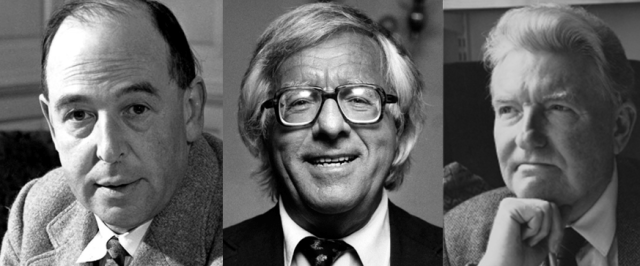
“Every age has its own outlook. It is specially good at seeing certain truths and specially liable to make certain mistakes. We all, therefore, need the books that will correct the characteristic mistake of our own period. And that means the old books.”  – C.S. Lewis

“The books are to remind us what asses and fools we are. They’re Caesar’s praetorian guard, whispering as the parade roars down the avenue, ‘Remember Caesar, thou art mortal’. Most of us can’t rush around, talking to everyone, know all the cities of the world, we haven’t time, money, or that many friends. The things you’re looking for, Montag, are in the world, but the only way the average chap will ever see ninety-nine percent of them is in a book. Don’t ask for guarantees. And don’t look to be saved in any one thing, person, machine, or library. Do your own bit of saving, and if you drown, at least die knowing you were headed for shore.”  – Ray Bradbury, Fahrenheit 451

“The process of living seems to consist of coming to realize truths so ancient and simple that, if stated, they sound like barren platitudes. They cannot sound otherwise to those who have not had the relevant experience; that is why there is no teaching of such truths possible and every generation starts from scratch.” – C.S. Lewis

“The study of history is a powerful antidote to contemporary arrogance. It is humbling to discover how many of our glib assumptions, which seem to us novel and plausible, have been tested before, not once but many times and in innumerable guises; and discovered to be, at great human cost, wholly false.” – Paul Johnson


Posted in quotations | Tagged | 11 Comments

Literary humor in RDR2

I’m currently wrapping up my fourth playthrough of RDR2, and am continuing to discover new things.  Recently while looting the body of some poor unfortunate (he had a case of bad manners, which I remedied with liberal application of fisticuffs) ,  I discovered this little gem that brought Gone with the Wind to mind:

gotw2

stonemasons

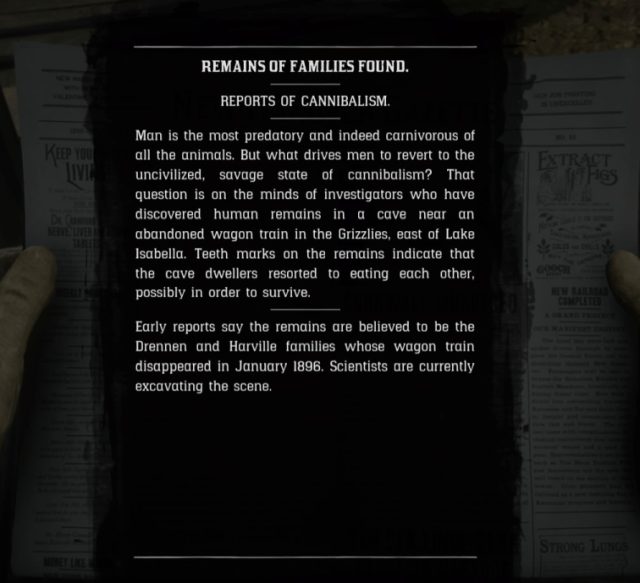
There are also historical  references, like this one to the Donner party:

donner

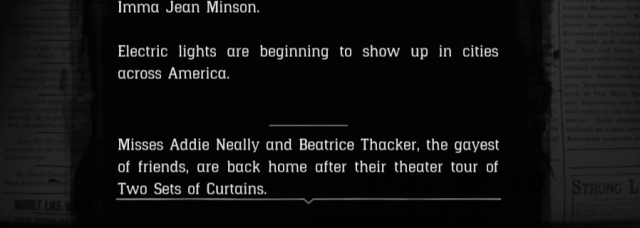
I’m almost certain this bottom article is a reference to something, I just don’t know:

curtain

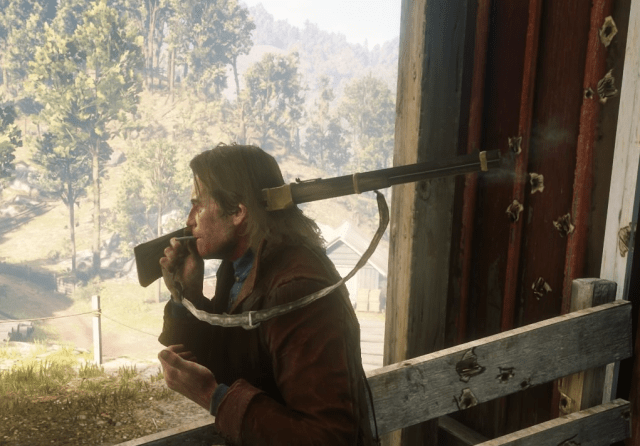
And just a glitch to wrap things up.  Would you call this….

…..

funny

…a headshot?


Posted in General | Tagged , | 2 Comments

The End of October

The End of October
© 2020 Lawrence Wright
482 pages

christalive

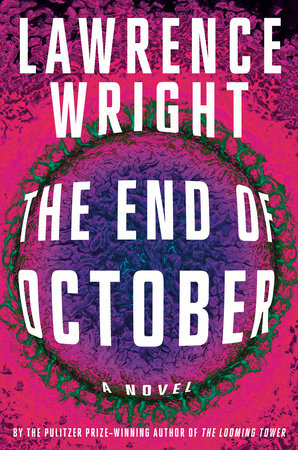
COVID-19 gotcha down? Cheer up! It could be worse. A lot worse. Like…the US president dying on live television, bleeding from the eyes worse.   The End of October was published shortly before COVID-19 went viral (hurr hurr hurr),  and when it popped up on my radar in late March its author lamented that he’d gotten so much right.  Well, time will tell, but so far Saudi Arabia and Iran haven’t triggered World War 2 as DC and Moscow back their favored brands of psychopaths,  so we’re ahead of the game. And the internet still works!  The End of October is a truly depressing medical thriller about the rise of a pandemic, possibly originating in a bioweapon, and the complete collapse or even destruction of global civilization. It is captivating, all-too prescient, and something you should avoid like the plague (hurr hurr) until we’re in the clear.

It all started in Indonesia, in an startlingly deadly outbreak of the flu in a concentration camp for homosexuals.  A physician attached to the CDC & and the World Health Organization investigated,  only to realize to his horror that this was a novel strain of flu altogether, and that people had already been filtering in and out of the camp, potentially spreading it abroad. One of them happened to be on the way  to perform the Hajj, a global gathering of Muslims in Mecca.   Our CDC doctor and his colleagues desperately work to impose a quarantine, then to understand and defeat the threat it poses,  but geopolitical stresses complicate matters and make the situation far worse for everyone.  The good doctor is ultimately stranded on a US submarine, while things go to hell in a handbasket the world over.  On the homefront, we follow his wife and kids as they witness society falling away around them.   This particular track of the novel is especially harrowing, and not helping matters is what we learn about the doctor’s backstory — his family’s previous run-ins with virulent diseases.

As a story, The End of October is excellent: it’s an unusual kind of thriller,  drawing on a medical mystery and the search for truth. Its characters are uniformly interesting and sympathetic people, including the Saudi royal who is utterly torn about how to respond to the blossoming horror in Mecca, and the looming war with Iran.  But boy, is the middle of a pandemic a bad time to read a book like this.  It’s interesting to compare what Wright predicts and what we’ve done:  our global response has been more aggressive than the response of  societies in the novel, as people continue meeting in person for the most part, and PPE is only mentioned when people are dealing with known vectors like their dead neighbors.    I don’t now what my reaction to this would have been had I not read it during all this COVID uncertainty, but I suspect it would have been one of the most depressing books I’ve ever read regardless.

In short, it’s a good read….but you’ve been duly warned.


Posted in Reviews, science fiction | Tagged , , | 7 Comments

Darth Plagueis

Darth Plagueis
© 2012 James Luceno
498 pages

uei

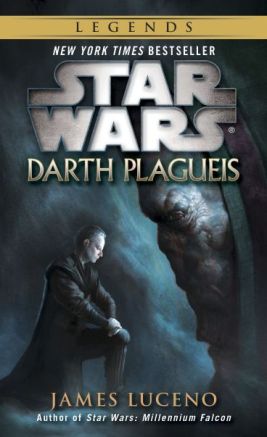
Did you ever hear the tragedy of Darth Plagueis the wise? ….it’s not a story the Jedi would tell you.   Beginning decades before The Phantom Menace, and culminating in its end,  Darth Plagueis follows the career of an ambitious Muun to realize the Sith’s Grand Plan:  the downfall of the Republic, the destruction of the Jedi, and the creation of a new order presided over by the Sith alone.  The prequel trilogy was driven by Palpatine’s manipulation of events to fully realize the plan, but long before that greatest of villains was pulling the strings, his master Plagueis was building the theater.  A story of political intrigue and subtle manipulations,  Darth Plagueis is a captivating look into the rise of Palpatine, who takes over the story even though it’s his master’s name on the cover.

According to Revenge of the Sith,  Plagueis was a dark lord of the Sith so powerful and so wise that he could manipulate the Force to stop those he loved from dying.   We are introduced to him as he kills his own master, Tenebrous, and devotes himself to his twofold work:   continuing and perhaps concluding the Grand Plan of the Sith,   and conquering death itself.  Plagueis has little love for the Rule of Two,  which keeps masters and apprentices in perpetual war with one another:  it is his hope to create a stable order in which two share in the power, each allowing for the other’s immortality.   In tapping the power-hungry and sociopathic Palpatine to be his co-conqueror, however, he….chose…poorly.

plageueis

As depicted in Star Wars Battlefront II (2017)

Plagueis, despite the chaos he creates, is a fairly sympathetic — the kind of villain who is courteous to waiters, you might say.  He’s curious about the world, and regards the chaotic-evil of many Sith as beneath him.  Young Palpatine, however engages in courtesy only as a manipulative trick: he regards himself as the king of the beasts, and proves himself in private to be The Emperor —  in all his cruelty and arrogance —  at heart long before he had achieved the power.   Here also we see the genesis of the events of later movies — Count Dooku’s disenchantment with the Jedi order,  whose total faith in their own righteousness sees them walk into blunder after blunder — and  the extraordinary request of Jedi Master Sifo-Diyas  that a clone army be created for the service of the republic.  Even  the leadership  of the Trade Federation under the cringy, brainless Nute Gunray is explained.

On the whole, Darth Plagueis makes for fun reading, explaining a lot of the backstory of the prequels and giving certain characters more depth.  Plagueis’ understanding of the dark side of the force is of interest, and I wonder if Luceno was channeling some particular philosophy or school of thought on Earth to inform it.   There’ an awful lot of business & political manipulation here, though,  making the non-Sith chapters a slow burn, and if the prologue of Phantom Menace sends you to sleep,  be forewarned that there’s a lot of debate about taxation, trade routes, business privileges, etc.

Posted in Reviews | Tagged | 2 Comments

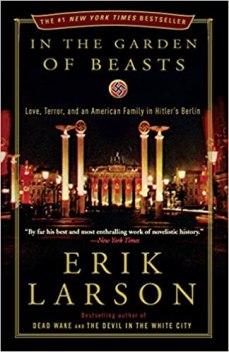
In the Garden of Beasts

In the Garden of Beasts: Love, Terror, and an American Family in Hitler’s Berlin
© 2011 Erik Larson
432 pages

tiergarden

In 1933, Franklin D. Roosevelt needed a man for a post no one wanted to fill: US Ambassador to Germany.  He found one in  William Dodd,  a southern academic who had interests in serving as a diplomat.  Dodd hadn’t expected a high-stakes posting like Germany, but resolved to do his utmost to promote the ideals of a liberal democracy and American interests.  Although Hitler and his Nazi party had already acquired a reputation for thuggishness,  Dodd viewed humans as essentially rational, and thought the man could be reasoned with —  and if not, the demands of high office would surely check his excesses.   Instead of influencing Germany to turn away from the path of horror it pursued — first at a snail’s creep, then headlong —   Dodd could only watch in bewildered despair as Hitler’s domination of Germany  became complete.   His frequent warnings that Germany was changing for the worst, and that Hitler was preparing to dominate Europe as his thugs now controlled the country, went unheeded.    In the Garden of Beasts is an interesting if unnecessarily salacious chronicle of the Dodd family, as they witnessed Germany’s transformation into a nightmare-state.

I found Dodd himself a very sympathetic man; a soft-spoken academic, a historian of the Old South who viewed its plantation elite with derision,   not admiration; a committed Jeffersonian who practiced frugality in spite of his government appointments,  even moderating his use of the telegraphic cable system to  minimize costs.   His prudent simplicity was out of place in Germany,  increasingly dominated by flashy decadents like Goering and Rohm.  Although Dodd quickly found sympathetic minds in Germany — many were uncomfortable with Hitler’s constant harping on the Jews, and his extralegal influence through militant organizations like the S.A. —     through his eyes we see a Germany where Hitler is plainly on the ascent. All of society is being ‘coordinated’ to support and promote the Nazi message;    Germans themselves, like the Chinese a decade later, are being molded by fear  to become tyrants of one another, bullying one another into conformity.  When Hitler institutes a violent purge of the S.A,  also using the opportunity to silence dissidents, any hope Dodd has for pulling Germany from the brink is lost.    Increasingly in poor health from his alienation in Germany, and frequently undermined by those in the State department who believe he is needlessly antagonizing Hitler,  it was a mercy for Dodd to finally resign and return to his farm. He probably would have done much earlier had he known his daughter was bedding the head of the Gestapo,  a Soviet functionary with ties to the KGB, and various and sundry others.  First enamored of the Nazis, then of the Communists, she cuts a very poor figure — though she must have been most charming to have so many men trying to get a sliver of her attention.

Dodd’s daughter’s sex life constitutes far too much of the book for me, being more interested in the slow corruption of Germany. I appreciated how early this book is set;  usually when I read histories of WW2, the SA are quickly covered in Hitler’s rise,  but they’re major players here  — and absolutely hate-able. The SA constantly parade through Berlin and beat those who fail to stop in their tracks, and they’re such odious thugs that the reader practically cheers their demise during the night of the long knives .  (Or at least, he would if Hitler weren’t also using the occasion to disappear a few critics, and intimidate his last significant opponents into silence.)   Although I can understand why the US was reluctant to be drawn into yet another European bloodletting,  Dodd was a persistent and credible witness that the world would soon be at war whether it liked it or not.


Posted in history, Reviews | Tagged , , , | 4 Comments

Re-read: The Ethical Assassin

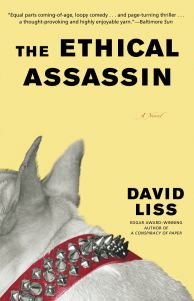
The Ethical Assassin
© 2006 David Liss
336 pages

vegan

A few weeks ago for TTT,  I mentioned David Liss as an author who made me smile, and happened to think  about the first novel I read by him, The Ethical Assassin.   It would prove to be an outlier, because everything else I read by Liss was historical fiction, usually thrillers with a business or political angle.  The Ethical Assassin, however,  was practically contemporary — set in the 1980s.   It wasn’t the first time I’ve thought about Assassin over the years, as it was a work that combined philosophy, satire, and a crime thriller with good effect.  Last week I decided to re-read the book to see how I responded to it, nine years later.

The Ethical Assassin opens with a young bookseller named Lem Altick standing in a trailer, dumbfounded as his two most recent customers are shot dead before his eyes. Their assassin, Melford Kean,  proves affable, assuring Lem that  he’s in no danger…provided doesn’t try to  create a fuss. Rest assured, Kean says,  those two deserved it.  As Lem and the reader experience more of the story, we tend to agree: “The Bastard” and his speedfreak girlfriend were mixed  up in a racket that spanned from animal-stealing to meth-dealing,  in cahoots with a closet pedophile and a cop who likes to pull over women and demand sexual favors in return for not giving them tickets on trumped-up charges.

All that’s fairly dismal,   and if there weren’t something worthwhile in all this, I would have never taken to the book back in 2011:   I’m not one for reading about depravity. But Assassin had a philosophical  curve to it. Kean & Lem were not able to go separate ways, but were forced by circumstances to work together against a mutual threat. As they work,  Kean engages Lem in debates about morality and ideology,  and we learn that he’s a vegan activist whose ire was tripped against this gang primarily because of their various animal abuses — from stealing pets for lab tests, to using a confined pig farm to mask their meth lab.

The question that has made this novel stand out for me, though, is Kean’s query to Lem, something of a test: why do we have prisons?  Kean and Lem argue about them, with Kean pointing to high recidivism of the system  and the idea that prisons serve as academies of crime,   sending people deeper into criminal activities.  Those who ‘serve their time’ are societal pariahs, often barred from useful employment — is it surprising  that they resort to earning money through illicit means, like narcotics? In the end, Kean suggests that DC promotes prions because they increase criminal tendencies, effectively converting people who might push for meaningful reform into common criminals,  easy to dismiss.

Although The Ethical Assassin is still amusing and thoughtful, this time around I was far more aware of how  awful most of the characters were — not badly written, but just awful, awful people, and the philosophical interest doesn’t  redeem it. I probably won’t be reading this one a third time, but I’m glad I revisited it for the humor at least, and it reminds me that I need to finish reading his 17th century crime/business thriller series.


Posted in Reviews | Tagged , | Leave a comment