Today’s blogging prompt from Long and Short Reviews is….”Films to Watch on a Bad Day“. I have an album of “movies I’d save in a fire’, and these all live there!
Groundhog Day. I have watched this movie dozens of times in the last twenty years, ever since discovering it at Blockbuster and giving it a shot because I like Bill Murray.
The Sandlot. The quintessential movie of American boyhood. I’ll never hear “Green Onions” without thinking of that particular scene.
The Philadelphia Story. Kathryn Hepburn, Jimmy Stewart, and Cary Grant. Competes with Groundhog Day for being my favorite movie. The Stewart-Grant scenes are priceless. (“Dog-gone it, either you’re gonna sock me or I’m gonna sock you!” “….shall we toss a coin?”)
The Three Musketeers, Disney version with Oliver Pratt, Tim Curry, Charlie Sheen, and Christopher O’Donnell. Fanciful, dramatic, and imminently watchable. Gabrielle Anwar played a perfectly lovely Queen Anne.
Lemony Snicket’s A Series of Unfortunate Events. The soothing narration, the story of children imperiled but finding sanctuary again and again, and of course Uncle Monty.
Airborne, Absolute ‘90s nostalgia for me. A surfer/rollerblader dude from Cali is stranded in snowy Minnesota, where he falls in love with the wrong girl and finds himself constantly harassed by a high school clique, one that includes Jack Black. Culminates in an epic rollerblading contest down a wickedly dangerous hill. Also features Seth Green trying to find a cool look to the sounds of Right Said Fred’s “I’m Too Sexy”, which is hilarious in its own right.
A Christmas Carol, Patrick Stewart. I will never tire of stories about redemption, and this one has Patrick Stewart singing “God Rest Ye Merry Gentlemen.” Stephen Warbeck did fantastic music for this movie, especially “Fezziwig’s Party” and “Fran’s Theme”. The latter is so utterly, utterly wistful.
D2: The Mighty Ducks. The Quack Attack is back, Jack! Rollerblading hockey-playing kids take on junior hockey teams from across the world. Sidenote: the Ducks recently made an appearance in Anaheim, in Ducks jerseys, to drop a puck to kick off a game.
Bicentennial Man, with Robin Williams, Sam Neill, Oliver Pratt, and Embeth Davitz. Robin Williams plays an android who is defective: he has personality and self-awareness. Like Data, he is on a journey to become more human. Funny, heartwarming, and features Embeth Davitz in two roles – a fact important to the plot. This movie is how I came to start reading Isaac Asimov’s fiction.
And finally….Men in Tights. I watched this entirely too young, but it was my first introduction to Cary Ewles….and Amy Yasbeck.
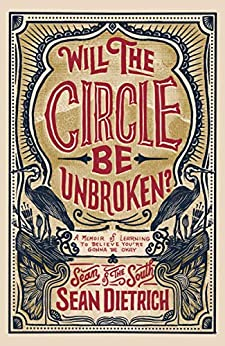
A memoir about a boy growing up in the deep shadow cast by his father’s suicide has no right to be this funny. Given the profundity of this event – its psychological toll, and the sudden poverty it thrust Sean’s family into – it’s come up in Sean’s other collections, but Will the Circle be Unbroken brings it center stage, a bit like The Prince of Frogtown did for Rick Bragg’s own father. Although some of these pieces may have appeared in other collections, this is not a hodgepodge: they’re tightly knit together, telling the lifelong story of Sean’s struggles with pain, sorrow, anger, and self-doubt, always haunted by the gangly red-head taking up permanent residence in his head. Despite this pain, it carries Sean’s hallmarks of charm, sweetness, and humor, and I suspect I will remember it as one of my favorite books of 2023.
We encounter Sean’s father first an idolized hero, young Sean watching him pitch and listening to the old folks wonder at his arm – but later having to regard him with fear, as psychological turmoil sets the stage for Sean’s father to recreating the same horrors of his own childhood, anger and abuse. The sudden loss forces Sean and his mother to work constantly to keep themselves and his sister fed: Sean helps his mother deliver papers, and drops out of high school to work construction, while also developing his skills with the guitar. The early parts of this memoir are saturated with deep emotion: Sean tells us of a young girl friend who he comforted after she’s orphaned comforting him in turn, when he flees his father’s funeral. Sean took deep comfort in the Baptist community he was raised in, though when their family leaves Kansas – and the painful memories thereof – behind, they are forced to draw more on their own reserves. As Sean grows, he continues to struggle with sorrow, anger, and confusion: his dad haunts him at pivotal moments both good and ill, often in the form of a bird but once appearing as a stranger in a bar. I realize mirages abound in the realm of memory, but they make for a powerful story, especially as we witness Sean’s refusal to give in to self-pity, and his realization that each of us suffers in unique ways but are here to help support one another along. The book culminates in Sean reaching a triumphant adulthood – finding himself a musician, a writer, and most importantly a husband, and someone who at long last can love and forgive his father despite the pain his suicide bathed Sean’s life in.
Will the Circle be Unbroken is wonderful in every way.
Kindle Highlights:
She was the first girl I ever kissed. We were first graders at the time, and she tasted like Nehi soda because that’s what she’d been drinking. After she kissed me, she punched me in the stomach to remind me who was boss. Marriage, I would discover years later, is not all that different.
“Were you a pitcher?” “Sorta. When I was a young’un, I wanted to be the next Walter Johnson.” “Who’s that?” My father stopped stretching. “You don’t know who Walter Johnson is? What dipstick raised you?”
The feeling was one I had never had before. It is the feeling you get when you lie in the surf and relax your body. The waves lift you, then drop you, and something works beneath you that you can’t explain. And it is as though all your experiences, the hell you’ve gone through, the minor triumphs, the pain, the self-doubt, they have been leading to this seemingly irrelevant moment. But this moment is not meaningless. It’s everything. You sense this, right when it’s happening. The veil is pulled back, and this morsel of time is perhaps one of the most important moments in your life. It is when you realize that your sole purpose is not just to survive but to help others survive. I kissed her forehead. I hugged her like she was family. And I said words I once heard a blind man say: “You’re gonna be alright.”
The girl scooted so close to me that her thigh was touching mine. I could smell her shampoo. “Oh, please,” she said. “Play us something.” A boy will do all sorts of things when he smells shampoo.
I rang the doorbell. I straightened my collar. I heard footsteps. I started to tremble. I felt like a groveling fool. I saw someone peek out the window. And I finally understood. I knew I wasn’t on that doorstep because of love. I was there because I was afraid of not being loved, and those two things are very different. Fatherless kids will do odd things to avoid being unloved. They will pretend to be people they aren’t. They’ll lie if need be. They’ll squeeze their fat feet into thrift-store shoes, buy bouquets, and spend money they don’t have. But you can’t make something true just because you want it to be. You can’t be someone you aren’t, and you can’t make people feel things they won’t.
“You ain’t gonna cry for that girl, is you?” “I might.” “Well, you shouldn’t. God just saved you from a mistake. That’s how God do, save us from mistakes. Hurts like the devil, but the mistake woulda hurt a lot worse.” “I’m not sure God has anything to do with me.” “Oh, he do.”
I’ve been a Baptist my whole life. My father converted to fundamentalism when I was a baby. He became evangelical because, as he once said, “It’s more fun to drink beer when your friends are teetotalers.”
Everything was off-limits. Most of the people within our congregation didn’t drink, and if they did, they at least had the decency to keep their beer in the garage refrigerator.
“Oh, I’ve been thinking about it a lot lately. I’m gonna go to college.” “College?” “You dang right.” “Isn’t it expensive?” “Yeah, but so is being poor.”
One day you realize that your life is one whole page of problems, and nothing ever gets solved—one ongoing equation with no equal sign at the end. But it occurred to me, beneath the canopy of a starlit heaven, that I’d been looking at my life all wrong. It wasn’t a math equation. Things weren’t supposed to add up. There was no solution. In fact, there was no problem. Life’s variables and numbers and pages of chicken scratch weren’t mathematical marks. They were art. A drawing, an abstract painting. It was meant to be beautiful, not sensical. And embedded within the mess of it all were miracles. Small ones. I had never paid attention to them because I was too busy, but it didn’t make them less real.
Today’s Top Ten Tuesday is favorite audio book narrators, which is a bit of problem because I haven’t listened to that many. Listening to a book takes a lot more time than reading it, so I tend to only listen (1) because the narrator is that good, because (2) I’m re-experiencing the story, or (3) because it offers something unique. Such as I have, though, give I thee:
(1) Wil Wheaton. Wheaton is, hands down, my favorite Audible narrator. I found him via a trial, when he did the audiobook of Redshirts— and boy, was that like eating meat for the first time and being exposed to bacon-wrapped grilled chicken. I’ve since listened to Wheaton on Audible several times.
(2) Roger Clark, Cold as Hell. Okay, full disclosure: I first heard Roger Clark as the voice actor for Arthur Morgan in Red Dead Redemption II, meaning I’ve listened to him for hundreds of hours already, and the fact that he was doing this character was the main reason I even tried it.
(3) Paul Scofield, narrator of one series of The Chronicles of Narnia books. Awesome.
(4) The fellow who did the American Harry Potter audiobooks. Jim Dale, I believe his name is.
(5) The fellow who did the British Harry Potter books. Stephen Fry, his name definitely is. He’s also done his own Mythos, which I’m….still…..listening to.
(6) John Cleese. I’m including him because he did the audio for The Screwtape Letters. Have I listened to it in full? No, but I know John Cleese and I can take it on faith they’re superb.
And er…that’s all I’ve got. Now for Tuesday Teases, this time from Will the Circle Be Unbroken? by Sean Dietrich.
At Halloween, my mother would only allow me to dress up as nonhorror characters. Thus, I was the only kid among my peers who went trick-or-treating as an angel or Moses or Oral Roberts, and one year—I’m not making this up—I went as Jesus. Being Jesus was my mother’s idea. She’d dressed me in her white bathrobe and then placed a Christmas wreath on my head to represent the crown of thorns. Before my mother sent me off, she kissed my forehead and almost started crying. “Oh, look at you,” she said. “Mama’s little Redeemer.” When I visited Mister Wallace’s doorstep, he took one look at me and said, “Well, well, if it isn’t the Ghost of Christmas Present.” “No sir,” I pointed out. “I’m Jesus.” “Who?” “The Fairest of Ten Thousand.” “For Halloween?” “Yessir.” “Why haven’t you said ‘trick or treat’?” “I’m not here for tricks, sir. I’m here to offer forgiveness.” And I held my pillow case outward. He tossed eighteen dollars into my sack and said, “ That’s all you get. I already gave last Sunday.”
Oh, and why not a bonus from John Steinbeck’s adaptation of Mallory’s Death of Arthur?
“If I should tell you that Guinevere will be unfaithful to you with your dearest and most trusted friend –“ “I would not believe you.” “Of course not,” said Merlin sadly. “Every man who has ever lived holds tight to the belief that for him alone the laws of probability are canceled out by love. Even I, who know beyond doubt that my death will be caused by a silly girl, will not hesitate when that girl passes by. You will marry Guinevere. You do not want advice — only agreement.”
Enter into the greenwood and consider two tales of Robin the Hood! One, the triumphant finale of Stephen Lawhead’s “Hood” trilogy, setting the Lincoln green-clad figure betwixt the rivers Wye and Severn; the other, an examination of Robin Hood ballads and stories, and of medieval records, in an effort to see what kernel of truth is within all the legend.
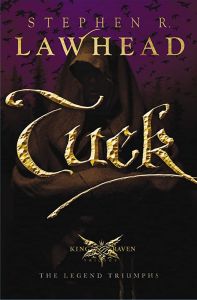
We begin with Tuck, third and last in Stephen Lawhead’s fascinating King Raven series, which sets the Robin Hood stories in Wales during the Norman attempt to consolidate its power in Britain. Rhi Bran, the prince of Elfael, was driven from his throne by the Normans and forced to refuge with some of his people in the forest – where in Hoodhe took on not only the mantle of noble responsibility, but the cloak of a terrifying bird-man who took control over the King’s Road and began exacting pain on the occupiers. Bran expected in Scarlet to be restored to the power after revealing to the Normans that their man in Wales was treacherous, but instead he returned to the greenwood empty-handed – and now, he is resigned to continuing the fight and expelling the Ffreinc through violence. He’ll need allies, though, and sets off to visit his kinsmen to the north in hopes that they will join his cause; meanwhile, young Merian also visits her father, one of the local magnates who despises Bran but who might be persuaded by his dearest daughter to lend aid against the faithless outsiders. In his quest, we see Bran at his best – passionate, clever, and indefatigable, despite continuing disappointments and constant danger. Though the late novel is mired in gloom from continuing setbacks, and the King’s army approaches to rout Bran and his followers from the greenwood, the tides of fortune have a funny way of turning, especially in the turbulent waters around the British isles.
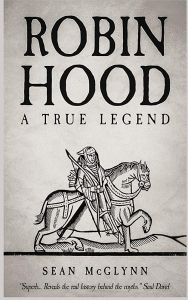
Next we move to Robin Hood: A True Legend, by Sean McGlynn. Robin Hood has a long pedigree in British folklore, and McGlynn here examine it to determine when the story of the whimsical bowman began, and who, if any man, might have inspired the Robin stories. There are problems in such a quest, McGlynn writes: what we have left is not necessarily what may have existed, just as Cicero and others often quote classical texts which have been lost to time. Nottingham and Sherwood are popular settings for Robin Hood stories, but this may be because only stories with that setting have survived: traveling bards often changed the setting of their stories to appeal to local audiences. McGlynn posits that Little John, Marian, and others may have been stars in their own regional stories who were later enveloped into the Robin Hood stories, rather like the cast of separate Marvel characters who later became the Avengers. After examining all of the early Robin Hood literature, McGlynn identifies some core characteristics of Robin Hood (the bow, the forest, a company of men, a hero/outlaw paradox) and then uses them to review and scrutinize several men who others have attempted to call The Real Robin Hood. These are all figures worth reading about, especially Hereward the Wake and Eustace – an ex-monk turned pirate – but the only one with real plausibility, McGlynn suggests, is William of Cassingham. Otherwise known as Willikin of the Weald, Cassingham led a resistance of bowmen against a French invasion following the days when John was dead and the realm was run by a child and his regent. I remember nothing of that story, so it may be high time for me to read McGlynn’s Blood Cries Afar, on said invasion. Robin Hood: A True Legend recommends itself highly as a concise review of Robin Hood lore and an inquiry into Robin’s possible historical roots.
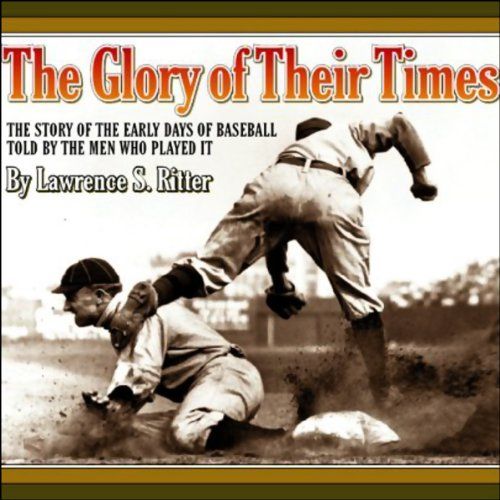
C.S. Lewis remarked that he enjoyed nothing more than the sound of men laughing. Listeners will find plenty of that in The Glory of their Times, consisting of interviews with men who played baseball when it was just beginning to become a sport with a mass following. These were men who played for the love of the game, not for money — there was none — or for clout, because they were regarded little better than wastrels or rogues. There’s great delight to be found in these five hours of old men (some in their eighties) telling stories of the Old Days, of feats on and off the field. Since Ty Cobb’s death inspired the book, Ritter realizing that a unique generation was passing away and its stories needed to be captured, he comes up a lot in the interviews: he’s regarded as a singular talent but a bit of an ass, someone who looked down on other players because the game didn’t come as easily to them, and who interpreted the hostility he generated from his arrogance as being aimed against him because he was a Georgia hayseed playing with northern boys. (Babe Ruth is remembered more fondly as both a talented athlete and a good fella to hang around with.) There’s some discussion of the Black Sox Scandal, of course. The most unexpected part for me was the prominent Native American presence in early baseball. I suspect the print version may have more interviews, because Ritter indicated that he planned to interview over thirty men. This was an all-around pleasure to listen to.
Since this is posted on April 23rd, St. George’s Day and the anniversary of Shakespeare’s death (and traditional birth), here’s something combining….baseball and Shakespeare.
“What is the name of the gentleman in the secondary position?!” “What is secondary!” “I asked not who is secondary –“ “Who is primary!” “I cannot tell!” “He is tertiary.”
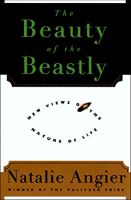
The Beauty of the Beastly is a fun collection of science pieces by Natalie Angier, ranging from macro to microbiology, with some science interviews added at the end. The reader will find here a chat with Stephen Jay Gould on dinosaurs and the tired nature-nature debate, a tribute to dung beetles, an examination of the importance of cell-deaths, the role of diet as a cancer-preventive, and a reappraisal of menses. Oh, and there’s cheetahs, scorpions, pit vipers, and hyenas, too. Angier is the rare science writer who can combine a command of details with literary flourish, delivering the truth in a beautiful way. Witness:
AS LONG AS there have been poets to pierce the darkness with their diamond songs, and painters to capture blades of sun shattering on cool cathedral stone, and artists of all persuasions to consort with the gods and articulate the union, there have been social critics to notice that an awful lot of these creative types are mentally unsound.
I found Angier first through her The Canon: A whirligig Tour of the Beautiful Basics of Science and enjoyed this collection. The nice thing about an essay collection is that if you’re bored by talk of telomeres, there’s always the digest-you-from-the-inside-out role that snake venom plays to consider.
Kindle Highlights:
Every single story that nature tells is gorgeous. She is the original Scheherazade, always with one more surprise to shake from her sleeve.
HEY ARE the P. T. Barnums of the flower kingdom, dedicated to the premise that there is a sucker born every minute: a sucker, that is, with wings, a thorax, and an unquenchable thirst for nectar and love. They are the orchids, flowers so flashy of hue and fleshy of petal that they seem thoroughly decadent. And when it comes to their wiles for deceiving and sexually seducing insect pollinators, their decadence would indeed make Oscar Wilde wilt.
BY TRADITIONAL RECKONING, DNA is the benign dictator of the cell, the omniscient molecule that issues commands to create enzymes, metabolize food, or die a willing death. Recent advances, though, suggest that DNA is more like your average politician, surrounded by a flock of protein handlers and advisers that must vigorously massage it, twist it, and, on occasion, reinvent it before the blueprint of the body can make any sense at all.
On occasion, a female copperhead will take advantage of the loser syndrome. Approaching a potential mate, she will mimic another male, rearing up as though ready for battle. Should the mock display terrify the suitor, she will take it as evidence that the male is a loser and reject him as unfit for paternity. Females mare almost exclusively with winners.
[Stephen Jay Gould] picks up a filament of an idea, follows it a short distance, loops it together with another insight and yet another, until enough strands have been threaded in to make a plushly coherent pattern. “Everybody has some curious little mental skill,” he says. “Mine just happens to be making these connections. If you’re lucky, you learn to convert that skill into a professional advantage. Otherwise, it’s just a party trick.”
A science writer who casually references A Thousand and One Nights!
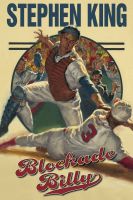
Okay, this has nothing to do with Read of England, unless I can claim that it’s a baseball story, and baseball grew from rounders which was invented in England and is slightly older than the United States itself. But I’ve got spring fever, the kind that makes a fella yearn to be sitting in the stands listening to the crack of bats and crowds yelling at the guy stealing second. And this is only a little distraction. Blockade Billy is a baseball novella by Stephen King, an improbable offering from the king of horror. The New Jersey Titans have just lost their pitcher and brought in a new guy, a Billy Blakeley, and he’s a curious kid – -wickedly talented, but has a tendency to talk to himself and he has a strange dispassion about him, lacking the fear all men carry with them when they begin in the major leagues — and, as one of his managers will discover, he has a secret. His story is told from an aging ballplayer talking to Stephen King (who, in real life, is a baseball fan) and regaling him with this sordid story that corporate ball has attempted to blot out. It proved interesting, but it’s unlike any other King work I’ve ever read. I’d say it’s best read by people are itching for a baseball story with a bit of mystery and danger. Troy Soos‘ golden age baseball mysteries are far more developed, though.
Other baseball surprises: John Grisham’s Calico Joe& Michael Shaara’s For the Love of the Game.
Coming up: Tuck, the finale in Stephen Lawhead’s Robin Hood trilogy, set in Wales in the days of William Rufus, the heir of William the Bastard.
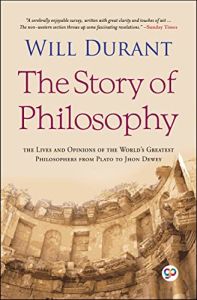
This is from Will Durant’s intro to his TheStory of Philosophy. I’ve wanted to read this for ages, since finishing his Story of Civilization, and saw it on sale a couple of weeks ago. I won’t be reading it immediately, though it might become a slow-but-steady background read.
Science tells us how to heal and how to kill; it reduces the death rate in retail and then kills us wholesale in war; but only wisdom—desire coordinated in the light of all experience—can tell us when to heal and when to kill. To observe processes and to construct means is science; to criticize and coordinate ends is philosophy: and because in these days our means and instruments have multiplied beyond our interpretation and synthesis of ideals and ends, our life is full of sound and fury, signifying nothing. For a fact is nothing except in relation to desire; it is not complete except in relation to a purpose and a whole. Science without philosophy, facts without perspective and valuation, cannot save us from havoc and despair. Science gives us knowledge, but only philosophy can give us wisdom.
Today’s Top Ten Tuesday is a non-bookish freebie. I was tempted to do my favorite PC games, since that’s one of my other hobbies, but I did that two years ago for a love-related freebie. Today I’m going to roll with…favorite podcasts! Although I listen to these through google podcasts, I’ve linked to their websites so you can learn more about them if you are curious.
(1) The Skeptic’s Guide to the Universe. I discovered this in 2006 or 2007, and I liked it enough that I would download it on a dialup connection. It’s a panel show on science news, skepticism, and sometimes science fiction — though they recently created a spinoff show, Alpha Quadrant 6, that is SF focused. It’s a nice mix of science news, analyses of topics that need a skeptical perspective (from homeopathy to anti-vaccination) and games like “Science or Fiction?” and “Who’s That Noisy?”. “Science or fiction” presents three dubious-sounding science news stories, and the panelists have to guess which are true and which are fake. I’m always surprised at the results.
(2) Says You, NPR. Unfortunately, this show is no longer produced, but I love revisiting its archives. It’s a game tailor-made for lovers of words, wordplay, puns, etc. My favorite part of the show is when one team’s members have to listen to four definitions for an obscure word, only one of which is real: the rest were made up on the spot by the other team. I always enjoy playing along and trying to spot the fake.
(3)Oologies, Alie Ward. An enthusiastic host interviews experts of often esoteric science disciplines, like poop, moss, and building decay. She is very chipper.
(4) The Tom Woods Show. A 30-minute daily with a happy variety of topics. On any given day, the arch-libertarian Woods and his guest may be discussing politics, history, economics, literature, or progressive rock. I like this show most for its sheer variety, but it also helps that Woods frequently has on guests he might disagree with on one point because they have common ground on another, so listeners get to listen to something analyzed from multiple angles. Woods has led me to some great authors like Brad Birzer, who has written on Tolkien and Christian literature. Birzer has a few courses at Woods’ Liberty Classroom, including one on politics and science fiction.
(5) The Rest is History, Tom Holland and Dominic Sandbrooks. Unlike many history podcasts, which choose one topic and marry it until death do us part, Holland and Sandbrooks do mini-series or one-offs. I’m currently listening to their series on the Hundred Years War, and previously finished their four-part on the rise of Hitler.
(6) EconTalk, Russ Roberts. IT’S NOT JUST ABOUT ECONOMICS! It used to be, but over the years Roberts has shifted more to human flourishing in general. I started listening to this out of college when I was hungry for intellectual stimulation, and curious about the perspectives that professionals like economists, doctors, and lawyers could provide in helping me understand current issues. Some of my very favorite reads over the years came from EconTalk interviews. They’re all an hour long, but Roberts often touches on interesting ground with his guests. It’s extremely varied.
(7) The General Eclectic Podcast. This is an utterly fascinating show on religion, culture, and politics — essentially a discussion between the Orthodox Rod Dreher and the trad-Catholic Kale Zelden on the topics of the day. It’s not a ‘reacting to politics’ type show, but more of a deep dive — investigating how issues people are talking about are just the surface. A discussion on consumerism or trans issues, for instance, will be less about consumerism or transitioning and more about the contemporary worship of the Self. Unfortunately, I’m not sure about the future of this show: it was produced under the American Conservative aegis when Dreher was the senior editor there, and now that he’s living in Europe with a new job, I don’t know that it will continue. Dreher has a substack in this same vein, and it never fails to be interesting reading.
(8) The Art of Manliness Podcast. This is a variety podcast that touches on skills, literature, style, etc. AoM celebrates and promotes authentic masculinity — not the gross consumer-sexualist antics of Tate and Trump, but more along the lines of being a man in full: virtuous, strong, stylist, savvy, etc, capable of bearing burdens and building a future.
(9) Sean of the South. A mix of traditional southern music and storytelling. It’s seasonal, alas.
(10) The Scott Horton Podcast. Horton has been interviewing people about geopolitics and DC foreign affairs for twenty years and has thousands of podcasts. He’s the author of two books on the terror war, Enough Already and Fool’s Errand. Listen to his guests and realize how shallow and self-centered the takes on TV are about global affairs.
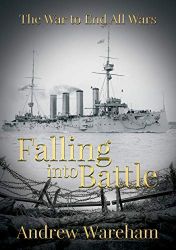
Christopher Sturton and Richard Baker are two young midshipmen who have come to the end of their day as mids: Christopher is moving on greater things as a sublieutenant aboard His Majesty’s Ship Sheldrake, while Richard is being shown the door – politely. Out of the service and back home to dear old dad, who shows Rich the door rather more forcefully and tells him to join the Territorials so as not to further disgrace the family. But war is coming, and both young men will soon distinguish themselves. Falling into Battle is a novel of the opening months of the War, witnessed primarily at sea (the Live Bait Squadron loss is portrayed) but with an increasingly strong land portion, following Richard as he discovers reserves in the trenches he never suspected he had at sea. Chris is also an interesting character, as he’s the orphaned product of a mixed (Christian/Jewish) marriage and effectively disowned by both sets of grandparents, aside from a small trust that gives him financial support. The book is extremely detailed, making it of great interest for those who want to learn more about the workings of ships of this transitional era (coal was giving way to diesel, and some of the older Navy men began their careers in the last days of sail), but a lot of the exposition is carried by dialogue. This creates a funny little dynamic between scenes where characters are lecturing each other, or engaging in spats of very dry humor about the brass and the like. I liked the gist of the story, especially Baker’s arc, but I suspect the sometimes mechanical dialogue could get wearisome if one read several of these close together. It’s nothing on the level of Max Hennessy, but if you want something like a technical thriller set during the early war, it may be of interest.
Highlights:
The Austro-Hungarians wish to unify their fissiparous Empire with a war. That’s a good word, by the way – Captain D was very proud of it; I didn’t ask him what it meant.
“Right, sir. As far as Sheldrake is concerned, submarines are mythical. No consideration is to be given to countering them. Given that, sir, what are we to do about submarines?”
“What’s happening in France and Belgium, sir?” “A damned good question, Sturton. Something.” “Thank you, sir.” “My pleasure. I am always happy to enlighten the ignorance of my junior officers.”
“Excellent! I foresee a great future for you, young man. Provided you can clearly demonstrate fundamental stupidity in the presence of your elders, you will undoubtedly be promoted far beyond your merits.”
“They’re bloody daft, sir!” “A discovery that we all make at an early stage in our careers, Mr Sturton. Carry on.”
Related: The Lion at Sea, Max Hennessey/John Harris. A young officer is forced into command at the Battle of Jutland. Much better WW1 naval reading in the balance, with equal strengths in description, detail, and characters.
Today’s Tuesday Tease comes from Falling into Battle, a novel following four young men (three midshipmen and one ex-midshipman-turned-Territorial) in the first year of the war.
“It is, and here I quote, ‘a known fact’ that there are German spies along the coast. I am informed that many of the members of the German brass bands, so popular in the coastal resorts, are in fact military men, young officers of both services, sent to spy upon Britain.” Dacres said it was highly likely. “Tubas, no doubt, sir. They have to display little musical talent other than the ability to play ‘oompah, oompah’ – ideal for a stiff-necked Prussian. No doubt while the trombones show off they are taking mental notes of the coastal defences of Cromer and Skegness – and Blackpool as well!” The holiday resorts were very popular and far distant from any naval port. “Shut up, Mr Dacres!” “I was merely applauding the wisdom of our betters in the Admiralty, sir.”
Today’s top Ten Tuesday is about books with animals on the cover or in the title, so I went through all fifteen of my existing “What I Read in ______” lists looking for critters. It proved to be quite the menagerie, with tigers and dragons predominating. (Most unexpected entries: one owl and one rooster.) Here are just a few…
(1) In the Forests of the Night. The title is drawn from Blake’s “The Tyger”, and Risika (the young vampire whose story is told in this book) incorporates tiger stripes into her appearance, as I recall. This is one I want to re-read!
(2) The Horse and his Boy, C.S. Lewis. A Narnian adventure about a horse, his boy, and a princess.
(3) The Leopard, Giuseppe Tomasi di Lampedusa. A novel about Sicilian rural aristocracy and modernity.
(4) Lamb, Christopher Moore. A comedic novel about Jesus’ missing years.
(5) Travels with Charley, John Steinbeck. Steinbeck and his dog road-trip across America in the 1960s and discovers that plastic and mass media are creating a dreary homogeneity.
(6)Sharpe’s Tiger, Bernard Cornwell. 18th century adventures in India.



 Reading Freely