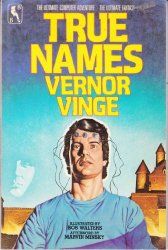
True Names collected into anthology with essays on cryptography 2001
How would you imagine the Internet in 1981? “What a silly question”, say you, “The Internet didn’t exist in 1981! ” Despite this, several authors in the seventies and eighties nonetheless imagined ‘cyberspace’, or as it’s known here, ‘the Other Plane’. Vernor Vinge imagines that other plane as a fantasy realm, in which hackers are warlocks, databases appear as lakes and swamps (literal data lakes!), and security protocols appear as forest sprites. Very little of True Names occurs in ‘meatspace’ (as we called it in the ’90s), instead taking place in a digital realm of mountains, dark forests, and castles built upon clouds of code. When it begins, our main character Mr. Slippery (his rather pedestrian nom de guerre) is picked up by the police in the real world, and ordered on pain of his True Name being leaked — being doxxed, in other words – to spy on his coven, his tightknit community of hackers. There’s trouble brewing: some arch-hacker known as the Mailman is expanding his reach into more and more networks, and is rumored to be behind a recent coup in South America. Could it be possible that digital potentates now have the ability to exercise — and hold — power in the real world? Slips, as he’s known to his friends, shares his predicament with his online BFF Ethyrina, and together the two use an old ARPAnet connection to begin investigating more broadly, risking the wrath of both the Mailman and the feds. Exciting and imaginative, I find it baffling I’ve never heard of this title before.
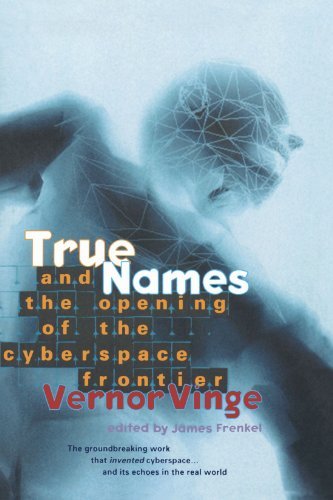
Twenty years later, to celebrate its anniversary, “True Names” appeared as the center of anthology of works celebrating its vision and persistence relevance. The world wide web had begun fully flowering then, even altering the economy as a dot com bubble appeared and popped, and it was beginning to change from the province of tech geeks into the all-pervasive infrastructure it is today. Most of the essays focus on theme of cryptography: as one of the obsessive concerns of True Names were the warlocks concealing their identities (and the plot turned on their discovering the identity of the Mailman, which — well, no spoilers, but Vinge was pushing into territory we’re still exploring today), so the resonance is understandable. The essays have instant appeal for me given their psuedo-datedness (I love watching videos from the 1990s about the Information Superhighway), but they’re not actually that dated: when Tim May wrote about the need for technological means to conduct anonymous commerce, I could only think of bitcoin and the variety of escrow services used on the dark net. May and authors are empathetic that true privacy, true crypto-tools, must not have a back door accessible by the government — not just to protect individuals from a nosy and aggressive state, but to protect individuals from government incompetence. Carve a back door into the wall, and no matter how strong the door is, the integrity and strength of the wall themselves are diminished. One essay printed in the physical collection is deliberately withheld from the ebook version by request of the author, Richard Stallman — whose “Right to Read” commented on how governments and corporations could use hardware and software to track reading and frustrate readers’ abilities to share, on pain of imprisonment and hefty fines.
I will be reading more of Mr. Vinge! Next up is either Facebook: the Inside Story or The Shockwave Rider.