
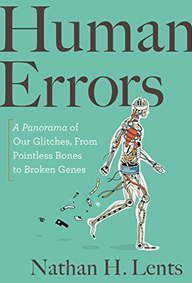
To err is human, they say, but at some point we can’t help it: we were born flawed, a conviction shared by both biology and the good book. Nathan Lents’ Human Errors looks at the frailties of the human body – quirks of our natural history that led to problems even before our own cleverness put us in environments our bodies were wholly unprepared for.
The book is truest to its title when it looks at actual glitches, errors, and ‘design flaws’ in the human body. Some of these are quirks of evolution, as it is forced to work with existing designs rather than start from scratch. So we have optic nerves punching their way through retinas that face the wrong way, and other nerves that run for miles longer than they need to, taking Moses- or Odysseus-like wanderings through the body before finally arriving at their destination. We carry a lot of baggage, detritus of the past like gobs of DNA that isn’t even ours. I am told that human cells only account for half of the cells inside the body, the rest belonging to the multitudes of bacteria that colonize our guts – but even a lot of ‘our’ DNA is actually viral material from long-gone infections that now gets replicated even if it’s inert. (Kind of metal, actually: our DNA carries the itty-bitty skulls of our foes!)
Other rough adaptations of our skeletal structure – to bipedalism – account for problems in our knees and backs. Other flaws are just sad accidents, like our inability to synthesize a lot of the vitamins other animals do simply because a mutation disabled the equipment – or almost worse, our guts creating B12 in the wrong area. Imagine a production line that tries to output directly into the garbage docks and you’ll get the idea. The body keeps the score, but sometimes it appears to be playing Calvinball.
From here we move into areas that don’t seem quite fair, because they’re less design flaws or human errors and more conflicts between the organism and our environment. We have immune systems that developed to live in a perpetual battle royale; now thrust into an increasingly sanitized world, our bodies enter an existential crisis and go to war with themselves, resulting in soaring rates of allergies and auto-immune disorders. Ditto Lents’ treatment of our brain’s large collection of heuristics: these served us well in the wild, allowing us to make inferences from past data (“That tall grass probably has a lion, avoid it”) but leads to our being terrible with money or thinking in prejudiced ways.
It’s been a while since I read a book like this, but it was just my cup of tea. It’s entertaining, informative, and varied, making me interested in some of the author’s other works that evidently include primate prostitution. While I think the title is over-expansive, all of the ground covered was great fun to learn about for the first time, or be reminded of.


The human body is certainly one of the arguments against ‘Intelligent’ design, that’s for sure!
Makes you wonder what a non-fallen body was like, doesn’t it?
If you haven’t read it already [although I think that you have] I can definitely recommend ‘Your Inner Fish – The amazing discovery of our 375-million-year-old ancestor’ by Neil Shubin. I remember that it had a very good explanation of some of the reasons behind our (apparently) weird nerve & ‘plumbing’ choices – essentially caused by evolution fiddling with the make up of our fishy ancestors.
Positive I read that one — it’s on my science shelves in my bedroom — but I may not have ever reviewed it for whatever reason. I’ve read several of his titles — most, with the exception of “Some Assembly Required”.