
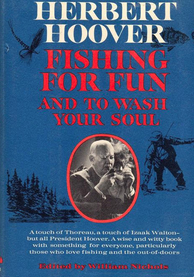
So, I ran into Fishing for Fun and to Wash Your Soul, and I kinda had to read it. I’m not much of an angler, but I enjoy reading outdoor works like those of Robert Ruark and was curious as to what Hoover’s writing voice was like. Biographies and other works have sold me on the notion that Hoover was a dreadful writer; in this case, he must have had a good editor. While the sentence structure tends heavily toward the short and successive, rather than the long and flowy that I tend to favor, it’s perfectly entertaining. Hoover here exhibits a dry sense of humor that I cottoned to immediately. It appears to have been written rather late in his life, as he refers to his friend, the late Robert Taft, who died early during Eisenhower’s administration. Hoover’s writing plays with levity and seriousness; he muses on how important escaping the frenzy of modernity and busy-ness and getting out into nature and wiling away the day talking to the fellows and trying to reel in dinner is for a man’s mind, but he also treats it with a mock-seriousness, referring to it as being ingrained in the Constitution. He also writes on the importance of addressing pollution. These days we tend to think of any environmentalism as being born in the 1970s, but Teddy Roosevelt, Woodrow Wilson, and Hoover all played parts in conservation and environmental stewardship. He also shares a few amusing anecdotes from his time fishing. Obviously my reading project inflamed my interest in taking this one, but it’s a little work and it led me to Grover Cleveland’s Fishing and Shooting Sketches. Well, tally ho.
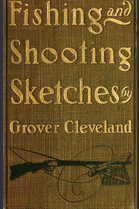
Mr. GC is a very different writer than Herbert Hoover; he rivals St. Paul for his love of long sentences and words whose price you may not know until you ring up at the register. I am a reader of some experience, who savors a finely-crafted sentence’s rhythms and words like the snootiest gourmand, and even I was reduced to staring in awe like a country hick who’d just seen his first train. The words just keep coming and coming, and each is grander than the last. Witness:
So, also, when people, more mistaken than malicious, have wagged their heads in pitying fashion and deprecated my indulgence in hunting and fishing frivolity, which, in high public service, I have found it easy to lament the neglect of these amiable persons to accumulate for their delectation a fund of charming sporting reminiscence; while, at the same time, I sadly reflected how their dispositions might have been sweetened and their lives made happier if they had yielded something to the particular type of frivolity which they deplored.
The entire text is like this. It’s less than a hundred pages, but reading a chapter feels like knocking off a volume of Dickens. There were times when I thought Mr. Cleveland was pulling my leg, as when he offers a few paragraphs to explain how the big ones really do get away, and why fishing stories should be believed. Unfortunately, this is the first time I’ve encountered any of Cleveland’s writing, so I have no basis for comparison. Like Hoover, he writes on the spiritual value of withdrawing from the world and communing with Nature and Nature’s God, and also draws distinctions between ‘market hunters’ — who shoot ducks or other critters indiscriminately — and True Sportsmen, who are there to glory in Nature and test their wits and spirit against the wild. Like Hoover, he also hails fishing for its ability to teach the student patience and increase the virtues overall. No man can be a fisherman without learning selflessness, he asserts, having to lend bait to comrades-on-the-bank in need who have found themselves short with fish there for the taking. Cleveland writes that despite this liberality, the true fisherman is also conservative in that he does not plunder the existing stocks, and he conducts himself at all times with honor and prudence. It’s gloriously Victorian, but this attitude is not feigned, I don’t think: Robert Ruark records his grandfather counseling him to only shoot a few quail, otherwise the covey as a whole will disappear and there’ll be no hunting next year. (Then one sees modern fishing ships with nets that rival the size of the boat and contain thousands upon thousands of fish: we are demented.) Interestingly, while he and Hoover are both aware of a hierarchy of fisher-folk — from the elite fly-fishers to the peasantry casting rods from the banks of lakes — Cleveland deplores the snobbery that drips down from those have time, money, and leisure enough to fly-fish. This little work was also connected to my present Hail to the Chief fixation, but the challenge of its prose proved to be an additional perk.
Coming up next week….science! At least two entries. Also hobbitses. Nasty, tricksy little hobbitses!
Quotations
“There is no subtle reason for this little book. Over many years in meetings of fishermen and fisherwomen, in public addresses, and in articles for magazines, I have made observations on fishing. Along came a publisher, who said to me “These meditations would make a little book of good cheer. And in the daily grind of trying to find out why the Communists get that way, it would be an expedition into relief.” (Hoover)
[Fishing] is discipline in the equality of man —for all men are equal before fish. (Hoover)
The human animal originally came from out-of-doors. When spring begins to move in his bones, he just must get out again. More- over, as civilization, cement pavements, office buildings, and radios have overwhelmed us, the need for regeneration has increased, and the impulses are even stronger. When all the routines and details and the human bores get on our nerves, we just yearn to go away from here to somewhere else. When you get full up of telephone bells, church bells, office boys, columnists, pieces of
paper and the household chores —you get that urge to go away from here. Going fishing is the only explanation in the world that even skeptics will accept.Life is not comprised entirely of making a living or of arguing about the future or defaming the past. It is the break of the waves in the sun, the contemplation of the eternal flow of the stream, the stretch of forest and mountain in their manifestation of the Maker —it is all these that soothe our troubles, shame our wickedness, and inspire us to esteem our fellow men —especially other fishermen. (Hoover)
Lots of people committed crimes during the year who would not have done so if they had been fishing.(Hoover)
A true fisherman is conservative, provident, not given to envy, considerate of the rights of others, and careful of his good name. He fishes many a day and returns at night to his home, hungry, tired and disappointed; but he still has faith in his methods, and is not tempted to try new and more deadly lures. On the contrary, he is willing in all circumstances to give the fish the chance for life which a liberal sporting disposition has determined to be their due; and he will bide his time under old conditions. He will not indulge his fishing propensity to the extent of the wanton destruction and waste of fish; he will not envy the superior advantages of another in the indulgence of the pastime he loves so well; he will never be known to poach upon the preserves of a fortunate neighbor; and no one will be quicker or more spirited than he in the defense of his fishing honor and character. (Cleveland.)
It is better to go home with nothing killed than to feel the weight of a mean, unsportsmanlike act. (Cleveland)



Based off of the excerpt I would have to read that on audio 🤣 I haven’t read so much of the more modern movement but I like the early conservation and preservationists like Muir, somewhat London, Thoreau I guess, I’m blanking but once went down a rabbit hole reading letters and stories and biographies and it was pretty interesting!
I did enjoy reading Cleveland aloud in different accents. XD
I keep meaning to read Muir!!