Warning: big post. Comments, videos, quotes.
Don’t wake me up
Don’t wake me up if I’m dreamin’
California dreams
Just let me lay in here in the Sun
Until my dream is done…
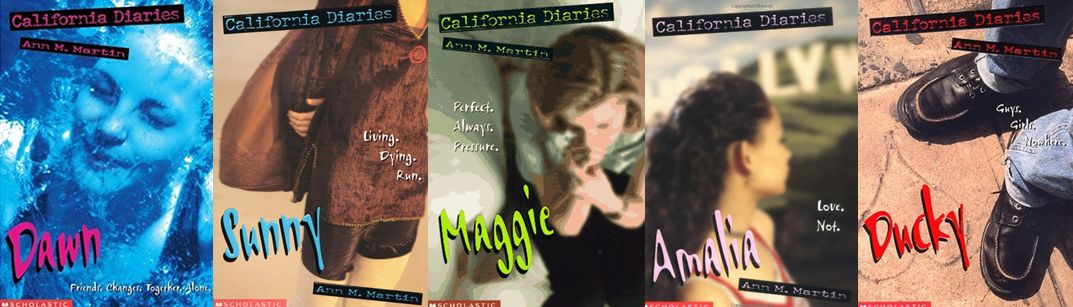
Years ago when the world was new and dinosaurs walked upon the face of the Earth, I saw a novel with an interesting cover and took a look. It proved to be a fictional diary, printed in a font that resembled handwriting — and it was part of a series including different characters who all had their own fonts! I was immediately fascinated, and as I progressed throughout the series over the years I loved the way Martin incorporated her characters’ creative sides into the journals, like Maggie’s song lyrics and Amalia’s drawing. The series as a whole takes us through a year in the life of five teenagers: four teenage girls (Dawn, Sunny, Maggie, and Amalia) as well as one slightly older teenage boy, “Ducky”. Each novel covers about a month in the next year of their lives. Each character has their own private struggles, as well as drama they experience together as they begin facing the challenge of growing up. I did an overview of the characters in a post a few years ago, when I was planning a re-read. Because the series consists of three rounds of journals in the same year, I’m going to re-read and review them one round at a time. Be forewarned: I read this series multiple times in high school, and am attached enough to the characters that I made versions of them in The Sims, so I’m not exactly going to be Mr. Critical Crankypants. This is more like “Family Photo Album” time, with the most serious criticism being “Oh, god, what is she wearing? They thought that was COOL?!”
Dawn introduces the series with Dawn Schaefer (yes, the Babysitters Club Dawn Schaefer), who is from a broken home and is struggling with getting used to her new stepmother, Carol. Dawn and her friends’ middle school building is so overcrowded that her grade is being shifted into the high school building. Suddenly, the eighth-grade “Rulers” of the school are the new kids on the block. As exciting as this is for some, some of Dawn’s friends are intimidated by it — and the high schoolers definitely don’t like a bunch of little brats suddenly wandering around their school. This leads to a substantial hazing incident that Dawn and her friends are rescued from by a tenth-grader named Ducky, leading to their becoming unexpected friends. This incident sets the stage for the series, introducing Amalia Vargas and Ducky to the established friendship of Dawn, Sunny, and Maggie. Dawn is the most grounded character in this series, her only rival for introspection being Ducky. She’s most cognizant of the changes the girls are going through — not just growing up, but of what’s happening to them in life. This is especially obvious with her BFF Sunny, who is not coping well with having a mother with cancer. Dawn is attached to Sunny’s mom, so she has her own sorrow to deal with as well as the uncertainly of how to deal with an increasingly unstable Sunny. Does she take Sunny’s weird behavior in stride out of love, or push back — out of love? That’s not to say Dawn doesn’t have her problems, especially coming to terms with her stepmother Carol who she regards as immature and meddlesome — not to mention pregnant, which is extra weird because it means she has a half-sibling on the way. And oh, Carol won’t tell her dad about it for some reason. Grown-ups, so weird, am I right?
Quotes:
I know why the teachers make us keep these journals, apart from the fact that this activity is a healthy habit, a creative outlet, good writing practice, and all that. The teachers never say so, but (since they were all kids themselves once) I bet they remember what it’s like to be consumed by feelings and to need an outlet for them. Or maybe that’s not a kid thing. Maybe it’s just a human thing.
We drove out to Jill’s house with Jeff making annoying duck noises the entire way. He was sitting in the front seat wearing a Donald Duck mask. (I WAS WRONG ABOUT THE ABSENCE OF DUCKS!)
Sunny is Dawn’s best friend, but she increasingly doesn’t live up to her name. For good reason, too: her mother is dying of lung cancer, and Sunny is struggling to deal with that. At the same time, her dad is attempting to renovate and run his bookstore, and she’s expected to pull more than her weight at home. The Sunny who appears in Dawn’s story is different than the Sunny we see in her own diary, because Sunny is performing. Sunny in Dawn’s story is outgoing, spunky, rebellious. Sunny herself is….anxious, depressed, angry. Despairing, and in denial about it. She wants to be the good daughter, but it’s all so emotionally overwhelming — she’s torn between her love for mom and her desire to escape those feelings so there won’t be so much pain, not to mention the grown-up responsibilities she’s saddled with while her mom is in the hospital and her dad is distracted by both the stricken spouse and his bookstore renovations. In this book, she finds escape by cutting classes to go to Venice Beach, where she falls in love with an older teenager who has dropped out and run away from his own home. Fortunately, things don’t go as badly as they could have gone, but it’s obvious to the reader that Sunny is NOT ok.
Quotes:
I just read what I wrote yesterday. I’m glad I’m not my friend. I would drive me crazy.(Maggie & Dawn: Oh, Sunshine, you have no idea.)
I’m sweating like a pig, bouncing down the street on a public roller coaster as I sit behind a fat man in a Hawaiian shirt eating a tuna salad sandwich. A lot of it is actually on the shirt, blending in nicely with the design. (This is one of those lines that’s lived rent-free in my head for 25 years and I have no idea why.)
This is not a public affair.
Honestly, I am so sick of all this.
I AM SICK OF…
Hospital visits.
Hair in the sink.
Medicines all over the house.
Know-it-all doctors who are always wrong.
Running out to the drugstore all the time.
Not being able to leave home on weekends because Mom can’t travel.
Visitors who act as if they’re paying last respects and cry as they drive
away in the car.
I DO NOT NEED THIS.
If I keep my chin up and act happy, I feel guilty. If I worry too much, I
lose sleep.
I need to get away.Today, for instance. 90 percent of the guys showed up in T-shirts with flannel shirts over them. It’s like, the uniform. Ducky? A bowling shirt, cool sneakers, and green overdyed jeans. (I absolutely remember this uniform and will confess to wishing I could wear it.)
Palo what? Sunny who? For today, that world and that person don’t exist.
I am free.Optimism is such a strange thing. It’s like a beautiful ice sculpture on a clear, sunny day. Everything seems perfect, but no matter what you do, the sculpture starts to melt.
“Sunny…why?”
It was a simple question. But just thinking about an answer was like preparing for a major war. I didn’t have the energy to do it
Maggie Blue is the daughter of a movie producer (Dad) and a drunk (Mummy dearest). At her softest, she writes song lyrics and dreams of being a veterination, but when she’s being hard on herself — most of the time — she’s a perfectionist, and overperformer, and (as we learn through the series) a budding anorexic. To be honest, Maggie is the character I bonded with least in the series, despite loving how Martin incorporated her song-writing into the body of the diary. Maggie’s first book is largely about finding a spark of rebellion and doing something off-script — joining a rock band and participating in the Battle of the Bands, skipping her big-shot father’s premiere in the process — with aide from Ducky, who I realized largely exists in the girls’ journals to taxi them around. Nevermind his private heartbreak over a best friend who’s depressed and heading for suicide.
“Sorry,” he said. “Not in the orchestra either. But we do have a spot for a sousaphone player.”
That sounded cool. I asked what that looked like. He pointed to a tuba. Thanks but no thanks. (Know that feeling. There’s a reason I switched from Band to Computers between seventh and eighth grade.)“Look, if I didn’t worry, my grades wouldn’t be so good,” I explained.
Sunny groaned. “Yeah, your average might drop to a 97.”Slow down,
Way down.
What goes round
Comes round.
Dry your eyes,
Clear your mind
You just gotta take it
One day at a time.
Years from now
What’ll you say?
“I tried my best” or
“I threw it all away”?
Life has no guarantees
It’s a roll of the dice;
So do it all,
Pay the price,
But dust off your heart
Take it off the shelf;
And don’t forget
To love yourself.
Just Slow Down,
Way down.
Slow Down,
Way down.
© Maggie BlumeI know that voice. It’s there when I take my exams. When I turn in a paper. When I play a piano piece. When I dress myself in the morning. Always. It’s me. The voice of Maggie.
It was dawning on me how strong that voice is. No, not just strong. More than that. It runs my life.
But at that moment, it wasn’t. Because another voice was telling me something else. That the mistakes didn’t matter. That winning the contest would be nice but who cared? That I’d done something worth doing. Something that I wanted to do.
Not for grades.
Not for my permanent record.
Not for Dad or the five-year plan.
For me.
Amalia Vargas is new to Palo City, and to Vista. She didn’t grow up with the other Vista girls, but transferred into its class. She’s part of the reason why they were forced to move into the high school building, actually: Vista is such a good school that it attracted too many kids! Amalia has a sister, St. Isabel, who works for a women’s shelter; Amalia also manages a garage band named VANISH, and is maybe in a relationship with one of its principals, James. She’s not really sure about the status of the relationship: James is certainly acting like they’re an item in terms of jealousy, but they’ve never talked about their feelings for one another. Amalia and Maggie’s journals are both unique in that they incorporate other media into themselves: in Maggie’s case, hand-written song lyrics; in Amalia’s, drawings. Witness:
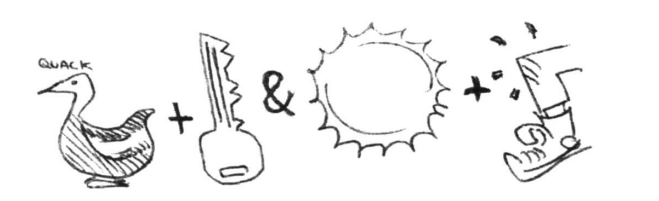
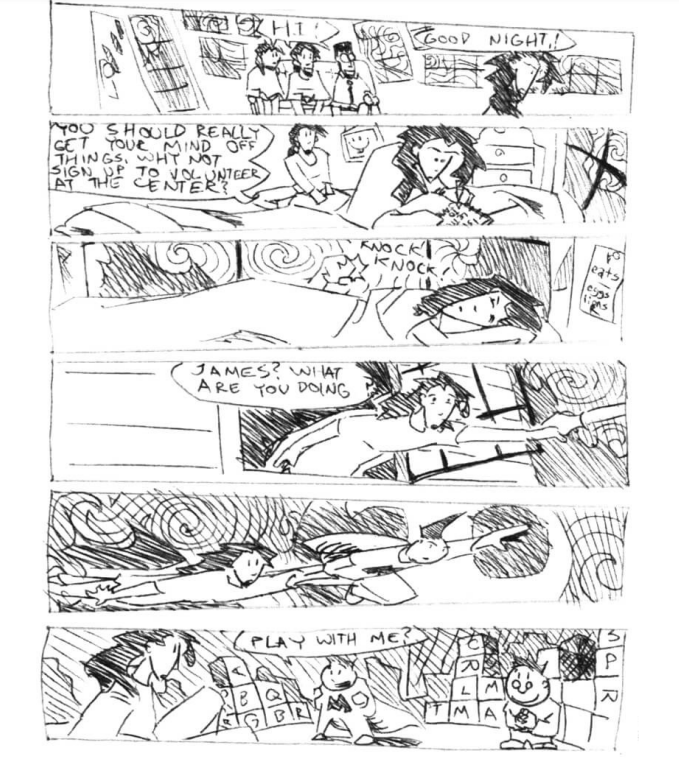
On Christmas Day, Amalia accompanies St. Isabel to the women’s shelter and becomes attached to one of the women’s kids, Mikey, which…will lead to plot-happenings, including pain and growth and all that. As a plus, working with battered women will come in handy when Amalia realizes oh, her boyfriend is an abusive, manipulative, jealous ass who will one day probably be responsible for creating future clients of women’s shelters. Amalia’s journal is one of the more serious of the lot, dealing with abuse and abduction, and when I was reading this at age…12, 13? That was all new to me. This was not a world I knew anything about. Amalia was an eye-opener for me, as was Sunny.
Quotes:
As I’m taking my books out of my locker, Maggie is singing a new lyric she wrote for Vanish. It’s absolutely beautiful. Something about a sad, lonely girl who spends her life only doing what everyone else wants her to do. As I’m listening, my heart is breaking.
Maggie’s songs are so personal. she’s struggling, Nbook. She’s really learning to break away from her Daddy’s-good-little-girl image. I wish her parents were more like Mami and Papi, who don’t put too much pressure on us. Maggie may have all that money, but what’s the point if she’s not allowed to be herself, right?“Yo,” James calls out, gesturing to me with his head.
As I walk toward James, I hear Ducky mutter, “I should try that sometime. So much more efficient than ‘would you come here, please?’”
“What was that?” James snaps. (Boy, James should try a little tenderness. And yes, Ducky is named after the Pretty in Pink character….)I am a total space cadet in class, Nbook. I can’t concentrate. I’m worrying about everything. Whether it’s really okay to cut math. Why James is so moody. What’s happening with Mikey. My school notebooks are filling up with doodles instead of classwork. On top of that, I can’t get Maggie’s lyric out of my mind. I think of the sad girl in the song, the girl based on Maggie.
But it’s not Maggie I’m picturing. I’m seeing someone else. Another girl who does things for others. Who thinks of herself second or third or fourth, but never first.
Someone with the initials A.V.No, Nbook. He didn’t hit me.
But he almost did.

We end round one with Ducky, Oh, Ducky, Ducky, Ducky. Ducky was my invitation into the California Diaries series. Would I have met these girls, considered their stories, had I not encountered them first through Ducky? I don’t think so, to be honest. Sure, when I was book-starved I had no compunction against reading my sisters’ Sweet Valley High books, but buying girls’ books? With an allowance that could easily go to WW2 memoirs, donuts, and Archie Comics double digests? Ducky is the outlier in CD, being both The Resident Dude and being older than the girls. He is….a character. Ducky is his own man, he follows his own script. He’s creative, compassionate, whimsical. He’s like the character who inspired him but without being love-struck for Molly Ringwald. Although Ducky will spend a lot of the series helping the girls through their problems by being Ducky McRae, Omnipresent Uber Driver, he has own problems as well. His parents are off in Italy, scouring Pompeii. He and his brother are living alone, but his brother is a college boy and does not give a rip about anything other than chasing skirts and chasin’ shots. Ducky’s two best friends, Jay and Alex, are…..um, kind of sucking at being friends. Jay has decided to become an uber-jock and sell his brain and soul and identity toward being a stereotype, and Alex has decided to drink himself to death. Ducky is heartbroken over both, and he’ll spend a lot of this book realizing that Jay is a doofus who just needs to be ignored until he grows up, while Alex is the one who really needs Ducky’s attention — not that said attention will help, because Alex is the one who has to decide to fight for himself. Ducky can’t make him want to live. As a dude who…also did not fit in, either in the 1990s or now, I resonated with Ducky immediately, and re-reading him after all these years I love him more as a character than ever. Despite how lovely Ducky is as a person, and a character, some pretty awful things happen in this book — most prominently, one of his friends attempting suicide.
Quotes:
A year ago, McCrae, the Cro Mag comments would have killed you. A year ago, you worried about their opinions. You wanted them to be your friends. HOW many years did it take to realize THEY WERE GOING TO MAKE FUN OF YOU NO MATTER HOW HARD YOU TRIED TO BE LIKE THEM?
As if you ever could.
So…if you can’t join them, do exactly what they hate. Like dance past them, singing “all you need is love,” and toss them a flower—then watch the look on Marco Bardwell’s face the moment after he catches it and realizes his apelike friends are NEVER going to let him live it down.
Ducky, you may be strange but you are a genius.At least Sunny KNOWS who she is. You can tell by looking at her—the weird hair, the funky layered outfits, the body piercings or magnetic studs or whatever those things are. Even her opinions—loud and clear even when they’re wrong—all of it says THIS IS ME, SUNNY WINSLOW, TOO BAD IF YOU DON’T LIKE IT.
Dawn’s like that too. She can obsess a little about the environment and global warming and health foods and yada yada, but you always know where she stands.
And Maggie. Serious, intense, attitude-of-the-month Maggie. Committed punk rebel for awhile, preppy good girl until that wore off, star rock singer after that. Always changing but STRONG, never really DRIFTING.
Amalia Vargas is another one. Sharp, full of opinions, and so COMMITTED to her artwork.
They don’t seem three years younger. They’re such personalities.
Definite, clear personalities.
I wish I felt like that. I never know how to be.
I know how NOT to be. NOT prep. NOT grunge. NOT jock. NOT hightech nerd.
Step right up, folks—meet Ducky McCrae, Palo City’s number one NOT! Make your own guess about what he is. EVERYBODY else has an opinion. (Um…thanks, Ducky. I hadn’t read any of the other books so it was nice to get the other characters all precis’d for me like that.)What HAS Alex become?
When I gave him that flower this morning—nothing. No laugh, No wisecrack, no response at all. As if this kind of scene happened every day and he was bored with it.
Alex the morph.
This is NOT the Alex I grew up with. It’s as if some alien ship came down and sucked out his soul.
I stared at him today at lunch, while he wasn’t looking. The same way I used to when we were kids and I’d try to send an ESP message, and most of the time he’d notice I was staring and sometimes he’d even GET the message. And we were convinced we could read each other’s minds, because we always finished each other’s sentences and we liked the same movies and books and CDs and TV shows, and we could look at each other—just look— and both burst out laughing. No one knew why, but WE did, because we’d both be thinking of EXACTLY THE SAME THING. And sometimes at home I’d reach for the phone to call him, and the phone would immediately ring, and it would be him. And we’d talk and talk until Mom would get angry and I’d look at the clock and see that TWO HOURS had gone by and it felt like two minutes.
And that person is gone gone gone, lost somewhere between 9th and 10th grade, replaced by a total stranger who doesn’t know I’m alive.I SHOULD know. It is TOTALLY WEIRD to be 16 and never kissed like that.
It is TOTALLY WEIRD to hang out with 13-year-olds.
It is TOTALLY WEIRD to live alone in a big house with your brother and your combined filth.
Isn’t it?
Maybe THAT’S the answer to “WHAT AM I?”
TOTALLY WEIRD.Sunny says, call Jay. I say she’s nuts. He should call ME!
Sunny says I’m a guy. He’s a guy. Guys TALK TO EACH OTHER after they fight. They argue and explode and say things girls would never think of saying to each other, and then it all blows over and they play basketball.
I tell her I hate basketball.
She doesn’t find that funny.Just got back from the hospital. The smell of the place made you nauseated. Not to mention all the WHITE—white uniforms, white walls, white sheets. It all gave you a headache.
But when Sunny Winslow says, “Are you coming to the hospital with me after school or what?” you go with her. Somehow, when SHE demands a ride, you don’t feel like you’re being taken for granted. Unlike some other friends who will remain nameless (his initials are Jay Adams). Plus, you know she’s feeling nervous and upset about her mom, who has lung cancer. As you walked through the hospital corridors, she took your arm and
muttered, “I hate this.”You didn’t know what you were supposed to see. But you knew Sunny needed a lot of yeses and that’s-okays, so you gave them to her.
Finally, when you were outside, you put your arm around her and she
started laughing. When you asked what was so funny, she just said, “I never cry,” and then burst into tears. You hugged her. You and she rocked back and forth in the parking lot, cars whizzing around you. You realized something then. Something you should have known awhile ago.
Why worry about Alex and Jay? You have other friends who need you.
Idea Over Breakfast
Here’s a thought:
Alex is quiet and miserable.
Sunny is loud and miserable.
They might actually get along.
Maybe they should meet.
Upon Further Reflection
Over Lunch
What are you, nuts? (Sunny and Alex do meet and do get along, if I remember. XD)The Secret to Contentment, According to Jay Adams: Meet a Girl.
The Secret to Contentment, According to Ducky McCrae: worry about how you look in the morning, because even though you can’t bring yourself to wear boring conservative clothes, you don’t want to risk setting off the Cro Mags. And make sure you don’t bounce too much as you’re walking into school, because Marco the Cro Mag king will say you’re flitting, which makes everyone laugh. If you survive THAT, you’re off to a good start, and IF YOU’RE LUCKY you’ll have a few laughs with your 13-year-old friends, the only ones who seem to appreciate you, and when you go home, you’ll find that your brother has not left the milk out of the fridge all day and has actually bought a few groceries and maybe run a load of laundry with some of your stuff in it. THAT’S contentment. And that’s pathetic.Sunny listened. She did not hang up on you or scream bloody murder. Instead, she said, “I don’t know what you’re talking about. I was calling to say thanks.”
A joke, you assumed.
But no. She was moved. By the GESTURE. She said that friends don’t always think of perfect solutions, but they try, and that’s what counts. She said her mom has a support group—and what were YOU doing but trying to find her a supportive friend?
For a 13-year-old, Sunny is pretty amazing
(I think this is what makes this series so great, because we’re not only seeing Sunny-as-she-is in the raw, we’re seeing how she presents herself to different friends, and realizing the truth of CS Lewis’ essay on Friendship, that different people bring out different parts of ourselves who would have never otherwise be seen. Ducky’s Sunny is not someone we can met in full in Sunny’s diary, or Dawn’s diary. Ducky’s Sunny is Ducky’s Sunny, just as D’s Stephen is different than R’s Stephen, or Stephen’s R is different than C’s R.)The Cro Mags think I’m a sissy bookworm. My teachers think I’m a slacker. My 8th-grade friends look up to me and I let them down. My 10thgrade friends feel betrayed.
I’M TRYING TO DO THE BEST I CAN, and my life gets worse every day.
I CAN’T TAKE THIS.
I need advice. I need to talk to someone.
But who?
Not Jay. He’ll just tell me I need a girlfriend.
Not Ted. He doesn’t have time for me. He’s too busy figuring out creative ways to destroy the house.
Mom and Dad are on the other side of the world. And Alex is halfway to Mars.
Maybe Dr. Welsch has an opening. Ha Ha.
Anyway, enough of this. I have to study Julius [Caesar].
“To be or not to be…”
Or is that another play?
Whatever.So you joked with her and reassured her and told her she was great, but your heart wasn’t in it, because all you could think about were Alex’s problems and the Cro Mags and Jay and math class and Julius Caesar and Ghana and YOUR OWN DEPRESSING LIFE, but you told yourself not to be selfish, and you listened to Sunny go on and on, being sarcastic and complaining about her poor, sick mom, and even though you didn’t mean to be rude, you said, “At least YOUR mom is around.”
Major, major mistake.
Right away you wished you could take that back. You wished you could catch the words in midair, the way a frog uses its tongue to catch a fly. And Sunny was staring at you, her mouth open, and you knew you had just blown it. Your best friendship in the world, flushed down the toilet.You look forward to coming back to a HOME. A HOME doesn’t stink.
SUNNY has a home.
You have a HOLE.
She has a FAMILY.
You have a
What? What do you have?Ted is flabbergasted.
You know this because he came into your room this morning and woke you up, saying, “Ducky, I am flabbergasted.”
You told him you’d be full of flabbergast too if your little brother had totally cleaned the house out of the goodness of his heart, without asking for so much as a dime.You could get used to this.
Today, friend of the Cro Mags. Tomorrow, who knows? Cigarettes, flannel shirts, and muttering with lots of one-syllable words.
Ha.
Ducky, you are SUCH a snob.You have had some weird nights in your life. Driving the girls home when the upperclassmen trashed Ms. Krueger’s house and framed the 8thgraders. Tracking down Sunny on Venice Beach the night she ran away from home.
This is weirder somehow.
You don’t know why, it just is.
So you sit and write.
And here you are, still at it.
Scared and exhausted. Worried.
Why did he DO that?Think, McCrae.
Do what you have to do.
DO
THE
RIGHT
THING
What seems like a lifetime later
Did you?
Did you do the right thing?
Who knows?I’m sitting here at 4:30 in the morning, so awake I could run a marathon, writing my brains out because I can’t talk to anybody—considering I’ve already broken a vow of silence, and Ted would be useless about stuff like this even if I COULD tell him, and Mom and Dad don’t like me to call Ghana —so all I CAN do is write, and that should be helping me, because PUTTING IT ON PAPER always makes thoughts clearer, and I’ve filled up a whole journal, wearing out my fingers, examining EVERY POSSIBILITY, dissecting, reasoning, spilling. And after all that, I should have an idea, I should know what path to take, I should have an UNDERSTANDING at least, and maybe a strategy.
I’m not a stupid guy. I should have all of that.
But I don’t.
I really don’t know what to do.
Except worry.
And hope.
Ah, lord. I love Ducky. I love this series! It’s so good. The way Martin introduces us to these five different people and their emotional issues, and then bounces them off each other and makes us realize that perfectly good people can be awful to one another because they’re just so consumed with themselves they can’t think of anything else….it’s so realistic, so close to home. It brings St. Augustine to mind, his comment that we are curved in on ourselves and cannot see any others. It’s a universal frailty. Saint or sinner, religious or otherwise — this is a pit we are all subject to fall into, and kudos to Martin for throwing a light onto it that we can appreciate in any context. Although I’m not a parent and can’t really appreciate the stuff contemporary kids are going through, in my naiviete all I can say is that I think this series holds up. Yes, today’s kids are going through different things. But human nature doesn’t change, even if society does, and a lot of the principal issues — kids trying to create their own identities, struggling with death and depression and things in life that suck — are still in effect. There are parts of this series that would be different if they were written today (lots of “SUNNY WHY ARE YOU SNAPCHATTING FROM VENICE WHEN YOU ARE SUPPOSED TO BE IN ENGLISH!!!!!!), I think the emotional core, the substance, is still true, still valid. Really glad I’m re-reading this series. It’s truly like revisiting old, cherished friends.