
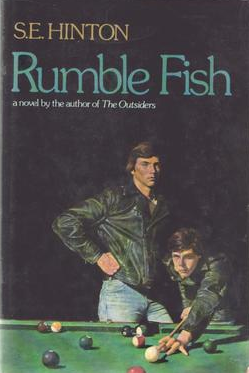
Many years ago, when the Earth was young and dinosaurs roamed the land, I encountered a book called That Was Then, This is Now at a Waldenbooks in Montgomery, Alabama. It proved to be my introduction to S.E. Hinton, and I later read everything I could find by her. The three titles I remember most, though, were my introduction, plus The Outsiders and Rumble Fish. Rumble Fish was especially startling.
Rumble Fish is the story of Rusty James, a troubled young man who has no place wherein he belongs. Much of his life is staked on being the little brother of The Motorcycle Boy, an impossibly cool, somewhat eccentric, and undeniably Tuff member of Tulsa’s population of undesirables. (Tulsa is not named, but given that Hinton’s other gang works appear to be rooted there, I’m going on assumptions.) Readers familiar with The Outsiders will remember its gang culture, particularly the constant fights between Greasers (working class boyos) and the Socs, the prep-school toughs. By the time Rumble Fish rolls around, the gang wars have died off, both those between the prols and the bougies and the internecine greaser wars. The Motorcycle Boy gets credit for ending them, but as he said it was mostly the dope that did the rumbles in.
Rusty James wants nothing more than to be like the Motorcycle Boy, but he’s caught between his admiration of his brother and the fact that the Motorcycle Boy is…weird. Their father was a lawyer who might have amounted to something: his formal diction is an anomaly in a world of tough-talking street types. As a kid, the father didn’t too much matter; he was odd, but that was it. As an adult reader, I wondered what makes a lush of a lawyer fail so dramatically in life. One could say the booze, but there are a great many members of the bar who have been members of other bars and still flourished.The father has imparted his unusual ways of thinking to the Motorcycle Boy, culminating in references to Greek mythology that Rusty James does not understand and inwardly despises.
Rusty James is, despite being an unpleasant person – he fights too quickly, he has no conception that lovin’ on a girl at a party would offend his girlfriend, and he has no interest in a productive life whatsoever – sympathetic. He is a lost boy whose icon will, in the course of this little novel, fail him. The Motorcycle Boy has his own issues, and in the end Rusty James will see him fall – to his own confusion.
This is a fascinating novel. Its sentences have lingered with me for over two decades, especially Rusty James’ friend’s weary question to The Motorcycle Boy – “Why is it that no one has taken a rifle and shot you yet?” – followed by the response, that every society no matter how primitive has an innate respect for the insane. There is something uncanny and eerie about the Motorcycle Boy, as if he does not quite belong. Rusty James’ frustration over him can be reflected by the reader’s own confusion. Who is the Motorcycle Boy? What’s his deal?
I still don’t know. This is one of those novels I’ve never stopped thinking about, and I’m glad I found a used copy of it while exploring an indie bookstore so that I could ride with the Motorcycle Boy again. I continue to marvel at Hinton’s ability to create complex and damnably interesting characters at a young age.
Quotations
“That ain’t fair!”
“When the hell did you start expecting anything to be fair?”“Man, those guys would have followed you anywhere. Hell, most of them still would.”
“It would be great,” [The Motorcycle Boy] said, “if I could think of somewhere to go.”“California,” he said, “Is like a beautiful wild kid on heroin, high as a kite and thinking she’s on top of the world, not knowing she’s dying, not believing it even if you show her the marks.”
“Pass me the wine,” Steve said.
“There ain’t anymore.”
“That”, he said, “is the most depressing thing I have ever heard.”“Progressive country, integrated mugging.”
“What a funny situation,” said the Motorcycle Boy after a long silence. “I wonder what I’m doing here, holding my half-dead brother, surrounded by bricks and cement and rats.”
“An acute perception does not make you crazy. However, sometimes it drives you crazy.”
“Your mother, “ he said distinctly, “Is not insane. Neither, contrary to popular opinion, is your brother. He is merely miscast in a play. He would have made a perfect knight in a different century, or a very good pagan prince in a time of heroes. He was born in the wrong era, on the wrong side of the river, with the ability to do anything and finding nothing he wants to do.”
“I wonder,” Steve said wildly, “Why somebody hasn’t taken a rifle and blown your head off.”
“Even the most primitive societies have an innate respect for the insane.”


