September 1862: Confederate scouts notice a Union courier riding at high speed. Taking their shot, they drop the rider and investigate as to what’s so important. Turns out that General Lee’s orders for a drive toward Washington via Maryland have been intercepted! Taking advantage of the Union belief that they know what Lee is doing, Lee instead alters his plans and achieves a critical victory, marching on Washington and forcing Lincoln to acknowledge the independence of the Confederate States of America. Humiliated and financially weakened by defeat, the postwar Union fails to live up to its manifest destiny seize colonies hither and yon from Spain, not to mention throw its weight around in the New World and create the Panama Canal. And now….let’s fastforward to World War 2 which begins the same exact way with the same exact European and Japanese characters, for some reason. A Nation Interrupted is a “what if” take on World War 2 that uses some consequences of Southern independence to tell a very different, darker, and increasingly nonsensical version of the war. The story is compelling despite the premises not being so.
World War 2 unfolds here very differently because Spain is still in possession of Cuban and Puerto Rico, which gives Germany the option of deploying from there with the aim of capturing the northern shipping ports (especially New York) that keep sending American material to England.. Hitler, his obsession with the Soviet Union somehow marginalized, decides to focus on the two Americas — the Union first, and then the South once Truman and Eisenhower — outraged by this German aggression against the CSA’s brother-country — declare war in solidarity. Because Hitler is evidently not wasting men and material in Africa and Greece (they’re never mentioned), and more importantly not invading Russia, he has plenty of forces to throw at the ill-prepared American states, who look toward The Bomb as their only hope of salvation.
On the plus side, I was completely absorbed by this story, largely for the original minor characters — a pilot who volunteered for the RAF, then resigned to fight for the US, as well as several Jewish characters who bear witness to Hitler’s ‘final solution’ being enacted in New York and Boston, using Ryker’s and Hart Island as labor & death camps. (A very young Carl Sagan and possibly Asimov would have been caught up in this, unless Asimov managed to escape the Naval base in Maryland before the Nazis took it.) I rather liked the idea of the two American nations existing in perfect peace, not becoming bitter foes like they did in Turtledove’s “Order191/How Few Remains” series, which also begins with an Antietam surprise. I liked how subtle historical details were used in the novel, like the mention of a Boston Braves game: in the 1940s, the Braves hadn’t yet moved to Atlanta. (Actually, that makes me wonder: given that baseball became nationally popular in part due to the Civil War, does that mean the South is baseball-less?) There’s a lot more questions, though. This ranges from minor details like Sherman tanks having that name (Sherman who?) to the global situation in general. Why did the northern Union enter the Great War, and how could it have possibly had the same effect on the peace as it did in our own lifetime, given it had less population to work with? We’re told slavery was phased out and formally abolished in the 1880s, but what does that mean for how African-Americans adjusted to citizenship? The only black character we see is a janitor in the north, though he plays a critical role. Why was Japan hostile toward a United States that has never involved itself in that hemisphere, and WHAT WAS THE SOVIET UNION DOING THIS ENTIRE TIME? And that’s not even going to the ending of the war, which….. I don’t want to spoil but I kind of do. So, I’m going to to insert an image below, and if you want to spoil yourself just click. FUN FACT: the plane below, a Dauntless bomber, survived Pearl Harbor, launched off the Lady Lex and sank a Japanese carrier, was abandoned on Midway Island after the Lex perished, was rescued and used as a trainer by the Marines, then accidentally flown into Lake Michigan (in said training service) before being recovered and touched up a bit. Those guns were rusting for a half-century but they’re the same guns that were firing at Zeros! (I went to a naval aviation museum recently, can you tell? :))
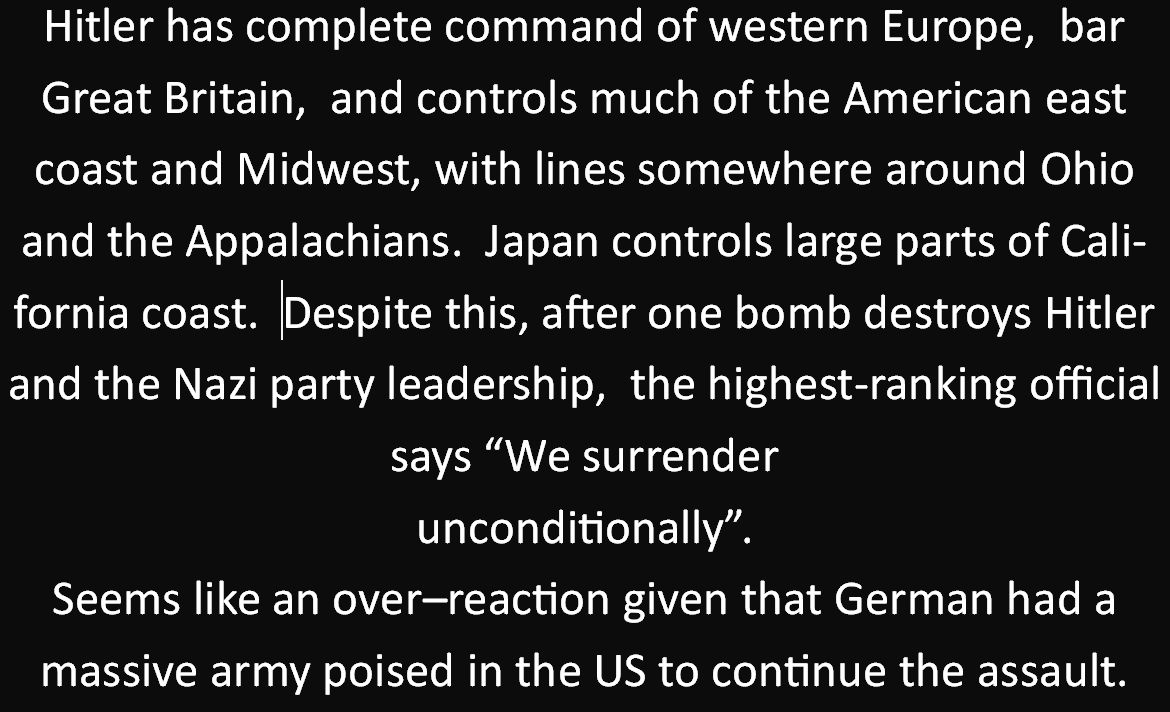
Honestly, I liked the story, but I could not buy the way the premise was executed.
And that’s the end of weekend vacation reviews!
Quotations:
Seventeen days after his narrow victory, President-elect Huey P. Long was assassinated in Baton Rouge by the son of a political rival. Under the provisions of the Confederate Constitution, Vice President-elect Harry S. Truman would now succeed him as the thirteenth president of the Confederate States of America. (The Governor just can’t win for losing!)
Across the Atlantic, spontaneous celebrations had already broken out throughout America. Missing from those who celebrated the historic ceremony was Franklin Delano Roosevelt. Three weeks earlier, on April 12th, the 32nd president of the United States had died from a cerebral hemorrhage at his residence in Georgia. (WHY DOES THE AMERICAN PRESIDENT HAVE A HOUSE IN ANOTHER COUNTRY?)