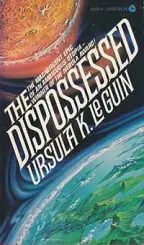
So you say you want a revolution? Well, brother, you must be the revolution. Shevek of Anarres is a brilliant physicist who is on the cusp of a breakthrough that could revolutionize humanity’s use of space and time, but he’s increasingly obstructed by members of his society, for reasons he can’t quite understand. Is it personal jealousy? Fear? Or has the anarcho-syndicalist society in which he lives simply begun to ossify? Shevek makes the bold decision to return to the planet that his forefathers fled from generations before, Urras, to break down the walls of silence between the two societies and perhaps find room to finish his work. He finds a startlingly different society, both intriguing and disturbing in turns, but realizes the answer he seeks isn’t there, either. The Disposessed is a fascinating work of political science fiction that offers the reader much to think about, amid a compelling drama about a man searching for the truth while trying to remain true to his values.
The Disposessed follows an interesting structure, with alternate chapters taking place on either of the two worlds and on different, but related timelines. In even-numbered chapters, we follow Shevek on Annares and learn about its culture and anarcho-syndicalist approach to society. It is highly collectivist without being authoritarian, using cultural and social pressure to push its members towards behaving. The individual is so downplayed that possessive pronouns are regarded as suspicious. Although people often do the work they’re declined to do (physics, for Shevek; biology, for his partner), one organization called DivLab also assigns needed work on a rotating basis, so people are frequently pulled away from “their” work to do what is needed, regardless of what that might mean for romantic pairs like Shevek and Takver — and their daughter! In the odd-numbered chambers, we follow Shevek as he explores Urras, the planet his people fled from seeking a revolutionary new way of life. Urras is capitalistic but also highly militaristic, and is engaged in a proxy war with its Soviet Union-esque rival in another nation. It’s interesting to find a bit of SF that has a planet without a unified government, at least in my limited experience: this one has at least the three, plus Anarres on the moon. Urras’ society is relatively ‘normal’, though there are some interesting fashion choices like women going around with shaven heads and bare torsos save for navel jewelry. Shevek is bewildered by how wealthy life on Urras is, although he realizes as the plot wears on that he’s only seeing on how one fraction of the planet lives: after sneaking out with help, he sees what happens to those in this society without resources or the ability to acquire them: think Down and Out in Paris & London or The Jungle. After realizing that the powers on this world want to use his breakthrough to create tools that will allow them to dominate the others, Shevek has to bolt.
The book’s subtitle is An Ambiguous Utopia, and that makes more sense the further along Shevek goes, as we’re seeing not a Perfect Society arrayed against an Imperfect one, but two societies that both have their flaws. Personally, I’ve long stopped believing that any human society can be stable in the industrial-technological age, and a stable society wouldn’t even necessarily be a good or perfect one, just stable. By book’s end, Shevek still vastly prefers his world of meaningful, peaceful poverty to the riches and lusts of Urras, but actions unfolding on Anarres prove that it has changes to make as well. To be honest, I wish I’d read this back in 2010/2011 when I still identified as a left-libertarian: I don’t think it would have greatly changed the evolution of my political thinking, but it would’ve definitely had an effect and would have resulted in a fascinating review to read in retrospect. This book’s multiple rewards (and Cyberkitten’s multiple reads of it over the years) definitely make sense, and I intend to revisit le Guin!
SFF Book Bingo Slot: “Best Buds“, a book read with friend or club. Another bingo!
Related:
The Moon is a Harsh Mistress, Bob Heinlein. The story of a revolution on Moon, drawing from both the American Revolution and the Soviet seizure of power.
The Great Explosion, Eric Frank Russell. An amusing short novel about a distant State trying to impose itself on colonial worlds, in which an aggressively anarcho-libertarian planet plays a big part. Myob!
Anthem, Ayn Rand. An individual emerges in a collectivist world. As with le Guin and Orwell, language is used to corral thought: “I” is not even a known pronoun.
Highlights:
“Speech is sharing—a cooperative art. You’re not sharing, merely egoizing.”
“I never thought before,” said Tirin unruffled, “of the fact that there are people sitting on a hill, up there, on Urras, looking at Anarres, at us, and saying, ‘Look, there’s the Moon.’ Our earth is their Moon; our Moon is their earth.”
“Where, then, is Truth?” declaimed Bedap, and yawned.
“In the hill one happens to be sitting on,” said Tirin.
“No—no, I’m not. I’m trying to say what I think brotherhood really is. It begins—it begins in shared pain.”
“Then where does it end?”
“I don’t know. I don’t know yet.”
“I want to learn, not to ignore. It is the reason I came. We must know each other.”
“The Odonians who left Urras had been wrong, wrong in their desperate courage, to deny their history, to forgo the possibility of return. The explorer who will not come back or send back his ships to tell his tale is not an explorer, only an adventurer, and his sons are born in exile.”
“You can’t crush ideas by suppressing them. You can only crush them by ignoring them. By refusing to think, refusing to change.”
“What’s wrong with pleasure, Takver? Why don’t you want it?”
“Nothing’s wrong with it. And I do want it. Only I don’t need it. And if I take what I don’t need, I’ll never get to what I do need.”
“What is it you need?”
“If you can see a thing whole,” he said, “it seems that it’s always beautiful. Planets, lives…But close up, a world’s all dirt and rocks. And day to day, life’s a hard job, you get tired, you lose the pattern. You need distance, interval. The way to see how beautiful the earth is, is to see it as the moon. The way to see how beautiful life is, is from the vantage point of death.”
“You have, we do not have. Everything is beautiful here. Only not the faces. On Anarres nothing is beautiful, nothing but the faces. The other faces, the men and women. We have nothing but that, nothing but each other. Here you see the jewels, there you see the eyes. And in the eyes you see the splendor, the splendor of the human spirit. Because our men and women are free—possessing nothing, they are free. And you the possessors are possessed. You are all in jail. Each alone, solitary, with a heap of what he owns. You live in prison, die in prison. It is all I can see in your eyes—the wall, the wall!”
They were all looking at him.”
“There’s a point, around age twenty,” Bedap said, “when you have to choose whether to be like everybody else the rest of your life, or to make a virtue of your peculiarities.”
“Or at least accept them with resignation,” said Shevek.
He had thought to bargain with them, a very naïve anarchist’s notion. The individual cannot bargain with the State. The State recognizes no coinage but power: and it issues the coins itself.
To him a thinking man’s job was not to deny one reality at the expense of the other, but to include and to connect. It was not an easy job.
You cannot buy the Revolution. You cannot make the Revolution. You can only be the Revolution. It is in your spirit, or it is nowhere.
“We’re only just beginning to feel what it’s like to be revolutionaries, as Shev put it in the meeting today. And it isn’t comfortable.”