Pedaling Revolution

Pedaling Revolution: How Cyclists are Changing American Cities
© 2009 Jeff Mapes
288 pages
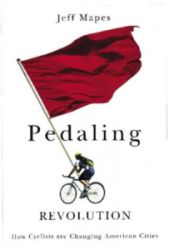
That’s some serious wind resistance there, buddy.

Governments across the world today are beset by problems common to all: rising fuel prices and obesity rates, the ever-present spectre of climate change, and the transportation needs of increasingly urbanized (or re-urbanizing) populations. Enter the humble bicycle: accessible to virtually everyone, regardless of age, sex, or income level; clean, quiet, and an excellent source of exercise. For too long in the United States, bicycling has been the province of a few intense racers and tourers who pride themselves on how miserable a trek they can endure. The end of the cheap oil era, however, has prompted cities to reexamine the bicycle as a means of transportation for the many, despite the car-centric nature of the American city.

Curbing car domination is not a futile hope: in the 1970s,  stirred by soaring oil prices, the Netherlands moved to discourage car use and promote cycling. The city of Amsterdam became a pioneer in modern cycling infrastructure; only Copenhagan can rival it. Both cities boast that nearly half of all trips within their cores happen via a cycle. Fittingly, then, Mapes begins with Amsterdam’s story — but the United States has its own homegrown success in Davis, California, a university town whose early growth was managed by a cycling advocate.  But Davis had it easy:  New York City and Portland, Oregon’s success in creating room for cyclists in an already established urban area filled with cars is arguably more impressive.

Mapes’ chapters on these cities not only demonstrate their success, but explore how they did it.  There’s no authoritative source for how best to integrate bike traffic into transportation infrastructure. Approaches range from the simple (simply painting bike lanes onto existing roads) to the more involved (separate bike paths and even ‘bike boulevards’) — and there are some who deny the need for bicycle infrastructure at all, harrumphing that cyclists should just learn to ride safely with auto traffic.  But more than just the built environment have to change to encourage cycling: traffic laws, like right-turn-on-red permits that allow motorists to take over pedestrian and cyclist right-of-ways, must be addressed. The book ends with a section on cycling safety, health benefits, and the important role bikes can play in raising children, and thus in creating a broader, sustainable bike culture.

Pedaling Revolution has great appeal to both cyclists and citizens concerned about the state of American cities, for whom it should prove most encouraging. The argue for cycling more is better made in The Green Metropolis, the cover of which is of a city in bodily form on a bike, but Mapes’ account gives the already-converted great reason for hope, and could easily intrigue the curious to becoming part of a bicycling renaissance.


Taken from an April edition of The Selma Morning Times, 1900.

Related:

  • Copenhaganize, a blog covering cities around the world as they move toward being more bike friendly, like Amsterdam Copenhagen.
  • The Green Metropolis: Why Living Smaller, Living Closer, and Driving Less are the Keys to Sustainability, David Owen
  • Walkable City: How Downtown Can Save America, One Step at a Time, Jeff Speck
  • The Sprocket and Critical Transit, two podcasts hosted by urban cyclists….based in Portland, naturally. The Sprocket’s tagline is ‘Simplifying the Good Life’; I especially enjoy their interviews with carfree parents.
Posted in Reviews | Tagged , , , , , , , , | Leave a comment

Shift

Shift
© 2008 Jennifer Bradbury
245 pages

Chris and his best friend Win decided to cycle across the United States in the summer between high school and their freshman year of college — but only Chris came back, and now his first month at university is being made difficult by an intrusive FBI agent and the threats of Win’s powerful father. In Shift, Chris tells the story of his adventure across America…the story that changed his and Win’s lives, and one which is a face-paced mystery for readers.

Jennifer Bradbury seamlessly weaves together the present-day story in which Chris adjusts to freshman life coming off his cycling journey with the story of said journey, with the questions of the agent setting the stage for Chris’s recollections. When I first picked the book up,  I was wary that this might be a murder mystery of some kind, but happily that’s not the case.  After the first third of the book, the reader will probably have realized what happened to Win, and will thus be a few steps ahead of the FBI agent, who is operating on his own, and without official sanction from the Bureau. Such is the power that Win’s father holds over people. What matters is how what happened came to happen: Shift is less a journey across the United States, and more the journey of two young men to find themselves…by way of getting lost.

Although I checked the book out because it was the only novel in the library concerning bicycles, the humor and character development quickly captivated me. It’s targeted toward high schoolers.

Posted in Reviews | Tagged , , , | Leave a comment

Reviving Ophelia: A Reading

“Most preadolescent girls are marvelous company because they are interested in everything — sports, nature, people, music, and books. Almost all the heroines of girls’ literature come from this age group — Anne of Green Gables, Heidi, Pippi Longstocking and Caddie Woodlawn. Girls this age bake pies, solve mysteries, and go on quests. They can take care of themselves and are not yet burdened with caring for others. […] 

Something dramatic happens to girls in early adolescence. Just as planes and ships disappear mysteriously into the Bermuda Triangle, so to do the selves of girls go down in droves. They crash and burn in a social and developmental Bermuda Triangle. In early adolescence, studies show that girls’ IQ scores drop and their math and science scores plummet. They lose their resiliency and optimism and become less curious and inclined to take risks. They lose their assertive, energetic, and “tomboyish” personalities and become more deferential, self-critical, and depressed. […]  

Psychology documents but does not explain the crashes. Girls who rushed to drink in experiences in enormous gulps sit quietly in the corner. Writers such as Slyvia Plath, Margaret Atwood, and Olive Schreiner have described the wreckage. Diderot, in writing to his young friend SOphie Volland, described his observations harshly: ‘You all die at 15.’ […]  Simon de Beauvoir believed that adolescence is when girls realize that men have the power and that their only power comes from consenting to become submissive adored objects. They do not suffer from the penis envy Freud postulated, but from power envy.

She described the Bermuda Triangle this way: Girls who were the subjects of their own lives become the objects of others’ lives. ‘Young girls slowly bury their childhood, put away their independent and imperious selves and submissively enter adult existence.’ […]
Girls know they are losing themselves. One girl said, ‘Everything good in me died in junior high.’ […] Parents know only too well that something is happening to their daughters. Calm, considerate daughters grow moody, demanding and distant. Girls who loved to talk are sullen and secretive. Girls who liked to hug now bristle when touched. Mothers complain that they can do nothing right in the eyes of their daughters. Involved fathers bemoan their banishment from their daughters’ lives. But few parents realize how universal their experiences are.

pp. 19-21, 23, Reviving Ophelia: Saving the Selves of Adolescent Girls, Mary Pipher.

Posted in quotations, Reviews | Tagged , , | 3 Comments

This week at the library: sheikhs, airplanes, and VW vans

This past Thursday, some friends drove me three hours into the woods, dropped me off in the midst of some 70 strangers, and left me there. They called it “Cursillo”, and it was a spiritual retreat which I liked enormously more than I would have ever predicted.  It helped that no electronic devices of any kind were allowed, so I enjoyed four days of conversations uninterrupted by phones ringing or people gazing at their gadgets.  But that’s where I’ve been — physically, all last weekend, and mentally, most of this week.

Before I left, I read On Saudi Arabia by Karen Elliot House, an exploration of Saudi Arabia’s culture, history, and political atmosphere. The nation is one worth learning about: home to the world’s largest petroleum and natural gas reserves, and a hotbed of religious violence which is simultaneously cozy with the United States despite being abusively backward in most respects. The Saudi Arabia that House unveils is one rife with contradictions and tensions, many of which are sourced in the Saudi royal family’s machinations to maintain control. They constantly strengthen and attack the warring factions inside the realm for their own advantage:  supporting and promoting Wahhabism across the world, for instance, but then swiftly attacking its adherents if their actions hurt the king or his standing in the world.  Although the Saudi family would like to  be more traditionalist, not only to pacify the swelling ranks of sectarian crazies, but to increase its own power, it is forced by reality to make changes — to allow more opportunities for women, for instance, and be more open to criticism. The Internet is a djinn in a bottle, that undermines the complete authority the Saudi  family and religious leaders once had.  Saudi Arabia is bound to change, but it’s in for a troublesome future.  There’s a great line in The Dark Knight Rises — “Victory has defeated you!” —  Saudi Arabia exemplifies the idea. It is a nation utterly ruined by its prosperity:  the rulers are corrupt, the people are spoiled (not working, not wanting to do anything useful, but eager to rage against the kingdom for not giving them more), and the economy is based entirely on oil, the production of which in Saudi Arabia may have already peaked. On Saudi Arabia is definitely worth looking at if you have an interest in global affairs and politics.

I also read Alain de Botton’s A Week at the Airport, inspired by his living in a hotel attached to Heathrow Airport, where he spent his days and evenings watching people as they set forth on globetrotting adventures, or returned home from the same. Although my interest in transportation might have piqued my interest in this book, its authorship made reading it inevitable. de Botton enthralls me, finding philosophical meaning in seemingly everything. I would not be surprised to learn he had once stood in the midst of a downpour, contemplating his umbrella. He makes the mundane sublime. Witness his shopping approach in an airport bookstore:

“I explained — with the excessive exposition of a man spending a lonely week at the airport — that I was looking for the sort of books in which a genial voice expresses emotions that the reader has long felt but never before really understood; those that convey the secret, everyday things that society at large prefers to leave unsaid; those that make one feel somehow less alone and strange.
Manishankar wondered if I might like a magazine instead.”

In A Week at the Airport‘s scant 100-odd pages,  de Botton muses on travel, the meaning of airport food, the inevitable expectation of arriving passengers that someone will be there waiting for them, the poetry of airline food menus, our faith in technology, other miscellany. de Botton fascinates, and the photography is stirring.

Earlier this past week, I also read Through Painted Deserts, the story of of two men’s journey together from Texas to Oregon in a VW bus, in which they descend into the Grand Canyon and ruminate on the Meaning of It All under the stars. I’ve read Miller before; he penned  Blue Like Jazz: Nonreligious Thoughts on Christian Spirituality, which left me feeling conflicted. As much as I liked Miller’s conversational tone and mellow thoughtfulness, I cringed there as he continued to hit himself over the head with dogma. One of the more intriguing episodes mentioned there, his living in the woods for a few weeks,  is explored in Through Painted Deserts in more detail.  The trip takes place earlier in his life, when Miller was still a young man trying to find himself — and he finds, on the road, that possessions and social status and all that are like, lame, man.  Through Painted Deserts alternates between low-key ramblings on life and intense summations of belief as Miller gets into simple living, mystic musings centered on the natural world, and confessions of love when he and his road-buddy aren’t fixing the van and enjoying the kindness of strangers.  I found it all rather endearing. A related work would be Desert Solitaire by Edward Abbey.

Posted in Reviews | Tagged , , , , , , , | 2 Comments

A Reading

“I began to wonder what personal ideas I believed that weren’t true. I believed I was not athletic enough; too stupid; I believed I had to go to college; I believed the Astros were a more important team than the Mets; I believed that jeans that cost $50 were better than jeans that cost $30; I believed that living in a certain part of town made you more important than living in another. I looked up at the cosmos and it had no scientific proof that any of this was true. The cosmos wasn’t telling me that I was stupid; it wasn’t telling me that one pair of jeans was better than another. The cosmos was just spinning around up there, as if trying to creature beauty for beauty’ sake, paying no attention to the frivolity of mankind  And I liked the cosmos. I liked the cosmos very much. It seemed that it understood something, perhaps, humanity did not understand.”

p. 11, Through Painted Deserts. Donald Miller.

Posted in quotations | Tagged | Leave a comment

Spring Reading

This week, the Broke and the Bookish asks…what books will you be reading this spring?

1. Cycle Journey
I’m itching to read someone’s account of cycling across the United States, but there are so many out there I haven’t decided on one yet!

2. The Universe Within: Discovering the Common History of Rocks, Planets, and People, Neil Shubin
I’ve been meaning to read Shubin’s Your Inner Fish for a while now, but this one channels Carl Sagan and Neil deGrasse Tyson.

3. Confessions of a Straphanger: Saving Our Cities  and Ourselves from the Automobile, Taras Grescoe

4. Religion for Atheists: A Nonbeliever’s Guide to the Uses of Religion, Alain de Botton

5. Earth: An Intimate History, Richard Fortey

6. Antifragile: How Things Gain from Disorder, Nassim Nicholas Taleb

7. Buddhism without Beliefs, Stephen Prothero, or similar.

8. Atomic Awakening: A New Look at the History and Future of Nuclear Power, James Mahaffey

9.  Fighting Traffic: the American City and the Dawn of the Automobile Age, Peter Norton

10. St. George’s Day is 24 April, and my reading around that time will celebrate England. I’ve not yet sorted out which books I’ll be reading, but Bernard Cornwell will certainly make a showing. Christian Wolmar’s Fire and Steam, a history of railways in Britain, is likely.  Other possibilities: Jane Austen, Charles Dickens, and P.G. Wodehouse.

Posted in General | Tagged | Leave a comment

This week at the library: bikes, Arab sheikhs, Christian urbanism, and marriage

What kind of car would Jesus drive? And he certainly would have to drive, were he to initiate a ministry in 21st century America, for it is an place impossible to navigate otherwise.  The Space Between: A Christian Engagement with the Built Environment explores the spiritual, religious aspects of …urban planning.  A book that quotes liberally from both the Judeo-Christian bible and authors like Jane Jacobs makes for a decidedly odd and manifestly intriguing combination, at least for someone like myself, for whom the built environment is a dear subject.  Although authors like urbanist authors like Jim Kunstler often address the way the built environment affects the human spirit — speaking of a building as honoring and comforting people , or distressing and demeaning us —  this is a distinctly religious spirituality explored here.  A key concept is that of shalom: while a common meaning of it is simply ‘peace’, author Eric Jacobsen writes that it has a fuller meaning, one that refers to a state of being where all is right with the world, essentially, where relations between people and relations between people and the divine are as they should be.  This idea allows him to explore ‘secular’ concepts like walkability and mixed-used  environments for their religious value.

Relatedly, I just finished Kate Braestrup’s Marriage and Other Acts of Charity, a memoir about love and marriage. The love in question is agape love, and Braestrup — a Unitarian Universalist minister — muses on marriage as a spiritual experience.  I read it for the author: her Here if You Need Me  lives on in my memory, despite having only read it once some three years ago. She writes with such naked, intense honesty, and her reflections stir one to both bliss and sorrow. Marriage is similar in that regard, allowing her to build off her background as a widow who became a minister (and chaplain to game wardens) after her first husband died in a car accident. Throughout the book Braestrup explores the theme of agape, through relationships between lovers,  families, and perfect strangers, mingling the sacred with the profane. As with Here if You Need Me, her second memoir is both profoundly moving  and sometimes hilarious.

More extensive comments are pending for Pedaling Revolution: How Cyclists are Changing American Cities and On Saudi Arabia: Its Past, People, Fault Lines, and Future.

Upcoming reads…oh, who knows? I recently received a book called Alabama Railroads, and have People with Dirty Hands, a tribute to gardeners, checked out as well.

Posted in Reviews | Tagged , | 2 Comments

Railroad Stations

Railroad Stations: the Buildings that Linked the Nation
© 2012 ed. David Naylor
336 pages

For the past couple of weeks I’ve been slowly enjoying Railroad Stations: the Buildings that Linked the Nation, a collection of photographs of the United States’ wide variety of railroad stations, from humble one-room shacks in the desert to astounding works of art that must rival even the cathedrals of Europe with their grandeur. It was released just last year, and appropriately timed given that Grand Central Station in New York is celebrating a hundred years of service.  The book is a feast for architectural admirers and railfans alike: after an opening section that gives a history of rail in the United States, and stations’ role in public and economic life, a tour of the US’s depots, stations, and terminals follows.  The photos range from the beginnings of rail days to the early 1980s, and while the majority portray the stations at their best (with crowds, families included, waiting to go on a trip, dressed in their Sunday best…including straw boaters for the men), a few in the southwest section offer a sad look at roundhouses and tracks overgrown by weeds.  Aside from the southwest and Alaska, though, the buildings are magnificent, and often connected to other forms of transit. In New York, for instance, a train station also had ferry landings, and quite a few were visibly part of a trolley (“light rail”) network. The photos included often cover a given site from multiple angles, building plans, and offer views of fine details, like a GC mongram emblazoned on the  doorknobs at the Grand Canyon station.  The editor sources the photos as well, so those curious can look for the original collections.

The four-page treatment of Union Station in Montgomery especially delighted me. I only discovered that the station was still standing a few weeks ago, and immediately took a trip there.

Click to enlarge.
Far more humble is the Old Depot, like Union Station part of the Louisville & Nashville line. I took this photo several years ago on an overcast day. 

Posted in history, Reviews | Tagged , , , | Leave a comment

Selma

Selma: A Novel of the Civil War
© 2008 Val McGee
396 pages

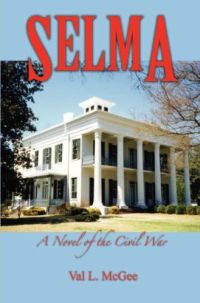
On the cover: Sturdivant Hall, a local home-turned-museum.

Today, Selma, Alabama is a small town on the Alabama river, largely forgotten save for its role in the Civil Rights movement. But once it was a great city, a commercial boomtown whose city fathers boasted of its many rail connections and steamboat landings. During the Civil War, Selma was an industrial powerhouse — and Val McGee has produced a story set during those years, one which follows a father and son team of attorneys and their friends through the war and beyond, on the stage that was the Queen City of the South.

Years ago, the curator of the local history museum (Jean Martin) produced a pictorial history of Selma under the name Selma: from Civil War to Civil Rights.  McKee could have very well used that as a subtitle, for he uses his characters to explore issues within slavery (its role in the war, its legality, its effect on the economy) and ends with an epilogue set in 2000, where President Bill Clinton visited the city to observe its storied role in the Civil Rights movement. The lead characters are as sympathetic as can be believable: anti-slavery unionists who believe slavery should be phased out. They rarely voice these views, however, for fear of disrupting good relations with their neighbors. As much as they dislike the path Selma takes, it is their home; for that reason, the son joins the Selma Rifles to fight against the Union which he would  would prefer to see kept intact. The other characters run the gamut, from businessmen and aristocrats to freedmen and slaves.

Selma’s greatest appeal for me, as a native son, is imagining life on its streets when it was a much more successful city. In my walks through its streets, I often imagine them as it were — my mind’s eye can see the trolleys on Broad Street, the lights in the upstairs windows of now-abandoned buildings, suddenly by my imaginings restored to life, full of people living and working in them.  The Selma of McKee’s story is a young, energetic city, where cotten bales slide down the long ramps from the bluff to the landing, where back streets are thick with  trade carts,  where men in suits and ladies in massive dresses boarded carriages for Sunday picnics out in the country, enjoying the fresh air where is now a rather large parking lot in front of an abandoned Winn-Dixie.  (Some of this romanticized, of course…I doubt anyone would want to return to wearing so much clothing these days, especially given the life-sucking humidity around here in August.)   But the rose of history has thorns, and in Selma’s case that’s slavery.  Those bales crashing down to the landings were picked by slaves. Dallas County was then and is now predominately agricultural, and owned by the cotton trade, and that dominates its destiny.  The townsfolk eagerly embrace the planters’ revolt — and pay the price when the Union army arrives to burn the foundry.

I suspect the book’s primary audience is Selmians themselves, though it was received poorly, and probably because McKee doesn’t romanticize the Old South, Gone with the Wind style. The culture of slavery was brutal, and that’s not shied away from here. Slaves are beaten and raped, abandoned in their age while the ‘good Christians’ of town champion slavery as an institution sanctioned and favored by God as a way of civilizing Africans. The lead characters are against secession, against slavery, and against the war — and while they may hide this from their contemporaries, their arguments between themselves are in full view of 21st century Selmians who don’t like being reminded of the dark side of history.  Like most people, we prefer to imagine our ancestors as noble, not base. But history is what it is, and every city has its sewers.  As a lifelong scalawag who nevertheless owns being ‘southron’, I found the book’s greatest weakness to be the stiltededness of the dialogue between characters. I don’t know if McKee went for the loquaciousness of Austen and came off sounding inauthentic (rather like Mr. Collins), but his characters sound like ideologues in their back-and-forth exchanges.  They don’t speak in ways that anyone in reality ever would: when a society man is hinted at as having fathered several children by slaves, a young socialite remarks that it’s a shame, but an unavoidable side effect of the socio-economic system in which they live — sounding rather like King Arthur’s noisy peasants.   I also wish he’d paid more attention to Selma during the war years: the book is set in 1860-1861, and then 1864-Reconstruction, jumping over most of the war after throwing Selma’s sons into an opening battle or two.

Selma is an enjoyable book, for the most part, and a treat in its author imagining the city in more prosperous days.

Posted in historical fiction, Reviews | Tagged , , , , , | 1 Comment

BTT: Libraries

BTT asks: How often do you visit a library? Do you go to borrow books? Do research? Check out the multi-media center? Hang out with the friendly and knowledgeable staff? Are you there out of love or out of need?

I visit the library every day. Of course, I work there, so it’s expected. But even before I began working at my hometown library, I visited it on a weekly basis. (Hence…this week at the library.)  It probably goes without saying, but I love libraries. “Love” is not hyperbole, because to me they’re community centers as well as places wherein the culture of our societies is preserved –rather like medieval monasteries, but without waking up at three a.m. to pray. I like seeing people come together in the library, whether it’s old friends chatting as they read newspapers together downstairs, or listening to a little girl read aloud to her sister. I still use the library heavily for my reading, and lately I’ve begun research in its microfilm room. Visitors frequently marvel at the library’s size, relative to the town it serves, and the friendliness of the staff.  Recently a retired couple touring the country in their RV paid us a visit, and shared several photos of the library’s insides here. Because of its location at the heart of downtown, the library is imminently accessible to virtually everyone: children and teenagers often arrive on foot or by bike.

This is part of an aerial photo of downtown Selma taken sometime before 1969. The library occupies the site which is circled above; the white building is the Wilby Theater, which burned. Alas, the grand building behind the site, the Hotel Albert, was lost to ‘progress’ in 1969. That site is now occupied by City Hall and a convention center. 
Our website is here.

Posted in General | 2 Comments