The Plain Reader

The Plain Reader
© 1998 various authors, edited by Scott Savage
272 pages


What really matters?  Such is the question explored by the contributing authors of The Plain Reader, a collaboration between Amish and Quaker communities to express how living simply allows them to ‘put to rout all that [is] not life’ and experience themselves, their families, their communities – every aspect of the human condition, in fact – in a more profound way.  Plain is a provocative work, prompting  readers to think critically about their own lives and how our habits reveal our values.In return, the lessons taught may allow those interested to create a more peaceful, meaningful life.


The Plain Reader begins with the account of a man who quit his job at an oil company and purchased a small working farm to run with his wife and children.  He was tired, he said, of working in a place that  encouraged reckless consumerism that allowed a tiny minority to live extravagantly (that’s us) at the expense of both the poor and of future generations, who will left with our messes and without resources. He was tired of working long hours at this company, being separated from his children and world outside his office. In place of all that, he was choosing a life that allowed him to practice sustainability and self-reliance, and to impart those values to his children while watching them grow up and working alongside them at the family farm while experiencing the glory of the natural world.  Toward the book’s end, one author writes that the essence of being Amish is choosing to reject anything that gets in the way of experiencing life fully, that constitutes a spiritual obstacle.

In that spirit, the authors of this book live. Some of them are not so different from most people who might pick up this slender volume: they have simply chosen to disengage from the constant havoc of everyday life. They’ve stopped shopping for the sake of shopping; they’ve shut off the television and found they liked a quieter home.  They’ve opted to bicycle to work, or move closer to it so they wouldn’t have to drive. Some start a garden and learn to can. And others have taken more dramatic steps, like joining Amish communities and taking up farming as a vocation. Because the sources hail from Christian religious communities, that tradition is touched on within, but these authors do not need to inject religious beliefs into their ordinary lives, like slapping a “HONK IF U LOVE JESUS” sticker onto their SUV; instead, their ordinary lives are their practice, and every action is imbued with the sacred, from birthing to washing clothes. They are not Puritans, for the most part; one contributor is a Quaker minister who uses a laptop to write his sermons and provide his pulpit notes.  He’s uncomfortable with having become dependent on the computer to write the notes he used to compose in longhand, but, he concludes, using the computer to write allows him more time to drive his buggy.


The relationship between humanity and machines is a running theme of the book; there exists a proper relation between the two, and working  out what that relation is should be left to people and communities. Critical discussion of the machine is not limited to tools and physical objects, however, like the effect of televisions and computer games on family life;  the authors take on Systems as machines, or as things which treat people like machines. They disdain an compulsory educational system that grooms  children to take tests, but doesn’t impart any skills; they reject dehumanizing work, and a medical approach that views organs and individuals in isolation and regards disease in both as something which should be treated with an array of patented pills.  The contributors time and again turn away from the big and impersonal to the small and human-scaled; they embrace barter and favors systems rather than money, and stress the importance of adults who know children personally in teaching them about the world, one-on-one and by example, like apprentices and masters.


A common thread is that of community. As mentioned, most of the authors hail from Quaker and Amish communities, and so put great stock by traditions which bring and keep people together; The Plain Reader, while attacking most of what modern people take for granted, is conservative in that it generally emphasizes the welfare of communities over that of individuals, although the essayists presumably have different ideas as to what the ideal balance is between individual and communal well-being. While one urges people to think for themselves, another writes that removing televisions from the home allowed him to shelter his children, teaching them to accept certain beliefs on face value; he explicitly scoffs at this notion of people believing any old thing they want. The catch is, of course, that the culture the authors adore so much, the traditions they keep to, are themselves artifacts, just as invented by human beings as television sets, automobiles, and SaladShooters.  


Though not a large book, The Plain Reader offers an abundance of food for thought. But that food isn’t candy; it isn’t necessarily sweet and easy to swallow. It’s substantial, chewy, and can be felt all the way down  your esophagus.  Even to someone as receptive to their ideas as myself, some of the essays presented a challenge, especially in  regards to health. While I find the “everything should be treated with pills” model as dubious as any,  the mention of holistic medicine and having an herb for everything makes my skepi-senses tingle. Diet and exercise have their place in warding off most diseases — but antibiotics have their place, too.  The trick is to not destroy the body’s immune system by swallowing a pill for every runny nose.  Everything in moderation — or should that be, most things?


The Plain Reader commends itself to those interested in a thoughtful life. 


Related:


Posted in Reviews | Tagged , , , , , , , , , , | 3 Comments

This week at the library: cities and simple living

This week at the library, I’ve started a series of England-themed readings to commemorate St. George’s Day, on 23 April. My selections are A History of the English-Speaking Peoples, Volume II: The New World by Winston Churchill, and A Dangerous Inheritance: A Novel of Tudor England by Alison Weir. I’ve never read any of Churchill’s work. So far I’ve found him a spirited if traditional storyteller.

The New Jim Crow is an unrelated read, as it examines the effects of the United States’ enthusiasm for prisons on African-Americans; I’m almost finished with that.

Earlier in the week, I finished The Plain Reader, but I’ve been so provoked by it that I’m re-reading it, essay by essay, and writing reflections on it in my personal journal. It’s a collection of thoughts on simple living. Reviews and comments are also pending for The Universe Within and The Death and Life of Great American Cities by Jane Jacobs.
I have three interlibrary loan requests pending.. Chimpanzee Politics,  Buddhism without Beliefs, and Crunchy  Cons. 
Posted in Reviews | Leave a comment

A Spectacle of Corruption

A Spectacle of Corruption
© 2004 David Liss
381 pages


When Benjamin Weaver went to a pub, he never expected to end up fighting for his life, let alone be arrested for the crime of killing a man he only met when the man saved his life during the struggle.  But that’s what taking jobs from mild-mannered preachers will get you.  The minister had been threatened with violence if he didn’t stop sermonizing against the Whig abuse of the poor, and asked Weaver — detective, bounty hunter, thieftaker, shakedown man — to find out who was responsible for the threats.  But during an election season, even a homily for the poor can be part of an elaborate plot. And so, after effecting an escape from prison and a death sentence, Weaver must find out who is trying to frame him, and why — and in the process, will find himself knee deep in a conspiracy to restore James II to the crown. A Spectacle of Corruption thrusts Weaver into the exciting and dangerous world of 17th century politics, taking readers on a journey through the dark, winding paths of London, into working class pubs and the galleries of the wealthy.

Spectacle is a  worthy successor to  A Conspiracy of Paper, dominated by Weaver and a few other outstanding characters — his doctor and friend, whose obsession with bloodletting  (a running joke) has switched to enemas, Johnathan Wild, the ‘thieftaker general’ who is involved in every criminal plot of note, and (of course) a beautiful woman who is far more canny than proper society will allow for. Weaver has no idea who would be trying to frame him , and even less idea as to who wants to help out him. Someone placed a sobbing lass with a lockpick in his path before he was incarcerated. The man who Weaver immediately suspects, Wild, has nothing to do with it. The mystery is part of the battle being waged between the Whigs (corrupt businessmen), the Tories (corrupt aristocrats), and to a lesser extent between the Tories and the shadowy Jacobin plot to one day displace George I and restore to the English throne a monarch who can actually speak English. Unlike Conspiracy of Paper and Ethical Assassin, Liss doesn’t use Spectacle to muse on any philosophical issue, except perhaps the frauds people perpetuate to find a better place for themselves within society, masking their true selves as not to cause alarm. 

I very much look forward to the third book in this series, The Devil’s Company. 


Posted in historical fiction, Reviews | Tagged , , , , , | Leave a comment

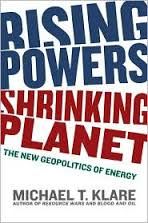
Rising Powers, Shrinking Planet

Rising Powers, Shrinking Planet
352 pages
© 2008 Michael T. Klare

For much of the 20th century, a handful of industrialized countries enjoyed access to a seemingly infinite supply of oil. But a century of economic progress has seen global demand for oil soar. Ever more countries are scrambling for a bigger piece of the petroleum pie, and there’s increasingly less to divide, while appetites the sticky sweet stuff have only just been whetted.  As nations scramble to find new oil deposits to replace those which they’ve already exhausted, the global balance of power has shifted. Formerly impoverished nations are now fat with wealth, and titans of the global economy have become increasingly anxious beggars on the verge of throwing punches. In Rising Powers, Shrinking Planet,  Michael Klare elaborates on why the global dependency on a resource with an unstable future is a growing threat to world peace and muses on how the great powers, old and new, can turn competitive tension into collaborative energy and prevent quests for energy security from becoming World War III.

Oil (and gas) are potent stuff.  The energy contained within them isn’t limited to fuel for transportation: they can  and have brought back to life, Lazarus-style, failed states like Russia which capitalized on its ability to control the flow of fuel to Europe. They’ve also turned desert wastelands dotted with yurts into spectacles of affluence; goodbye tents, hello opulent towers and water fountains performing music.  This enormous wealth has been generated because global demand for oil is climbing at the same time that supplies are faltering:  the great wells have been drained, discoveries of new ones are falling, and wells are exhausted more quickly than they can found. In addition to our rapacious appetite for fuel wreaking havoc on the environment  (who needs mountains when you can have coal? Aw yeah.), they’re not having a happy effect on global politics, either. Not only has the wealth and power given to Russia and the new petrostates been restricted to a relative few, with little of the wealth being invested back into their societies, but the few have used the power to strengthen their hand; petty tribal chiefs now have money and foreign militaries doing their oppressing for them. Which foreign militaries? Those of the United States, Russia, and China, the Big Three who are canvassing the globe in search of resources and playing games with whatever tinpot dictator they can pressure to give it to them — from the Caspian Sea to Africa, and especially the Middle East. Although Klare’s early chapters detail the rising demand for oil, most of the book is given to studying how various powers, the big three in addition to Japan,  India, and a few other states, are competing with one another in board rooms cutting deals, and increasingly on the edge of the battlefield. While no wars have erupted yet, Klare seems to think they’re inevitable. His final chapter urges the powers to work together to solve their common problem of energy security, rather than wasting scarce resources trying to stave off the inevitable.

Rising Powers, Shrinking Planet is a book to read if you’ve any interest in global affairs and the future of energy. It’s replete with data to impress (and horrify) your friends: did you know we’ll have to double our production of oil to meet predicted demand by 2020?  (Considering that we’ve been reduced to smashing  greasy rocks together to find it, that’s a fairly daunting challenge.) Klare is an engaging writer, making a discussion of production figures seem interesting; it helps that competition for them is causing so much conflict.  Given the importance of the subject, this is a book I think more people should read, but there are a couple of niggling problems: first, this book is four years out of date, and  so many of the facts may have changed.  Russia’s Gazprom, for instance, isn’t quite as intimidating now as it was in the book, and the new petrostates aren’t wasting all of their oil money. Some nations on the Persian Gulf are investing in renewable energy in anticipation of the inevitable day that oil proves to be not magic and runs out, like every other resource.  Additionally, some of his advice seems a bit unhelpful, namely that suggestion that China and America collaborate to make more fuel-efficient cars; those meager contributions be dwarfed by the fact that both nations are aggressive car promoters and yearn for more automobile sales. These are trifling matters, though; the meat of the book is more than food for thought.

Posted in Reviews, World Affairs | Tagged , , , , , , , , , , , , | Leave a comment

Monday Musings

Every Monday, Should Be Reading posts a list of questions people can write on as they like. I don’t think I’ve ever participated before, but I usually enjoy reading others’ responses. The questions are:

• Describe one of your reading habits.
• Tell us what book(s) you recently bought for yourself or someone else, and why you chose that/those book(s).
• What book are you currently desperate to get your hands on? Tell us about it!
• Tell us what you’re reading right now — what you think of it, so far; why you chose it; what you are (or, aren’t) enjoying it.
• Do you have a bookish rant? Something about books or reading (or the industry) that gets your ire up? Share it with us!
• Instead of the above questions, maybe you just want to ramble on about something else pertaining to books — let’s hear it, then!

I recently purchased The Plain Reader: Essays on Making a Simple Life, and anticipate it arriving in the post sometime this week. I first heard about it on The Sprocket podcast, which covers bikes, beer, music, and ‘simplifying the good life’.   I have on order, through Interlibrary Loan, two books: Frans de Waal’s Chimpanzee Politics, and a bit of historical fiction by David Liss called A Spectacle of Corruption.   Last year I purchased eighty books, which is waaaaaaaaaay too many,  and right now I’m trying to declutter.

I currently starting two books, Neil Shubin’s Your Inner Fish and Michael Shermer’s The Believing Brain. I’ve read both authors before; in fact, I read Shubin just a few weeks ago. I enjoyed his The Universe Within Us, but haven’t posted comments yet.  Your Inner Fish has been on my to-read list foreeeeeever, and I bought it a few weeks ago because I wanted a science read.

Posted in General | 5 Comments

1356

1356
© 2013 Bernard Cornwell
432 pages

And by God, he thought, there was nothing like this feeling. A good horse, a tight high saddle, a lance, and an enemy taken by surprise.

It’s the year..well, 1356, and after a lull in the fighting, the Hundred Years War is about to resume. England is having a merrie old time raiding the French countryside, setting fire to every structure and peasant they can find, and carting it all back to Calais.  Somewhat chuffed, the French king has at last decided to take action. His goal: capture the Black Prince, young Edward, and use him as a ransom to force the English to recoup France its losses in land and goods, and end the war. With an overwhelming advantage in numbers, and the wisdom learned after numerous defeats (to wit: don’t make it easy for the English archers by riding massive targets into battle),  France seems poised for a momentous victory at Poitiers…but then comes Thomas of Hookton, the knighted leader of a group of archers who call themselves the Damned.

Thomas is known to readers of Cornwell as the bastard son of a priest (“the devil’s whelp”) who rose from the ranks as a common archer to the leader of men, and one who found the Holy Grail, to boot. 1356 sees him on a mission  to ensure that the French don’t recover a relic known as la Malice, the sword that Simon Peter used to defend Jesus in the Garden of Gethsemane.   His rival is his opposite, a golden-haired idealistic  virgin who fancies himself an actor in some heroic quest, fighting dragons and demons and restoring France to glory.  These two opposites — Cap’n Mal and Captain Hammer, if you will — meet first in battle over a woman, as a young countess has decided to run off with another knight, one who isn’t her morbidly obese and stupidly cruel husband. The Virgin Knight, Sir Roland, sees it as his duty to restore a naughty adulteress to her god-given master, hubby dear, and Thomas rescues her while shaking the count down for unpaid debts. (The aristocracy may sneer at Thomas’ band of common longbowman, but they’re willing to pay a rich price to enlist their service.).  While Thomas and Roland seek la Malice and spar over the woman, each trying to avoid capture and death while traveling through a war zone — the English and French armies move to engage with one another, and eventually Thomas takes his place on the battle lines, where he fights desperately and accomplishes stunning deeds — as Cornwell’s heroes are wont to do.

Cornwell’s strengths as a writer aren’t missing here: his scenes are rich with detail, the dialogue is lively and hilarious, the prose commands the reader’s emotions, the battles are intense. He’s wonderful — but what I liked most about 1356 was Thomas’ foe, Roland. The two are on opposite sides throughout most of the novel, but it’s not as if Roland is a bad guy. He’s committed to Doing the Right Thing; like Thomas, he has a talent for fighting and enjoys the competition. But Roland is an innocent, not for his ‘virgin’ status but because he thinks the world is a fairy tale, in which he is Prince Charming. He undergoes a fair bit of character development as the tale goes on, learning how truly contemptible ‘noble’ rulers can act, and how virtuous the damned can be,

1356 is another rollicking story of war, love,  and mischevious monks.

Posted in historical fiction, Reviews | Tagged , , , , , | 5 Comments

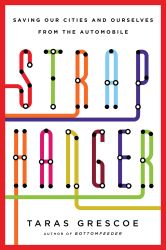
Straphanger

Straphanger: Saving Our Cities and Ourselves from the Automobile
336 pages
© 2012 Taras Grescoe

The cheap energy era is over, unless someone invents a Star Trek replicator that can magick barrels of oil into existence. Cities across the world are working to meet the challenge of keeping millions of people moving and their local economies growing by investing in mass transit. In Straphanger, Taras Grescoe visits thirteen cities in the Americas, Europe, and Asia to experience their transportation systems, finding what what works and what doesn’t. These cities include not only those with long-successful and fully integrated systems, like Paris and Tokoyo, but cities like Phoenix which were built for the automobile and which are now trying to transform themselves. Watching these cities strive for the future has for Grescoe all the thrill of attending a rocket launch: when they’re successful, it’s glorious, but when they fail…the results aren’t pretty.  Happily for Grescoe and readers, most of his accounts are of successful takeoffs — and even the failures have something to teach.

Prior to the automobile, the great urban centers of the industrial age depended on transit systems to keep their expanding population mobile: even small cities could boast a trolley system. But as the automobile zoomed into the historical spotlight, these systems were abandoned and destroyed — until now. The transit renaissance is not only bringing old systems back to life, but bettering them: only only are trains cleaner and faster these days, but the systems themselves are better thought-out. Take buses, for instance, which are increasingly being taken out of congested traffic and deployed in Bus Rapid Transit systems, in which they’re given a full lane of the road, dedicated to them. Those who board these  have pre-purchased tickets, much like train lines — allowing BRT drivers to more than double the average speed of their buses outside the system. BRT systems are ideal for poorer cities in desperate need of transit, but which lack the means to create more involved systems. like subways.

Straphanger combines history and public policy,  covering traditional transit (trolleys,  trains, and subways),  transitional transit with a twist (BRT), and bicycles as well. Although bicyles are individual vehicles, Grescoe demonstrates how they can be connected to cities’ mass transit systems. For instance, in Paris, a Metro ticket that allows subway access can also be used to rent a bicycle to take to the train station — and bus stops there nearby, as well. Copenhagan’s history of recent expansion has been done while simutaneously promoting bicycle use, making it in Grescoe’s view an excellent choice for American cities to study. The great lesson of Straphanger is that for mass transit to succeed, it must consist of a network that people can actually use to get places. Busses that run erratically are of no use to people who need to get to work on time, and bike lanes that go nowhere do more harm to the cause of bike commuting than good. Integration is a key element of that, both in working in transit options where people live, work, and shop, and in connecting those options to expand people’s opportunities.  Paris’ achievements in this field make it Grescoe’s favorite, but Straphanger’s writing doesn’t focus just on functionality: he points out how transit can be a place for civic art, as exemplified by Moscow’s subway, and expand people’s quality of life:  cycling is fun, far more than sitting in gridlock.

Straphanger is a winsome, thoughtful, and entertaining book which should be of interest to citizens who want to make their communities better and more sustainable places to live.

Related:
Walkable City, Jeff Speck
Pedaling Revolution, Jeff Mapes
Waiting on a Train, Jeff McCommons
The Green Metropolis, Jeff  David Owen

Posted in history, Reviews | Tagged , , , , , , , , , , , | 1 Comment

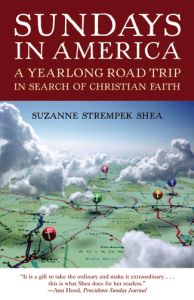
Sundays in America

Sundays in America: A Yearlong Road Trip in Search of Christian Faith
© 2008 Suzanne Strempek Shea
311 pages

The outpouring of devotion that followed Pope John Paul II’s death stirred Suzanne Shea: why hadn’t she felt like that in a long, long time? And how — where — could she experience such an intensity of religious feeling again?  And so, armed with a seeker’s desire to find That Something Out There, as well as impressive traveling budget, she spent a year visiting American churches,  one each Sunday (and some few on Saturdays, the ‘traditional’ Sabbath),  touring communities both close to home in New York, and as far as Hawaii.  The churches ranged from the huge to the  humble, and spanned every denomination you’ve heard of and some you couldn’t have possibly imagined, Taking notes, Sundays in America is her chronicle of that year of church-shopping,  one which allows readers to play voyeur, experiencing the services and beliefs of churches they’re curious about, but would never go into — and one which might provoke thoughts to what they’re looking for at church.

I’ve read a work like this before, in Hemant Mehta’s I Sold my Soul on eBay. A Jain-turned-atheist, Mehta wanted to explore Christianity, but figured…why do it for free? He offered his church attendance for sale on eBay, and the winner — interested in reaching out to nonbelievers — asked him to visit fifty Christian churches of all kinds and critique them so that Christians could learn what they might do better.  Mehta liked energetic services with easily understood messages, exemplified in Joel Osteen’s megachurch, and panned both high-church liturgical services and low-church bible-thumping.  Shea approaches churches from a different angle, however, as someone who believes the faith, yearns to feel it more fully, but has never ventured to do so before because the nuns who raised her threatened her with hellfire for even visiting another church.  Here, she visits an astonishing variety of churches, from the standard American faiths (Episcopalian, Methodist, Presbyterian,  Baptist) to quirky up-and-comers (Mormons) to the bizarre (a church which worshiped God and John Coltrane). *A handful of niche churches, like the chapel at West Point, are included as well.  The author took care on some Sundays to choose an appropriate church: she visits the West Point chapel on Memorial Day, for instance, and a kooky Christian Spiritualist community on All Saints’ Day.

Shea’s account quickly revealed her personal tastes to be simple, but refined: she recoils from huge productions like Joel Osteen’s megachurch,  stares glumly at the unadorned walls and unfrocked preachers in Protestant churches, and finds the focus of some congregations on spiritual warfare (fighting actual…demons?) and hate-campaigning to be flabbergastingly strange and distasteful. More to her style are the meditative services of the Quakers, or those of Catholic-like denominations, with formal liturgies and generous decor. But she appreciates some of the novelties, as well: the intense emotional energy  of places like New Mount Zion Baptist church and their enthusiastic inclusion of the congregants in the service as doing more than repeating lines appeals to her. For Shea, a this-world spiritual approach is paramount: she delights in churches with social programs like food pantries, and scorns those that only focus on helping their attendees avoid God’s Imminent Wrath.

I found Sundays in America quite engaging, as the author and I seem to look for many of the same things in a faith community, in regards to the emphasis on helping others and the abscence of hate politics. Her story allowed me to find out a bit more about a few denominations, amused me with some of its bizaare visits,  made me appreciate having escaped my childhood Pentecostal background by forcing me to revisit it, and stirred me with her accounts of visiting the Quakers and a few other groups  whose emphasis on simplicity and mindfulness I greatly appreciate.

For those curious about the varieties of Christian religious experiences, this could prove very much worth your while.

* I used to say I went to the First Church of Frank (Sinatra), joking that we sang the Voice’s standards and read devotions from The Way You Wear Your Hat: Frank Sinatra and the Lost Art of Living. Finding out that a church existed that actually did that, with another artist, was startling to say the least…

Posted in Reviews | Tagged , | 2 Comments

Hey Mom, Can I Ride My Bike Across America?

Hey Mom, Can I Ride My Bike Across America? Five Kids Meet their Country
© 1990 John Siegel Boettner
with excerpts from the journals of Heather Deutsch, Joy Fulton, Jimmy West, Carl Fagerlin, and Ethan Turpin.
439 pages

The United States isn’t a nation that makes touring it by bike easy: those who wish to do it must tackle mountain ranges,  broad deserts, a cornucopia of potential natural disasters — and that’s not even including American drivers. Imagine trying to do it while simultaneously watching over five teenagers —  five kids, really, a group of three boys and two girls, all eleven between eleven and thirteen years old. That’s what John Siegel Boettner, a middle-school teacher in California, did in the year of 1986. Beginning at the start of summer break, he and his wife toured with the kids from Washington, D.C. across the continent to Oregon, then down California to their home, a journey of nearly five thousand miles — braving tornadoes, heat waves, snowstorms, and a string of mechanical problems, all in an effort to teach the kids about their country.

John Siegel Boettner isn’t your usual teacher: the fact that’s he willing to take care of five of his kids for four months across the nation and through a variety of disasters might already indicate that.  An avid cyclist, as soon as he began teaching he organized a bicycle club and began taking his kids on extended trips called “Educational Safaris”: in one, he and his wards biked through the northeast,  exploring the sites of the American Revolution. Not only did the bike trips give the kids an opportunity to learn about themselves, of what they could achieve through their effort alone, but it made their history, their culture, come more alive…and such was their teacher’s intention here, as after Mississippi they follow the Oregon Trail to the west coast.  By day, John is their leader, captain, mechanic, and coach, helping them to organize and keep moving, and calling the shots when things get hairy…as they did, often.  Unlike David Lamb’s Over the Hills,  Hey Mom is peppered with near-disasters, usually near the mountains. By night, he’s a teacher, reading to them from the journals of an Oregon Trail pioneer whose path they follow and whose experiences are an eerie mirror of their own.  The trip extends a month past summer vacation, but John feels no guilt about keeping the kids about of school. In his view, the experiences they are gaining on the road are worth far more than a month of memorization and regurgitation. This is the trip of a lifetime, the intimate details of which John accounts in the book, and when it was finished I felt sad, as though I’d been part of the experience and it was now over.

Before leaving on the trip, John read to his kids from Peter Jenkins’ A Walk Across America;  Jenkins, too, transversed the nation in an effort to learn about it, to spend time with its people. Like Jenkins before them, John, his wife, and the kids gain much from the kindness of strangers…and strangers across the continent are very kind indeed to a band of kids doing what most think impossible even for adults, crossing a land of three thousand miles by bicycle.   Although this is the story of a journey, it’s more about the people — both the kids involved, like young Ethan who could barely ride a bike when the tale began, and the people who they meet, like the Amish folk in Tennessee.  I find accounts of people walking or cycling the entire country to be fascinating by themselves, but Hey Mom is extraordinary for featuring kids, whose energy, idealism, and joy and make a work to revel in reading.

Very much recommended. 
Related:
  • The author giving a TEDx talk called “The Joy of Looking“, in which he shares how one of his cycling students taught him the lesson of The Dead Poets’ Society: gather rosebuds while ye may.. It’s beautiful.
  • A Walk Across America, Peter Jenkins
Posted in Reviews | Tagged , , , , | 2 Comments

Teaser Tuesday (26 March)

One man from Nebraska even wrote us a couple of times, filling his envelopes with books and brochures. He apologized for always filling my mailbox and ended one of his letters with, “I’m just so excited that you’ll be coming through our state!” It seemed that not too many people were interested in pedaling across Nebraska.

p. 26, Hey Mom, Can I Ride My Bike Across America? Five Kids Meet their Country, John Boettner

In 2010, the highly conservative International Energy Agency announced that output of conventional oil would peak within ten years if demand continued to grow on a business-as-usual basis.
“Even if oil demand were to remain flat,” Fatih Birol, the agency’s chief economist, conceded in 2011, “the world would need to find more than forty million barrels per day of gross new capacity — equal to four new Saudi Arabias — just to offset this decline.”

p. 10-11, Straphanger: Saving Our Cities and Ourselves from the Automobile, Taras Grescoe

Posted in General | Tagged | Leave a comment