1984

1984
© 1949 George Orwell
326 pages
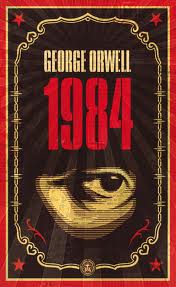
1984 needs no introduction. Written in 1949, it envisioned a world of constant surveillance, perpetual war, and a state with  complete control over people’s minds. Concepts from it – “Big Brother”, “thought police”,  and “doublethink” —  appear in pop culture from time to time.  Written as a warning, it has gone unheeded. Today, systems of surveillance are more sophisticated than ever, featuring “SmartCameras” that  track automatically and signal if they exhibit ‘aberrant’ behavior; meanwhile, SmartPhones like the iphone from Apple allow anyone’s location to be tracked – and governments like that of the United States engage in widespread warrantless wiretapping.   Such rampant invasions of privacy are condoned in the name of National Security or convenience, and one wonders when people will say “Enough!”

            I read 1984 back in high school, and it was the first work I ever read without an encouraging ending. I found it depressing, and it had that same effect this week, even though what was coming.  If you have never read it, or if it has been a while since experiencing the story,  it’s one of a man named Winston Smith, who thinks he is the only sane man in the world. Like many others in Airstrip One, an area of a global empire once known as England, he lives a bleak, depressing life. The buildings around him are decaying, the food is terrible, and  most manufactured goods are shoddy if available at all. And there are no arts to feed the soul, to give the mind relief from the universe – no culture, no science, not even honest laughter.  Smith is miserable, and so is everyone else – but he’s seemingly the only man who knows he is miserable, who knows that life can’t be this bad on accident. But then he chances to find a kindred spirit, and his spirits begin to soar…until they’re captured again, and ground up like so much beef chuck.

            What strikes me most about 1984 is the utter inhumanity that people are subjected to.  Every aspect of life is Controlled:  there is no spontaneity. Even the English language is being steadily reduced, a mighty oak turned into a utility pole stinking of resin. English in its altered form, “Newspeak”, is an engineered tongue, crafted carefully with the intention of making seditious – free and expressive – thought impossible.  Virtually everyone live under the constant view and orders of the Telescreen, which not only spews forth propaganda, but issues orders. Under such scrutiny, people live behind masks, constantly managing their faces and preventing any kind of expression, even unguarded eyes, from betraying them to the telescreen. Everything sacred to the human experience – music, family life – is broken and its remnants put to use: children, for instance, spy on their parents.  Little wonder that Winston’s greatest acts of defiance comes in having sex in a field:  such passion is impossible to govern, which is why the Party seeks to destroy it completely.

            How, in 1949, did Orwell manage to predict such supremacy of institutions and machines over men?  He had witnessed elements of both already, at work both in totalitarian and democratic states during World War 2, but considering how primitive television was in those days the domination of the telescreen in his work is remarkable. What would Orwell make of the dominance of computers and the internet in our lives, wherein we expose so much of our private selves thinking we are safe…when in reality,  every search query into a Google box, every click of the mouse, can be monitored and saved into a database?

            1984 is a short work, barely three hundred pages, but it speaks volumes about the human condition. It’s never been more important to read than this day and age.
Posted in Reviews, science fiction | Tagged , , , , , , , , , , | 6 Comments

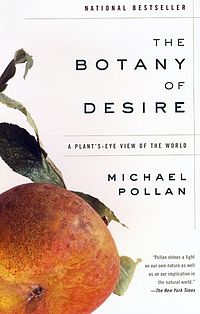
The Botany of Desire

The Botany of Desire: A Plant’s Eye View of the World
© 2001 Michael Pollan
256 pages

     Meander through your garden and ponder the meaning of life; such is the advice of Michael Pollan, who in The Botany of Desire asks what four domesticated plants (apples, tulips, marijuana, and potatoes)  might tell us about ourselves. Although he describes his subject as human-plant coevolution, the final result is more philosophical than scientific. In truth, it’s a little of both – a surprising read that makes the average garden even more interesting.

            Pollan’s four chosen examples allow him to explore the subjects of sweetness, beauty, intoxication, and control. The first section on apples is the most ‘scientific’, as he establishes fruits’ sweetness as not some happy accident, but an evolutionary strategy: animals that eat fruits swallow their seeds – and later deposit them in a pile of fertilizer. That sweetness appeals to us because it’s a signal: here lies energy-giving glucose, lots of it. Pollan’s treatment of each subject isn’t a straightforward “The relationship between plants and human evolution is THIS and THAT” —  Pollan strolls,  exploring side roads that somehow connect to one another. The section on apples introduces Johnny Appleseed,  praise for the merits of apple reproduction (each apple contains five radically different seeds: that great variety has allowed apple trees to thrive in different climates), and the introduction of a dichotomy that becomes a running theme: that of Apollian order and Dionysian wildness.

            Tulips inspire a discussion of beauty, with a history of tulip mania in Holland thrown in; Holland is also the stage for much of the discussion of marijuana. In that section, readers are treated to the comic tale of Pollan growing marijuana in his home garden in pot-friendlier times, then acting like a panicked sitcom character when his firewood delivery man, who doubled as a police chief, stopped by the homestead. This section is the most philosophical, since Pollan uses it to muse on consciousness. The final chapter, on potatoes and control, will be familiar ground to those who know Pollan’s usual subject. Here he revisits a topic introduced with the apples, the problems endemic to monocultures, and examines both the Irish Potato Famine and GMOs.  Each account is a mixture of history, science, philosophy, and personal anecdotes, and in this final section Pollan records his attempt to grow a potato that was engineered by Monsanto to produce its own insecticide, the “New Leaf”.  That astonished me: both that an author who despised GMOs and nutritional science for taking over food  would allow such things in his garden, and that Monsanto would allow the author of The Omnivore’s Dilemma and a contributor to Food, Inc to play journalist with their magic potatoes. But Botany of Desire was written in 2001, possibly before Pollan had established his reputation as being critical of industrialized agriculture.

            Botany of Desire is fun reading for a foodie: it doesn’t have the teeth that Omnivore’s Dilemma and In Defense of Food had,  but it’s also happily missing the anti-science tint that marred both of those. As usual, he provides plenty of food for thought.

Related:
Reefer Madness, Eric Schlosser
Fast Food Nation, Eric Schlosser
In Defense of Food, Michael Pollan
The Omnivore’s Dilemma, Michael Pollan

Posted in Reviews, science | Tagged , , , , , , | Leave a comment

Garbage Land

Garbage Land: on the Secret Trail of Trash
© 2006 Elizabeth Royte
335 pages

Where does the garbage go? In an impressive attempt to answer that most pressing question of modern life, Elizabeth Royte spends a year following her trash to landfills, incinerators, recycling centers, municipal compost dumps,  and even water treatment plants. As she learns how waste is handled, managed, and (sometimes) reclaimed, Royte puts the lessons learned into effect in her own household.  Subjecting her kitchen rubbish bin to a weekly weigh-in, she strives to emphasize the “reduce” aspect of environmentalism’s mantra: reduce, reuse, and recycle.  The result of her study is the best book on garbage you’ve never read, one that follows the entire waste stream and offers ways households and nations can stop wasting so many resources while  simultaneously producing so much garbage.

Royte opens with a chapter on the history of waste, quoting Susan Strasser’s Waste and Want: A Social History of Garbage. Strasser’s account demonstrated how, in an era where households were regarded as productive places themselves, and not just dens of consumption, people found uses for virtually everything — feeding scraps to chickens and pigs,  burning rubbish for fuel, using their sewing talents to repurpose aging clothing. The account also illustrated the trends that create such so much waste today, like the emphasis on sanitation that led to paper cups and pigless streets, as well as the rise of the consumer economy, fueled  by goods created with a short design life.  Royte’s account, however, is not a history of how waste came to be, but how we handle it today.

She tracks first her regular garbage,  tagging along with sanitation men on their route and learning the ins and outs of their occupation, before meeting with the corporate executives of waste management firms and getting an idea for the large-scale practicalities: how does one design a sanitary landfill, for instance? It’s not simply a question of digging a hole and throwing rubbish in: in fact,  modern landfill cells are elaborate, hermetically sealed tombs to our waste, horrifically expensive but still not quite up to the job of preventing noxious chemicals from leaching into the soil.  Although some garbage CEOs are proud of their dumps, others are secretive, and Royte’s attempts to get a first-hand look at them involve canoing around perimeters and sneaking through fences in the wilderness.

Royte next examines composting, both in households and by cities. Composting organic wastes like kitchen scraps (barring meat) not only removes them from the trash can, but puts them to use: if tucked away properly,  scraps can be broken down into garden soil and put to use growing more food. Royte adopted composting herself, with mixed results.  She then moves on to recycling: some cities and states have mandatory recycling, and others only encourage it. Recycling proved more problematic than she expected: while paper was a straightforward affair,  “recycling plastic” seemed to mean nothing more than “dumping plastic in another hemisphere”.   With the kitchen exhausted, Royte took on the bathroom, following the waste stream down the toilet, learning how liquid and solid wastes are reclaimed or otherwise dispose. Here she emphasizes the waste of using clean water to dispose of waste, and introduces the reader to people who are rethinking plumbing: one man has redone his pipes so that grey water (“gently used” water, the kind used when rinsing dishes and so forth)  collects behind his house for use in watering plants; another has constructed a toilet that turns our own biological waste into compost. The book ends with the rise of anti-waste movements, with sections on the “ecological citizen” and the zero waste idea.

Although most people consider garbage to be an ‘icky’ subject,  accounts like Royte’s should command our attention not only because of how much needless waste we produced, but because of how much more the human race is expected to produce as the ‘developing world’ continues to develop and demand the middle-class lifestyle of the developed world, with all the buying and throwing away that entails.  Garbage Land takes readers on an adventure, sometimes exciting and sometimes disgusting, and is commendable for its depth. Waste and Want was only a history; Gone Tomorrow only covered landfills. Garbage Land combines the best elements of both and adds to them inquiries into composting, recycling, and bathroom waste.

Related:
Flushed! How the Plumber Saved Civilization
Waste and Want: A Social History of Garbage, Susan Strasser
Gone Tomorrow: the Hidden Life of Garbage

Posted in history, Reviews | Tagged , , , , , , | 6 Comments

BTT: 50

Booking through Thursday asks this week for readers to turn to page fifty of their current read, and share the first fifty words. As luck would have it, my book started a new chapter on page fifty…

New York City was not unusual in shunting quantities of noxious waste to its backyard. Every American city, up until about the middle of the twentieth century, dumped its rejects on nearby scraps of low-value land — usually in swamps. In 1879, a minister described the situation in New Orleans to the American Public Health Association:

Thither were brought the dead dogs and cats, the kitchen garbage and the like, and duly dumped. This festering, rotten mess was picked over by ragpickers and wallowed over by pigs, pigs and humans contesting for a living from it, and as the heaps increased, the odors increased also, and the mass lay corrupting under a tropical sun, dispersing the pestilential fumes where the winds carried them.

This is over fifty words, but who could cut short such a description? This from Garbage Land: on the Secret Trail of Trash, by Elizabeth Royte.

Posted in General | Leave a comment

This week at the library: the cosmos, Jane Austen, zombies, and the Middle Way

— Minireviews — 

Some zombies like to lurch about groaning for brains. Some zombies like to ride the escalators, listen to Frank Sinatra, and daydream about their past life. That’s R,  a zombie who has forgotten most of his life, even most of his name.  R is of the mobile damned shambling around a ruined Earth, living in a hive of the undead in an abandoned airport. He sometimes goes into the remains of civilization to find someone to nibble on. Brains are especially fun, because eating them allows the diner to experience the memories of the dined-upon. It adds a bit of color to the zombies’ dreary, grey not-lives. But when one young man dies saving his girlfriend’s life and R munches down on his memories of growing up with her, R unexpectedly develops a crush — and instead of turning her into a second course, he totes her home and hides her from his moribund brethren.  Such is the beginning of Warm Bodies, a novel of the living and the damned, and the bridge between them.  I checked it out not because I like zombies, but because a friend of mine — a mature, knows-how-to-manage-her-time-well friend — stayed up all night reading it. While the premise intrigued me, the humor and earnestness of a zombie yearning for more, even love, snookered me completely. I read it in one sitting, as it’s the kind of novel that doesn’t let you go away: it continues to rise in intensity until the very end.


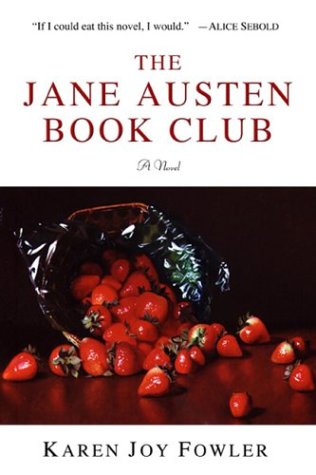
With Warm Bodies out of the way, you know now that the title does not refer to my reading Pride and Prejudice and Zombies again. My Jane Austen reference was to The Jane Austen Book Club, a novel  which covers the stories of five women and one man who get together once a month and discuss a given Jane Austen novel, each taking it in turn to host. As a guy who has read Pride and Prejudice, I thought it might be fun to see another fellow go through it. His responses aren’t all that remarkable. I hate to admit it, but this is the rare instance wherein a book doesn’t compare favorably to its movie  Admittedly, I saw the movie before reading the book, and in fact read the book after finding out it was the source for a money I thought hilarious. (The Austen-reading man is developed far better in the movie: he’s a riot: I screamed in laughter at the faces of the women as he, an SF buff, tried to compare the plot of an Austen title with the development relationship of Luke and Leia through the original Star Wars trilogy.  Great movie, all-right book: I might have enjoyed it better had I actually read more than one Austen novel. It made me feel guilty, actually..

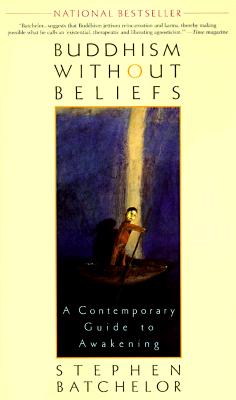
I also read Buddhism without Beliefs by Stephen Batchelor, which wasn’t as ferociously compelling as I thought it might be, possibly because I’ve taken Buddhism’s extrareligious applicability for granted for a few years now.  Batchelor treats Buddhism as a practice in response to certain realities, and invites readers on meditations to cultivate a sense of compassion within them. Batchelor’s philosophical explanations sometimes seemed like vague esoterica (the chapter on emptiness, for instance), others were eye-opening, like the section on no-self. He compared us to clay spinning on a wheel:  the thing that emerges is the result of a lot of actions acting in concert: the constituency of the clay, the pressure, the wheel; there is no ideal Pot that will suddenly materialize there. The same is true for us: there is no ideal Self floating around inside us, or out in the ether: we as beings are being constantly created by drives internal and external.

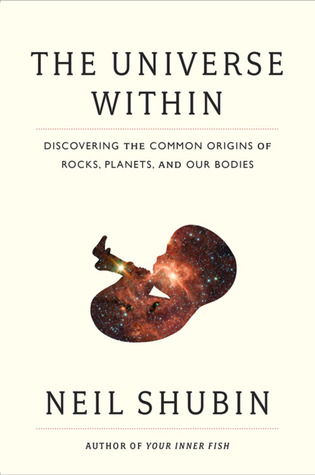
And on a final note, a book I need to re-read because it’s been a few months since I finished it:  The Universe Within reveals the profound connectivity of the universe, exploring the ways our biology has been shaped by astrophysics and geology. But it’s not actually about us: his account demonstrates how all of nature is bound together in cycles — water evaporating into the air, then returning as rain; sea crust being formed at ridges, and dissolved again in volcanic explosions —  and how no field of science can exist without connection to another. A rock can tell you about physics, chemistry, and biology.  Had the book been about the interconnectedness of the sciences, it would have been a triumph. It’s supposed to be about how these processes have shaped human beings, though, and the human connection is added in only tangentially at the end.

————————————————————-
Today I also received two books through interlibrary loan: Michael Pollan’s The Botany of Desire, which examines human-plant coevolution, and Garbage Land by Elizabeth Royte.  I’m looking forward to both:  Pollan is a weird author in that I’ll finish his books regarding them too problematic to recommend, and yet I never stop thinking about them. Neither The Omnivore’s Dilemma nor In Defense of Food are never far from my mind.

Look for more food books as the spring matures!

Posted in Reviews | Tagged , , , , , , , , , , , | 1 Comment

eaarth

earth: making a life on a tough new planet
© 2010 Bill McKibben
253 pages

Oh, we’re in trouble.  For two decades, forward-thinking politicians have made noise about climate change. “We’ve gotta do something to save the world for our grandchildren,” they say. But the consequence of our actions as a global society are no longer the future‘s problem. The future is here. We’re living on a new Earth, one considerably more unstable and less congenial to our kind of life than the one which has existed for hundreds of thousands year prior. This new Earth, which McKibben dubs eaarth, won’t be kind to us, or anyone else. Life as you know it is over, and the sprawling governments of Earth can’t possible adapt quickly enough. The good news is, there there are no solutions, there are ways to minimize the damage. After establishing how utterly up the creek we are, McKibben delivers an impassioned case for the revival of localism and citizen-led change.

Change will come regardless of our attitude, but we’re really not ready for the four horsemen of the developing climate catastrophe — pestilence, drought, flooding, and famine. We’re starting to run out of the energy we use to make changes, including the kind of changes responding to this new eaarth requires. This is doubly problematic considering how much we rely on petroleum, now peaking,  to keep our global food network going, trucking food hither and yon and processing it into all manner of fun things with unpronounceable ingredients.  Starvation isn’t imminent: it’s now. The amount of food per acre is decreasing, while the rate of malnourished is on the rise — and somewhere in the shadows of history, a vindicated Thomas Malthus laughs bitterly.

Chaos is going to be the new normal; we can’t fix it, we can only ride out the wave, but maybe if we start early enough we can find ourselves someplace worthwhile when all is said and done. In the second half of his work, McKibben offers ideas as to how we can keep people feed, maintain a functioning electric grid, and stay online.  McKibben advocates a more fine-grained approach: instead of having great big farms of monocultures, grow different kinds of foods everywhere you can, using ecology to work for your behalf: eliminate waste  by turning it into compost. Stop using gadgets that constantly drain power, and start generating your own by covering the roof with solar panels and turning streams into little hydropower plants. People all over, and especially Americans, have to start doing this because the national government is now completely dysfunctional beyond blowing up kids in Pakistan or spying on its citizenry:  the changes to be made have to be made by us.

eaarth is simultaneously alarming and invigorating.

Posted in Reviews, science, World Affairs | Tagged , , , , , , , | 1 Comment

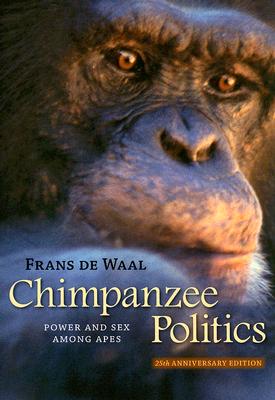
Chimpanzee Politics

Chimpanzee Politics: Power and Sex Among Apes
©  1983 Frans de Waal
256 pages

Back in the 1970s, primatologist Frans de Waal conducted one of the first extensive studies into the social structures of chimpanzees.  Chimpanzee Politics is the result,  establishing facts now taken for granted, namely that chimpanzee populations are organized by rank, which for males influences how successful they are are spreading their genes. It also illustrates their startling intelligence, both social and physical;  de Waal witnessed chimpanzees collaborating to overcome obstacles, like electrified wire wrapped around the base of a tree that could provide a bounty of food in leaves,  as well as engaging in Machiavelli-level manipulation to increase their status within the community. Admittedly, some of this is subjective, but only some, and de Waal’s ideas were confirmed by other researchers’ observations of different populations, like Jane Goodall’s Gombe Valley project.  Chimpanzee Politics makes for fascinating reading if you’ve an interest in our fellow primates:   de Waal’s work indicates that  leadership, even in a  sheltered environment like the zoo enclosure in Arnhem where he did his work — comes with responsibilities, like keeping order.  Alpha males haven’t simply brute-forced their way into the top of the sexing order; they’re seemingly expected to protect the weak against the strong and settle disputes.   de Waal also points out that leadership in a chimpanzee tribe isn’t limited to brute force: he demonstrates how an older, deposed chimpanzee was able to maintain a position of immense influence by continuing playing two young contenders for the seat of power off of one another. It’s rather like a game of Survivor, with less whining and more fur — and instead of being voted off, you get beaten senseless. de Waal’s study did have its limitations: the chimpanzees did not interact with other tribes, nor did they compete for food, so important aspects of the equation are missing.  He did compare his experiences with those of Goodall’s, however, and his general conclusions aren’t at odds with those she reached in Through a Mirror.

Related:

Posted in Reviews, science | Tagged , , , | 1 Comment

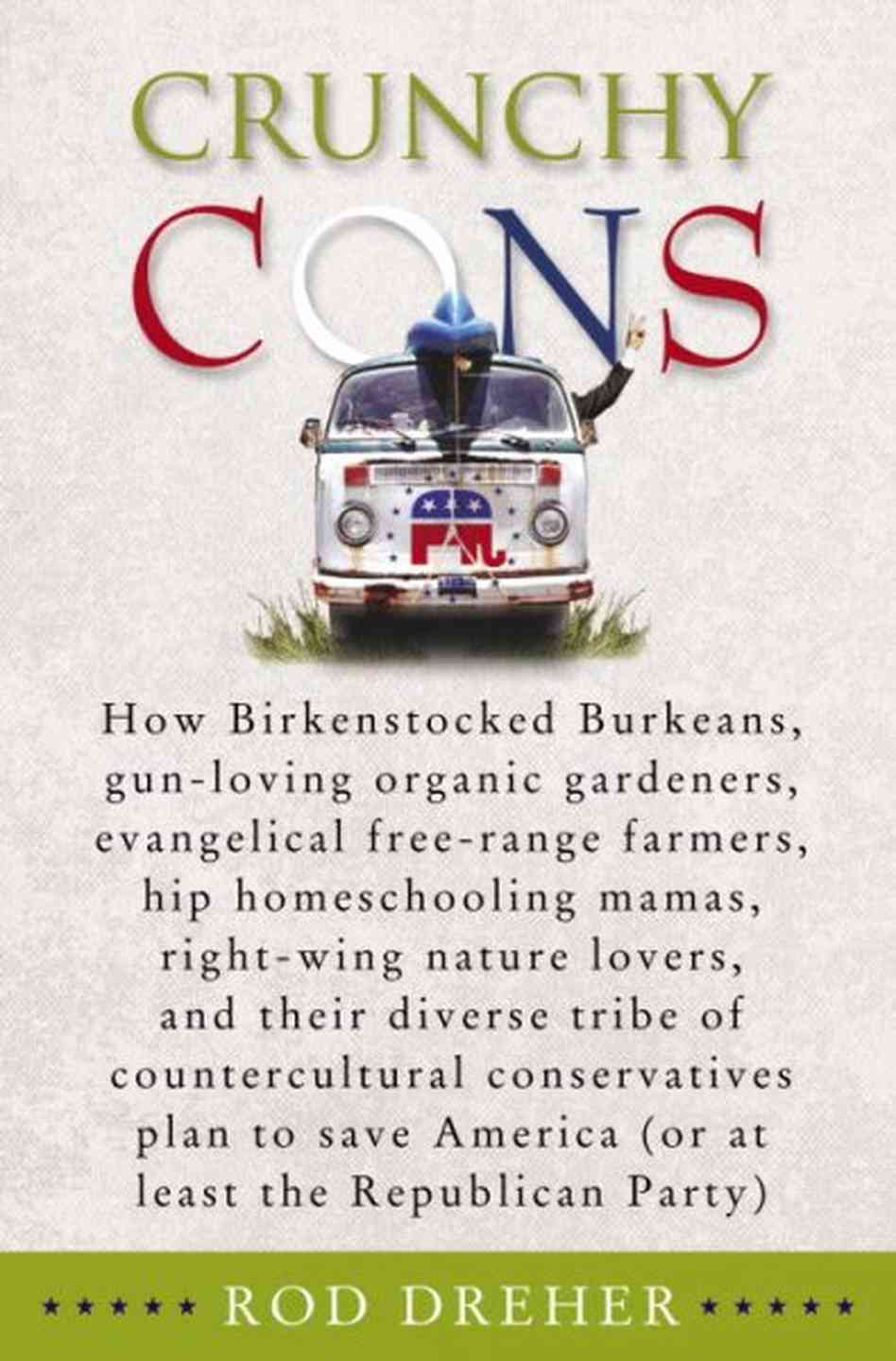
Crunchy Cons

Crunchy Cons: How Birkenstocked Burkeans, gun-loving organic gardeners, evangelical free-range farmers, hip homeschooling mamas, right-wing nature lovers, and their diverse tribe of counterculture conservatives plan to save America (or at least the Republican party)
© 2006  Rod Dreher
272 pages

Imagine a Republican who praised Jimmy Carter instead of dedicating a Two-Minute Hate to him. That’s Rob Dreher. In an age of bitter partisan rancor, it’s refreshing to encounter someone who looks beyond the asnine liberal-conservative divide and realizes that politics and values aren’t as simple as they tell you on the television. Alas, values are still simple to Dreher, who knows there’s still an Us and a Them; it’s just that the Thems and the Us’s sometimes swap sides.  The Us’s are those people on the left and right who seek a meaningful life and are prompted by their inner convictions to live differently than the mainstream; the Thems are those wretched modernists, the consumerists, the cafeteria Catholics, and the individualists who defy culture and brazenly think for themselves. (You know, because thinking for yourself makes you so mainstream.)

The title alone may give you a feel for the goings-on of crunchy cons. Various sections cover Dreher’s (who is the authority on who may be and who cannot be a Crunchy Con) thoughts on consumerism and technological dependence (bad), food (industrial food bad, CSAs awesome), homes (modern architecture bad — read Jim Kunstler), and religion (orthodoxy for the win). While the thoughts as expressed can be found in other books*, Dreher’s positions and criticisms are couched in the language of conservatism and traditionalism; he attacks agribusiness not on the grounds of social justice (as Eric Schlosser did in Fast Food Nation and Reefer Madness), but because he wants  to promote the rugged  old values of small farmers and promote self-reliance.  Dreher doesn’t attack consumerism because mindless consumption plays into the hands of the bourgeoisie, or destroys Mother Earth; his hostility stems from the fact that there’s more to life than owning stuff, and the idea of our being able to buy happiness is not only unhealthy, it’s impious.

Religion undergirds Dreher’s approach: for him, being a ‘crunchy conservative’ means living sacramentally; “viewing the physical aspects of life — the food we eat, the places we live, the world in which we move — as being inseparable from spiritual reality.”  Dreher’s aim in being a crunchy con is to live a meaningful life, and for him, religion supplies that meaning. The problem with mainline conservatism is that world changes too quickly for traditionalism-for-principle’s-sake to mean anything. Yesterday’s raging liberals are today’s  conservatives, because the status quo is a moving target. Dreher’s people stand out among  other conservatives by defining what they intend to conserve, instead of being content to resist change on principle. Hence, while most conservatives are fine defending relatively recent developments like automobile oriented sprawl, Dreher is still defending the old-fashioned, traditional, human-oriented cities that have now been embraced by progressives.

There’s a lot to like about Crunchy Cons, but there were a few too many flies in the soup for me. Like the authors of The Plain Reader, Dreher puts a lot of stock behind parents being the chief cultivators of their children.  And while I get the reason for concern — I, too, would prefer not exposing children to television for numerous reasons, the values it imparts among them —  as someone who was raised in a “conservative”, no-television household, I’m awfully glad I was able to view TV and other media from time to time that let me see the world beyond the prison walls of my controlled environment. I was able to compare my parent’s worldview with another, and figure out what I wanted out of life. This obsession with controlling children, witnessed in both The Plain Reader and in Crunchy Cons, and displayed in the authors’ hatred for public schools and media, strikes this escapee as sinister and unhealthy. Your values mean nothing if children cannot grow into adults who can make a choice. And therein lies the rub with Dreher’s work, for as much as he advocates choice in other areas — people should be free to run small farms, instead of being forced to play by agribusiness’ rules; people should be freed from compulsory education, raising their children whatever way they decide; when it comes to belief, people should Learn their Place and believe what they’re told. Tradition is God, and if you think you can modify it you are a degenerate loser who is responsible for the imminent destruction of humanity.

At times, Crunchy Cons was an eye-opening delight. Like The Plain Reader, it demonstrates how people can lives of purpose and value amid the noise of an entertainment-obsessed world.  The author’s contempt for those who do not seek more meaning, however, and his anti-human belief in the primacy of tradition, left me feeling sick. The Plain Reader was a far better example of a conservative counterculture, and though problematic in ways, it was far gentler.

*In Praise of Slow, The Omnivore’s Dilemma, Fast Food Nation, The Geography of Nowhere, Technopoly, Amusing Ourselves to Death, To Have or to Be, American Mania, and Bowling Alone.


Posted in Reviews | Tagged , , , , , , , , , , , | 7 Comments

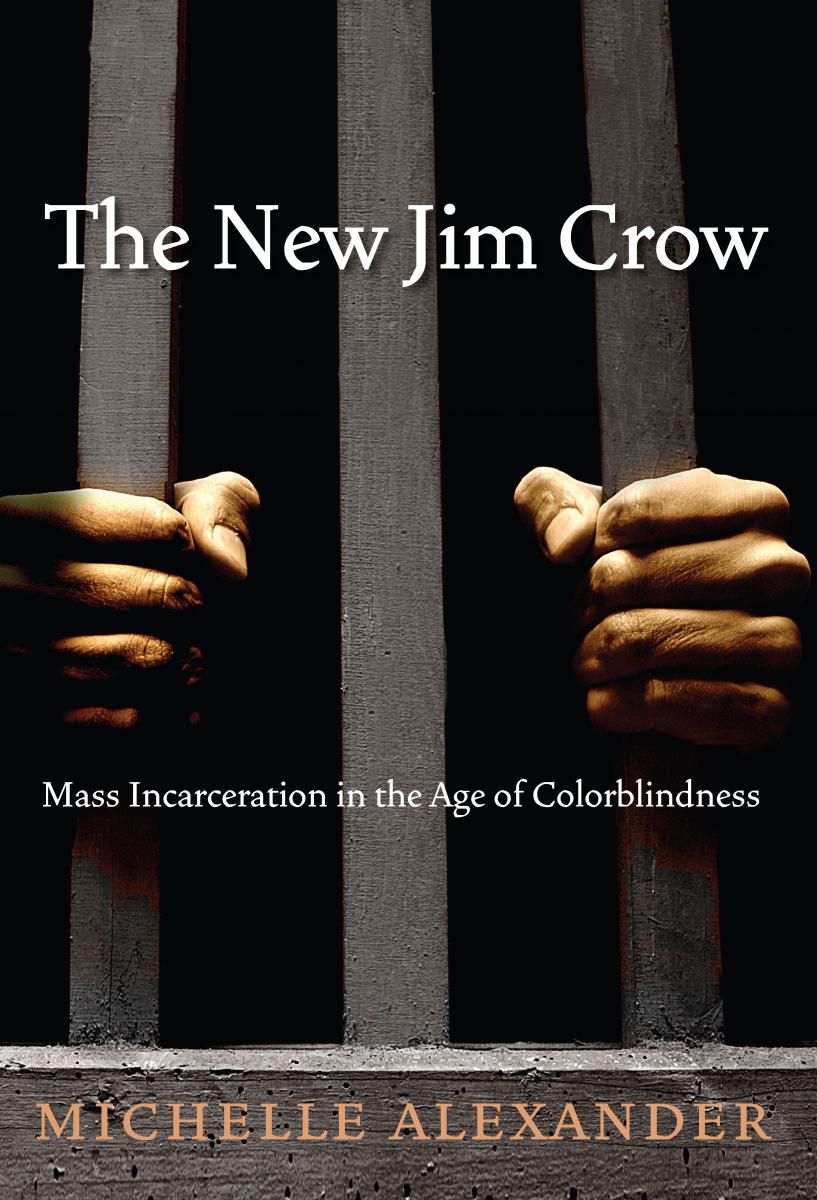
The New Jim Crow

The New Jim Crow: Mass Incarceration in the Age of Colorblindness
© 2010 Michelle Alexander
290 pages


            In The New Jim Crow, Michelle Alexander argues that the United States’ drug laws, coupled with its law enforcement and penal cultures, have ushered in a new era of discrimination, segregation, and 2nd class citizenship for  African Americans.

            In building her case, Alexander first demonstrates how law enforcement practices have become increasingly abusive, both physically and of the law. She then scrutinizes the penal system as a whole, revealing how dramatically the ranks of the imprisoned have swelled since the declaration of the drug war. That war is waged not against the manufacturers of narcotics in South America, but against their users; the streets and homes are the battlefield, through which the police storm through in full riot gear.  Next, she elaborates on the traumatic consequences of being touched by the penal system; a mistaken arrest, not even a conviction, can haunt an individual for life, ruining their ability to find work and housing both on the market and through government assistance. So much as touching a joint can warrant an individual being thrown into a sinkhole of self-perpetuating despair and poverty.

            Although each point is condemning on its own, throughout the text Alexander emphasizes the disproportionate way they impact African-American families. The police kick down the doors of black apartments, not white suburbs, even though drug use is statistically the same across ethnic lines. Blacks, not whites, are most subject to arbitrary traffic stops and unconstitutional drug searches. The result of these policies and practices is that African-American families and communities have been destroyed: millions of black men are in prison, and millions more unable to build a life for themselves through honest toil after having been branded a criminal. The chief weakness of her approach is that drug use is voluntary, something Alexander counters only with pointing toward the double standard which exists wherein blacks are punished hard for the same crime that whites are ignored for violating. (This is a a valid point, to be sure, though it doesn’t seem quite the match for countering the criticism.)

            The old Jim Crow separated blacks from whites, relegating them to the sides or beneath the status of whites, through segregation and disenfranchisement. Although law enforcement and penal practices were not arranged deliberately against blacks like Jim Crow, the effects of the two sets of laws, Jim Crow and drug war, are strikingly the same:  the act of being discriminated against by agents of government strangles any notion of citizenship among black youth in the cradle, while destroying their ability to create a life and stable family for themselves and become constructive members of society.The New Jim Crow exposes the lie that discrimination is a thing of the past;  bigotry and abuse are plainly rampant. The work stands as a penetrating criticism of the United States’ prison system, which as much a stain on its human rights record as Jim Crow or slavery. This is one well worth reading.

Related:

Posted in Reviews | Tagged , , , , , , | 1 Comment

The New World

A History of the English-Speaking Peoples, Volume II: The New World
© 1956 Winston Churchill
400 pages

Shortly before the eruption of the Second World War, Winston Churchill was busy at work authoring a history of the English and American people, of which this is volume II.  Although one might think The New World is set in North America, the new world here is one of political culture, not geography. To be sure, this volume is set in in the Age of Discovery, and there is a section on the first few English colonies…but this work’s primary focus is charting the transformation of England from a strongman monarchy into a constitutional government largely run by Parliament. Not coincidentally, Churchill also tracks the effects of the reformation on English religion; here we witness the break from Rome, the birth of the Anglican church, the rising of Protestant sects like the Puritans, and the tension between all three that would lead to wars, a dictatorship, and the happy departure of the Pilgrims to America, where they could ruin a whole new continent with their raging dislike for life. As mentioned prior, Churchill is a traditional historian,  completely focused on the king and the leaders of Parliament. Most people exist to do the ruler’s bidding (the soldiers of the New Model Army) or to be put down by a good ruler (the Chartists, Levellers, and Diggers).  Despite this, it’s fairly entertaining because Churchill so unabashedly throws in his own opinions, never missing a chance to commend his ancestor Winston Churchill or to get in a few digs at the dig-worthy Oliver Cromwell.

I may read another volume of this series eventually; I’m curious as to how he handled the American Revolution, and I’m told his coverage of the American Civil War is commendable.  Besides that, reading the work in his voice amuses me to no end.

Posted in history, Reviews | Tagged , , , , , , | 1 Comment