Pride and Prejudice and Zombies

Pride and Prejudice and Zombies
© 2009  Seth Grahame-Smith
319 pages
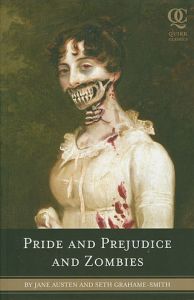
Pride and Prejudice and Zombies is the old story of girl meets boy, girl declares boy to be Worst Man in the World and humiliates him, girl and boy fight off horde of drones from hell together and decide the other’s alright after all. And there’s dancing, lots of dancing.

Hearing about this book some many months ago scandalized me at first. The idea of modern people, taking a Classic and sullying it with their infantile obsession with monsters and sparking vampires! — and yet after I read the  Classic, the idea of Elizabeth Bennet dispatching zombies with a musket was too good to pass up. (It was a bit silly of me to defend the honor of a book I hadn’t read, anyway.) Pride and Prejudice and Zombies is in a word, hilarious, largely because the author has managed to take most of Austen’s text and set it against a completely bizarre background, one in which England is suffering under a prolonged plague of zombies.  The dead refuse to stay properly buried, and insist on shambling around trying to nibble on people’s heads — and being bitten can cause the transformation of the living into the undead.  In this world, families who can afford it send their sons and daughters to the East to learn martial arts, and children spend their time learning musketry instead of the pianoforte.

The woes of Mother Bennet in trying to marry off each of her five daughters are now complicated by the fact that every trip into the countryside between homes is perilous  attacks on  carriages by zombie bands are common, and solitary travelers are suicides. It’s not as if she’s rich enough to support a security force of ninjas, not like Lady Catherine de Bourgh.

Those who have seen the Leonardo de Caprio version of Romeo and Juliet may have been amused, as was I, by the combination of Shakespearean language and modern scenery, wherein the Capulets and Montagues fight not with swords in a plaza, but with pistols at a gas station.  That kind of contradiction is here: the archness of Austen’s writing and the dignity of her characters stand against the absurdity of zombies and ninjas. For the most part, Grahame-Smith makes subtle adjustments: Mr. Bennet is cleaning his musket while Mrs. Bennet prattles on, Mr. Darcy admires Elizabeth’s martial poses rather than her piano playing, and so on. He also adds to the plot; characters in general are much more aggressive here, with Mr. Bennet and Darcy both threatening violence against chatterbox women who won’t leave them alone.  Some alterations are more substantial, like the fates of Charlotte, Mr. Collins, Lydia, and Wickham. At its best,  the tension between Austen and Grahame-Smith is wildly funny, as when a ball is interrupted by a zombie attack and Elizabeth’s impulsive plan to follow Darcy outside and kill him for insulting her (it’s the warrior code, doncha know) falls apart.  Other times, it’s a bit too absurd.The Bennet sisters being warriors, renown for their expertise in slaying the walking damned, that’s hilarious — (“Girls! Pentagram of Death!”). But ninjas? That’s just silly. At its worst, Graham’s brief additions can be gratuitously vulgar:  one character becomes lame and incontinent in the course of the story, and the humiliation of their constantly soiling themselves becomes a running joke for the final third of the novel — a tasteless display which dampened even my enjoyment of the Epic Duel between Lady Catherine and Elizabeth.

I would have like Pride and Prejudice and Zombies a lot more were it not for the toilet humor.  The zombie plague almost makes the book like a western, with lots of action and the wilderness being a dangerous, hostile place.  Unlike in the original novel, here the blue-blooded characters have use: they’re not sitting around gossiping, they’re out defending the realm against the ‘sorry stricken’. And the invisible ‘other’ characters, the legions of servants  and laborers who were nonexistent int the original, make quite a few appearances here. Usually they’re beating eaten, but they’re there.   I don’t know that I’ll be reading any more of the “Quirk Classic” series, but this is definitely a work I’ll remember, and it met the yearning in me for more of Pride and Prejudice.

Posted in Reviews | Tagged , , , , | 3 Comments

Reads to Reels: Pride and Prejudice

Pride and Prejudice has been subjected to several dramatizations, but the 2005 movie starring Kiera Knightly is my first.  I only finished the book a day or two before watching the movie, and indeed looked for the movie because I wanted to experience the story again — and it was a success in fanning the flames of my enjoyment.  Liberties are taken, of course: quite a few lines are added, and areas of the book are squished. The scene in which Mr. Darcy is rebutted by Jane is a prime example. After he declares his love and proposes (woodenly so, an exception to most of the scenes), Jane  refuses him and then tells him why, in no uncertain terms. In the novel, Darcy sends a letter to answer her condemnations of his character, but here he tries to argue with her. The letter is still used, but doesn’t dump as much information at once.  The letters in general are integrated into the story well, with the most potent bits being used as narrative, read aloud by one character during transition scenes — like a carriage ride between estates. Lydia’s transgression is truncated: the family learns she’s run off and is shacking up with a dandy, they’re scandalized, and the next moment they receive word that she’s married, and all is well. The tension should have been stretched out a bit there, I  think.

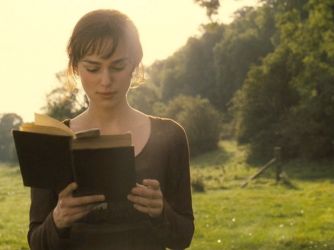
Visually and musically, this is a most attractive film. Jane and Elizabeth Bennet are supposed to be right beauties, and the casting captures that. Elizabeth’s first scene charmed me immediately:  little can match the allure of a woman walking through a beautiful countryside, caught up in a book. Mr. Darcy is a bit rough around the edges for a polished blueblood, always tromping in from fields with a five-o’clock shadow.  The music is wonderful, from a piano piece that echoes throughout the film to the ballroom dancing scene. I’m biased, of course: dancing always captivates me, and if a period movie involves it, the dancing scenes will rank among my favorite — as they did in the Patrick Stewart version of A Christmas Carol.  The only negative point for me was the spottiness of Matthew Macfadyen (Mr. Darcy)’s acting: although his character is supposed to be emotionless and reserved, when Darcy makes his anguished declaration of love, he sounds…bored. Fortunately that’s quickly forgotten when he’s memorably rebuked by Jane.

A memorable and fun movie — definitely a keeper for me.

Posted in Reviews | Tagged | 1 Comment

Booking through Thursday: Bibliophilia

This day, Booking through Thursday asks….what do we love most about reading?

In picking up a book, I can throw back the curtain of time and communicate with a person long dead. My mind can engage with their arguments, study their convictions — connect with their soul, as it were. This is just as true in reading a novel as reading a philosophical or scientific treatise.  To read is to explore, to contemplate, and there’s no thrill like reading words penned centuries ago and having them resonate just as if they were being spoken by someone living right now, in our present circumstances. Regardless of how drastically we alter the world around us, the human experience at heart doesn’t really change, and there is strength to  be found in communing with the ages, as we can through books.

Posted in General | Tagged | 7 Comments

The Seven Wonders

The Seven Wonders
© 2012 Steven Saylor
332 pages

A few years ago, I read through the Roma sub Rosa series in which a first-century Sherlock Holmes named Gordianus the Finder made his living investigating murders and other sundry mysteries which were in great supply during Rome’s transition from republic to empire.  The Seven Wonders marks the return of the Finder, or rather his beginning as a freshly-togaed young man touring the world with his tutor, Antipater of Sidon — a poet who fakes his own death, and not just to get out of town. Although Gordianus will encounter mysteries in every city he visits, the greatest intrigue is in his own camp. The stars of The Seven Wonders are the wonders themselves, as Saylor’s story is a fictional travelogue of the ancient world. Today, of course, only one of the “Seven Wonders of the Ancient World” remains standing, the Great Pyramid. The others have been lost to natural disasters or human neglect. In Gordianus’ day,  most of them dominate the landscape of their cities. The Colossus of Rhodes has already fallen from earthquakes, but even partially submerged it’s magnificent — and the Hanging Gardens, though largely a pile of rubble, are a very impressive pile of rubble protected by the staggeringly beautiful Ishtar Gate. Gordianus invariably arrives in each city just as something special is going on: the Olympics, for instance, or a fertility festival.   The Seven Wonders is a cultural tour of the classical world punctuated by death, theft, and skirt-chasing. (Gordianus was a responsible family man in virtually every other Roma sub Rosa series, but here he’s young, knows no fear, and is randy as a goat in springtime. He even manages to be seduced by a goddess while sleeping in the Great Pyramid.)   I daresay the novel is more enjoyable for the setting than the actual mysteries, since most of the time the reader is kept clueless until Gordianus reveals what he’s been noticing and mulling over without letting the reader know. Had the work been longer, the mysteries might have been more enticing — but 300 pages is brief considering the scope of his travels.

The Seven Wonders is enjoyable enough, though nothing on the order of Roma or Empire.

Posted in Reviews | Tagged , , , , | Leave a comment

Pride and Prejudice

Pride and Prejudice
© 1813 Jane Austen

Pride and Prejudice is the old story of girl meets boy, girl declares boy to be Worst Man in the World and humiliates him,, girl’s family is saved from social and financial ruin by boy and she decides he’s alright after all. And there’s dancing, lots of dancing.

It’s more serious than that, of course. Pride and Prejudice has “~Classic~” status, which means it’s a book you’re liable to have been assigned in school, and which literate people expect you to have read. I’ve never explored the world of Austen, though, because – well, didn’t she write romances? But the 200th anniversary of the book’s publication passed recently, and since I’d been intrigued by descriptions of Mr. Darcy as a model for gentlemanly behavior, I decided to explore it.   Romance and marriage do dominate the story, which is largely one of the efforts of the main character’s mother, Mrs. Bennet, to get her five daughters hitched. But dashing young gentlemen are fickle,  and it’s so hard to imagine how plain Mary or silly Lydia could attract a man –  not to mention Elizabeth, who is stubborn and opinionated and not at all interested in settling for the first propertied fellow who wanders into the family estate.

Published in 1813,  Pride and Prejudice‘s language has all the frills and ruffles of a stylish hoop skirt. It’s a ball to read, but considerately more challenging than the simple staccato of modern prose. Spending time with Elizabeth Bennet is well worth the effort, however:  she’s a strong spirit, quick to speak her mind and stand up for herself against pompous individuals who try to belittle her for her sex or social status She’s wonderfully sarcastic to boot. Despite being praised for her keen intelligence, however, she’s easily contented with hearsay, and passes quick judgment on those she’s introduced to. The aforementioned Mr. Darcy finds her dismissal of him intriguing  and despite the fact that she’s less gently born than him, she ensnares his attentions.  She thinks him at first the worst snob she’s ever met, but he’s given competition in that category by other characters — like the boorish Mr. Collins, her pompous cousin who was born into poverty but who has become wealthy thanks to attracting the favor of an aristocratic lady — a lady who happens to be the aunt of Mr. Darcy.  The world of the landed gentry is small indeed.

Pride and Predjuce is a lovely story, full of grace and humor but sometimes difficult to take seriously, which may be deliberate.  Worrying about romance seems to be the chief occupation of most of the characters, who spend their days talking and their nights dancing. The work that produces the money they’re obsessed with is done by invisible Other People — the kind Dickens wrote novels about. I’ll definitely be tempted to read more of Austen, but first I want to poke my nose into Jane Eyre. But before that, I’ll be reading a book that’s very much like Pride and Prejudice, but with a  rather deliciously funny twist.


Posted in historical fiction, Reviews | Tagged , , , | 5 Comments

The Bloody Ground

The Bloody Ground
© 2001 Bernard Cornwell
398 pages

In the fall of 1862, Robert E. Lee took the initiative after a string of triumphs over the bungling Union army and launched an attack into the north, aiming to bloody the Federal army’s nose in its own territory and provoke the people of the United States into pressing for peace– for how many people would support a distant war against the south when the shells were falling in their own fields, with their own homes used as quarters for wounded soldiers?  Despite a record of impressive incompetence, McClellan managed to intercept Lee’s army on September 17th, resulting in the bloodiest day of combat in the entire war.  McClellan didn’t lose disastrously  and that for him was a triumph…but the victory owed more to the Union officers who found Lee’s battle orders wrapped around a few cigars not far from their lines — and The Bloody Ground is the story of how they got there.  The likely end of the Starbuck chronicles,  Bloody Ground is wet with death both triumphant and tragic.

‘Til now,  every battle involving Nathaniel Starbuck — who chased a girl into Virginia right as the war erupted and decided to fight for the south to anger his abolitionist father —  has been a victory for the Confederacy, largely thanks to McMilquetoast,  with some assistance from the stunning heroics of Starbuck’s company. Here the streak ends, though the Union victory owes more to the actions of secondary characters, especially Starbuck’s counterpart — his best friend Adam, who despite being the son of a southern aristocrat, fights for the north, and here becomes involved in the murky world of intelligence. Adam is a tragic character, far more sympathetic than Starbuck but so earnest that Cornwell prefers to punish him instead of reward him; rewards are for scoundrels and brigands in Cornwell’s world. But perhaps the scoundrels deserve the rewards more: Starbuck, after all, has to cope with being Enemy #1  to Washington Falcouner, who has seen fit to “promote” him to the leader of a punishment battalion known encouragingly as “The Yellowlegs”.

The Bloody Ground‘s intensity is fitting for the bloodiest day of the war, though combat takes a backseat to the espionage threads; there are spies everywhere, including a man pretending to be a southron in Starbuck’s ranks to avoid capture as a Union raider who, Iago-like, starts turning his company against him.  Considering that Starbuck’s company will be present in some of the battle’s bloodiest moments — the skirmish in the cornfield and the orgy of death that was the Sunken Road —  you’d think his life is in peril enough from the Union army, without adding murderous subordinates into the mix.  Starbuck is at his most likable in The Bloody Ground, though; while his motives for fighting may have been petty, he is admirably devoted to his comrades-in-arms, especially those scorned by officers, and a protector of underdogs. (“I am Starbuck, defender of whores!”)

Quite a fun read, but the ending is rather distressing. The bloodletting doesn’t stop with minor characters, and I’ll leave it at that. It seems a shame this series has been discontinued, but if Cornwell had to choose between Starbuck and Sharpe, I’m glad he chose Sharpe. Speaking of whom, I think I left him about to invade France…

Posted in historical fiction, Reviews | Tagged , , , , , | 3 Comments

Waiting on a Train

Waiting on a Train: the Embattled Future of Passenger Rail Service
© 2009 James McCommons
304 pages

You leave the Pennsylvania Station ’bout a quarter to four,
Read a magazine and then you’re in Baltimore!
Dinner in the diner, nothing could be finer
Than to have your ham and eggs in Carolina!
(“The Chattanooga Choo-Choo”, Henry Warden & Mack Gordon)

Since 2000, U.S. gasoline prices have more than doubled  Not coincidentally, since 2000, ridership aboard the country’s only nation-wide passenger rail service, Amtrak,  has risen 49%. In 2008, in the middle of an as-yet-unbroken sting of nine consecutive record-breaking years, James McCommons traveled  the length of Amtrak’s many varied routes to gauge the state of the nation’s passenger rails. In the wake of an ostensibly transit-friendly president being elected, and in anticipation of some stimulus money being applied toward improving rail infrastructure,  such a journey seemed timely. Chatter about rails is on the rise, and in Waiting on a Train, McCommons offers a sober — sometimes bleak, sometimes hopeful — evaluation of the passenger rail services in America, and advice on how restore a largely abandoned service.

There was a time when railroads were the default means of extensive travel for most Americans, every city and town of consequence linked in a network that covered the continent.  A casual glance at the Amtrak map now reveals how drastically the situation for passenger rail has declined: although the northeastern U.S., Chicago, and west coast  are seemingly well-covered,  the majority of the nation receives scant services, and some states none at all.  Throughout his yearlong journey, McCommons explains how this came to be: public distrust of the railroads as large, corporate entities, coupled with enthusiastic popular and governmental support for the automobile and airports relegated them to the sidelines, where stifling, archaic regulations drove them into moribundity until they sloughed off the need for passenger service and focused on freight.  Passenger service became the exclusive domain of Amtrak, a queer public-private corporation that was given access to the freight’s rails…or was supposed to have been.

As McCommon’s account shows, passenger service is very much the “red-headed stepchild”  of American railroading. Although the rail companies, now purely freight-haulers, are obligated to let Amtrak use their lines, freight is given priority more often than not. Time and again, McCommon’s ride is driven into the sidings to allow freight trains to pass them. (“Make way for the cheap crap for Wal-Mart!” said one conductor, disgusted. European passengers were utterly aghast at the concept.) With demand for both freight and passenger services on the rise, limited infrastructure is a worsening impediment to expansion. Not only did railroad companies throw away hundreds of miles of lines in the 1970s in a leanness effort, but many current lines were built for an older generation of slower engines, and their curve ratios can’t take speedier modern trains…and especially not the bullet trains which some rail advocates seem to think is the only kind of rail it is possible to enjoy. But the greatest problem is the scantness of the network itself, which a recent article from The Atlantic demonstrates nicely.

The good news is, despite of the weaknesses of the system, in spite of the work that needs to be done,  the situation can’t help but improve. A new generation of officials and service professionals are running Amtrak these days, and they’re notformer freight employees who regard passengers as problems to be endured. Even if President Obama conforms to the longstanding Democrat tradition of giving trains lipservice and then ignoring them, states are beginning to take their rail systems into their own hands – and while that’s almost just as well, because local officials know their needs better.  Ultimately, though, McCommons believes restoring passenger rail service will require a substantial investment from the federal government, because the revival of passenger rail will depend on a network that serves the many, that reaches a multitude of destinations – not just one limited to parts of the coasts and Chicago. Forget profitability, McCommons writes; accept that passenger railroads are an investment in the future, a foundation to build around and not a revenue-producer by themselves. Unfortunately, that’s an argument we hear from the highways, too, and these days making investments without some idea of the returns isn’t going to sell well. What will sell well is the fact that since heavily subsidized highways and airports also don’t generate profits , we’re better off with the transportation option that loses the least money – trains.  Future rises in oil prices will help, as well.

 Waiting on a Train is part travelogue, part citizen-advocacy, but a travel tale wherein our guide gives more attention to the means of transportation than the landscape – except when he combines them by reminiscing about how lovely the Rockieslooked from the dome-covered observation cars of old.  For Americans  with an interest in reviving passenger rail in the United States, Waiting on a Train is a solid beginning, sizing up the system’s current strengths and weaknesses and at the same time giving rail romantics like myself an appreciation for the practicalities of rail transportation; it is a lesson in railroad logistics. 


Posted in history, Reviews | Tagged , , , , , , , , | 4 Comments

Walkable Cities

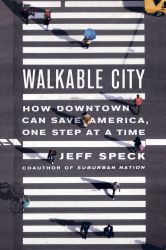
Walkable Cities: How Downtown Can Save America, One Step at a Time
© 2012 Jeff Speck
312 pages

  For most of human history, cities were limited to the area that people could cover on foot within a day, but the advent of railed transportation and later cars expanded our range, and cities grew enormously, far beyond pedestrian access. In the United States, where most cities were young or as-yet unformed, the automobile effectively created them in its image, to its scale, resulting in vast urban, decentralized urban areas wherin auto transport was assumed to be the norm — and was, in fact, the only viable means of transportation.But those were the days of cheap energy, of abundant petroleum being used by a minority of the world.  While the 1970s oil crisis prompted European cities to retreat from auto-dependency, supporting instead cycling and passenger rail, the United States was ‘lucky’ enough to find new reserves…and dig itself a deeper hole.  But today, the prices at the pump aren’t being inflated by a cartel: they’re being driven, instead, by the world’s ever-burgeoning thirst for oil, and its ever-real scarcity. The ‘changing energy reality’ of the 21st century demands a response. For Jeff Speck, city planner and architectual designer, the best adaption is the restoration of the walkable city, and in his first solo release (Walkable City), he timidly explains why walkability is important before more boldly laying out a ten-step path to human-scaled communities.

Although Walkable City eventually proves a work with muscle, it doesn’t start out that way.  Speck introduces the book by explaining that it’s not the next great piece of urban criticism. The arguments have already been made, he writes: what Americans lack is application. Perhaps for that reason, the section on the why of walkability lacks teeth; instead of championing as the path to municipal solvency (or better yet, dependable prosperity), a solid approach given how concerned Americans are with financial strain, he lists three reasons: walkable cities are green, good for your health, and hip.  He borrows from David Owen’s The Green Metropolis for the section on cities’ environmental advantages, of course, and that’s a superior read for the why of walkability. Speck shines in execution, though.

How do you make a city walkable? First, check the forces that destroy it — rein in the cars, promote mixed-used development, and for the love of all that is holy, stop building so many parking lots.  These set the stage: they are the foundation from which everything else can spring, although Speck doesn’t stress the importance of mixed-used development nearly as much as I’d expect from someone who coauthored Suburban Nation; that section is positively anemic. Speck then stresses that incorporating other modes of transportation, like transit, are crucial. The section on the integration of trolleys into the urban fabric is one of the best in the book, in my option, because Speck doesn’t see them as an magic if-you-build-it-they-will-come creator of walkability, but a fertilizer that allows downtown areas to flourish.  Some of his steps are less material, and more aesthetic  like making streets “Places”. That will sound familiar to anyone who has read Jim Kunstler, or even The Great Good Place, but aesthetics also have material values. Streets lined with trees,  for instance, not only look appealing, but the trees make the street safer by calming traffic and provide pedestrians relief from the heat,  although they do expose them to the occasional peril of nut-throwing squirrels.  Chuck Marohn opined in Building Strong Towns that in certain instances, solutions to our cities’ fiscal problems weren’t possible: nothing can be done to save some places completely. What we have are opportunities for rational responses, and Speck takes this view as well,  advocating for urban triage, picking winners and letting some areas wither away.

Walkable Cities is a book to remember. The slow beginning is disappointing: this is a good book that could have been great. It could have been what Speck claimed from the start it wasn’t, the next great book on American cities. As it is, Walkable Cities is a solid hit, distilling a lot of literature into one short and punchy work. (Among the books cited: the Holy Bible of urbanism, Jane Jacob’s The Death and Life of Great American Cities; Donald Shoup’s The High Cost of Free Parking; Jeff Mape’s Pedaling Revolution; and Tom Vanderbilt’s Traffic). Just as Suburban Nation was a fundamental book for understanding the problems of American urbanism, Walkable City is its complement, a comprehensive citizen’s guide for advocacy,  giving people an idea of what measures they can work to effect on the local scale. Bit by bit, neighborhood after neighborhood, Americans can restore their urban fabric and create a nation of strong towns.

Related:

Posted in Reviews | Tagged , , , , , , , , , | 3 Comments

Home from Nowhere

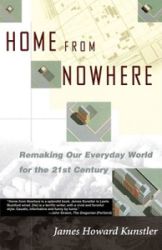
Home from Nowhere: Remaking Our Everyday World for the 21st Century
© 1998 James Howard Kunstler
320 pages

“History doesn’t believe anybody’s advertising.” (p.1)

James Howard Kunstler penned The Geography of Nowhere in an attempt to answer the question: why is America so obscenely ugly? His answer came in the form of a cultural history of the United States, one that introduced lay readers to urban planning and enticed them with its relevance to their lives, not to mention Kunstler’s playfully vicious style. As much ground as it covered though, and as hilariously as Kunstler excoriated suburban sprawl and modernist building, he offered no solutions to the problems he detailed, except for the hope that oil would peak and destroy the entire rotten system. Home from Nowhere follows in Geography’s footsteps,  demonstrating how communities can be restored and are being restored– and elaborating on why he is hopeful for our future.

Home from Nowhere is less a book in its own right, and more a continuation, or a fulfillment, of The Geography of Nowhere. It begins by repeating Kunstler’s basic criticisms of the unraveling of America’s urban fabric, detailing his beef with the suburban sprawl which replaced traditional cities.  Kunstler’s perspective is different than that of Chuck Marohn (Strong Towns) or Andres Duany (Suburban Nation). While those authors focus on sprawl as a financial loser, Kunstler examines planning from a more humanistic perspective, probing into how traditional and planning both effect us, as people. Crucial to Kunstler’s view of urbanism is a sense of “place”. Traditional neighborhoods and cities have this sense of place: they have clear centers and edges. They can be defined. Sprawl, however, is a seemingly endless  and stultifyingly homogenous expanse of asphalt and neon — a desert of concrete that engenders feelings of lostness and despair in those trapped in it.

Home builds on Geography first in providing ample illustrations — not photographs,but attractive and elegant sketches which demonstrate architectural or planning concepts (like symmetry and proportion) or by depicting streetscapes and homes which can be emulate. Some chapters elaborate on the problems which inhibit the restoration of American urbanism, like real estate taxing policies (“A Mercifully Brief Chapter on a Frightening, Tedious, but Important Subject”) that discourage the erection of fine buildings and promote instead the conversion of downtown into parking lots. The remaining third of the book is dedicated to covering the travails and triumphs of not only new urbanist planners like Andrues Duany and Peter Calthorpe designing communities, but concerned citizen-politicians who have been laboring to effect changes in their own cities, restoring traditional neighborhood development. Part of Home is a response to the criticism of new urbanist projects that most of them have consisted of greenfield development — new development far from city cores, in effect creating much better suburbs but suburbs all the same.  Working within existing cities means constantly struggling with minds locked into old thinking. This argument is dated now, of course: since the bubble burst in late 2007, the new urbanists have been focusing on infill, on reactivating dead spaces inside cities. The wind is blowing in the direction of urban restoration, and Home from Nowhere chronicles its beginning.

Although the recap of The Geography of Nowhere means that Home could be read by itself,  Kunstler argued so well before that the first third seems watered down in comparison. The encouraging work he reports on is a welcome addition to the jeremiad-like Geography, though, and recommends itself to those concerned about the shape of America’s cities. Kunstler’s own personality imbues the narrative with strength: he’s an interesting man, pining for a lost world of decorum, virtue, and grace and wanting to see it restored — first through the built environment.

Posted in Reviews | Tagged , , , , , , | Leave a comment

Teaser Tuesday (29 January)

Teaser Tuesday is a weekly event in which particpants share excerpts from their current reads. Play along at Should Be Reading!

Now we aim — after some work — to connect in the reader’s mind, with a single thread, elements seemingly far apart, such as Cato the Elder, Nietzsche, Thales of Milteus, the potency of the system of city-states, the sustainability of artisans  the process of discovery, the onesidedness of opacity, financial derivatives  antibiotic resistance, bottoms-up systems, Socrates’ invitation to overrationalize, how to lecture birds, obsessive love, Darwinian evolution, the mathematical concept of Jensen’s inequality, optionality and option theory, the idea of ancestral heuristics, the works of Joseph de Maistre and Edmund Burke, Wittgenstein’s anti-rationalism, the fraudulent theories of the economics establishment  tinkering and bricolage, terrorism exacerbated by death of its members, an apologia for artisan societies, the ethical flaws of the middle class, Paleo-style workouts (and nutrition), the idea of medical iatrogenics, the glorious notion of the magnificent (megalopsychon), my obsession with the idea of convexity (and my phobia of concavity), the late-2000s banking and economic crises, the misunderstanding of redundancy, the difference between tourist and flaneur, etc. All in one single — and, I am certain, simple, — thread.
How?

p. 20, Antifragile: Things that Gain from Disorder, Nassim Nicholas Taleb.

Posted in General | Tagged | 3 Comments