The New Faithful

The New Faithful: Why Young Adults are Embracing Christian Orthodoxy
© 2002 Colleen Caroll
320 pages

 Every action produces its reaction, and to Colleen Carroll decades of religious liberalism have born their fruit in the form of young people flocking back to conservative religious traditions, complete with smells and bells. One of the new faithful herself,  Caroll’s own views mingle with those of the Generation Xers she interviews:.  Raised in broken families, they are resacralizing marriage; burned out by one night stands and shallow relationships, they are embracing chastity;  frustrated by Pontius Pilate’s question, ‘what is truth’, they are sneering at relativism and declaring: the truth is whatever the Bible says.  The Youth Faithful mixes anecdotes and statistics, and despite being part of her subject matter, Carroll tries valiantly to be objective: some conducted interviews are with theologians and intellectuals critical of this trend ,and see it  merely as a reflection of the age-old defiance of the reigning generation by the young.

But what if that’s not the only motive? Even considering that the now-historic trend commented on here (this book is nearly twelve years old) may be being reversed (considering the surge  of people reporting as Nonreligious),what if these young people have motives which can open our eyes to the fact that society-as-usual isn’t providing something they want or need? No one here offers a real reason for  re-adopting old dogmas, beyond deferring to St. Augustine or C.S. Lewis, but the prevailing idea that all of reality is subjective is no doubt frustrating. Even if you believe it, who wants to? It rails against every instinct: something must be true.  Part of this conservative morality seems linked to the resurgence of the religious right in general in the 1980s, rather than being connected to a return to Orthodoxy.  The historic appeal of orthodoxy is touched on — there’s a sense of security in associating with long-established traditions —   as is the sense of order and peace that comes from daily rituals.  More importantly are the practical reasons for the reversal: Generation X grew up after a series of profound, society-changing movements had started to take effect. They grew up in an era of skyrocketing divorces and sexual license. They were the children whose homes fell apart, whose adolescent peers’ lives were ruined by the rise of STDs and early pregnancy.  They are the generation who first experienced these effects, and they are rallying against the cause of them – “liberalism”, used generically . More than anything, the people interviewed in this book are yearning for stability — stability in beliefs, in practice. They want a faith that can be counted on to guide them through the hard times. It’s worth pointing out, though Carroll doesn’t, that her ‘young adults’ are not so young: while there are college students here, many more are thirty-somethings with young families, and thus a heightened appreciation for morality and security are not too surprising.  It’s a lot easier to want to set the world on fire with change when you don’t have children of your own who can be burned.

The Young Faithful is a thought-provoking book, if grating by the end as a result of the casual use of ‘liberal’ as an attack word, which damages the general sense of professionalism conveyed by Carroll’s writing.  It is out of place in a more serious work like this.  Considering that current religious growth is in fact in ‘conservative’ branches of Christianity like Catholicism, the Church of Latter-Day Saints, Pentecostals, and the like, as opposed to the more liberal mainline denominations,  The Youth Faithful remains of interest despite its increasing datedness, if not wholly appealing.

Related:
Crunchy Cons, Rob Dreher. Dreher is a Gen-Xer who left the Baptists for Eastern Orthodoxy.

Posted in Reviews | Tagged , , , , , , , | Leave a comment

Taft 2012

Taft 2012
© 2012 Jason Heller
246 pages

In another world, William Howard Taft vanished from history after his presidential term. Rather than going on to become a Supreme Court Justice, he simply — disappeared. He became the world’s most famous missing man, at least until 99 years, whereupon he sprang up from the muddy  ground of the White House lawn, interrupting a press conference given by President Obama before being dutifully shot down by the Secret Service. Fortunately, when you weigh close to 400 pounds, you carry your own kind of bullet-slowing protection. Thus begins Taft 2012, a lightening-quick work of political satire which sees a stodgy lawyer from another era become an objection of obsession to a nation distressed by its disunity and eager to believe in anyone who can rise above the fray. Taft’s contempt for partisan or dirty politics makes him a man of the hour, a man whose broad shoulders bear the weight of a nation’s hopes and fears — from liberals who want someone who will really take it to Big Business, to conservatives who want someone who knows how to balance a budget. Taft 2012 combines the easy entertainment of temporal displacement (see Taft stare at biracial couples in astonishment, scarf down a Twinkie, be seduced by Wii Golf, complain about modern music, etc) with more serious cultural observations (television is alienating) and a political campaign centered on food and education. The author mixes a conventional narrative with excerpts from the world he’s created — news articles and twitter conversations about Taft, press releases from the Draft Taft element of the Taft Party — and the like. There are also pieces from an in-universe history of the Taft presidency, which draw allusions from history to the actions in the story. Within a matter of months, the Rip Van Winkle-like Taft goes from a national curiosity to a serious write-in candidate for the presidency. This is aided by the fact that a great-granddaughter of his, one Ms. Rachel Taft, is a popular independent legislator in her own right — but there’s more sinister workings afoot, and Taft truly comes into his own by novel’s end rather than being the man everyone pins their hopes on. This is fast, funny, and sometimes pointed. Most Americans will enjoy it

Posted in Reviews | Tagged , , , , , , | 1 Comment

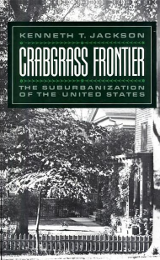
Crabgrass Frontier

Crabgrass Frontier:  The Suburbanization of the United States
© 1985 Kenneth Jackson
432 pages

For thousands of years, people lived in either the country or the city, but with the coming of the industrial revolution that changed, and especially in America.   Seemingly as soon as they were able, the wealthy and later the middle class abandoned the cities in favor of neighborhoods set in the country, first commuting into the city and then commuting to other areas outside it once jobs followed the wealth out of town. Why was the traditional urban form abandoned for the suburbs to the degree that it was in the United States, and not in Europe? In Crabgrass Frontier, Kenneth Jackson chronicles urban flight and the making of the ‘burbs,  establishing that Americans have an historic cultural distaste for cities,  inherited through England,  and have been trying to have the best of both worlds, city and country, at least since the end of the 18th century.  Wealth and technology first allowed a prosperous minority to establish separate country residences, and later government policy made ex-urban living the easiest choice to make, resulting in it becoming the cultural norm. Jackon begins detached and eventually waxes passionate as the suburbs’ success prove to be at the expense of the cities, but he’s never caustic.

The Revolutionary War was scarcely over before suburbs appeared on the American scene; even before horsecars, trolley lines, and the automobile, wealthy citizens of New York established their residences on the Brooklyn Heights nearby, and commuted by ferry.  While the borders of cities have historically been slums, home to necessary but despised industries like leather tanneries, in the United States cities came to be ringed by affluence.  Reasons for the wealthy leaving were varied, but a desire to get away from the city’s “problems” — the noise of industry and the presence of common working folk — ranked high. The simplest explanation, however, is that they could. The United States had more land than it knew what to do with. At first, living outside the city and commuting to it to work was the domain of the very wealthy, but the arrival of railroads allowed moderately wealthy persons to join in.  The trolley and the introduction of balloon-frame homebuilding made suburban living affordable for more people, and saw a manifold increase in the number of these communities. This was not the beginning of sprawl, however: even as they multiplied,  suburban communities remained distinct, walkable places.

It was the automobile which allowed suburbia to truly transform the urban landscape, extending the ease of complete mobility to the entire middle class. At the same time, government policies promoted suburban expansion, directly and indirectly, by promoting home ownership through subsidized loans and highways. Having lost the wealthy and middle classes, their tax base, cities deteriorated further, prompting even more flight. At the same time, home loan and insurance policies favored the suburbs heavily, stifling attempts by those in the city to improve or protect their buildings. These policies were at times openly racist, denying coverage or loans to whole blocks if a Jewish or black family were to move in.

Motivated by a cultural preference for country homes over city living, enabled by the widespread availability of open land –and technological innovations like the rail line and automobile which used that land as a broad canvas to draw an entirely new kind of urban landscape – and further encouraged by government support, the Americans thus became suburbanized.  The work, which Jackson introduces as an extended essay, ends with a reflection on where the suburbs are taking the American people. Built on cheap land, connected by cheap transport, and occupied by cheap buildings,  Jackson believes contemporary sprawl to be not worth much in comparison to the city, and points to trends in the 1980s which might signal a turning point.

Thirty years after the fact, we know that sprawl recovered from those hiccoughs, only for its tide to slow and reverse in the later years of the 21st century’s opening decade,  influenced by the financial crisis and the new normal of  high gasoline prices.  The Millennial generation has displayed a sharp preference for city living over the burbs, and car ownership is on the decline. As Americans begin to rebuild their cities and the civilization which they foster, this look back at what caused their disintegration will prove most helpful. This comprehensive history of suburbia not only establishes why American suburbs are so different from those from across the world, but delves into the full range of factors that led to their creation: cultural, technological, economic, and political.  Those wanting to understand the development of suburbia will find it a worthy guide,  especially for its less strident tone as compared to an author like Jim Kunstler.

Related:
The Geography of Nowhere, James Howard Kunstler
Suburban Nation, Andres Duany, Elizabeth Plater-Zyberk, Jeff Speck
Asphalt Nation,  Jane Holtz Keay

Posted in history, Reviews | Tagged , , , , , , , , , , , | 1 Comment

Uncommon Carriers

Uncommon Carriers
© 2006 John McPhee
256 pages

Uncommon Carriers invites readers to spend a day in the life of a truck drivers, ocean-going cargo ship and riverbound freight tugboat pilots, train engineers, UPS aviators, and — just for good measure — pleasure-canoers sailing the Concord and Merrimack Rivers.  Aside from the odd inclusion of his retracing Henry David Thoreau’s oar-beats, the work is part human interest and part-inside look into the transportation service that keeps the world of goods going round. Some sections are more useful to the latter end than others; his chapter on cargo ship pilots takes place at a training school off the coast of France, and communicates the difficulty of moving across something that has a mind of its own, but nothing about the business of commercial freight.  The chapters on river freight and UPS  more conducive to understanding the ins and outs of the industry.  What Uncommon Carriers offers besides that is the personal aspect of these jobs. McPhee’s research is all first-hand: he shares the lives of the men who do these jobs, befriending some and enduring the teasing of others. He’s especially fond of the truck driver who carries a chemistry book to help him wash his rig, judges truck stops on whether they carry his beloved Wall Street Journal, and who moonlights as a wordsmith. The account is peppered with many lively characters like him. On whole, this was quite an interesting peek into a world we depend on so much.

Related:
Ninety Percent of Everything: Inside Shipping, the Invisible Industry that Puts Clothes On Your Back, Gas in Your Car, and Food On Your Plate. Rose George

Posted in Reviews | Tagged , , , , , | Leave a comment

This week at the library: bikes, Greeks, stuff, and eeeeeevil

Dear readers:

September’s winding-down for me has been busy for me, and especially today. All three meals were taken with friends while out and about; it was a day filled with a country drive and a long walk through beautiful old neighborhoods in my college town, ending with a trip to the library and my exchanging one pile of books for another. I have good, sturdy messenger bag for the toting. This month’s haul:

  • Bicycle: the History, David Herlihy 
  • The Origin of Satan, Elaine Pagels
  • Greek Ways: How the Greeks Created Western Civilization,  Bruce Thornton
  • A Consumer’s Republic: the Politics of Mass Consumption in Postwar America, Lizabeth Cohen
  • The City in History, Lewis Mumford
  • The Box: How the Shipping Container Made the World Smaller and the World Economy Bigger, Marc Levinson
  • The Last Human: A Guide to Twenty-Two Species of Extinct Human, G.J. Sawyer & Viktor Deak

Reviews are pending for Uncommon Carriers and Crabgrass Frontier. I’m also considering reading Robert Harris’ The Fear Index, but now it’s competing with a book on shipping containers. It’s gonna be a tough call.

Happy reading, everyone!

Posted in Reviews | Leave a comment

Field Grey

Field Grey
© 2011 Phillip Kerr
384 pages

Bernie Gunther survived Hitler’s Germany and a Soviet prison camp, so when he’s forcefully detained by the American  Navy on the open seas and interrogated, he’s not too much impressed by their attempt at viciousness. Sure,  he had the bad luck to be traveling with an attractive lady who happened to be wanted by the American government for assassinating a cop in Cuba and fomenting revolution, but he’s had worse luck.  Back in the 1930s, he once saved the life of another cop killer who is now one of the most powerful men behind the Iron Curtain: Erich Mielke, head of the Stasi. Did I mention Gunther is a detective who actually doesn’t like cop-killers?  The US Navy would like to know why Gunther was running around the Caribbean with an assassin and a lot of money — and the Central Intelligence Agency is even more curious as to his association with the head of the Stasi.  Mockingly thrown into the very prison cell that housed Adolf Hitler, the man who destroyed his country and whom he hated, Gunther is made to tell his own story.

 Field Grey is a tangled political thriller set in  Germany as Hitler came to power and drove it to ruin, but set also in the Germany of the Cold War: a Germany divided by the victorious allies, now scheming against one another in equal measure.  Bernie Gunther is no Nazi, but neither is he a good communist or a reconstructed German: he’s a proud, jaded Berliner, and the story he tells is one calculated to guard his most precious secrets from the treacherously friendly Amis.  Field Grey impresses with its pacing; the plot moves forward steadily with a few bends here and there until a hairpin at the end: it doesn’t rely on confusing the reader to thrill. Although Gunther is your standard-issue world-weary cynical detective, he has a wicked sense of humor which he uses to good effect to irk enemies and allies alike.  Despite technically being a member of the SS (which absorbed criminal investigations), he’s sympathetic yet realistic:  not a Nazi, but not a knight in shining armor, either.  Field Grey is one of numerous Gunther novels by Phillips Kerr, which I selected to read first because it ranged through so many years.  It will not be the last! Look for this if you’ve an interest in detective mysteries, historical fiction, and Cold War intrigue.

Oh!  And there’s romance, naturally. Can’t have a detective story without beautiful women..

Related:

  • Fatherland, Robert Harris. Likewise a detective novel with a German lead,  this work is also one of alternate history, for it’s set in a Europe where Hitler is celebrating his 70th birthday,  presiding in triumph over Europe and a broken Russia, hoping to reach detente with the Americans. Unfortunately for him,  a murder investigation leads to the facts of the Holocaust being unearthed.
  • Garden of Beasts, Jeffery Deaver.  Gunther is a proud Berliner, claiming the city as his more readily than anything else, and Beasts is set in 1933 Berlin.  An American reporter shows up during the Olympics and realizes that Hitler is up to something other than building highways. 
Posted in historical fiction, Reviews | Tagged , , , , , , , , | 4 Comments

Home Economics

Home Economics
© 1987 Wendell Berry
192 pages

The term economics originally referred to household management, and to Wendell Berry, that’s what it should remain still. Home Economics collects essays on the meaning and relation of economy to human life. In it, he deplores the cancerous growth of massive, unwieldy structures like agribusiness, globalization, and the state which destroy culture, communities, and the land, reducing the human experience to economic inputs. He ruminates thoughtfully on the value of more traditional ways of life, and advocates for an approach which is much more finely-grained For Berry, the humane society is one built to a small scale, built on local economies wherein people, not institutions, are the primary actors, and where the relationships between people and the land are respectfully maintained.

Berry is a fascinating author. At first glance, he’s manifestly romantic and old fashioned, advocating for the same kind of agrarian  Republic of citizen-farmers that Thomas Jefferson yearned for. Though he’s grounded in the past, quoting freely from classical poets and the Bible life, he’s not mired by it: he does not despise cities as Jefferson and other agrarians did, and writes that if we wish to preserve the wilderness and farms, we must preserve our cities, too.  Though he doesn’t outline his reasoning, it may be similar to that of David Owen’s, who sees energy-efficient cities as the best hope for combating climate change. It’s certainly a better  hope than car-dependent suburbia, which Berry despises (however much a gentle and aging scholar-farmer can despise something).   Berry urges readers to consider a return to localism not just because it’s better for the environment (his veneration for which is religiously inspired), and not just because the new institutions are oppressive and destructive but because Nature has a way of correcting the unsustainable. That which cannot sustain itself will not: eventually it will fail. We will not persist living as we do now forever: our choice is in how and when we change.  In the hereafter, Berry writes, we may ask forgiveness for the crimes Nature has judged us for, but God has never shown any inclination to overturn her just sentences.

At times a warning, the vision of Home Economics is not dire.  In elaborating on the weaknesses of industrialized and globalized modernity,  he affirms that the ongoing desecration of human life and the planet will not long endure — and in articulating what was lost, he makes clear to modern readers what it is they miss without being able to describe; the bonds of family and community life, attachment to place, and the sense of a life of meaning and purpose. His holistic vision offers to restore those powers laid waste in getting and spending.

Related:
Folks, This Ain’t Normal, Joel Salatin. Salatin advocates some of the same ideas, at least in terms of farm ecology. He’s more cheerfully manic and provocative, though.
Desert Solitaire, Edward Abbey (on the virtues of the wilderness)

Posted in Reviews | Tagged , , , , , , , , , , , , | Leave a comment

The Working Poor

The Working Poor: Invisible in America
© 2004 David Shipler
352 pages


“Like my daddy used to say — ‘Son, life’s hell to pay for when you’re poor — cause  always just outside the door’s another Hard Time.'”    (Jerry Reed)

The United States is simultaneously one of the richest and poorest countries in the world, a land marked by both obscene waste and desperate poverty. Explanations vary as to the cause of the widening income gap; some blame a deteriorating culture, others globalized free trade, and still others maintain it’s a classic case of exploitation.  Poverty may be endemic to economics, but the great tragedy is tragedy’s juxtaposition with the American dream of success: work hard and you will prosper. Reality is more complicated than that. In The Working Poor: Invisible in America, David Shipler shares the lives of people who, despite long shifts, can’t get ahead.  They are black, white, Hispanic and Asian; some have lived here for generations, others are newly arrived immigrants. The reasons for their quicksand desperation are complex and varied: although many mire themselves in self-destructive cycles of behaviors, others are truly and continually ensnared by cycles of poverty — poor housing that leads to bad health that leads to spotty employment and debt that lead to poor housing.  It’s not as if they don’t try, but the odds are against them: even a small hiccup, an unexpected dilemma, can completely derail hopes of progress.

  Shipler’s work doesn’t propose any grand national agenda like the War on Poverty, and his account demonstrates how problematic proposed solutions have been so far.  Welfare offers intrusive, obtrusive bureaucracy and distorted incentives;  public education for impoverished areas is largely a failure, and while there are a great many incompetent teachers, whose talent is less about communicating with children and more memorizing what Has to be Taught,  the reality of poverty is that it isn’t just material. There’s a greater cultural poverty present that Shipler details as well: a loss of hope, of ambition. Some of the stories here are outright depressing in demonstrating how failure can run in a family, with unparented children growing up to have babies who grow up likewise unparented. They lack not just the data accumulated in twelve years of schooling, but ordinary life skills.  There are also hopeful stories, like the single parent who embraced poverty of the material kind by refusing to work two jobs, deciding that devoting time to her children, giving them the attention and instruction they need, was more important than a financial cushion.  Though raising two children on a single  wage was hard, her children were success stories who later escaped poverty.

The Working Poor is a valuable book, demonstrating that there is more to financial security than simply working hard — and more to insecurity than bad personal choices. Although Shipler is probably more sympathetic to the progressive, he’s by no means convinced that government can be a decisive solution here. His work illustrates how complex the problem of poverty is, communicating to the reader that it would take more than a money dump in one program or another. The problems of poverty — dismal education,  the costs of healthcare and housing, access to transportation, availability of jobs, the shattered status of a family life — are all connected, and there is no Gordian solution.  As grim as it can be, the book is girded with hopeful stories of struggle and resilience. Based on extensive interviews and Shipler’s own research (including  time spent observing schoolrooms), it’s as close to a comprehensive understanding of working class poverty as one will find without living it.

Related:

  • Nickle and Dimed, Barbara Ehrenrich. This is the author’s account of attempting to live on minimum wage in three different states, with little success. Her experience demonstrated many of the problems here (the costs of housing and expense of transportation, especially)  though family life was not an issue and she never had to deal with state welfare offices. 
  • Reefer Madness, Eric Schlosser, which also shone a light into the dirty business of migrant agricultural labor. 
Posted in Reviews | Tagged , , , , , , , | Leave a comment

Free to Choose, Born to Buy (and Left to Die)

In the past two weeks I’ve been reading a series of books which connected together despite being on disparate subjects. Milton Friedman’s Free to Choose, published in the 1970s, argues for a completely free market — that is, one with no regulations, tariffs, government licenses, public financing, etc. Friedman follows initial chapter on the power of markets with sections that compare the effects of government attempts to improve safety,  protect consumers against defective products, raise wages, etc.  Time and again he made good points about market efficiency,  but the general attitude advocated is extreme. Friedman is not nearly as extreme as other free marketeers: he respects the potential power of monopolies and advocates for free trade so that potential monopolies are always disrupted from outside, and  (staggeringly, for the 1970s) acknowledges environmental hazards.  Although I’m often tempted to agree with him on principle, in practice caution is warranted. While Friedman is correct in pointing out that people who buy defective products will not be likely to purchase them again,  consumer-driven corrective measures aren’t always the best. What would he make of malware, for instance, which invades people’s computers and then pretends to be an anti-virus program, which will rid the obvious infection for a fee?   On the whole, this work makes the same arguments as Thomas Sowell’s Basic Economics, but Sowell was far more thorough.

A much different view was taken by Juliet Shor, whose Born to Buy examined the commercialization of childhood. After providing a history, an overview of the tactics, and an examination the consequences, Shor argues — pleads, as a parent — for regulation and taxation to reign in the corporate invasion of schools, the ubiquity of product placement in television, the insidious attitude in advertising that encourages kids to not only seek approval by buying things, but to assert their coolness by badgering their parents into buying them the latest and greatest — advertising that blames the parents for being  mean and the cause of their child’s misery if they don’t. Released in the same year as Susan Linn’s Consuming Kids,  Shor’s work contains more concrete data, but is not quite as helpful:  Linn focused on especially destructive themes and counseled parents on how they could make decisions in their household and in conversations with their children to counter consumerism and premature sexualization.  Shor largely passes by  media sexualization and only looks at government regulation to reign in the abuse. Considering that the Supreme Court regards corporation as people who can dump however money they’d like into elections,  I would not count the US government as an ally in this fight.   Born to Buy is still very much worth reading, though, just for the numerous interviews with marketing execs, many of whom (parents themselves) left the business when they could no longer reconcile their work with their consciences. (With good reason:  their usurpation of child psychology and carefully planned invasions of home and school borders on villainy.)  A quotation from one:

“Banks [,a marketing agent], believes buzz practitioners are just getting started.
‘We’ll have ten or fifteen more ways of encircling the consumer in ten years […] surrounding almost every move you make, that would be the ideal.’ Asked about consumers who didn’t like being marketed to, Banks didn’t hesitate. ‘Covert messaging. Use their friends.'”

Born to Buy was published in 2004. Nine years later, ‘Banks’ must surely be pleased with the ubiquity of facebook, which converts our friends’ passions into ads for us, projected across the internet via plugins.

And lastly there was The Working Poor: Invisible in America, which profiled the millions in America who do their damndest to fulfill the promise of the American dream, but cannot seem to escape poverty.  David Shipler attempts to find out why, and realizes the answer is…complicated! Yes, shockingly, a societal problem has nuance. Poverty cannot be reduced to bad character nor oppression inherent in the system. Instead, it’s a little of both. More extensive comments on this piece will follow this week.

Posted in Reviews | Tagged , , , , , , , , , | Leave a comment

The Sky is Not the Limit

The Sky is not the Limit: Adventures of an Urban Astrophysicist 
© 2004 Neil deGrasse Tyson
203 pages

          How does a young black kid from the Bronx become a world-famous astrophysicist, Director of the Hayden Planetarium and the second coming of Carl Sagan?  The Sky is Not the Limit is Neil deGrasse Tyson’s semi-autobiographical account of how he came to be seduced by the study of the  night sky,  one that doubles as a light work of popular science, promoting informed, critical thinking and asserting that yeah, science is cool.   Subtitled Adventures of an Urban Astrophysicist, Tyson’s memoir reveals that anyone can take joy from studying the stars, even if their view of the sky is washed out from city lights and their ambitions discounted by everyone they meet. The biography-turned-essay collection is Tyson’s most effective attempt so far to convert his gift for communicating science in public lectures into written form. Though his being seduced by heavenly bodies takes center stage, one essay (“Dark Matters”)  sees Tyson make a rare comment on race. Although he received support from his parents and guidance from remarkable individuals like Carl Sagan and Isaac Asimov, Tyson had to overcome the obstacle for race: at every step along the way of his education people questioned his choice of occupations, from patronizing whites doubting his intelligence (“Why don’t you just play basketball?”) to patronizing blacks who thought astrophysics was too white and that an intelligent black man should be helping the race by  being a social activist instead. He persevered, however, and eventually became a celebrity scientist, the first black man (to his knowledge) to be interviewed on television and asked for his professional opinion on something outside of race or civil rights. The Sky is not the Limit covers astrophysics, math, skepticism, telescope stargazing as a first date (not successful), and September 11th, 2001.  Those looking for an entertaining science read should find this attractive. 


Related:

  • Dr. Tyson hosts a weekly podcast called “StarTalk Radio“, which is ridiculously awesome. He always hosts with a comedian, includes interviews, and fields questions from listeners about science and popular culture. The last show featured an interview…Buzz Aldrin, one of the first two men on the moon. Tyson has also spoke with Dr. Ruth (that “Dr. Ruth”) and frequently features authors like Mary Roach and Neil Chaikin.
  • An interview with Dr. Tyson about the book on Point of Inquiry


Posted in Reviews, science | Tagged , , , | Leave a comment