Recarving Rushmore

Recarving Rushmore: Ranking the Presidents on Peace, Prosperity, and Liberty
© 2009 Ivan Eland
527 pages

Presidential rankings tend to favor  those who were most active, reigning during a crisis or creating expansive new programs that alter the nation’s fortunes.  What of the peaceful administrators, however, those men who fulfilled their oaths expertly and restrained themselves from intervening unnecessarily in the lives of the people, or in the affairs of other countries? Recarving Rushmore ranks the presidents based on their performance in peace, prosperity, and liberty, and the results challenge conventional judgments and topple legends.  Here the forgotten men of presidential history are honored, and the mighty, humbled..

Eland’s standards view the accomplishments of most presidents as liabilities. Intervention in foreign affairs, for instance, not only costs American lives and destroys the nation’s resources, but typically leads to further interventions as the area is destabilized at greater risk to now-present American forces.  To add insult to injury, the wars often profit an elite who lobbied for intervention in the first place.  Collusion between the government and economic powers drives, in part, Eland’s continual disapproval of any meddling in the economy, whether it come in the form of denaturing the currency with silver,  forcing wage and price controls, or offering subsidies. The economic downturns of the 19th century, when no attempt was made by the government to  ‘correct’ them, always proved shorter and less intense than the depressions of the 20th century. Eeland sharply condemns not only abuses of power – forced Indian migrations,  civil liberties violations,  uses of the military in a civilian context – but failures to protect and fulfill the rights of minorities, chiefly blacks.   Eland’s perspective is consistently libertarian, but errs on the side of federalism in regards to the Civil War and the Civil Rights movement, viewing secession as suspect and offering rare praise to Johnson for his support of civil rights.   The author thus avoids the distracting public-relations pitfall of state’s rights.

Eland’s measure favors the unknown and scrutinizes the well-publicized, as expected. There are surprises to be found here, however, as he maintains that some presidents are overrated even  by conventional standards. Teddy Roosevelt may have had a reputation as a  jingoistic trust-buster, but the real work of beginning American Empire was inaugurated by his predecessor, William McKinley.  Given the classically liberal stance, one might expect FDR and his New Deal to be utterly damned.  His gentle thirteen-year reign takes fire, but FDR was only building on inroads carved out by predecessors. Hoover had meddled in the economy,  and it was Wilson who made the presidency an object of fixation and began turning every home into an outpost of the Civil Service. (Wilson holds the inglorious dead-last rank, for the Income Tax, the Federal Reserve, the Great War,  his deliberate segregation of the Armed Forces, his abusive crackdown on those who questioned dissent, and more. Wilson commits practically every presidential sin possible in this book,  the exception being that he never broke an Indian treaty.)   Other presidents who are not unknown, but regarded poorly, actually perform quite well here: Jimmy Carter is designated the best president of the modern era, for instance,  for his almost-consistent avoidance of international entanglement,  and his deregulation of some major industries.  He was also fiscally conservative in a way not rivaled until another Democrat, Bill Clinton, arrived on the scene. (Bill is, surprisingly, “Average”.)

Eland has some curiosities as a writer; he refers to Nixon as the last liberal president, for reasons which are never explained. If we are to take liberal in the classical sense, his wage-and-price controls and gold-standard departure would seem to severe him from any claim to that label, and  the welfare/warfare model that marks modern liberals was practiced by virtually every president to follow.  He repeats the tired old canard that JFK referred to himself as a jelly donut (as silly a claim as Taft being remembered for getting stuck inside a bath tub), and describes Selma as the most violent town in the South, which is based on nothing but the March 1965 assault  (The town had no reputation for racial violence before that, and even the Klan was kept away by the city fathers.)   On the whole, however, the facts presented are consistent with conventional histories; only the author’s judgement differs.

These marks aside, Recarving Rushmore is a most fascinating book, one that turns appraisals of the executives on their head. Even if one disagrees with Eland’s standards for measurement,  if nothing else they.   This is a text that evaluates its subjects not based on their ability to seduce a crowd, charm the cameras, or ‘inspire’, but on their performance as public administrators. Did they keep the fiscal house in order,  ensure the peace and stability that lead to prosperity, and safeguard the rights of the people?  If so, they are the model of a Constitutional president, one who allows the American people to be the primary actors in their own lives, the creators of their own destiny — not simply the tools  to be used in some great vision.
Posted in history, Politics and Civic Interest, Reviews | Tagged , , , , | Leave a comment

Summer vacation — bring on the light and fluffy!

Dear readers:

My reading of late has been emotionally intense, and after the recent racial violence in Charleston, doubly depressing and disturbing. I haven’t felt this drained since surviving Chris Hedges’ Empire of Illusion, and I stand in need of some encouraging, or at least fun, reads. I’ve mentioned in a comment that once through with the American Revolution series, I plan on taking a summer break of sorts,  keeping my reading lighter and varied. Old favorites like science, Star Trek, trains, philosophy and such will get some much-needed attention.  I had planned on playing with the revolution and politics throughout July, but I can’t take it.  As C.S. Lewis wrote in The Weight of Glory, which I read recently seeking relief from all this gloominess:

A sick society must think much about politics, as a sick man must think much about his digestion; to ignore the subject may be fatal cowardice for one as for the other. But if either comes to regard it as the natural food of the mind—if either forgets that we think of such things only in order to be able to think of something else—then what was undertaken for the sake of health has become itself a new and deadly disease. 

So, I’ll be mixing in other material with the American revolution series, and then keeping things mixed for a while before I do anymore big themes. I’ve just purchased a batch of books that includes some titles I’ve wanted to read for at least a year, including Philosophy for Life and Other Situations. Another book, not included in this set but to be pursued later, will be Amsterdam: A History of the World’s Most Liberal City.

So, happy summer, and may my future reading be far more hopeful.

Posted in General | 6 Comments

The Cost of Liberty

The Cost of Liberty: The Life of John Dickinson
© 2013 William Murchinson
257 pages

“Experience must be our only guide; reason may mislead us.”
Can you claim to be a Founding Father if you didn’t sign the Declaration of Independence?  What if not signing it is your crowning moment of infamy?  This biography of John Dickinson is part of a series on the lives of forgotten founding fathers, but his name may ring a bell moreso than the rest .Who beyond revolutionary historians has any idea who Luther Martin is, for instance?  But Dickinson was the antagonist of both 1776 and an episode or two of John Adams, where he opposes the titular solon’s argument that independence is the only route  left to the American people.  In 1776, he is cast as a sneering and  aloof aristocrat,  more concerned with protecting his money than with  rights and liberties. In the other, he is a sniveling knave, horrified at the prospect of having to take a stand against the Mother Country. The Cost of Liberty gives the lie to both accounts, delivering an portrait of a man who knew how to fight for his principles, and would – before his peers at the bar and in Congress, or on the field of battle. John Dickinson made his name infamous by resisting the Declaration of Independence, but he was a leader of the Revolution even so , putting pen to paper to cry “Injustice” against Parliament long before Congress was ever assembled.   Though after 1776 he never achieved any national greatness, he had already made himself a champion in the eyes of his contemporaries.

While he never signed the Declaration of Independence, nor would he play a part in the national government, Dickinson was nonetheless a leader in the revolution. For Dickinson, of course, it was less a revolution than a restoration.   Brought up in a well-placed Quaker family, he  sought advancement in the law, studying at the Inns of Court in London.  His upbringing and this experience on the home isle gave him a keen appreciation for deep English roots; though he and Thomas Jefferson would eventually become friends, even collaborating on the Virginian’s Necessity for Taking Up Arms, they approached human liberty from different perspectives. Whereas Jefferson believed in natural rights,  Dickinson had a  less idealistic conviction. They might be instilled in us by the Creator, but they were guaranteed only through law and force. Hundreds of years of excellent strife had given the colonists their rights as Englishmen, and it was for that dignity Dickinson would fight.  He was a constitutionally prudent man; when the people of Pennsylvania asked the king to assume direct control over their colony, overriding the Penn family which ‘owned’ it in a propriety charter, Dickinson resisted:  Pennsylvanians had lived and contended with the Penns for decades, and had earned a status as the freest colony on the seaboard. Were the king to assume direct control,   all those accomplishments could be cast to the wind; even if the king were the noblest of fellows, his governors might not be, and Pennsylvanians could find themselves set back to square one, having to fight for their freedoms all over again, and this time against a far stronger authority. The resistance Dickinson would later display against the Declaration of Independence did not stem from any special loyalty to the king, but more to an acute sense that great changes have unpredictable results. 

William Murchinson takes readers through the pivotal early years of the Revolution, where Dickinson takes the lead.  His Letters from a Farmer in Pennsylvania not only gave strength to resistance against the Tea and Coercive acts at home, but generated popular support in England. Dickinson was never one for rabble-rousing, urging mobs to commit violence against the authorities, but he did argue passionately for civil resistance.   Dickinson’s fall from grace came in 1776 when the American temper was so aroused against Britain that war had already erupted.  Dickinson continued to hope that changes might be effected cautiously, still in connection to England, but the blood shed at Lexington and Concord lit a fire under the king, as well. The rebels would pay for their defiance, and so the path of reconciliation was ignored by both the patriots and the king, to the dismay of men like Dickinson in America and Edmund Burke in Britain.

After the war, Dickinson would continue to lead at the local level in both Pennsylvania and Delaware, but he would not assume great office and his name has faded with the ages.  Murchison’s reappraisal of this man of peace, prudence, and principled resistance is a welcome balm.

In the words of his friend, Thomas Jefferson…

“A more estimable man, or truer patriot, could not have left us. Among the first of the advocates for the rights of his country when assailed by Great Britain, he continued to the last the orthodox advocate of the true principles of our new government and his name will be consecrated in history as one of the great worthies of the revolution.”

Posted in history, Reviews | Tagged , , , | Leave a comment

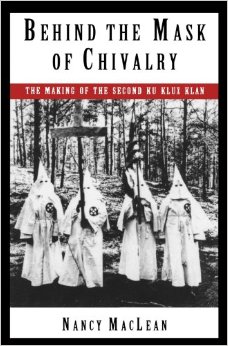
Behind the Mask of Chivalry

Behind the Mask of Chivalry: The Making of the Second Klan
© 1995 Nancy MacLean
336 pages


I’m a faithful follower of Brother John Birch,
and I belong to the Antioch Baptist Church 
 — and I ain’t even got a garage, you can call home and ask my wife!
(“Uneasy Rider”, Charlie Daniels*)


Nancy MacLean’ Behind the Mask of Chivalry examines the Ku Klux Klan at its most insidious: the opening of the 1920s. Using its activity in Athens, Georgia, as a case study, she probes its tactics, its composition,  its worldview, and its impact.   She demonstrates that the Klan’s lingering horror stems not from its penchant for burning homes and whipping people, but that the most respectable castes of society could hide behind its robes. Viewing the Klan essentially as a reactionary, populist socio-political movement, she offers an intriguing comparison between it and the fascist movements in Italy and Germany, which were on the rise as well. Though not a serious rival to The Fiery Cross as far as Klan history goes,   for the reader only interested in the Klan at its modern height, it should serve fairly well.  It has limits, however, in that the author uses the history to scratch an itch against male privilege. This is essentially a feminist history of the Klan that sees a war between the sexes at every turn.

Despite the Klan’s association with ‘white trash’,  more than half of the members of the Athens group were independent business owners, managers, or small freeholders. They were the very stock of citizenry, in fact, including in their ranks mayors and pastors.  While there were a few unskilled workers in the Athens organization, the majority were men of some accomplishment – if nothing else, then masters  at a trade. They were diverse and largely successful, far from being the bitter and dispossessed ex-soldiers of the 1870s who sought revenge against their imagined enemies in the form of “northerners and Negroes”.   Their concerns and fears were diverse, but the Klan would unite them in one simple message:  old-fashioned America was in peril. Its menaces were both economic and social, both real and imagined.  The United States had only entered the Great War for a year, but it would be enough to radically alter the nation: the wartime agricultural boom led to failing farms after Europe began to recover, for instance. Other social consequences of the war were a renewed sense of resistance from black soldiers who discovered there was more to the world than institutional racism, and increasing control by the government of every aspect of life.  This was an age of industrial concentration, of department stores like A&P out-competing smaller firms. Fear of business conspiracies abounded;   with so much capital being controlled by so few hands, takeovers by a corporate elite were a common object of dread. The transformation of society by science, government, and capital had completely outpaced the moderating hand of tradition, leading to drastic changes in social customs.  A family’s move from an agricultural homestead to wage-warning in the city, for instance, disrupted some of the ties that bound children to the care of their parents. Instead of working around the family farm, young people were paid pages that they felt a sense of individual ownership over. Emboldened by this, they explored the new world of the growing city, and all of its temptations — like dance halls and pool clubs.
.
In answer to all this stress and fear came the Klan, assuring parents and citizens that their fears were justified,  that true Americanism was under attack and needed defenders.  This was an age of civic and fraternal organizations, far more active than they are today. The Klan had all of their attractions, plus the costumes and rituals of older societies, and it promised to do something about the problems faced by concerned traditionalists.   Racism is the Klan’s home territory, but MacLean’s research indicates how broadly the Klan’s sheets billowed: over half of the recorded violence done by the Athens klan, for instance, had white targets, and this was from an area  bound to be more racial than most.  The Klan attacked blacks who questioned their subordination under an elite, yes,  but they also attacked men accused of not supporting their wives. They were footsoldiers of Prohibition, leading the fight against  purported moral decay even though their leaders were known to knock a few jugs back. (Hypocrisy seems to be endemic to the human condition.)   The klan functioned on many levels: first, it offered a forum for concerns to be voiced and encouraged;   it knit members together with socials and consumer-based activism, in which Klansmen only patronized the stores of other Klansmen; and, when it occasioned, offered a sanctified use of force to take down those deemed malefactors.   The klan was more than a criminal gang: it was a tribal-civic religion, combining Christianity with racial purity — a rebirth of paganism, almost, with a binary focus on the Tribe and its god, both supported by willing warriors.

 The religious aspects of the Klan combined with its embrace of violence invites comparison to the Fascist movements in Europe, which also not only defended tradition against modernity, but combined it with an absolute worship of the Nation and its symbols. MacClean points to the Nazi’s party’s success during periods of economic depression, and and the Klan’s own decline after America recovered from the postwar bust, to suggest that both were  born of and sustained by severe socio-economic stress.   Had the United States endured as long a downturn as Weimar Germany, she muses, the Klan might have well brought fascism to the United States, wrapped in the flag and carrying a cross.  Given their success in the midwest (practically taking over Indiana), that may have been a possibility, but as MacClean notes most Klansmen had a serious ideological animus against dictatorship. Their hatred for the Catholic church, for instance,  fixated on the notion of papal authority.


As useful as MacLean’s work into the Klan’s demographics is, indicating how popular it became by masquerading as a civically-minded fraternal organization,  MacLean’s sexual hangup presents serious baggage.  Not only does she dismiss the entire concept  of honor as one of male ownership over women, but she reduces male bonding rituals to suppressed homosexuality.  Seeing sexual undertones in every relationship is one of the more tiresome aspects of the modern mind, and does not serve this history well. MacLean also seems to place blame on the subjects’ concerns, rather than than their actions:  how dare parents be concerned about their children risking their health and futures in premature sexuality? Bring on the STDs and abortion, baby, it’s time for liberation. She also uniquely targets white men as being the reactionaries, as if their wives (enlisted in a Women of the KKK) or black men didn’t share those concerns about their children’s futures.  Granted, the villains here are white men, but MacLean singles out the concern, the very act of judgement. Moderns don’t like to be judged, but  evaluating events as good or ill or some balance of the two, is how humans exist.

Behind the Mask of Chivalry is serviceable if limited. Its foray into the demographics of the second klan is more extensive than The Fiery Cross, but that work held its own in that respect and offered reams more substance with less editorializing. 


* “Uneasy Rider” is a highly entertaining song about a long-haired peacenik wandering into a redneck bar and escaping from a fight by accusing one of his antagonists of being a long-haired hippie, guilty of voting for McGovern and hired by the FBI to infiltrate  the KKK.  


Posted in history, Reviews | Tagged , , , , , , , | 1 Comment

The Terrorist Next Door

The Terrorist Next Door: The Militia Movement and the Radical Right

© 2004 Daniel Levitas
544 pages

How does the grandson of Jewish immigrants become a leading voice in anti-Semitic movements? The Terrorist Next Door reviews domestic militancy in the United States,  as viewed through the life of Bill Gale, founder of the Posse Comitatus.   Taking its name from an act meant to prevent Federal troops from interfering in civil affairs, the group’s abiding faith was animosity towards a government viewed as corrupt at best, and taken over by alien forces at worst. (“Alien” in this case referring to the Illuminati, Freemasons, Jews, or agents of the One World Government. No one here fears the sneaky Reptilian menace.)  Covering essentially the same kind of reactionary violence as Harvest of Rage, but  with less grace, it doesn’t avail much other than to build on biases. Unfortunately, the use of one monstrous man as a lens to view related movements casts an evil light on even the comparatively innocent.

The Posse Comitatus is a fairly vile bunch, a Klan without robes and with less concern with decency.   Gale himself took to the racist politics of the Christian Identity movement – which sees Anglo-Saxons as the true children of Israel, and contemporary Jews as Russian pretenders – fairly early on, but the popular support he built was based on a kind of localism on steroids. The basic government unit of every American state, he maintained, was the county, and its only constitutionally-sanctioned officer the Sheriff.  The sheriff could summon the men of the county as a posse to deal with serious threats to law and order.  Gale’s posse considered itself a self-organizing and constitutionally-sanctioned force in service of the same. Their enemies varied, as Gale was able to build a following beyond his initial band of white supremacists, appealing first to farmers on the road to ruin and then later the burgeoning tax resistance movement. Later still, during the Clinton administration, the comitatus would inspire dozens of self-organized militia movements, all of which viewed the federal government as its chief object of contempt, dread, and hostility. 

Gale’s posse wasn’t merely a right-wing crank group that gathered together to swap bits of foreboding news and complain about what the government was up to;   they were a force in the true sense of the word, applying violence to ‘solve’ problems. One man with a claim on a farm, for instance, called the group to come to his aid: they  took possession of the place, running off the owner and blockading  the only access road. They also vigorously defended themselves, shooting Federal agents who attempted to subdue them.  Civilian casualties in Federal encounters gone wrong only inflamed passions and spurred on greater activity: after the ideologically-linked Oklahoma City bombing, for instance, militia involvement grew. The same was true after President Clinton introduced the Brady Bill, viewed as  an attempt by the government to disarm the populace.   

Like Harvest of Rage,  The Terrorist Next Door is written as a warning, but whereas Harvest seeks to understand its subjects, Terrorist is content to condemn them and anyone it can connect ever so tangentially to their cause.  Under Levitas’ pen, anyone who resists the government, who cries overreach — especially if they do so from a Christian perspective — is a racist with a lynching rope in the closet.  The problem with this is that the people covered in this book aren’t part of a uniform organization, or ones even like the Comitatus.  For instance, Alabama’s chief justice, Roy Moore takes heat here for installing a monument to the ten commandments within his courthouse. As problematic as that is from a constitutional perspective, to smear him as connected to the Christian Identity clan is contemptible.  Even those with actual connections to Gale’s group weren’t under his violent command:   they had their own motivations and ideas for taking action, like attempting to pay tax bills with fraudulent checks and filing false liens in their courthouses. Criminal, yes, but ‘terrorist’?    Tarring any reaction against the growth and abuses of the state as violently racist makes as much sense as declaring at the Federal Reserve is a Zionist conspiracy to take over the world, or regarding every man on a motorcycle as a card-carrying member of the Mongols.

My interest in this book came from the hopes of gaining some insight into the militia mentality, but Levitas is more concerned with declaring that they exist, they’re everywhere, and something oughta be done about `em.  Sure,  have the Federal government go after them — that’s worked so well so far. Levitas himself documents how militancy and paranoia flourished amid real or perceived persecution, spiking after Waco, Oklahoma City, and the Brady Bill. Obviously, going after armed people who already think the government is against them is a really swell idea that will lead to happy times for everyone.  At least the author of Harvest of Rage knew, as nutty as his subjects could be, at the root of their paranoia lay real despair and genuine concerns — about their status as economic losers in a globalized world, or  the collusion of big agriculture, big banks, and big government. Their pain and fear was twisted by the Bill Gales of this world, but for Levitas anyone remotely connected to Gale is as bad as him.  This is an alarmist and dismissive account that will make those already predisposed to view grassroots reaction as ignorant, racist, and violent feel justified, but has little purpose beyond that  Its focus on the Comitatus has its uses, but as far as understanding right-wing militancy goes,  this is far inferior to Harvest of Rage.

Related:
Harvest of Rage, Joel Dyer

Posted in Politics and Civic Interest, Reviews | Tagged , , , | Leave a comment

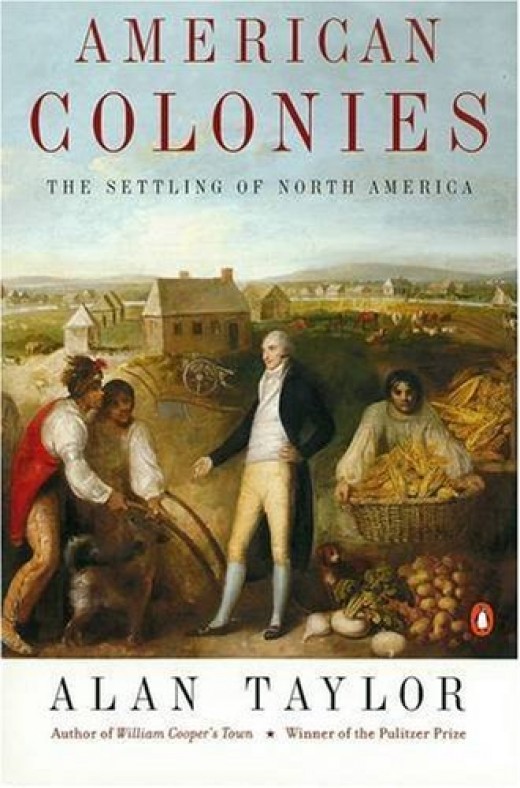
American Colonies

American Colonies: The Settling of North America
© 2001 Alan Taylor
526 pages          


American Colonies is a sweeping history of the New World,  one that attempts to convey the full American experience, beginning with the arrival of natives and then covering Spanish, French, English, Dutch,  and Russian colonial efforts in turn.  (Hawaii is also addressed, though it’s a bit of a two-thousand mile stretch to call it ‘American’.)  Taylor’s declared intention is to tell more than simply the Anglo-American story, which relegates the Indians and other European powers to the role of villains.  At this, he is largely successful, providing a complete survey of native and European settlement and rendering the history of their relations with one another.  The work demonstrates how profoundly diverse both the natives and the Europeans were, documenting the extent of their tangled military and diplomatic relationships. The tacks taken against the natives by Europe varied not only from country to country (in Spain’s case, no tact was involved), but from colony to colony, as varied geography and the nature of the neighbors demanded intelligent adaptation. The story of the New World is not simply one of Europeans plowing over the war-and-disease-ravaged lands of peoples like the Iroquois and the Lakota, however, for Europe’s nations also waged war against one another in this new battlefield.

Taylor’s narrative style is pleasant enough, even if bothered with a little factual repetition. The content itself is a different story, being nearly five hundred pages of disease, war, slavery,  misery, and death.  No group discussed here comes off particularly well, not even the one-paragraph Vikings. Both the European and native powers wage war against one another and themselves, and in utterly vicious ways;  every chapter brings descriptions of  women raped, children executed, homes and fields burned, men tortured. There are no noble savages here,  and no exemplars of Christian civilization — only ambitious and wrathful men with blood on their hands.

Taylor’s narrative gives a good general view of European evolution, as explorers turned to nation-builders. Death ended to follow in the wake of the pioneers, as many of the diseases Europeans were exposed to as children never existed in the Americas, particularly those which originated from domestic animals, like smallpox.  Early colonists arrived with varying motives; some seeking fortune,  some to create a new society in their own ideal image, and others because it beat starving to death at home.  Invariably they offended their new neighbors, and war erupted.  Conflict between the native peoples and the newly-arriving colonists forced them to adapt to one another:   after seizing Canada, for instance, the English realized it was easier to give their new neighbors tribute every now and again than to maintain a war-footing. The natives, too, had adjustments to make: in the first pitched battle between European forces and Indians, for instance, the tribe in question attacked in a massed formation that fared none too well against organized gunfire. They quickly adopted the guerrilla tactics now associated with ‘Indian warfare’.  

Taylor also puts forth a few theories of his own, all rooted in a worldview that sees economic warfare as the driver of everything else. In his view, the French and Iroquois maintained war between themselves for economic advantage,  as the warzone between their territories prevented regional competition with other powers for their goods. Though no fan of capitalism, Taylor’s punches against mercantilism could be thrown by Adam Smith himself, pointing out how mother-country meddling smothered economic development time and again. Intriguingly, he suggests that the tax policies that sparked the American Revolution were not simply enacted to cover the costs of the French and Indian War, but to discourage too much emigration to the colonies. 
Slavery is a recurring topic here; a common byproduct of war,  in the age of discovery and colonization it became an economic institution,  especially as practiced in the colonies of the deep south and in the Caribbean.  The sugar plantations of the Indies were particularly dependent on slave labor; for this reason the abolitionists of William Wilberforce’s day avowed that those who took sugar in their tea might as well be drinking the blood of captives. The ranks of slaves were initially more diverse, consisting of captive natives who died in great numbers, and indentured Europeans who ran away and assumed the identity and status of free settlers.  Africans were already accustomed to Old World domestic diseases, and stood out from among both the native and European populations. Consequently,  the plantation lords drew more from African markets, and slavery assumed a racial-and color-based nature, the legacy of which continues to poison the society of the New World.   Before this, however, African slaves had been treated like any other indentured servants,  freed after a time of service and thereafter at liberty to create their own fortune – sometimes by investing in slaves.

American Colonies is a book to be considered,  taking on centuries of North American history  and taming it. Taylor’s stated goal was to go beyond the English colonies on the seaboard, and this he does — taking the reader as far south as Mexico, and galloping through the plains of the Apache to the northern wastes of Alaska.  He makes the complex comprehensible and is especially valuable in the time spent on Spain and France. He has a particular animus against the English and their American ‘spawn’ that grows tiresome; to his credit, however, he does not make their rivals into moral paragons.  Perhaps it’s not so easy to be detached from one’s ancestors as those in academia might wish.

Related:


Posted in history, Reviews | Tagged , , , , , , , , , , , | Leave a comment

The Ashes of Waco

The Ashes of Waco: An Investigation
© 1995 Dick Reavis
320 pages

What happened at Waco?  Dick Reavis had an itch to find out, and since no one else at his alternative newspaper was curious, he volunteered as man on the ground to investigate. Getting close wasn’t easy: during the fifty-one day siege, the ATF and FBI kept journalists at a distance, and their scissor job with the phone lines restricted communication in and out of the surrounded center.  Inside the center were nearly a hundred members of the Branch Davidians, a splinter sect of the Seventh-Day Adventists, expecting the apocalypse and living in the belief that their leader David Koresh was chosen as the next messiah, meant to  reveal God’s word to the world.   What Reavis found was a gung-ho mob of bureaucrats and gunmen, constantly getting in one another’s way and approaching a situation that demanded delicacy with all the tact of a bull in a china shop.

The Ashes of Waco is a more comprehensive text on the Waco disaster, which started off with the deaths of ten people – six civilians, four agents —  and ended in an inferno that killed eighty more, including children. Reavis covers the sect’s religious background in a series of introductory chapters, covering their revolution from an Adventist group to one increasingly dominated by Koresh’s interpretative of the Book of Revelation, then moves on to the ATF investigation and the bloodshed that followed.  If Reavis seems at all partial in his sharp criticism of the government which follows, this owes more to their half-cocked Rambo tactics than overt  sympathy for the Davidians.  He doesn’t dwell on the child marriages, but at the time of writing Koresh was still being lynched by the media as a deranged pedophile with a private arsenal.  Reavis doesn’t shy away from their kookiness, covering aspects that Tabor missed altogether, like a belief in biblical UFOs that transported people from Earth into Heaven.  In Reavis’ eyes, however, a government which uses extreme force recklessly is far more dangerous than a religious group that had lived peaceably in Texas for decades.  From moment one, Waco was a catastrophe for civil, competent law enforcement. From the raid’s opening, with a helicopter strafing the building, to its closing fifty-one days later with tanks used to batter down walls and shoot in tear gas grenades banned from war and known to be incendiary in enclosed situations, the operative word was Fiasco.

The Ashes of Waco is well-done, drawing on extensive interviews with Federal agents,  Waco residents (the centers’ neighbors), and Davidian survivors. Reavis conveys a good sense of what life was like inside the community, including maps of the connected buildings. He also looks beyond the front lines to consider how neighbors reacted to the showdown, including one radio host who — after realizing the center’s residents were listening to his show — had them move a dish mounted on their roof in response to questions, a la Christopher Pike in “The Menagerie”, in Star Trek.   Although obviously appalled by the actions of the ATF and FBI, they are not villainized, All told, this is as even-handed and thorough an account one could hope for, written so soon after the debacle.


Posted in Reviews | Tagged , , | 3 Comments

The English People on the Eve of Colonization


The English People on the Eve of Colonization
© 1954 Wallace Notestein
302 pages

   If there was ever an exemplar for not judging a book by its cover, The English People on the Eve of Colonization is it. The binding is plain and burdened by an unwieldy title that seems to threaten readers with clouds of dust and pages of population statistics upon opening. Instead,  Wallace Notestein delivers a lively social history that opens the hood (or bonnet, if you prefer, since we’re looking at the English) of Stuart England, revealing the social machinery at work inside.  Here are the daily lives of men both great and small – the details of their work,  their concerns – and an examination of the institutions which create and sustain civilization Notestein’s chatty survey gives life to farm laborers, country gentlemen, sheriffs and justices of the peace; he also takes us to the Inns of Court and the universities, the very marrow of intellectual life.    Although there are brief chapters on Parliament and the corporations that would lead the way in exploring the globe and settling the new world, the emphasis here is on the small and ordinary, and delivered in so personable a fashion that one is immersed in the life of centuries gone by without realizing he’s being educated.  Religion isn’t addressed directly, beyond the life of the church as a community,  which is the only hiccup. 

Related:


Posted in history, Reviews | Tagged , , , , | Leave a comment

So you say you want a revolution?

After a couple of months almost entirely devoted to England, ’tis time to part — momentarily.   It’s June, and almost time for my annual tribute to the American revolution. I had thought to have an appropriate mix of English and American colonial history  before launching into the revolution itself, but the books ensnaring my interest lately have been more diverse.  I’m not through with England for this year, as I still have an itch to read about  the English Civil War.  The next couple of weeks will feature a couple of books on the colonial period as a segue.  We’ve already seen one in Daniel Boorstin’s The Americans: The Colonial Experience.


Once the Revolution series starts in earnest, it will include:
– two biographies of lesser known Founders,  one being John Dickinson;
– a novel by David Liss (whom I’ve read before) set in the early Republic during a crisis
– a book on Tom Paine and political philosophy
– a look at Constitutional opposition
– a comparison of Canadian, American,  Australian, and English governance
…and possibly a history of how Parliament came to fight its own colony.  

If time allows, I’ll also throw in Bob Heinlein’s The Moon is a Harsh Mistress, as it’s inspired by the American revolution.

Read of England 2015

English Classics
Come Rack! Come Rope!, Robert Hugh Benson
Peter Pan, J.M. Barrie

English History
Boudica, Vanessa Collingridge
Faith and Treason, Antonia Frasier
The Fall of  Saxon England, Richard Humble
Agincourt: The Battle that Made England, Juliet Barker
The Wars of the Roses, Alison Weir

 Fiction, Set in England
Armada, John Stack (Historical)
In a Dark Wood, Michael Cadnum (Historical)
The Other Queen, Phillipa Gregory (Historical)
Ruled Britannia, Harry Turtledove (Alt-History)
The Inimitable Jeeves, P.G. Wodehouse
Bachelors Anonymous, P.G. Wodehouse
Very Good, Jeeves, P. G. Wodehouse

Books by English Authors
Medieval Essays, Christopher Dawson.
The Everlasting Man, G.K. Chesterton

I also made it halfway through The Vicar of Wakefield before becoming distracted by history.

Posted in General | 9 Comments

The Colonial Experience

The Americans: The Colonial Experience
© 1967 Daniel Boorstin
528 pages


   Daniel Boorstin’s The Americans delivers a cultural history of the American colonies, beginning first with profiles on the disparate groups that settled on the eastern seaboard (Puritans, Quakers, and Cavaliers), and then following the growth of American religion, law, and education in the new world.  Though appearing weighty, being five hundred pages or so, the expanse flies by in a multitude of comparatively short chapters, divided (appropriately enough) into thirteen sections.  This is an inbetween America, neither raw nor finished.  For students of American history, this is deftly written, and gives a feel for how truly distinct the settling populations were, both in their origins and in their evolution.  While the Pennsylvania Quakers and New England Puritans set out to create utopias on a fresh plain, for instance,  Virginia’s settlers knew perfectly well that the utopian mark already existed in England, and their intention was to re-create its social institutions. Despite the wide variety of these cultures,  constant resettlement from one area to another in the pursue of fresh land ensured a mix of experience, and  prevented rabid clannishness.   Despite being mostly agrarian, agriculture would be the nascent American civilization’s weak point: flush with land,  no one had any interest in putting a great deal of imagination or work into improving their lot. Once tobacco or cotton had drained the soil, they could simply move on.  Otherwise,  the abounding energy and optimism of the Americas, so distant from the institutions of Europe, allowed for enthusiastic questioning that led to early triumphs in technological and scientific innovation. For Americans interested in the lives of the founders, this provides an enormous amount of  storied context.

Related:
Daily Life in Early America, David Freeman Hawke

Posted in history, Reviews | Tagged , , , , , | Leave a comment