Infinity’s Prism

Star Trek Myriad Universes, Vol 1: Infinity’s Prism
© 2008 William Leisner, Christopher L. Bennett, and James Swallow
527 pages
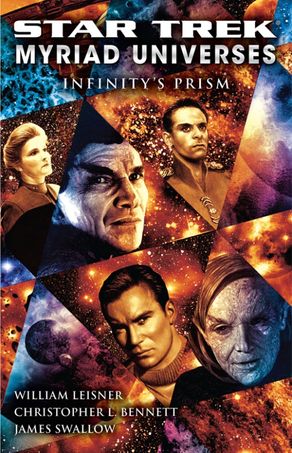
What if….Khan won the Eugenics Wars? What if….Earth had succumbed to fear after the Xindi attack, and withdrawn from the Coalition of Planets and exploring the final frontier? And what if — and this is a big one — what if Harry Kim was promoted to lieutenant?   Such are the stories, the three novellas, comprising ST: Myriad Universes, volume one.   Three Treklit veterans have produced here a collection of stories that have old heroes and villains — Kirk, Dukat, KHAAAAAAAAN! —  playing very different roles. An unexpected discovery for me, I couldn’t stop reading it.

William Leisner’s “A Less Perfect Union” starts us off with an alternate Babel conference,  featuring a xenophobic James Kirk who serves the United Earth ship Enterprise, under the command of an aging Christopher Pike. Although  Earth succumbed to xenophobic politics following the conclusion of the Xindi war, withdrawing from the proto-Federation,  after a century of isolation some on Earth are interested in restoring relations with the Vulcans and Andorians. Unfortunately, their spokesperson — T’Pol, who remembers the hopeful days of Archer’s Enterprise — is   kidnapped by a Romulan impersonating Ambassador Sarek, with the unwitting help of Jim Kirk.  Leiser almost rivals Greg Cox for subtle allusions to parts of the Trek verse, including Trek literature.  This was a strong start to the book, with the hilarious sight of  Doctor McCoy urging Jim not to be so defensively racist about Vulcans.

In Christopher Bennett’s “Places of Exile”, we see a Voyager too shattered by its first encounter with Species 8472 to continue pressing on towards the Alpha Quadrant, choosing instead to temporarily settle among the residents and officers of a space station-based civilization.  Bennett brings his customary science strengths to the table here,  and they serve him and the reader well when he begins exploring fluidic space.  Janeway and Chakotay’s enthuaism for making a home in the Delta Quadrant vary widely: Janeway’s intention of returning to the Federation never wavers, and she is concerned that her crew might lose its identity.  But it is Federation ideals that move Janeway and the other to work with refugees of the Borg-8472 war, creating a nascent coalition that works to find a way, martial or scientific, to end the brewing catastrophe.  Another interesting aspect of this story is the expansion of the Doctor, who becomes a dispersed intelligence controlling medical droids throughout the Coalition’s stations and ships.  Although Bennett kills off Tuvok and Paris, Harry Kim finally gets a love life and a promotion.  (Was it worth it, Harry?)

“Seeds of Dissent”, authored by James Swallow, visits a very different 24th century,  one in which Khan Noonien Singh won the Eugenics Wars and created a human empire nearly engulfing the Alpha Quadrant.  The discovery of an ancient human freighter — the Botany Bay — sparks problems for the Children of Khan, however. The freighter contains the last survivors of unmodified humanity, and their memory banks contain records of the atrocities committed during Khan’s rise to power —  and challenging a history of Khan that sees him personally doing everything from being the first to step foot on Mars to breaking the lightspeed barrier.  Although this story features an amusingly perverse pairing of Kira and Dukat (rebel lovers), it’s mostly a generic rebels vs the Empire story.  The augmented humans aren’t even interesting: they’re big and can survive in space for a few moments, but nothing of their society is revealed beyond a lot of Roman-derived titles.  The ending was a little different than expected, however.

Of the three,  I regard Bennett’s as the strongest. Swallow’s had the most interesting premise, but its development wasn’t nearly as imaginative as it could have been.  This book is first in a trilogy of alt-tales, but the others don’t seem particularly interesting — with one exception, of Soong-type androids becoming pervasive in the Federation. As usual, Bennett posts annotations for his story.
Posted in Reviews | Tagged , , , , | 5 Comments

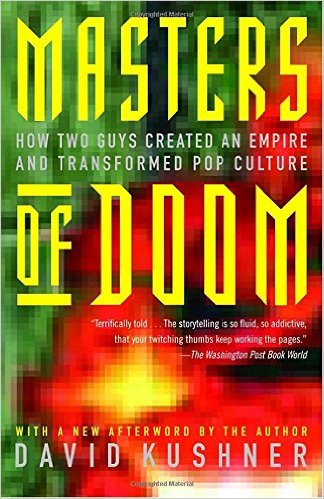
Masters of Doom

Masters of Doom: How Two Guys Created an Empire and Transformed Pop Culture
©
2004 David Kushner,
Audible presentation read by Wil Wheaton, runtime 12 hours & 43 minutes
334 pages

I wasn’t playing PC games  in the early nineties when Wolfenstein 3D, DOOM, and Quake revolutionized both the industry and the hobby, but  they were legends I never stopped hearing about after I subscribed to PC Gamer in 2000.  I was conscious of playing in their shadow:  one of my favorite games,  Star Trek Elite Force, used the Quake III engine.  When I learned that Wil Wheaton, a geek gamer’s gaming geek,  narrated an audiobook about  the formation of id software, I couldn’t pass it by.  Masters of Doom chronicles the coming-together of two programming geniuses – John Carmack and John Romero, their overnight transformation from pizza cooks into millionaires, and the pressures that broke their team apart.

This book’s main lure for me was the voice of Wil Wheaton, and I’m happy to say he delivered. Wheaton’s acting experience  serves him well here; his reading is flawless and even,   giving slightly difference voices to different people.   On several occasions he uses an accent, or gives a ‘dramatic reading’, as he does when he imitates one game developer announcing his game in the imitative style of Walter Winchell. The effect is utterly hilarious —  and ditto when he does a reading of Bill Clinton’s accusations against Doom in the wake of the Columbine bombing attempt.

I’d previously heard id described as innovative, but never appreciated how far back their innovations went. John Carmack, for instance, introduced side-scrolling to the PC at a time when it  was regarded as impossible given the hardware limitations of computers themselves. His test project inserted an id character, Commander Keene, into the first level of Mario.  Several other major breakthroughs are mentioned here; dynamic lighting, for instance, and tweaks that forced the Apple II to create colors  beyond its original pallet.   At this time, id was creating relatively innocent games like Commander Keene, which set a young boy against an alien invasion.  Elements that would become id hallmarks (the retention of slain enemies), were already present.  More importantly,  multiplayer itself was an id creation, at least as far as LAN connections went. The software that allowed multiple computers to dial a remote server – creating gamerooms to meet other gamers and play matches against them in – was created by a fan, but quickly purchased and integrated into the core gaming experience. From Doom and Quake came  gaming clans, still a staple of gaming competitions.

Throughout the book, id grows from two guys doing all of the work – designing, programming, art-crafting – into a team of men with different ideas and different directions. Although their success  — and their garages of Ferraris – had been made by working together, their wealth also enabled the two senior owners the resources to go their own way once their personal differences had become too much to bear. Carmack, for instance, is seen here as deeply serious coder who likes the challenge of it more than anything else.  Romero,  initially no less dedicated a programmer (and initially the engineering strength of the two-man team), later grew to relish the attention and moolah id’s success had given him.    The last quarter of the book details Romero’s departure from id,  the creation of his Ion Storm design firm, and the projects both men pursued throughout the 2000s. As of the book’s publication, and the audiobook’s presentation, both were still involved in gaming — Romero was then branching out into the un-exploited terrain of pocket pc/smartphone games, and  Carmack was still finishing Doom 3 despite nursing another hobby in rocketry.  (According to Wikipedia, he’s now involved in some VR project that Facebook bought out.)

Masters of Doom proved a fun bit of computer and gaming history, and my first look inside the gaming industry. My favorite designers are guys like Sid Meier (Civilization)  and Will Wright (SimCity /The Sims), both Carmack and Romero were fun guys to get to ‘know’ through these thirteen hours spent listening to Wil Wheaton.  There’s more than a little nostalgic appeal here,  too.

Related:
Doom 2 Easter Egg:  John Romero’s Head hidden inside final boss
IGN Plays Doom with John Romero

Posted in history, Reviews | Tagged , , , , , | 18 Comments

Fahrenheit 451

Fahrenheit 451
© 1953 Ray Bradbury
158 pages

Like 1984, I suspect Fahrenheit 451 is famous enough that its basic details have seeped into the cultural consciousness of people who have never read it. Here we have a fireman whose job is to burn books, because so few people read them and the few that do are rendered unhappy by their contents. He’s fighting a losing battle, however, for despite the veneer of prosperity and the abundance of entertainment, the world the Fireman inhabits is a deeply unhappy one. Work is light, goods are cheap, travel is fast, and televisions can encompass entire rooms – but there is something wrong with a world where so many people try to commit suicide that stomach-pumping technicians are as routine as garbage collectors.

Our fireman, Guy Montag, is not like all the rest. While his wife buries her malaise by ensconcing herself inside her television stories, he finds the meaningless noise a distraction. The slight imperfection in his character that makes it impossible for him to simply sink into the soporific covers and ignore the sense of alienation widens into an outright fracture after he encounters two women with upraised heads. The first is a teenager reared without television, whose childhood curiosity has never been squelched, who looks to the heavens in wonder and asks the Fireman questions he has never heard before, or thought to ask. The second is an old woman who, threatened with the destruction of her house and books, takes the match from the firemen and sets the house and herself ablaze, staring in defiance all the while.

“There must be something in books, something we can’t imagine, to make a woman stay in a burning house; there must be something there. You don’t stay for nothing.”

So the fireman  takes home a book, wondering — is there really something he’s missing?  But this isn’t the first time. It’s just the first time he’s admitted what he’s done to himself, the first time he’s dwelt on it enough to take out the other books he accidentally didn’t burn and then hid away – the first time he’s dared to read them, to confront what they have to say. His wife and coworkers can’t help but notice he’s not the same – and apparently unpracticed at guile, he’s terrible at it, sinking into bed with depression and quoting lines of poetry he could have only encountered through the forbidden fruit of books.

It’s when his boss arrives to put him back on the wide and winding that the book really reveals its substance. This is a book about the decline of literacy, yes. Books declined not because of a conspiracy but because people tended to gravitate toward easy entertainment, shorter synopses, that sort of thing. They failed to challenge themselves and became vapid creatures living for soma. But the book-burnings themselves were deliberate, created by a government that sought to minimize disruption and the loss of a happy-clappy world. Anything that could be offensive to anyone was purged. Anything that might start a mind to thinking about the world, to doubting, to unsettle everything was likewise burned. The chief’s case covers a couple of pages and is mesmerizing in its condemnation – not of his world, but of ours.  Our lives are saturated in sensation — news, politics, action-and-sex movies, dissent is filtered out through  our will and the design of search engines, and language and history are the stuff of clay, to be molded to fit the conceits of the day.

“Colored people don’t like Little Black Sambo. Burn it. White people don’t feel good about Uncle Tom’s Cabin. Burn it. Someone’s written a book on tobacco and cancer of the lungs? The cigarette people are weeping? Bum the book. Serenity, Montag. Peace, Montag. Take your fight outside. Better yet, into the incinerator. Funerals are unhappy and pagan? Eliminate them, too. Five minutes after a person is dead he’s on his way to the Big Flue, the Incinerators serviced by helicopters all over the country. Ten minutes after death a man’s a speck of black dust. Let’s not quibble over individuals with memoriams. Forget them. Burn them all, burn everything. Fire is bright and fire is clean.”

Bradbury!  thou shouldst be living at this hour:
  America hath need of thee.

Related:
1984,  for the widespread anomie and the total loss of history and language.
Brave New World, Aldous Huxley

Posted in Reviews, science fiction | Tagged , , | 4 Comments

I Know Who You Are and I Saw What You Did

I Know Who You Are and I Saw What You Did: Social Networks and the Death of Privacy
© 2013 Lori Andrews
272 pages

Think about what you put on facebook. If you’re like most people,  there is something in your photos, comments, likes, etc. that could get you into trouble.  I Know Who You Are and I Saw What You Did  explores the many ways that social networking websites expose individuals to physical and legal abuse. Written by an attorney,  the book has a legal emphasis, with many chapters on how publicly-visible facebook posts can prejudice judges against one claimant over another, or function as evidence not admitted in court when jurors begin googling people.   In many of the instances recorded here, the exposure comes not from people being careless, but from sites’ privacy settings being adjusted without their knowing — or because technology was being used to switch on their webcams without their awareness. Because of this, the author argues for a ‘constitution’ that would govern ‘facebook nation’, in essence a digital bill of rights protecting people.  Having read Future Crimes and Data and Goliath,  this was old hat for me, but a distilled reminder is always a good thing.  The catchy title and comparative slimness might draw in readers who ignore those other works, as well.    Very few congressional officials seem to know anything about cybersecurity, so I doubt we’ll have a cyber bill of rights any time soon — especially when easy violations of privacy serve the national security state so well.   In the meantime all we can do is stay paranoid.

Posted in Reviews | Tagged , , | 14 Comments

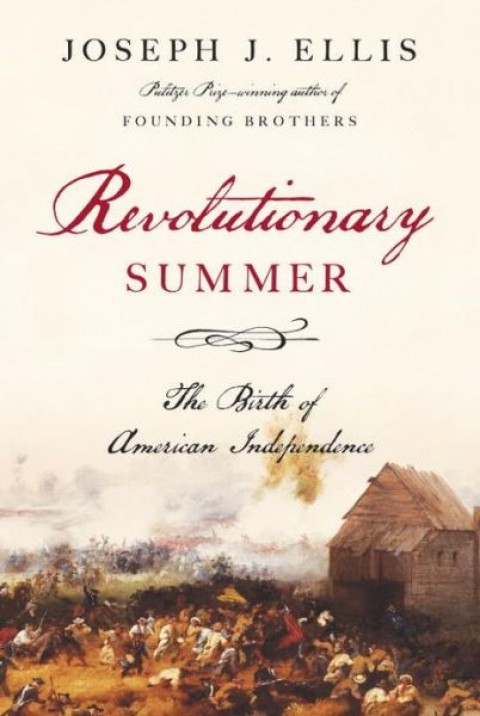
Revolutionary Summer – Independence Kickoff


288 pages
© 2014 Joseph J. Ellis

Earlier in the week I read Joseph Ellis’ Revolutionary Summer to kick off my yearly tribute to American Independence.   Ellis should be familiar to readers here, as I enjoy his narrative histories of the revolutionary and early republican period of America enormously. Revolutionary Summer follows two interlapped threads of the revolution, political and military, as they flowed together.   That summer was the summer in which a tax rebellion sharpened into a bid for complete independence, and it started before the Declaration of Independence. In May, for instance, the colonies began working on their own constitutions,  superseding the earlier ones granted through the king’s authority.   British commitment to reversing the rebellion – two diplomat-generals  and a task force of 50,000 men, carried on the largest fleet ever seen off the waters of North America – also made it clear that a threshold had been passed: both sides were committed, root, hog, or die.

I’m using Ellis’ book to kick off my annual tribute to American independence, or rather the early Republic since I tend to read little about the war itself. I am no less fatigued with politics than I was last year, however, largely because the political atmosphere here is  still charged and turbulent, and so will be cutting the politics with literature and one travel memoir.   Expect a biography of a forgotten founder, at least one book on the Constitution, and a bit of literature. I’ll most likely use my Classics Club list to provide the spot of American lit.

Posted in history | Tagged , , , | 7 Comments

Baghdad without a Map

Baghdad without a Map and Other Adventures in Arabia
© 1992 Tony Horowitz
285 pages

So your wife is on extended assignment in Cairo, and you’re a freelance journalist without a regular gig. What do you do? Why not wander around northern Africa, the Arab world, and Iran whenever an opportunity presents itself – chasing stories, even when they led you into dark mountains where grenades and AKs are cheaper than a week’s worth of the local narcotic? Baghdad without a Map presents anecdotes from Tony Horwitz’s time spent in Iraq, Egypt, Libya, Sudan, Jordan, Yemen, and Iran, mixing comedy and tragedy.

Because Horwitz is chasing stories — a refugee crisis in Sudan, for instance, or the still-simmering conflict between Iraq and Iran on the border — he is often exposed to misery and danger. He still finds humor in the chaos of Cairo’s streets, the chanciness of Egyptian-Sudanese air travel, or the loopiness of Yemense men after a goodly amount of qat-chewing. Horowitz attempts to learn about local cultures and politics as he can on the ground, conversing with people in his rough Arabic, chewing qat, or playing soccer. Although much of the middle east has changed drastically since the 1980s – the invasion of Iraq and the Arab spring just in the last ten years, these snapshots of life in the middle east are worth taking a look at for readers with any human interest in the region.

Posted in Reviews | Tagged , , , , , | 3 Comments

The Martian Chronicles

The Martian Chronicles
© 1950 Ray Bradbury
222 pages

As the 1940s began giving way to the 1950s, Ray Bradbury began penning a series of stories about the future human exploration of Mars — stories that he thought of as fantasy in his letters, but which were called science fiction by everyone else. The stories were re-published as an integrated novel, the result is more of a mosaic than a straightforward tale.

Th Chronicles do not present a rosy, optimistic view of Mars exploration — or of the future in general. Although arriving on Mars safely is a considerable challenge for the Earthmen, eventually Earth triumphs in the same way it survived a Martian invasion in H.G. Wells’ earlier work, and the same way Europeans came to posess a widowed continent. One of Bradbury’s characters, Spender, could be an Ed Abbey in space — gazing at the ancient beauty of Mars, of the sad ruins of a once-great civilization — and lamenting that one day settler would arrive like locusts and devour all of this, plonking down hot dog stands. “We have a way of ruining big, beautiful things,” he says, shortly before going on a shooting spree against those who would chuck wine bottles into the pristine Martian canals. Mars is settled, and emptied, as Earth’s cold war finally waxes hot and all colonists are called home to fight — an odd and tragic development, considering the war’s nuclear nature.

There’s more to the Chronicles than environmental concerns and nuclear dread, however. In another story, “Usher II”, Bradbury introduces a theme later expanded in “Fahrenheit 451”, when a man builds a house of horrors inspired by the works of Edgar Allen Poe. The house is a tower of rebellion, for on Earth all works of fantasy and politics were long burned and their ashes buried, in the hopes of burning and burying imagination and discontent with them. The political police catch up to the house’s architect, but he invites them to tour the house just once before they burn it. The vengeance then wreaked through recreations of Poe’s stories testifies to a delicious anti-authoritarianism, a contempt for those who would control the lives of others for them. Many people came to Mars to escape conformity, bureaucracy, the sterile life — but found it came following after them, like the Alliance in Firefly.

And yet there is more to this little volume of stories. Needless to say, after spending an evening with it, I now know why it’s held in such high regard.

Posted in Reviews, science fiction | Tagged , , | 5 Comments

"Far winds and whispers and soap opera cries"

“In writing the short novel Fahrenheit 451 I thought I was describing a world that might evolve in four or five decades. But only a few weeks ago, in Beverly Hills one night, a husband and wife passed me, walking their dog. I stood staring after them, absolutely stunned. The woman held in one hand a small cigarette-package-sized radio, its antenna quivering. From this sprang tiny copper wires which ended in a dainty cone plugged into her right ear. There she was, oblivious to man and dog, listening to far winds and whispers and soap opera cries, sleep walking, helped up and down curbs by a husband who might just as well not have been there. This was not fiction.”

Ray Bradbury, 1953

This week I’ve been listening to a survey of science fiction from Bradbury to Star Trek, and it’s reminding me that I’ve only read his Fahrenheit 451, and that was in high school. I’m long overdue..

Posted in quotations | Tagged | 7 Comments

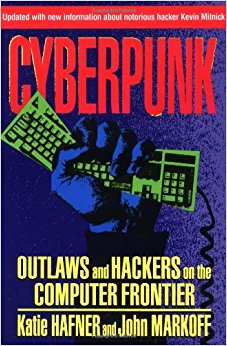
CYBERPUNK

CYBERPUNK: Hackers and Outlaws on the Computer Frontier
© 1991 Katie Hafner
400 pages

Cyberpunk takes readers back to the early days of hacking, when it was so old-school that computers weren’t involved. Using three case  in the United States and western Germany,  Katie Hafner’s history introduced readers in 1991 to the general idea of hacking, and her history sheds some light on what hackers were, what they did, and what they might want. It’s a fun look at early internet history, with the net as we know it developing slowly  throughout the course: ARPAnet, the internet’s predecessor, only appears halfway in.

The story begins with telephone lines, which — in the mid-20th century — bored teenagers began to examine with great interest.  Kevin Mitnick and Susan “Thunder” met over their mutual interest in learning to detect the patterns used by telephone switching systems and reproducing the sounds to manipulate their way through the boards, arranging free phone calls for themselves. (This was a bit of a cultural education for me — evidently there were conference call lines advertised where people called in and just chatted with whoever was also on the circuit, a telephone chatroom!)  When the systems became controlled via computers,  Kevin, Susan, and a few more of their friends began tinkering with them.  (For readers born in the eighties, whose first computers came with web browsers, it takes a bit of chewing to realize that Mitnick and Thunder were literally dialing other computers;  telephone and computer network access systems were much more closely related)  Their explorations would eventually led to purloined and privileged accounts on sensitive systems across the United States; Susan had a particular interest in looking at military hardware.  The group weren’t plundering records for profit.

Although this group acquired an enormous amount of access via its steady experimentation, little was involved in the way of programming. They weren’t creating bugs to invade systems;  at most they rooted through the dumpsters of phone and computer-access companies looking for manuals, notes, and other juicy bits of detritus. The manuals not only allowed them to understand the systems they were ‘phreaking’, but often included passwords from people who hadn’t yet developed any sense of security.  They also engaged in what Hafner calls ‘social engineering’ — lying, essentially, and obtaining information by talking to telecommunications and networking personnel under different guises — almost exactly like phishing, but they did it in person. Eventually an interpersonal feud led to one of the crew being turned in, and the tip was used to great effect by a security specialist who had been doggedly tracking their excursions.

From here, Hafner moves to a group in Germany whose hacking begins to resemble what we in the 21st understand it to be. Initially, they too were interested only in the thrill of entering computer systems.  Unlike the American group, “Chaos” did experiment with programs to do their work for them — and unlike the Americans, some of the Germans became interested in converting their skills into currency. Specifically, they approached East German border guards (who connected them to KGB personnel), offering to sell them information obtained through the networks.   The Soviets’ real interest was in the actual software — compilers, especially — but they were willing to engage in occasional business.  (Chaos also claimed to be working on behalf of world peace, since if a balance of power was maintained, war was less likely.)

The third act in Hafner’s book concerns the “Morris worm”, the invention of a son of the NSA who invented a self-spreading program to explore the size of the internet. An error in judgement allowed the program to collect several instances of itself on one machine, consuming their memory, and causing system after system to grind to a halt.  The worm infected ten percent of all machines then connected to the internet. Needless to say, this unexpected attack caused a panic, and in the resulting trial some members of the cyber-communications industry were out for blood despite it being fairly obvious that the culprit hadn’t intended any harm and had in fact sent off anonymous warnings within a couple of hours of noticing that his creation had gone berserk.  Although a zealous prosecutor — and an equally zealous witness, the man who had led the hunt for the Mitnick intrusion — did their best to incarcerate Morris, in the end the judge erred on the side of mercy and concluded with a sentence of community service, probation, and a large fine.

Cyberpunk was quite the education for me.  My interest in the early days of the internet, and in particular the quasi-libertarian ethos of some of the personalities attracted to it, first interested me in the volume.  Most of the people cataloged here are quirky individuals, all uncomfortable in school but obsessive about learning the ins and outs of different systems.  They were driven to explore a new world, to prove themselves masters of it — but they were also inspired by the literature they were reading. From time to time books like Shockwave Rider,  Neuromancer, and the Illumantus Trilogy show up. (Interestingly, the latter was used as a staple of one of the hacker characters in David Ignatius’ The Director..)   Although Hafner was recounting these cases to an early 1990s audience just starting to explore the consumer-oriented internet,  the cases as arranged offer a look at the internet and its cultured as they evolved.  I enjoyed it enormously.

As a side note: the case of Kevin Mitnick continues provoking controversy, with numerous books authored by him and others arguing with one another over the “truth”.  According to this book’s epilogue, Hafner’s own account is “80%” true.

Posted in history, Reviews | Tagged , , , , | 4 Comments

Neither East nor West

Neither East Nor West: One Woman’s Journey Through the Islamic Republic of Iran
© 2001 Christiane Bird
396 pages

Christiane Bird didn’t have an ordinary childhood. Her father was a doctor attached to a Presbyterian mission a world away, in Iran.  They focused more on healing bodies than converting souls, but the Iranian revolution still forced them to return to the west.  Despite all the negative news about Iran in the decades that passed, however, Bird remembered her time in Tabriz fondly and wondered (as an adult) which parts were true, which parts were merely disguised in the haze of childhood nostalgia, and which parts had disappeared or endured. So, contacting  one of her father’s former colleagues in Iran,  Bird requested a visa and set about touring the country,  living in the homes of Iranians and talking to them in her rough Persian about their lives. Neither East nor West is a travelogue through Iran, but Bird’s previous experience and emotional ties to Iran produce an memoir that isn’t just another wide-eyed tour through an ‘exotic land’,  Combining her travels with reflections on Iranian history and culture,  she has produced a balanced look at Iran much needed in the west.

Bird’s journalist visa gave her more freedom of movement than an ordinary tourists’s, but she remained under the watchful eyes of the tourist-management of the Iranian government, and was required to find local guides. As time wore on Bird suspected this was done out of genuine concern for her protection, as Bird encountered several potentially volatile situations. (She also actively courted them, as she visited a  shrine in Mashdad that strictly prohibits non-Muslims) Bird toured Iran throughout 1998, when a bombing in Saudi Arabia had cast a darker-than-usual pall over DC-Iranian relations,  and  President Clinton was answering charges that he had lied under oath regarding his kennedian antics in the Oval Office.   Bird’s interviews with Iranians — from liberal Tehranis to orthodox Qom clerics —  involved both give and take. Bird’s various guides encouraged her to live with them and their families during her stay, and she often did,  bonding with their daughters and friends.  Bird queried her new friends about their life before and after the Iranian revolution,  probing for its effects on their lives. They in turn asked her about America:  was it really so violent? Were the women really all so skinny?  And why did it hate Iran?

Most of the people Bird spoke with had cautious praise for the Iranian revolution, which ousted the Shah and led to its present mixed-state, theocracy and democracy intermingled.  While she encountered many young students in Tehran who scoffed at the ‘morals police’, outside the capital other people took Iran’s status as an Islamic republic more seriously; these included women who believed in the hijab and were frustrated that Americans seemed to view the entire middle east as if it were Saudi Arabia. Iranian women run and vote for office and own businesses, for instance, and many would wear the hijab even if it weren’t legally required.  She often found wariness about the pervasive moralism of the new Iranian state, a belief that the country had gone too far in the reverse of the Shah.   Bird was similarly conflicted by Iranian traditionalism; she delighted in the lack of consumerism and the closeness of Iranian family life, in the fact Iranian men regarded their family and not their jobs as their first priority — but didn’t like how old women on the street would regard any young woman and man talking together on the street as evidence of decadence that needed to be checked.

The Iranian people’s relationship with their republic has undoubtedly changed in the last twenty years; during the reelection of Mahmoud Ahmadinejad, Tehran’s young people did more than scoff at authority, they challenged it.  Many aspects of Iranian culture that Bird encounters here are still present, however:  for instance, the overwhelming hospitality she encountered was likewise commented on by Niall Doherty when he found himself in Iran with nothing but $10 to his name.  (Another common aspect is the double lives that urban Iranians live; circumspect behavior out in public, and relaxed rules behind the familiar walls of home.)    Because it combines travel with history so smartly — reflecting on Iran’s Shi’ism during a visit to a shrine, or on the durability of Persian while visiting the home of a legendary poet — and shares a land that western news presents only as a villain, Neither East nor West could serve well as an introduction to a fascinatingly rich culture that has endured for millennia.

Posted in Reviews | Tagged , , | 1 Comment