Passionate Sage

Passionate Sage: The Character and Legacy of John Adams
© 1993 Joseph Ellis
288 pages

G.K. Chesteron once wrote that the Catholic Church is the only thing that saves a man from the degrading slavery of being a child of his age. I don’t know that the Church has a monopoly on timelessness, but some historic personalities have  a sense of integrity that bids me think they would remain who they were if they were plucked up bodily and thrown into another age. Robert Ingersoll is one such man; John Adams is another.    This sense of integrity isn’t magically imbued;  it requires a certain force of mind, and the decision to root one’s self in deeper principles.  Passionate Sage is a rare treatment of John Adams which focuses on him not as an architect of the revolution, or as an executive officer, but as a retired statesman coming to terms with what he and others had wrought —  satisfied with what he’d done, even if he was regarded as an anachronism. He had followed his own convictions, and that was enough.

Ellis’ treatment of Adams make me suspect that Adams would be his own man in any time because while classical allusions were rife in the founding era,   Adams’ very soul was grounded in the classical tradition. Some revolutionaries like Thomas Jefferson believed that the Revolution had made all things new again, that institutions like monarchy which prevented people from fulfilling an innately good nature had been escaped from.  Adams held to an older view, however, that man was flawed and would constantly struggle with his inner demons — that virtue and vice hold us in a perpetual tug of war. Our greatest flaw, Adams believed, was pride and vanity; these would drive men to compete ferociously with one another even if they were economic equals.  For Adams, the great problem of politics was how to build a productive government that took human frailty in mind. He was a grim realist in an age of idealism.   This led him to promoting unpopular ideas — for instance, that the presidency should be invested with a certain sense of awe, not to honor the person but for the office and for the law’s sake. If people do not believe in the law, have a certain respect for it, it loses its persuasive power.  If awe does not work, people resort to brute force — and things go to pieces. His pragmatism also led him taking a high and lonely road during his administration, when he doggedly pursued a course of non-interference during the Franco-English spats of the time. Federalists looked to trade and defense deals with England,  and Republicans looked to France. Adams defied them both,  following his studies of philosophy that indicated one must do the right thing even if it was unpopular. Adams hoped that history would vindicate him, and on that matter it has. (Ellis notes that Adams often chose the course of action that would alienate the most people, being suspicious of popularity even as he desired it.)

Although Ellis focuses on Adams’ thinking and writing, even still we get glimpses of Adams the man — reading ferociously, for instance. Adams  not only challenged Jefferson in terms of the piles of books they both read, but filled his books with notes arguing and debating the authors. Adams loved a good intellectual bout, though his approach was more a pugnacious boxer’s than an exercise in rapier wit.  In his exchange of letters to Thomas Jefferson, for instance, he fired off as twice as many letters as he received.  Although  often bombastic in his criticisms (especially where the “bastard brat of a Scotch pedlar”, Alexander Hamilton, was concerned),   Adams’ delight in conversation meant that he’d mend bridges with people like Jefferson or Mary Otis Warren just so he could  lock horns with them again. Although by the time he died Adams was regarded as highly as Jefferson, throughout the 19th century his reputation was steadily surpassed by his old friend, who sometimes seemed to be shadowing Washington.   Ellis attributes this to the triumph of Jacksonian democracy, which had and less use for Adams’ caution, and still  less for his philosophic intransigence.

For my own part, I have found Adams endearing and redoubtable ever since discovering him via 1776 and David McCullough.  Although self-conscious about his frailties, particularly his vanity and temper, that never stopped him from charging ahead in a roar, with a mouth firing off fusillades.  He had a rare energy that left him only when the grave took him.

Related:
John Adams, David McCullough. Selected  Adams quotations from the same.
First Family: John and Abigail Adams, Joseph Ellis

Posted in Reviews | Tagged , , , , | 8 Comments

Contra Mundum

“And this I believe: that the free, exploring mind of the individual human is the most valuable thing in the world. And this I would fight for: the freedom of the mind to take any direction it wishes, undirected. And this I must fight against: any idea, religion, or government which limits or destroys the individual. This is what I am and what I am about. I can understand why a system built on a pattern must try to destroy the free mind, for that is the one thing which by inspection destroys such a system. Surely I can understand this, and I hate it, and I will fight against it to preserve the one thing that separates us from the uncreative beasts. If that glory can be killed, we are lost.”

John Steinbeck, East of Eden.

Posted in quotations, Reviews | Tagged | 1 Comment

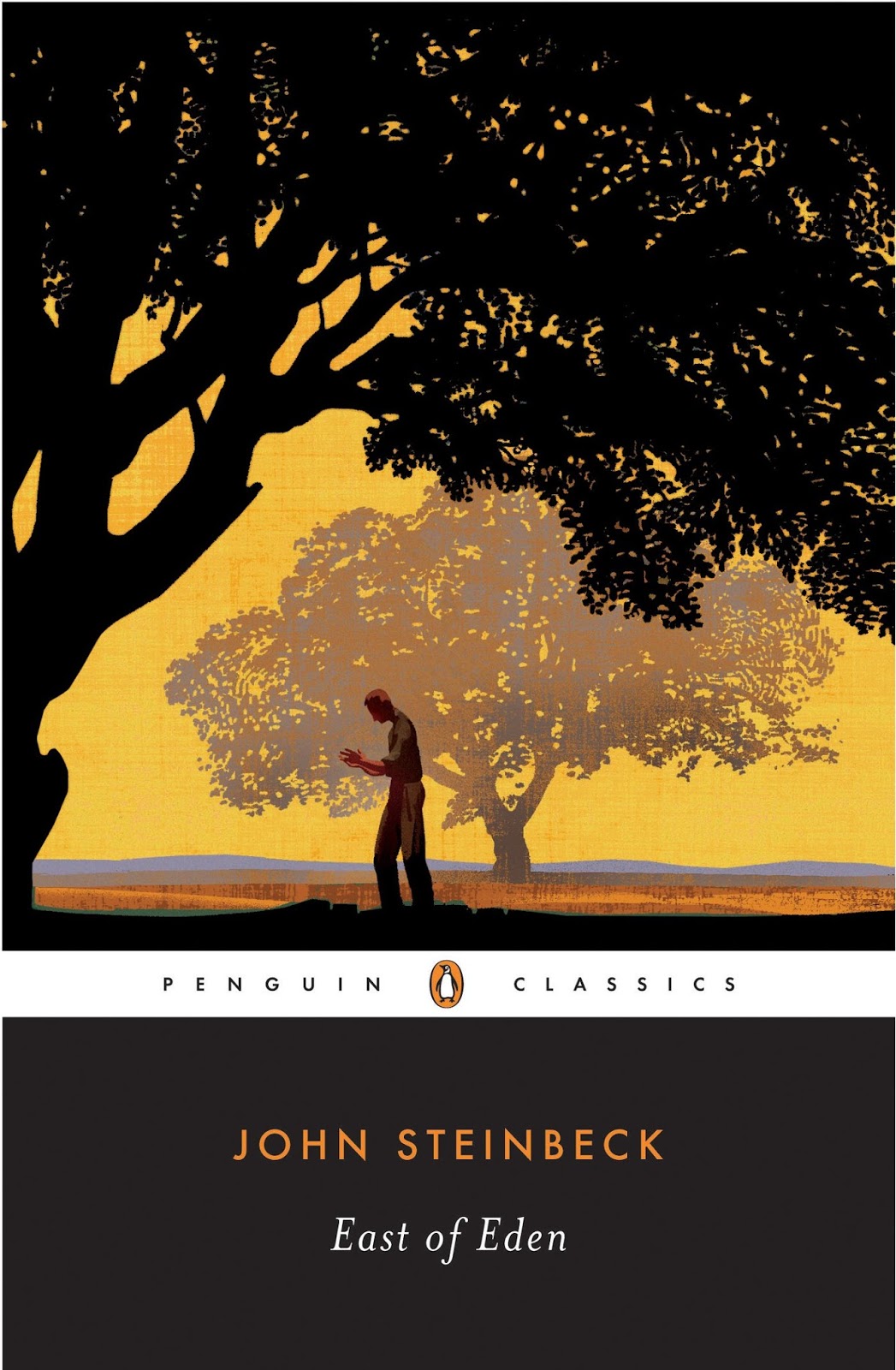
East of Eden

East of Eden
© 1952 John Steinbeck
580 pages

Why did Cain kill Abel?  East of Eden explores that question via a family saga, one that stretches across North America, spanning the continent as well as the generations;  a story that begins at the end of the Civil War ends only at the end of the Great War.  It’s the story of two families and one individual, a woman who bares more resemblance to the apocryphal Lilith than to Eve. When I approached East of Eden, I did so only as a story about brothers; I had no idea that Steinbeck mixed in his own family history, let alone that he regarded the book as his magnum opus. Only time can tell if I will remember this story as vividly as I do that of the Joads ,in The Grapes of Wrath…but I wouldn’t bet against it.

Readers who retain a familiarity with the Hebrew bible will remember that Genesis is essentially a family epic, particularly following the line of Abraham: he has a son, Isaac, who has two boys, who fight, and the victor thereof (Jacob) creates an entire litter of boys with more fighting ensuing, taking the family story to Egypt and back, until the family has become a nation.  East of Eden begins with a man and his two sons, who fight, and their story will take one brother not to Egypt but to the Salinas valley of California.  That brother, Adam Trask, wants to build a life and farm for himself in the west, but his ideals and dreams are shot when he himself is shot by a woman he shrouded with lies and hope: his wife.  Adam’s sons grow up, bearing the names Aaron and Caleb,  and their own dram

East of Eden leaves a great deal to mull over.  There is a very obvious aspect of siblings vying for their father’s affection;   Adam and Charles do this with their father, Cyrus, and  Adam’s sons Aaron and Caleb echo it with him.  The homage to Genesis is deliberate, as several characters frequently ruminate over the meaning of the story in Genesis in which Cain grows distressed after his sacrifice to God is snubbed in favor of his brother’s; that distress takes the form of murderous jealousy sentences later when Cain kills his brother and becomes an outcast, sojourning east of Eden.   Of particular interest is the fact that God “marked” Cain so that others would see him and not slay him– saving judgment for God’s own hand.  Several characters in East of Eden are ‘marked’, not through liver spots or birthmarks, but scarred through their own actions. These characters struggle with darkness; one is saturated by it, possessed by it — and others  live in fear of themselves, wondering if they are doomed to persist in their vices. That question is the great theme of the book, the question of destiny: is our fate in our hands?  For the characters it all comes down to a single word, a word that fixates rabbis and Chinese wisemen and frustrated farmers alike.

What I appreciated most about East of Eden,  is that every character save the sociopath was conflicted. The “good”, doted-on brothers frequently made mistakes, and their failures provoke the plot as much as the failures of the ”Cains’. Of course, this is a character-driven drama;  relationships here are all-important.  This was definitely a novel to savor..

Related:
Big Rock Candy Mountain, Wallace Stegner. Another family epic set in the West..

Posted in Reviews | Tagged , , , , , , , | 15 Comments

Medical tricorders, dirty old men, and controlling the internet

Before we head further into July, here are a few ‘missed’ reviews..

First up, The Patient Will See You Now. This book was part of the “Rebuilding Towards the Future” series, in which I read books about ways that ideas and work of regular people, as well as technology, are allowing us to make a better life for one another.  This particular book argues that smartphones and big data will (1) give control of their medical data to people by making them the originators of it, and (2) use that data in conjunction with everyone else’s  to fight big diseases like cancer.  He documents the incredible functionality of apps and sensors that can turn smartphones into diagnostic scanners taking all measure of readings.  I was suitable awed, but so poorly-read in the area of medical technology that I can’t comment too much. I was introduced to this book by EconTalk, as Russ Roberts interviewed its author back in May 2015.

Next:  Edward Abbey’s Black Sun.  Abbey opens with a character very much like himself, a disgusted ex-professor who has found solace in the wilderness. For half the year,  Will Gatlin lives by himself in the southwest wilderness, manning a fire tower.  His chief human contact is the radio, and a friend of his who  writes letters entreating him to come to town and chase skirts like a normal human being.  A girl shows up, and seduction follows; he is seduced by her despite having twenty years on her, and she is seduced by the wilderness. In terms of content it’s much like Hayduke Lives! — nature writing mixed with  utter randiness. Unlike Hayduke, I finished this one, as it was rather short.

Lastly, this past week I read Who Controls the Internet, an interesting mix of internet history and law. The author begins by reminding readers of  a time when cyberspace was a discrete thing, not part of our everyday life, and as an imagined world, people hoped the usual rules would not apply. They imagined a border-less new world, where people could be who they wanted, without regard to culture or the states in power. The book then goes on to explain and document how borders re-asserted themselves.  Because the internet originated as a military research project, the US did not want to lose control of it, and other governments have no interest in losing control of their people. China, for instance, aggressively pursues internet connectivity in order to propel itself forward economically, but also works with manufacturers of internet hardware like Cisco to block ‘undesirable information’ from entering the Chinese web.   Much of the borderization was driven on by people themselves, however:  as more ‘common’ people started using the internet, they began congregating with like-minded people (fellow Chinese speakers, for instance) and when they began using the internet for goods and services, businesses like Yahoo found that having region- or language-specific portals a necessity.

As Tuesday is the Fourth of July, expect some American lit and a dash of American history or biography this week.  More internet books to come as the summer progresses, too!

Posted in Reviews | Tagged , , , , , , | 5 Comments

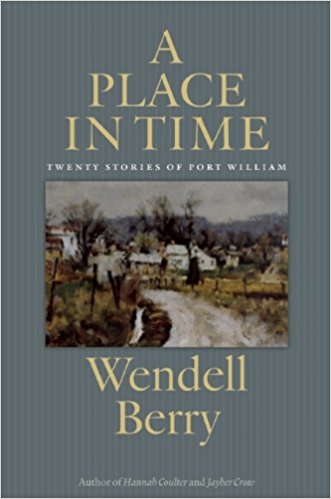
A Place in Time

A Place in Time
© 2013 Wendell Berry
256 pages

Come again to Port William (and vicinity), a community — a membership — on the banks of the river.  A Place in Time collects twenty stories of the community, all  of varying lengths, moving from the 1860s to 2013. The stories are often told in the first person, moving from person to person within the community as the years progress.    A quotation from Jayber Crow applies with force here, as to any book in the series:”Telling a story is like reaching into a granary full of wheat and drawing out a handful. There is always more to tell than can be told.”   The Port William novels, are not discrete stories by themselves, though some (Jayber Crow, Hannah Coulter) have the outline of distinction.   Instead, the stories — be they a few pages or a few hundred — are part of a greater story, one that Berry describes (through his characters) as the conversation the town has about itself.   Every story is a different view of the river;  sometimes tales repeat from the same angle.   What happens to one life is remembered in another.

Remembrance is especially important to A Place in Time,  both because it takes place over a hundred and fifty years, and the characters grow through their losses.  Every generation does; first our grandparents leave us, then our parents, then our peers. But some of Port William’s losses were particular tragedies,  forced upon the community by war.  That includes the greatest lost, Port William itself — its agricultural rhythms forever marred by the industrial-technological complex that invaded farms after World War 2. But  despite the losses, the people of Port William remember what has gone on before, and it provokes them to act in ways that seem futile, because it’s the only thing they can do.

If all this seems very general to the series itself, that’s true enough. Berry here has created twenty tales of tenderness, loss, warmth, friendship, pride, weakness — all knit together. Two stories might recount the same event from different perspectives; the events of one tale will be mentioned in another.  A reader who has read Port Williams books before will find it a reunion of old companions; someone new to the series might feel as though they had sat down in the middle of a conversation. But I think that’s true with any Port William book; although my introduction to the series was through Jayber Crow,  and aided by a narrator who came to the town as a stranger and had to learn about it himself, even then I was aware that there was more to the town’s story, that it had been going on before Jayber arrived. For me, this was just another visit with friends.

Posted in Reviews | Tagged , , | 6 Comments

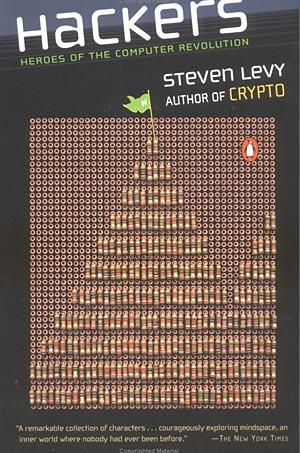
Hackers

Hackers: Heroes of the Computer Revolution
© 1984 Steven Levy
458 pages

How did computers cease to be the playthings of secretive governments, universities, and multinational corporations and become instead fixtures in 80-90% of all American homes?   Hackers: Heroes of the Computer Revolution is a history of that transformation, driven by young men who could not be satisfied with the status quo. Stealing into locked rooms, or spending night after night learning the best tricks to convert typed words into real-world action, their persistent  curiosity edged technology forward.  Their obsession with mastering computers, with pushing them to their limits and fiddling with them to get more out of them, not only influenced the development of the machines themselves, but created new industries.

Nowadays we think of a hacker as a force for ill, someone who invades others’ computers and systems and wreacks havoc or steal things.  That negative baggage was acquired only in the mid-1980s, however, when a few young people made headlines through their network intrusions.  Before that, the term referred to ..tweakers, if  you will, to those who fiddled with  electrical and computer systems to learn their ways and to see what they could do with them — often improving them along the way.  Hackers fills itself with the stories of young, awkward men (and one woman) who forced innovation by refusing to stop their incessant modding. Through these restless lives we see a progression of computers, increasingly accessible and increasingly more agile. This was not the area of “plug and play”:  some users were operating in basic assembly language,  compared to which FORTRAN and company were user-friendly.  The computers were often put to unorthodox uses, programmed as calculators or even games (Spacewar). As interested in them grew,  companies arose to put computing hardware into the hands  of technically-savvy consumers.  This was not the era of the Apple II, though — not yet. The first ‘hardware kits’ produced a machine whose ‘output’ was blinking lights.  Hackers is not all technical, however; some people who are drawn to computers have grand ideas for their use, as a portal to human awakening. Some of the pioneers here weren’t pushing hardware so much as they were access – like a computer ‘collective’ on the west coast that sought to establish a public-access mainframe in Berkeley, with a communal directory of information.

Hackers is thus a personal history of the computing revolution,  driven on by curious enthusiasts whose fascination with the potentials of these devices bordered on obsessive.  In a day where “nerd” and “geek” have achieved a kind of faux-chic,   Hackers provides a memory of the genuine article.

Posted in history, Reviews | Tagged , , , | 8 Comments

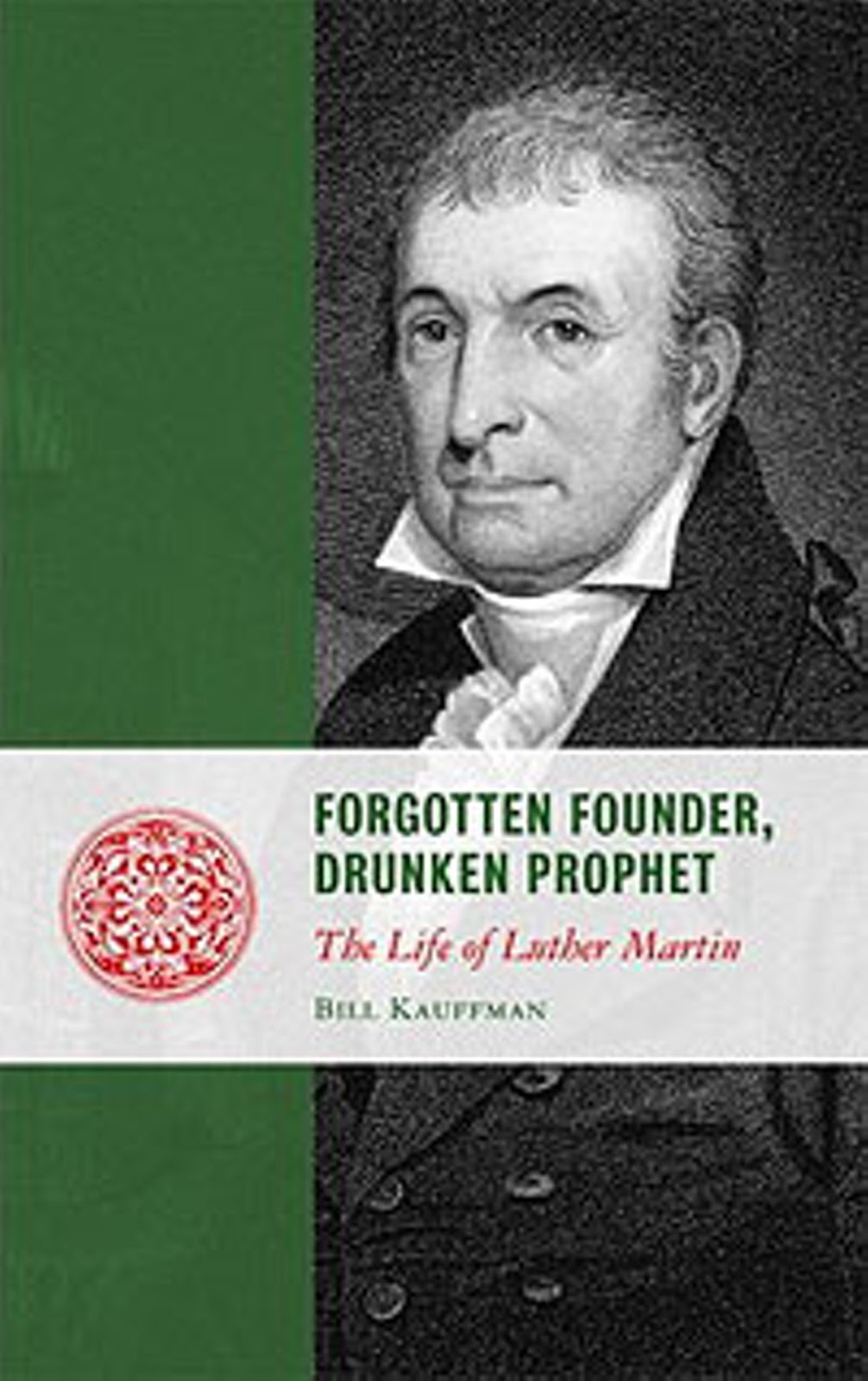
Forgotten Founder, Drunken Prophet

Forgotten Founder, Drunken Prophet: The Life of Luther Martin
© 2008 Bill Kauffman
227 pages

There isn’t enough whitewash in the world to create a Luther Martin hagiography, Bill Kauffman admits, but in the spirit of lost causes he does his best. Billed as a biography, Drunken Prophet is truly more about Martin’s role in the Constitutional debates, in which he warned the assembly that the Constitution they were debating would destroy the States altogether  Few realize today that the Constitution – -regarded as a guardian of our liberties, however much a token now — was rightfully feared in its day as a tool of big-government enterprise.  In this biography of Martin, Bill Kauffman gives voice to one of the Constitution’s chief opponents, a man who refused service in the government it created.

When the delegates invited to reform the Articles of Confederation chose instead to create an entirely new government, Luther Martin took a stand against it. He could do no other.  He wasn’t alone in being suspicious of the Constitution; Patrick Henry wouldn’t even attend the convention, claiming to smell a rat. The convention contained radicals who wanted to do away with the States themselves, men like Hamilton, and Martin was their steady opponent.  He promoted the New Jersey plan against the Virginia plan, arguing that Virginia’s bicameral legislature was beyond the scope of what was necessary. A government that need so many checks and balances was oversized to begin with.

Following the conclusion of the convention,  Kauffman’s usual energy and the book’s point drift. Technically, this is a biography of Martin, but little of import happened in his life  beyond the convention, other than a couple of court cases. Oddly, the staunch anti-Federalist became a defender of Federalist politicians, defending Sam Chase in the first-ever Supreme Court impeachment, and later defending Aaron Burr. (Kauffman notes that Burr’s only crime was invading the Southwest too early, and shooting Hamilton too late.)  Kauffman suspects that Martin’s defense of Federalists owed principally to his hatred for Thomas Jefferson.  Another case Martin participated in was the famous McCullough v. Maryland, arguing against the expansion of Federal powers.   Martin was evidently regarded well-enough in Maryland that the state imposed a tax on all lawyers just to give the aging attorney fiscal support after stroke and alcohol forced him to retire.

Drunken Prophet is the first Bill Kauffman book I’ve read that didn’t absolutely bowl me over, but those interested in the anti-federalist or republican case against the Constitution will definitely find it of interest.

The Anti-Federalists stood for decentralism, local democracy, antimilitarism, and a deep suspicion of central governments.  And they stood on what they stood for. Local attachments. Local knowledge. While the Pennsylvania Federalist Gouverneur Morris ‘flattered himself he came here in some degree as a Representative of the whole human race’, Anti-Federalists understood that one cannot love an abstraction such as’the whole human race’. One loves particular flesh-and-blood members of that race. ‘My love must be discriminate / or fail to bear its weight,’ in the words of a modern anti-Federalist, the Kentucky poet-farmer Wendell Berry. He who loves the whole human race seldom has much time for individual members thereof.

From the introduction, “The People Who Lost”.

Previous books in the Forgotten Founders series:
American CiceroCharles Carroll (Brad Birzer)
The Cost of LibertyJohn Dickinson (William Murchinson)

Posted in Reviews | Tagged , , , , | 2 Comments

The Lost Continent

The Lost Continent: Travels in Small Town America
© 1989 Bill Bryson

When I read The Road to Little Dribbling, full of Bryson complaining and thinking murderously about people who so much as annoyed him, I returned it disappointed. “Bryson’s turned into a real crank,” I thought. The Lost Continent makes me think he’s always been that way, he just hides it better in some books than others.

This book chronicles Bryson’s attempt to apparently re-live his childhood road trips, often following the very routes his father chose to get lost on in those bygone summers. That can only be a beginning, however, because by the end of the book he has visited (or at least zoomed through) all but eight of the 48 states, Hawaii and Alaska being frauds. Although billed as a tour of small-town America, he zooms through several larger cities as well. (One, Los Angeles, is pointedly avoided.) The book consists of Bryson chattering along as he drives, recounting stories of his family’s travel misadventures, complaining about the view (or rarely, admiring it), or venturing into completely irrelevant terrain. When he is not being an utter pill — heaping scorn on any development that is not a 18th century mansion, or raging against locals for being ignorant, too friendly, too suspicious, etc, Bryson can be funny. To an extent he’s funny when attacking people, but it grows obnoxious after a while.

Related:
I’m a Stranger Here, Myself: Notes on Returning to America After 20 Years, Bill Bryson

Posted in Reviews | Tagged , , | 17 Comments

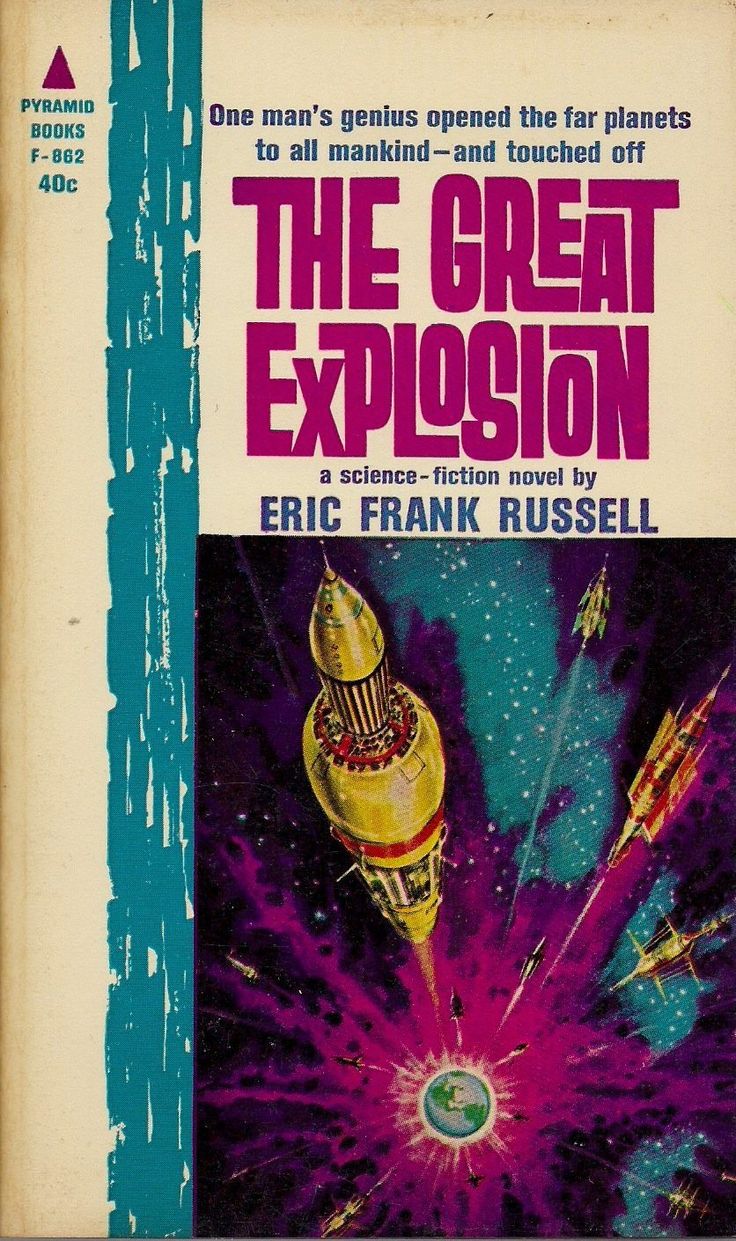
The Great Explosion

The Great Explosion
© 1962 Eric Frank Russell
187 pages

Following the discovery of faster-than-light travel, Earth’s population fell by half as her children fled to the stars.  After decades of benign neglect, the powers that be on Earth — the military and politicians — have decided to reassert their authority.  A grand ship is built, and ordered to fulfill an even greater commission:  arranging a meet between the imperial ambassador and the local leaders, so that his lordship can declare to them that it’s time to rejoin hands with Earth and march together into the future.  But as the Dude would say — yeah, well…that’s just, like, your opinion, man.

The Great Explosion is a SF comedy, an expansion of the author’s amusing “And Then There Were None” (1951).  The plot is straightforward: a ship with hundreds of crewmen, soldiers, and government flunkies visit a series of planets and attempt to reunite them to the lovingkindness  (a compound word  translating to “rules and taxes”) of Earth.  Shockingly, however, no one who left the Man behind on Earth is eager to see him come back — whether they’re criminals, nudist health freaks, or libertarians. Anyone who has had an ill experience with government functionaries — from IRS auditors to DMV clerks — will find vicarious amusement here,  as a series of rebellious characters annoy, exasperate, obfuscate, and harass humorless G-men and their pompous, pot-bellied prince.

The third story is the heart of the book, as the ship lands on the planet ‘Gand’.  The imperials  are utterly tactless in their approach to the locals, regardless of the planet, but Gand is a particularly bad place to be grabbing people and pressuring them for information. Gand is composed entirely of some tribe of libertarian anarchists, who don’t cotton to authority.  So deeply do they loath the idea of uniformity or regimentation that there isn’t even a common style of clothing.  Every  intrusive question is answered “Myob*!”, and attempts to physically coerce the Gands is met with civil disobedience. One exploring sailor on his bicycle, out of uniform, manages to discover what makes the Gands  tick. Close to the Gandian heart is cooperation; they don’t even use money, instead using a barter system of favors, or “obs”. The Gands live in small communities in constant contact with one another, meaning that free riders (‘scratchers’) don’t get away with it for too long. Those who break rules are shunned. The Mahatama would be intrigued.

As a novel there are faults; the health-nudists of Hygeia, for instance, insist that Earth deal only with them, and ignore a smaller community on their planet. Why?  Who knows, because  the Earthers leave without this other community ever being mentioned again. There the ship goes directly to another planet where there were settlers, but now…there aren’t. Every sign of civilization also points to the planet’s population being long gone, their structures surrendered back to Nature. What happened there — again, who knows, because the Earthers enter orbit, decide not to risk a pandemic, and break orbit.  As a rule, creators of fiction avoid introducing elements have have no functional element in the story, so to see two instances of it back to back was rather odd.

Still, I enjoyed the original short story, and this expansion of it.  It’s a short bit of comedy with some food for thought sprinkled in.

*Mind your own business!

Related:
The Moon is a Harsh Mistress, Robert Heinlein. Another libertarian society where culture is more important than force.
The Martian Chronicles, with another chapter of free-spirited settlers being chased down by  humorless drones working for the government.

Posted in Reviews, science fiction | Tagged , , | 16 Comments

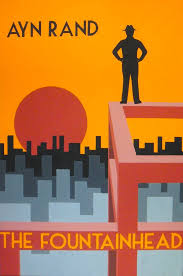
The Fountainhead

The Fountainhead
© 1943 Ayn Rand
753 pages

“Howard Roark laughed.”   This epic novel opens with the roar of its main character, leading the reader to wonder what is to come. Is he laughing in triumph? In fatalistic glee, like a Spartan before the Persian hordes?   The Fountainhead is his story, his triumph over those who would crush or control him. It is an eight hundred page tale, featuring only five principle characters, all of whom grapple with one another.  Written consciously as a heroic epic for a world in need of  a fire lit under its bottom,  it is an confrontational story, targeting the reader,  that deserves its reputation. In the end it is not a book about economics, or politics; at its heart, this is a novel that forces each character and the reader to answer the question: What are you living for?   Is it for your own convictions, or for the approval and at the whim of others?

First and foremost, The Fountainhead is a novel about integrity. The main character, Howard Roark, wants to be an architect — but for him, designing buildings isn’t just an occupation. It is an expression of his soul, something he pours his everything into.  Roark designs and builds according to his belief that form follows function, that the site and materials of a building should spur its design. Not for him are the fake Greek pillars of Beaux-Arts, standing pretty but adding no functional support. (He would not be a fan of McMansions, brimming over with random and functionless elements, from fake shutters to mismatched windows).  If Roark can’t design according to his guiding principles, he simply won’t;  he’s content to work in a quarry if no one wants his kind of building.    He encounters occasional interest, however, and develops a practice in New York — and through that practice, establishes a certain reputation for obstinacy.  He won’t design a building that he doesn’t believe in, and those who are accustomed to wheedling, manipulating, etc, gaze at him with disdain and indignation. Who does this man think he is, refusing work and scorning compromise? Maybe he should be taken down a peg or two…

The book remains controversial because its main character lives out a creed that the author, Ayn Rand, championed as ‘the virtue of selfishness’.   On the face of it, this is a slap in the face to every belief system — religious, political, moral-philosophic — on the planet.  Even the beasts of the field, to use language Rand would despise,  engage in mutual aid. As I progressed through the novel, it seems to me that Rand/Roark had something altogether different in mind than the usual understanding of selfish. The main character is self-possessed, self-driven — but he does not use others for his own private gain.  Roark does not dismiss self-sacrifice; he tells one character he would die for her, and at one point when waxing on the beauty of the New York City skyline — the will of man made visible,  creativity rendered corporeal —  he declares he would fling himself bodily on these buildings to protect them from war.  But it is the act of will that is important;  Roark cannot be satisfied if he is not the master of his fate, the captain of his soul.  His convictions are such that he cannot allow anyone to think for him, to manipulate him into doing anything he does not believe in doing, to force him to sacrifice his time and creativity against his will.  He is like the woman in Fahrenheit 451 who sets the match to her own house and to her own person rather than surrender them; like  Henry David Thoreau, who chose to be thrown into prison rather than give money to pay for an unjust war.  Even like Gandhi, who maintained* if he were imprisoned the British would have his body — but not his obedience.

We see why Roark lives as he does, through  other characters who act as foils.  Most prominent among these are his sometimes-colleague, Peter Keating. Unlike Roark, Keating doesn’t have the courage of his convictions; he constantly seeks the approval of others, even when designing products of his own. He sinks hours and hours of his life in socializing with people he doesn’t actually like,  diligently making connections so he can get bigger jobs, better commissions, and more influence. By novel’s end, none of this has made him happier. He is old before his time, and he isn’t even proud of his work, because so little of it is actually his.  Hank Williams said it best:  wealth won’t save your poor wicked soul.  Another minor character of note is Peter’s jilted finance, a relationship he let lapse because another woman offered better connections, even though he loved the jiltee genuinely.     All of the principle characters seemed strange to me, save Peter Keating,  but as the novel reached its height — the second trial of Howard Roark,  accused of blowing up his own building rather than allow other designers to mar it —  I found him admirable in his constancy. The rest are either deceitful manipulators who keep their actions and motives in the dark, or pliable creatures whose actions move with the wind, like Keating and another. Howard, for all his strangeness, is constant.

While I still regard a worldview centered around individualism as problematically simplistic, in the limited context of The Fountainhead there is no difficulty at all in appreciating Roark’s stand. This novel champions integrity and creativity, and while it calls its champion selfish, the men who act in in the way we truly understand as selfish are the bad guys. They are the would-be dictator who uses a political platform of equality-first to manipulate unions,  or people who marry others not to love them  but to seek advancement.  But ironically, by Roark’s understanding, their selfishness is Other-driven: they are obsessed with power over Others, with reputation in the eyes of Others,  with things that Others will admire. Their actual selves are shallow, empty creatures, like the  pathetic, shriveled thing that was Voldemort in the aftermath of Harry Potter and the Deathly Hallows.  Early on Roark meets a woman who wants him to design a house with a historical look. When he asks her why — why she came to him for this kind of work, which he did not do, and why she wanted that kind of house in the first place —   Roark receives nothing but vague answers and references to her friends.

“He tried to explain and to convince. He knew, while he spoke, that it was useless, because his words sounded if they were hitting a vacuum. There was no such person as Mrs. Wayne Wilmot; there was only a shell containing the opinions of her friends. the picture post cards she had seen, the novels of country squires she had read; it was this that he had to address, this immateriality which could not hear him or answer, deaf and impersonal like a wad of cotton.”

Whatever the limitations of Rand’s philosophy as a whole, The Fountainhead is a call to life.  One can — without knowing anything of Objectivism, let alone embracing it —  appreciate Roark’s stand. Without being a Stoic, a person can monitor their thoughts from time to time and ask: why am I dwelling on this? What good is it doing?  Likewise, without adopting Rand’s philosophy in full, a person can monitor their thoughts and actions and ask: why am I doing this? Am I doing it because I want to, or am I merely following the path of least resistance?   We needn’t be self-obsessed, but we can at least maintain a level of self-possession, to be present and active in our lives. These are the questions that have made hippies, that have sent people to Quaker communities and on other journeys — questions that sent Thoreau to Walden Pond.  Having climbed Mount  Roark with this novel,  I think Rand deserves more thoughtful consideration than outright dismissal.

Architectural Addendum: 
Architecture is important to the Fountainhead, being Roark’s reason for living. His attempt to maintain his own integrity and the buildings are linked. as I’d expected to dislike Roark’s architecture on principle, because very little of the 20th century’s building designs appeal to me. They are all bizarre forms that are  building-size art projects, or dismal inhuman hulks, like the cattle pens for proletarians the Soviets called apartments.  Roark’s architecture is not bizaare; it follows a certain logic. And it is not inhuman: Roark’s designs are explicitly humanistic, designed for perfect and comfortable use rather than public approval. (Unlike the works of the starchitects!)  He builds to the human scale, with grace and proportion– his designs are nothing like those featured on something like Jim Kunstler’s ‘Eyesore of the Month”  series.

*Well, sort of. It’s a line given to him in the Ben Kingsley performance of Gandhi.  It’s a belief completely consistent with his character, so far as I know it from reading books like The Story of My Experiments With  Truth.

Related:
A Man in Full, Tom Wolfe. Another epic novel about two men sloughing off banal expectations and learning to stand and live with steel in their soul.

Posted in Reviews | Tagged , , , | 6 Comments