Midnight’s Furies

Midnight’s Furies: The Deadly Legacy of India’s Partition
© 2015 Nisid Hajari
352 pages
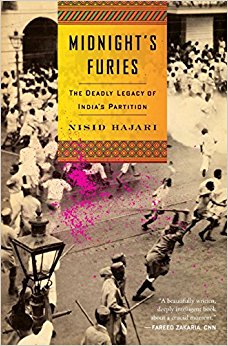
Although greater India has rarely remained united in its long history, there was every reason to hope that it would emerge from the centuries of British dominion in one piece. Instead, the people of India erupted as two — then three — nations,  with armed borders and bloodbaths between them.   Midnight’s Furies is a history of how the Partition happened, and a full account of the massacres on every side until the United Nations was able to meditate a cease-fire.  Although its pages are bloodsoaked, no less  than a history of the fighting and civilian slaughters between Hitler and Stalin’s empires in WW2,  it does deliver a sad understanding of why tensions between India and Pakistan continue to haunt the region and the world.

The two most prominent personalities of this tale are Jawaharlal Nehru, a key figure in both the independence movement and India’s Congress Party, and Muhammad Ali Jinnah,  also a leading voice in the movement but one who relied on Muslim support.  Although both Nehru and Jinnah supported a future for India as a secular state,  the long road to independence and personal quarreling made them feuding allies at best, and rivals at worse.  Gandhi gave the Indian independence movement a strong populist flavor; his supporters were not middle-class Indians, but India’s poor masses, and the Mahatma and his followers channeled their desires and energy through Hindu religion. This was exceptionally  off-putting to Jinnah, who not only feared Hindu nationalism given his Muslim background, but had a marked distaste for the underclass, reluctant even to shake hands with his followers. As the movement grew larger and more populist, Jinnah was marginalized and found relevance only by doubling-down on his Muslim background and becoming an stubborn voice for a Muslim state that would protect its citizens’ wishes against the Hindu majority.

Although Nehru comes off much better here (confronting the leaders of mass violence, dreaming of a united India)  Hajari does delve into his culpability. As the day of withdrawal grew closer and Indian leadership became a fact, not a proposal,  Nehru targeted his critical energies against Jinnah’s partisanship with the same zeal he’d once thrown at the British.  In treating Jinnah  and his followers like the enemy, he aided the two countries’ downward spiral of accusation, attack, and counterattack.  The bloodbath that overtook the country  when the Partition came into effect — as majorities tried to push minorities out — was not exactly their ‘fault’, but their inability to work with one another set the stage. (Jinnah’s call for “Direct Action” to effect Pakistani independence from India kicked off the blood feud, however, so he seems more culpable than Nehru.)  The violence was not a simply Hindu v Muslim feud;  in the Punjab, where the new state line split the militant Sikh community in two,  it involved Sikhs and Muslims.   The ever-present spiral of violence is obvious here: one community attacks the other ,who attacks the first in self-defense, who attacks the other in reprisal, etc.  The aggression and violence simply keep ratcheting up, until the streets are literally filled with broken bodies, including children, and air is filled with the smell of  blood and the cry of wounded and raped victims.

This is not a book for the faint of heart, though it’s not as gruesome as The Rape of Nanking.  Although ending in 1947,  the spasm of brutality documented here continues to effect Indian and Pakistani relations, and particularly Pakistan’s foreign-policy worldview. For it, India remains the existential threat and the priority — not cold wars or terrorism.

Posted in history, Reviews | Tagged , , , | 3 Comments

Redshirts

Redshirts: A Novel With Three Codas
© 2012 John Scalzi
320 pages
Audible presentation read by Wil Wheaton, runtime 7 hrs 41 minutes.

“I’m not even supposed to be here! I’m just Crewman #6. I’m the guy in the episode who dies to prove the situation is serious!” (“Guy”, GalaxyQuest)

Redshirts is not what you think it is.

To be sure, it’s mostly what you think it is, what you’ve heard it is; a spoof of Star Trek that mixes it in with concepts from The Truman Show and Stranger than Fiction, and comes within a few words of quoting that other great Star Trek spoof, GalaxyQuest. As far as spoofs go, it lives up to its reputation for being hilarious and meta. We have self-aware redshirts who avoid interactions with the bridge crew of a Federation , having realized that those guys go on away missions with crewmen and come back with bodybags. One member of the crew believes that the good ship Intrepid is in fact a TV show, and that when strange things happen, that’s the Narrative at work. A lot of the silliness of shows like Star Trek is played with, particularly plot implausibilities, and the ability of battered characters to heal overnight, like the much-abused Miles Edward O’Brien. After a couple of ensigns begin to that they’re living in a conspiracy, they go on a mission to put things to rights, and it involves time-travel, doppelgangers, and other such hijinks. If that were everything, I’d put this book up on the shelf having gotten my laugh, and think of it fondly from time to time as I do Night of the Living Trekkies. But that’s not the entirety of Redshirts. Buried at the end are three codas, titled “First Person”, “Second Person”, and “Third Person” respectively. These three codas transform an amusing novel into one which is profoundly moving. I can’t say if the conclusion’s effect on me is merely a consequence of the author’s writing, or if it was Wil Wheaton’s delivery. Suffice it to say, I never thought Wil Wheaton could move me, but he did.

Posted in Reviews, science fiction | Tagged , , , , , | 7 Comments

Consent of the Networked

Consent of the Networked; The Worldwide Struggle for Internet Freedom
© 2012 Rebeca MacKinnon
352 pages

A couple of weeks ago I read Who Controls the Internet, which covered in part nation-states’ role in reasserting national boundaries in cyberspace. Consent of the Networked  examines threats to the open internet, both from states and corporations.  The threats are not always overt, like the Chinese state apparatus that keeps the Chinese internet connected to the global net only through a half-dozen filtered gateways, or the common suppression of social networks in times of social unrest, as we witnessed in Tunisia and Egypt during their respective revolutions, and in Iran during the controversial reelection of former president Mahmoud Ahmadinejad.   The author also examines more indirect threats to an open internet; the  irresponsible privacy policies at Facebook, for instance, which  issue updates that change privacy settings without giving appropriate forewarning. In some countries, a policy update that exposes bloggers, tweeters, etc’s real identities can lead to imprisonment or worse.  Other threats include the end of Net Neutrality,  an end which might channel people into using particular social networks. If those networks are as cavalier about user info as places like Yahoo and Facebook have been,  activists and others could be compromised all too easily. MacKinnon also sees overly-aggressive attempts by companies to protect their intellectual property as a threat to free expression.

Intriguingly, MacKannon does not demonize solely the private sector or the public; both have compromised people, and the free democracies have few bragging rights: just recently, the United States and United Kingdom were both named as ‘enemies of the Internet’ for their intensive surveillance.   (Sometimes public and private work together, as when Cisco became a partner to China in its firewall enterprise, and Yahoo thoughtlessly handed over user info when requested…again, by China.) MacKinnon isn’t particularly enthusiastic about the United Nations, either, but  holds that international agreements are a necessary road forward given the internet’s global nature.  While the only surprise here for me was the degree of European governments’ internet surveillance and strictures. Given their constant run-ins with Google over privacy, I’d had the impression they were better about safeguarding private internet security than the U.S.

Posted in Reviews | Tagged , , , | 9 Comments

Unsettled America

Last week I read Wendell Berry’s The Unsettling of America, on the subject of agriculture and culture. Its title is apt, because Berry believes that the triumph of industrialism — as it has turned farms into agribusinesses, and America from an agrarian republic into an industrialized, centralized, state –has put on us an unsustainable trajectory. Berry’s writings are of interest to me not because I believe in an agrarian revival, or pine for a lost utopia, but because his insights go deeper than the simple defense of family farms.  He views man not as a creature walking across the Earth, but one who has a role in it — as a steward, a husband.   The care of Earth in Berry’s view is not maintaining it in perpetual stasis, but working it as a co-creator, healing the land and aiding in its increase.  This role, destroyed when man simply uses, plunders, or conquers Earth, is to the ruin of man as well.   To abandon creation, to become mere consumers, is to die a slow death.   I’ve  ruminated over Berry’s view in much of his nonfiction, and so would like to leave one of the most provoking passages of the book, one that reminds me of the anomie predicted in Kurt Vonnegut’s Player Piano.

====================================================
“The beneficiary of this regime of specialists ought to be the happiest of mortals – or so we are expected to believe. All of his vital concerns are in the hands of certified experts. He is a certified expert himself and as such he earns more money in a year than all his great-grandparents put together. Between stints at his job he has nothing to do but mow his lawn with a sit-down lawn mower, or watch other certified experts on television. At suppertime he may eat a tray of ready-prepared food, which he and his wife (also a certified expert) procure at the cost only of money, transportation, and the pushing of a button. For a few minutes between supper and sleep he may catch a glimpse of his children, who since breakfast have been in the care of education experts, basketball or marching-band experts, or perhaps legal experts…

The fact is, however, that this is probably the most unhappy average citizen in the history of the world. He has not the power to provide himself with anything but money, and his money is inflating like a balloon and drifting away, subject to historical circumstances and the power of other people. From morning to night he does not touch anything that he has produced himself, in which he can take pride. For all his leisure and recreation, he feels bad, he looks bad, he is overweight, his health is poor. His air, water, and food are all known to contain poisons. There is a fair chance that he will die of suffocation. He suspects that his love life is not as fulfilling as other people’s. He wishes that he had been born sooner, or later. He does not know why his children are the way they are. He does not understand what they say. He does not care much and does not know why he does not care. He does not know what his wife wants or what he wants. Certain advertisements and pictures in magazines make him suspect that he is basically unattractive. He feels that all his possessions are under threat of pillage. He does not know what he would do if he lost his job, if the economy failed, if the utility companies failed, if the police went on strike, if the truckers went on strike, if his wife left him, if his children ran away, if he should be found to be incurably ill. And for these anxieties, of course, he consults certified experts, who in turn consult certified experts about their anxieties…

It is rarely considered that this average citizen is anxious because he ought to be… He ought to be anxious, because he is helpless. That he is dependent upon so many specialists, the beneficiary of so much expert help, can only mean that he is a captive, a potential victim. If he lives by the competence of so many other people, then he lives also by their indulgence; his own will and his own reasons to live are made subordinate to the mere tolerance of everybody else. He has one chance to live what he conceives to be his life: his own small specialty within a delicate, tense, everywhere-strained system of specialties.”

Posted in quotations, Reviews | Tagged , , | 6 Comments

Yokohama Print from Cultural History of Japan

In my “On the Horizon” post, I mentioned a print reproduced in  an art history of Japan which depicted a woman in traditional dress riding a bicycle. The book mentions it only as a Yokohama print, with Fuji in the background.

Source: The Cultural History of Japan, Henri Stierlin.  Printed by Aurum Press in London, 1983.  All photographs and prints were attributed to Stierlin.

Posted in General | Tagged , | 3 Comments

The Job

The Job: True Tales from a New York City Cop
© 2015 Steve Osborn
272 pages

Steve Osborn grew up by his father’s side in a bar, standing on boxes to play pinball and idolizing the men his father hung out with. They were all cops, and their lurid stories of policing the City’s streets captivated him. He knew that’s what he wanted to do — and at some point in the early eighties, he became a patrolman in New York City, and started collecting stories of his own. The Job shares some twenty-odd tales of life on the beat, starting from his first rookie patrol to his last takedown.  Although these stories are shared for their entertainment value, they’re not uniformly comic;  instead, we see a young adrenaline junkie maturing into a tough beat cop, whose emotional walls are sometimes broken by events like 9/11,

The Osborn evidenced here is a natural beat cop; he has no desire to be a detective, rise as an administrator, or work for something like the FBI;  his happy place is the city street,  where he can mingle with people and watch them, and ‘collar’ the ones that prey on their fellow New Yorkers.  I referred to Osborn as adrenaline junkie before, because he loves chasing down suspects, and his enthusiasm is such that in his early years they led him to doing really dumb things, like following a robber into the subway tunnels.  When he’d gotten far enough in be stuck, and felt a train approaching from behind him, he could only think that this was a stupid, stupid way to die and that from now on, he’d be the morbid example used in Track Safety classes.  Osborn’s passion for the job, and for his home city in particular, allowed him to flourish as an officer and truly connect with his partners,  some perpetrators, and citizens themselves.

Although throughout the book Osborn established himself as a world-weary cop,  forever scanning and processing the people and places around him for trouble,  using dark humor to cope with the horror and uncertainty that his occupation makes him face every day,  a few stories show another side.  Early on, for instance, he’s assigned to investigate a foul odor in an apartment — but runs into a problem when he learns that that the foul odor is most definitely a body, and the deceased’s parents are waiting outside the apartment demanding to see their child one last time.    The young lady has at this point been dead for days,  and decaying in a stifling-hot July apartment.  Knowing he could not allow the woman’s mother to see the ghastly remains, the putrefied blob of something that was human,  Osborn finds some source of inner strength that allows him to take a knee and convince the sobbing, desperate woman that she doesn’t want to see her daughter this way.   It’s one of the first times Osborn realizes his job was about taking care of people, not just chasing bad guys.     Another break in the tough-guy wall comes shortly after 9/11, when — scarfing down McDonalds during a multiday shift pulling out bodies from the rubble —  Osborn discovers a card made of construction paper tucked into the bag. Somehow, schools across the country had gotten their kids to make “thinking of you” cards for fire&police officers, and place them in the meals being given out to first responders. The realization that New York is not alone, that people across the nation are thinking and standing with them, almost makes the grizzled lieutenant cry in public.

Page for page, 400 Things Cops Know* is more informative about the way police officers notice and interpret the world, but The Job humanizes an occupation and an institution (the NYPD) that is  being increasingly villanized.   While Osborn doesn’t comment on this directly, he does include stories of being attacked by mobs just for making arrests on the streets, and presumably his sympathies are with the officers.

*I read 400 Things last year, but did so over the course of several months, reading a few chapters at a time when visiting a local Books a Million and drinking coffee. Because I kept skipping around, I’m not sure I read it in its entirety.

Posted in Reviews | Tagged , , , , | 5 Comments

American Independence Wrapup & On the Horizon

Well, gentle readers,  July’s halfway marks the conclusion of my American Independence series, at least for another year. What ground did I cover this year?

  • Revolutionary Summer, Joseph Ellis;  a history of the summer of 1776,  in which the States declared their independence, and the British fleet arrived to squash the rebellion.
  • Forgotten Founder, Drunken Prophet, Bill Kauffman;  a biography of Luther Martin which is principally about the Constitutional debates. Martin was the most prominent republican (‘anti-federalist”) in attendance
  • The Lost Continent:  Bill Bryson travels the United States to revisit childhood trips through small-town America, regaling the reader with memories and reflections. Though Bryson pines for an image of small-town America, whenever he arrives in a small town he complains about the lack of restaurants and the presence of locals.
  • A Place in Time, Wendell Berry. Stories about the Port William membership, a ready remembrance of the America that was.
  • East of Eden, John Steinbeck; a family epic set in the Salinas Valley of California that revisits the story of Cain and Abel.
  • Passionate Sage, Joseph Ellis; on the character and beliefs of John Adams.
  • Unsettled America, Wendell Berry.  Berry’s first and most famous defense of agrarian America, doubling as a condemnation of the thing that replaced it.

I’d also been reading Founding Federalist, on the life of Oliver Ellsworth, but halfway in realized I am very tired of reading about the Constitutional convention.  It’s time to move along, and resume this year’s study series: the Discovery of Asia. I’ve eased myself back into the waters with Japan: A Cultural History, which is presumably dated given its early-1980s publication,but contains some outstanding photography.  The author takes readers briefly through a sketch of Japanese history that mostly serves to provide context for the art that is commented on;  the era of the pre-Shogunate civil wars is covered in the chapter on castles, for instance.  Architecture is the chief focus here, but there are also sections on laquerware and prints.  A favorite of mine features two Japanese women and a bicycle.

This isn’t the print…I am still scouring the web for any digital reproduction of the one I saw.

Earlier in the week I also finished India: A New History, so the Discovery is on the move!

Posted in history, Reviews | Tagged , , , , | 5 Comments

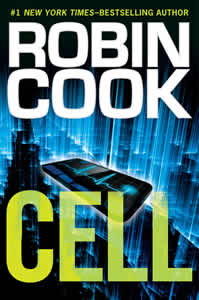
Cell

Cell
© 2014 Robin Cook
416 pages

The future of medicine is here, in the form of a smartphone that can function as a medical diagnostic tool, complete with a machine-learning program called “iDoc” which monitors patients’ diets and vitals,  chatting with them about their health and prescribing advice or pills as appropriate.  iDoc is poised to revolutionize medicine,  reducing costs and focusing on long-term preventive care rather than crisis response. Why then,  does a small but chronic percentage of  its beta test group keep dying?

The premise is the most interesting part of Cell, and once it’s absorbed early on everything else is downhill. The main character is a radiologist trying to cope with the sudden death of his fiance, and perhaps his grief keeps him distracted: as a main character goes, he’s not particularly savvy.  He’s kind of dumb, in fact; at one point he’s being transparently probed for info by a woman in a bar and is completely oblivious, despite the fact that he didn’t seem all that interested in her to begin with. (Why is he even dating a couple of months after the love of his life died?  Plot demands, I suppose.)

Fortunately for him, the ‘bad guys’ aren’t really bad guys, they’re just managing a problem and at the end of the day, everyone goes home happy despite deaths, car chases, kidnappings, and burglary; the main character’s faint worries are taken care of by dropping a letter to a friend with the message “If anything happens to me, read this and do what you will” attached to a longer report.   At the heart of the story Cook is embedded a serious question about medical ethics, one iDoc ignores with HAL-9000esque execution.  Robin Cook seems to be a very popular author, so I may give him another try, focusing on his earlier work in which the medical thrills were more important than the author’s brand name.

As thrillers go, this was an excellent premise that unfortunately flatlines once the stage is set.

Posted in Reviews | Tagged , | 5 Comments

A New History of India

A New History of India
© 2000, sixth edition Stanley Wolpert
471 pages

India isn’t an easy place to keep running. Stanley Wolpert’s A New History of India gives a chiefly-political, mostly-modern history of one of the world’s most ancient civilizations, a land whose soaring mountains and depth of peoples have frustrated long-term attempts at centralized control.  Beyond a geographic introduction,  and some early  content on  Indian religion, culture, and literature,  A New History largely delivers a story of rulers and killings.    The Indian subcontinent seems to have been riven in war for most of its history,  with occasional figures like Ashoka and Akbar rising to reign over largish- and stable-ish parts of the north.   This pattern of central authority giving way to chaos, then back to authority again, has a heart-like rhythm about it.  British India  receives the lion’s share of attention (both the accretion of British authority, and the Quit India campaign)  and as the book draws closer to the ‘modern’ period, the author gets saucier.  In the section on WW2, for instance,  he refers to the Japanese catching the British at Singapore with their gin-and-tonics half-down.   This particular edition covers India (and Pakistan) up to the year 1999, but later editions cover India until until 2008.  Frankly, I found the running commentary on India in Nehru’s Glimpses of World History  far more useful as far as pre-modern history goes.   This reminded me a bit of The Persians: Ancient, Medieval, and Modern Iran  in its near-solitary fixation on rulers, deaths, and successions.

I think I may follow this with  Nehru’s own The Discovery of India, the name of which I am borrowing for this Discovery of Asia inquiry into Indian and Chinese history.

Posted in history, Reviews | Tagged , , , , | 6 Comments

Passionate Sage

Passionate Sage: The Character and Legacy of John Adams
© 1993 Joseph Ellis
288 pages

G.K. Chesteron once wrote that the Catholic Church is the only thing that saves a man from the degrading slavery of being a child of his age. I don’t know that the Church has a monopoly on timelessness, but some historic personalities have  a sense of integrity that bids me think they would remain who they were if they were plucked up bodily and thrown into another age. Robert Ingersoll is one such man; John Adams is another.    This sense of integrity isn’t magically imbued;  it requires a certain force of mind, and the decision to root one’s self in deeper principles.  Passionate Sage is a rare treatment of John Adams which focuses on him not as an architect of the revolution, or as an executive officer, but as a retired statesman coming to terms with what he and others had wrought —  satisfied with what he’d done, even if he was regarded as an anachronism. He had followed his own convictions, and that was enough.

Ellis’ treatment of Adams make me suspect that Adams would be his own man in any time because while classical allusions were rife in the founding era,   Adams’ very soul was grounded in the classical tradition. Some revolutionaries like Thomas Jefferson believed that the Revolution had made all things new again, that institutions like monarchy which prevented people from fulfilling an innately good nature had been escaped from.  Adams held to an older view, however, that man was flawed and would constantly struggle with his inner demons — that virtue and vice hold us in a perpetual tug of war. Our greatest flaw, Adams believed, was pride and vanity; these would drive men to compete ferociously with one another even if they were economic equals.  For Adams, the great problem of politics was how to build a productive government that took human frailty in mind. He was a grim realist in an age of idealism.   This led him to promoting unpopular ideas — for instance, that the presidency should be invested with a certain sense of awe, not to honor the person but for the office and for the law’s sake. If people do not believe in the law, have a certain respect for it, it loses its persuasive power.  If awe does not work, people resort to brute force — and things go to pieces. His pragmatism also led him taking a high and lonely road during his administration, when he doggedly pursued a course of non-interference during the Franco-English spats of the time. Federalists looked to trade and defense deals with England,  and Republicans looked to France. Adams defied them both,  following his studies of philosophy that indicated one must do the right thing even if it was unpopular. Adams hoped that history would vindicate him, and on that matter it has. (Ellis notes that Adams often chose the course of action that would alienate the most people, being suspicious of popularity even as he desired it.)

Although Ellis focuses on Adams’ thinking and writing, even still we get glimpses of Adams the man — reading ferociously, for instance. Adams  not only challenged Jefferson in terms of the piles of books they both read, but filled his books with notes arguing and debating the authors. Adams loved a good intellectual bout, though his approach was more a pugnacious boxer’s than an exercise in rapier wit.  In his exchange of letters to Thomas Jefferson, for instance, he fired off as twice as many letters as he received.  Although  often bombastic in his criticisms (especially where the “bastard brat of a Scotch pedlar”, Alexander Hamilton, was concerned),   Adams’ delight in conversation meant that he’d mend bridges with people like Jefferson or Mary Otis Warren just so he could  lock horns with them again. Although by the time he died Adams was regarded as highly as Jefferson, throughout the 19th century his reputation was steadily surpassed by his old friend, who sometimes seemed to be shadowing Washington.   Ellis attributes this to the triumph of Jacksonian democracy, which had and less use for Adams’ caution, and still  less for his philosophic intransigence.

For my own part, I have found Adams endearing and redoubtable ever since discovering him via 1776 and David McCullough.  Although self-conscious about his frailties, particularly his vanity and temper, that never stopped him from charging ahead in a roar, with a mouth firing off fusillades.  He had a rare energy that left him only when the grave took him.

Related:
John Adams, David McCullough. Selected  Adams quotations from the same.
First Family: John and Abigail Adams, Joseph Ellis

Posted in Reviews | Tagged , , , , | 8 Comments