This week features a quote from Will Durant, whose epic Story of Civilization, partially co-written with his wife, was a masterful review of western history — surveying literature, politics, philosophy, etc — from Mesopotamia to Napoleon. This particular quote comes from his much shorter Heroes of History, which introduced me to the author.
“I will not subscribe to the depressing conclusion of Voltaire and Gibbon that history is ‘the record of crimes and follies of mankind’. Of course, it is partly that, and contains a hundred million tragedies — but it also the saving sanity of the average family, the labor and love of men and women bearing the stream of life over a thousand obstacles. It is the wisdom and courage of statesmen like Winston Churchill and Franklin Roosevelt, the latter dying exhausted but fulfilled; it is the indiscouragable effort of scientists and philosophers to understand the world that envelops them; it is the patience and skill of artists and poets giving lasting form to transient beauty, or an illuminating clarity to subtle influence; it is the vision of prophets and saints challenging us to nobility.
“On this turbulent and sullied river, hidden amid absurdity and suffering, there is a veritable City of God, in which the creative spirits of the past, by the miracles of memory and tradition, still live and work, carve and build and sing. Plato is there, playing philosophy with Socrates; Shakespeare is there, bringing new treasures every day; Keats is still listening to his nightingale, and Shelley is borne on the west wind; Nietzsche is there, raving and revealing; Christ is there, calling to us to come and share his bread. These and a thousand more, and the gifts they gave, are the Incredible Legacy of the race, the golden strain in the web of history.
” We need not close our eyes to the evils that challenge us — we should work undiscouragingly to lessen them — but we may take strength from the achievements of the past; the splendor of our inheritance. Let us, varying Shakespeare’s unhappy king, sit down and tell brave stories of noble women and great men.”
Fathers and teachers, I ask myself: “What is hell?” And I answer thus: “The suffering of being no longer able to love.”
The Brothers Karamazov has the unusual distinction of having been recommended to me, repeatedly, over a course of fifteen years, by both hardened atheists and arch-traditional Catholics. First appearing as a family drama and murder mystery, it quickly proves to be far more substantial than that, doubling as a medium for philosophical debate about the nature of man, God, and the cosmos. In this first reading, I’m almost certain that there’s much I’ve missed, and yet even so I suspect I’ll be thinking about it for a long while to come.
I didn’t think much of the Brothers K at the start, peopled as it was by some fairly odious characters. Fyodor Karamazov, for instance, is a man so void of principle he cannot even rise to the level of villain; he is merely a pig, divided between appetite and filth. He’d somehow married twice, and driven both women away, and between the two had three legitimate children — there being a fourth, if you believe the town gossips. The brothers Karamazov are archtypes of a sort, all with extreme personalities; Dmitri is the most his father’s son, and is another of creature and appetite — though as the narrative progresses, he proves to have something worthier inside. Then follows Ivan — the rationalist and skeptic, who struggles with his sanity late in the novel and strikes me as a sorrowful figure. Last, and for me the most likable, is Aloysha,the faithful, who at the book’s beginning is planning on joining a monastery. All of the brothers are thrown into self doubt throughout the story, and there is considerable interest in their debates with one another.
The debates are a welcome distraction from the drama which pushes the story forward: Karamazov’s feud with his oldest son Dmitri over both money and a woman. Karamazov himself is almost pathetic, an old man going moony over the same woman as his son, and when the men all seek the advice of a monastery elder over their conflict, he makes even more of an ass himself in front of the elder….who sees him for the fraud he is, and doesn’t believe his flannel for a minute. Eventually, the feud between Karamazov and Dmitri comes to a head, blood is spilled, and a trial ensues.
There’s so much more to the book than the fighting between two dogs over a bone, though, particularly the ongoing debate about God, man, and morality. A few characters, most notably Ivan, do not believe in God or a moral universe, and while some see this as as a license to do whatever they can get away with, Ivan himself is troubled by that possibility, especially when he believes that his observation about atheism and license lead to the murder that marks the latter half the story. For all his doubt, Ivan seems to believe in something — one of the more interesting chapters in the novel is his poem, “The Grand Inquisitor”, in which Jesus reappears in Spain and is immediately apprehended by the Inquisition….which recognizes and rejects Jesus for what he is, arguing that the Son of Man’s trust in humanity was misplaced, and that the church’s embrace of Caesar has proven an easier cross to bear. Ivan’s moral analysis of the church’s embrace of what Christ shunned is surely based in an understanding of moral order: if there is none, the church was merely being pragmatic and clever. There are several side stories throughout the book, my favorite being the history of the monastery elder, Zosima, who never appears but to offer wisdom of a kind well worth remembering. One of the monastery scenes has an extended debate about the nature of church and state, in which it is argued that Rome tried to make the Church the state, when the correct approach is to make the State become the church. I found this especially interesting given the cult/state religion status of communism in Russia following the fall of the tsar. Dostoevsky weaves insights and arguments of interest throughout the story.
Although at novel’s end I still found myself preferring the obvious character evolution within War and Peace — and its connection to a history I knew well enough to follow along with — this more intimate village moral & legal drama had many winsome moments, and my appreciation for several of the characters grew throughout the work — particularly Dmitri, who proved that he could rise to the occasion when truly put to the fire.
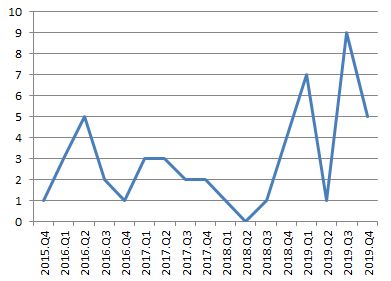
Yesterday, I finished The Brothers Karamazov, and, with that last page, completed the Classics Club challenge. I began the challenge in September 2015, and pecked away until late 2018, when I realized I had two years left and over half the stack still to tackle. Just for my own amusement, I took a look at how my reading was dispersed, more or less*:
As you can see, I started making a concerted and deliberate effort only at the end of 2018, although this was interrupted by Red Dead Redemption 2 in late March and April of last year. (That huge dive in Q2 2019? Allllllll Arthur Morgan’s fault.) By way of wrapping up, here are a few highlights:
Favorite from the list: The Gulag Archipelago
The Unfavorite: The Sun Also Rises. I figured I would take to Hemingway, but the appeal of this one was lost entirely on me.
Books I would drop from the list were I do it again:
Most of the nonfiction (surprisingly, given my usual reading is 70% nonfiction).
Books that surprised me: The Gulag Archipelago (amazing), The Gallic Wars (…not exciting), The Jungle (more enjoyable than I’d anticipated)
Book I started and stopped the most times before I finished: Catch-22. I’d tried the book three times before, once in high school and twice during the CC period.
Book I’m proudest to have finished: War and Peace, Bragging rights for life!
First and last read: Emma (Dec 2015), The Brothers Karamazov (Sept 2020).
Oldest and youngest(The Epic of Gilgamesh, ~2000 BC; 2001: A Space Odyssey, A.D. 1968)
Authors introduced to me from this series whom I’ll be reading more of: Willa Cather (O Pioneers!), Aleksandr Solzhenitsyn (Gulag Archipelago), and Leo Tolstoy (War and Peace).
Fastest and slowest reads: The Picture of Dorian Gray (<2 days); War and Peace (~ five weeks). Brothers K wasn’t too far behind War and Peace, though.
Will the Classics Club return? Absolutely; I’ve been keeping a word file with ideas, and will start the challenge again on January 1st, 2021, which is when the list is scheduled to go live. So far I only have about twenty possibilies, but I’m shopping and adding.
*I stay more or less because I created it in late ’19, in anticipation of finishing Brothers K in December. For that graph to have remained accurate, I would have needed to add an extremely long tail to account for my farting around throughout all of 2020.
There was a time when I was a youthful idealist, full of love and hope for humanity. These days, sometimes the only guard against misanthropy in my possession is recognition that we’re all broken creatures – in the gutter, as Oscar Wilde might say. But to follow on his epigram…if some of us are looking at the stars from that gutter, what are the rest looking at? In The Coddling of the American Mind, Greg Lukianoff and Jonathan Haidt argue that a new philosophy has made itself predominant in American, and increasingly western, culture — and that it rests on three untruths, promoted in schools, by parents, and enforced by the rest of society. Not only is it driving depression and anxiety, it also foments violence in the streets. Coddling is an insightful, sometimes depressing, but ultimately hopeful look at why people have sunk to such lows in recent years, and how we can rise again to assume the dignity of human beings – and treat each other likewise.
It begins with a visit to the guru of Stupid – or rather, ‘Koalemos’, as the authors open the book by recounting their visit to a guru in the Greek hinterlands who taught three things:
What doesn’t kill you makes you weaker.
Always trust your feelings.
Always assume the worst about other people, for the war is divided between good and evil people.
If the curious reader googles Koalemos, s/he will discover that said deity was the Greek god of stupid. The guru, as it happens, is fictional; a rhetorical invention. But his untruths are taught still – by our schools, at all levels – and increasingly encouraged throughout society, from parenting strategies to government policy. The untruths are manifestly destructive, sabotaging self-development and inculcating anxiety, depression, and paranoia. One of the authors, Greg Lukianoff, reveals far into the text that he once very nearly committed suicide; he was able to recover his mental health by learning to identify the ways his own mind was poisoning itself, through self-defeating ways of thinking. He learned to use CBT, a psychological tactic very kin to Stoic mindfulness, to break loose of his worst inclinations. The great untruths, he couldn’t help but notice, operated the same way his former destructive mental habits did.
Lukianoff and Haidt believe the initial popularity of these untruths came from an obsession for safety that overtook parents of the eighties and nineties – spurred by the crime spike of that era, and several public health crises. But overprotection can be deadly; an immune system that doesn’t get tested early on will become self-destructive later on, resulting in autoimmune disorders and rampant increases in food allergies. We are, Lukianoff and Haidt write, anti-fragile creatures: we not only find strength in resistance, we need resistance and danger if we are to grow at all. What the modern world is continuing to build for itself, however, is a world where people are expected to be completely sheltered from not only what might hurt them, but what they imagine hurts them. Somehow, we have fallen from being watchful for bad actors, and become paranoid about opinions which go against ours, or disrupt our peace of mind. We’ve become like the people in Fahrenheit 451, wanting to lose ourselves in fantasy and throwing into the fire anything that disrupts the dream.
This book can be thoroughly depressing, infuriating, or otherwise dispiriting in several chapters, but never moreso when chronicling the campus riots and unrest of the 20-teens, as ‘student’ bodies rushed to de-platform or get fired anyone they disagreed with – including professors who were their ideological allies. Haidt & Lukianoff document this kind of hysterical childishness on both sides, though as one ideological bent dominates college, it pops up proportional more in this view. But Haidt & Lukianoff are not talk-show hosts or polemicists casting a mocking eye at this fracas and scoffing at them: they present it at the same time as they present figures on growing rates of suicide, depression, and mental health disorders among the young. Something is deeply wrong here.
The authors then explore various contributing factors; the cult of safety being one, but supported by a maniacal obsession with college, one that often begins in kindergarten as overzealous parents try to get their little ones working on their college resumes before they’ve mastered the art of Play-Doh. Another giant problem in this mental health arena is that the present generation has been wholly reared on devices. The ramifications of obsessive screentime are still being studied, thirteen years after Steve Jobs opened that particular pandora’s box, but device usage has already been linked to growing rates of depression, as people’s doting on social media timelines convinces them that they’re not as popular, and their lives not as good, as the peers around them.
Is there a way out of this? Lukianoff & Haidt hope so. They note that some of the masters of social media are pretending to care about their products’ role in damaging mental health and fomenting radicalization, and there are growing enclaves of people who realize how unsustainable giving into childish mobs on campuses every other week is – who realize that the purpose of a university is to push young people to become more than they are, to refine their dross – not to patronize their worse impulses. There are parents, too, who realize children need freedom to grow….that exercising autonomy is a necessary experience. Unfortunately, parents in this regard have to work in tandem with local governments, since there exist cretins masquerading as humans who will call the police if they see a child playing outside on her own. Ultimately, Haidt and Lukianoff write, Americans need to restore the culture of dignity over the culture of victimhood – to push for social justice along common identity, not common enemy, lines. Treat a man as your enemy and he will become one.
The Coddling of the American Mind is a most helpful book, helping readers understand the chaos around us without dismissing its participants as universal bad actors. Much of what has happened, what continues to happen, is driven by people with the best of intentions – but good intentions count for little when the consequences are quite this bad. Although it’s not as eye-opening and insightful as The Righteous Mind, Haidt’s previous work, it’s not too far from its neighborhood. It is especially relevant into today’s hysteria over COVID and racially-linked police deaths, as people tar and feather those whose opinions differ from their own. We can have calm discussions on the efficacy of masks, or on the nature of death-by-cops, or we can scream “YOU JUST WANT PEOPLE TO DIE” at each other. One course is more helpful.
Mal Reynolds didn’t survive the Independence War by not trusting his gut. It was that same gut that told him to back away from this latest job of Badger’s. The item may have looked like a crate, but when he saw how anxious the middle-men were to get rid of it, and saw the Blue Sun markings on its exterior, Mal knew that little box was more trouble than it was worth. But Jayne had different ideas, and when he smuggled the cargo onto Serenity in the middle of the night, he unwittingly exposed them to being lost and destroyed by their own fantasies.
Almost immediately after the ‘ghost machine’, as the mules called it, is aboard Serenity, the story as traditionally developed disappears. The Firefly’s crew sink to dreamworlds reflecting their heart’s desire. For Mal, this is a home and family, with Inara and handful of beautiful kids; for Kaylee, it’s to work side by side with her now-living pop in his repair shop. But while the Serenity‘s crew sleeps, the ship sails on — to its looming destruction, for with no one at the helm it’s on a course to crash at full speed into the surface of a moon. And still worse: those dreams have a way of turning into nightmares. Their only hope is River — River, who could sense something dangerous in Jayne’s bunk, River who alone could stay awake and then enter her friends’ dreams to try to rescue them from the nightmares they’re immersed in, and to get the ship out of danger.
Ghost Machine is easily the most unusual of the Firefly novels so far released, and the most unsuited for those not already familiar with the characters — because its appeal is how it twists and plays with people we’re already familiar with, exploring their innermost dreams and fears. The dreamworlds are sometimes amusing or endearing: while one might expect Jayne’s living fantasy to involve mansions and women in their ‘scanties’, in truth it’s nothing more than to fight with his brother, defending the family farm against ne’er do wells. Jayne’s a simple man. Wash’s, unexpectedly, is to be a transportation mogul with Zoe at his side. Because the character’s dreams often involve one another, each succeeding chapter might see radically different interpretations of the same person — Zoe as a charismatic captain of industry in Wash’s dream, and a whiskey-slugging bounty hunter in her own. When the dreamscapes turn to nightmares — a flaw of the machine — familiar characters become treacherous and unrecognizable.
I’ve thoroughly enjoyed the Firefly series so far, but if you’ve not watched the show, this would not be the place to start. Its appeal is more like that of “The Naked Now”, “The Naked Time”, or “Dramistas Personae” from Star Trek’s bench: a deliberate toying-with of loved characters to see a little deeper into them.
Kindle Highlights:
“Wash can make takeoff nice and gentle,” said Mal. “Can’t you, Wash?” “A feather on a breeze,” Wash said, then frowned. “Something like that, at any rate. There may be a better analogy.”
“Damn straight you couldn’t,” Jayne growled. “If you’d gone and committed suicide, Mama would’ve killed you!” “That makes no—” It dawned on Matty that Jayne was ribbing him. “Oh yeah. I get it.”
Maybe Mal Reynolds always needed someone to fight against. He defined himself by what he resisted, and therefore without anything to oppose, he was nothing.
“Where’d you come from?” he said. “Your head,” she replied. “And mine. It’s complicated.” “Sounds like it.”
“This? It’s a distortion. It’s what you thought you wanted, but what the heart desires isn’t the same as what the heart needs.”
From The Brothers Karamazov, an early chapter in which the brothers and their father receive advice from an Elder at the monastery:
“Above all, above everything else — do not lie.”
“About Diderot, you mean?”
“No, not exactly about Diderot. Above all, do not lie to yourself. A man who lies to himself and listens to his own lie comes to a point where he does not discern any truth either in himself or anywhere around him, and thus falls into disrespect towards himself and others. Not respecting anyone, he ceases to love, and having no love, he gives himself up to passions and coarse pleasures, in order to occupy and amuse himself, and in his vices reaches complete bestiality, and it all comes from lying continually to others and to himself.”
“Captain, permission to speak freely? You’re a good egg.”
“…I’m not sure how to respond to that.”
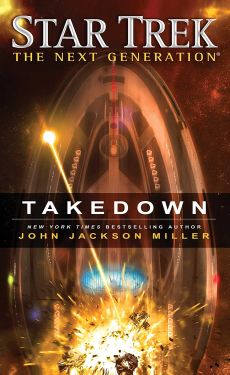
I spotted this title at a surplus-goods store a few years back, and couldn’t help be flabbergasted by the premise. Admiral Riker, leading a flotilla of ships against Federation outposts — against Captains Ezri Dax and Jean Luc Picard? Where on earth did that come from? What huge twists and turns in previous novels had I missed? ….turns out, Takedown is largely self-contained, almost an episodic throwback to the old numbered novels. It’s a definite page turner with an out of left field premise, one that starts when members of the Khitomer Accords (Feds, Cardies, Ferengi, Klingons) and the Typhon Pact (Romulans, Gorn, and a few other villains) receive invitations to a space station in the middle of nowhere. When the meeting is over, each of the delegates — including Admiral Riker — are acting….a little odd, and within a few hours they’re all zipping across the Alpha and Beta Quadrants, destroying communications arrays — including those of their allies, and seemingly working in concert — while the six powers grope in darkness and wonder: what the hell?
That question was on my mind for most of the story, which I would have devoured in one sitting were it not for the fact that my body mutinied and insisted I go to sleep. The mystery of what happened to the diplomats, and why they’re suddenly obsessed with destroying arrays that have no conceivable military purpose (some of them are deep space telescopes, probing the cosmos beyond any known powers), drives the story, particularly abroad the Aventine. Captain Dax is a little confused when Admiral Riker transfers his flag to her ship, moreso when he isolates himself in the holodeck, and finally has to push back when Riker declares that the greatest threat to the Federation which now exists ….is a Ferengi relay station. Once Picard and the Enterprise enter the picture, we learn more — but ultimately, it proves to be one of those “Now that you’ve foiled me I’ll reveal my entire plan” resolutions, which I don’t particularly care for.
Takedown is a fun story, but not one to take seriously: there’s no character growth, and I’ve never seen the events here referenced in other novels. Its author, John Jackson Miller, is a new name for me in Treklit — and as bizarre as this story is, I enjoyed his use of humor. It helps, of course, that we get to visit both the Aventine and the Enterprise: I’m particularly fond of the Aventine crew, having grown fond of novels including them over the years. It was nice to see the real Picard in Treklit, not that tired imitation from Kurzman’s rubbish pile.
No spoilers, but if you’re a student of TNG episodes. this may ring a bell…
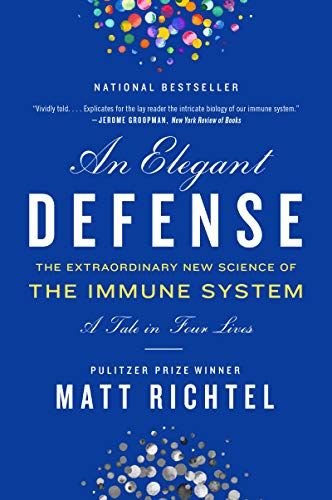
Back in January, long before the pandemic was on my mind (or anyone else’s outside of China), I watched a charming and educational series called Cells at Work!, an anime about the human body — and specifically, the immune system. My interest ignited, I looked for something that might shed more light on the impressive complexity of the immune system, and (mostly) found it in An Elegant Defense. Richtel’s work takes us through the history of how we came to understand the immune system, and what medical researcher’s struggles with modern foes like cancer and AIDS have taught us. Although the book is often too breezy and disjointed for me, its subject is of considerable interest, and I found it worth the while.
My earliest conception of the immune system was terribly exciting: in fourth grade, I learned that my body was host to a little army, that when invaded by germs or such, would take to the field and drive the enemy away. Exciting — but simplistic. In reality, Ritchel writes, the immune system is more of a bouncer at a very lively bar; it’s there to keep the peace, destroying troublemakers without disrupting the other guests. But there’s not just one bouncer, but several of them, and they can both collaborate or step on the other’s toes: our bodies have several “first lines of defense”, not one integrated hierarchy. But those bouncers can also act like warrior cops, causing more trouble than they prevent — sometimes destroying the body in an effort to destroy their prey. To this end, there are natural safeguards, like specialist T-cells that regulate their brethren, or even self-destruct switches that particularly pervasive diseases like cancer can use to their own advantage. Ritchel guides us herky-jerky through the various players — T-cells, B-cells, dendrites, and a host of others that I remembered from Cells at Work! — while at the same time using medical research cases to show how our struggles to understand the immune system are offering us possible answers in the fight against cancer. One interesting case involves injecting T-cells with DNA from HIV — HIV’s anti-B cell weaponry — and then setting those T-cells loose on cancerous B-cells. It’s fascinating that we’ve come so far that we can manipulate the body this way, but I was also pleased to see that Ritchel includes information on how our immune systems are dependent on bacteria within us — bacteria that not only fight rival invaders for food and space, but trigger the formation of specialist cells in our bodies that can go to work rooting out malfactors. As much biology as I’ve read, learning that there are parts of our body that go unrealized unless they’re in communication with outside bacteria makes my mind boggle at how deeply interwoven the strands of life are.
This is a fascinating, deeply relevant book — but it has its irritants. The author likes to keep introducing new players and trains of thought, then jumping away to something else, then jumping back, and so on and so forth. It’s wearisome, especially when the jumps are always prefaced with trying-to-be-cool hooks like “And it all started with a werewolf.”* This becomes less of a problem 2/3rds into the book, because everything that can be introduced has been, and now it’s just a question of bringing all the threads together — using the medical cases of four people to sum up the past and future of immunology. While this title certainly isn’t in the competition for ‘best popular science ever’, those who want to learn more about the immune system will be largely well served by it.
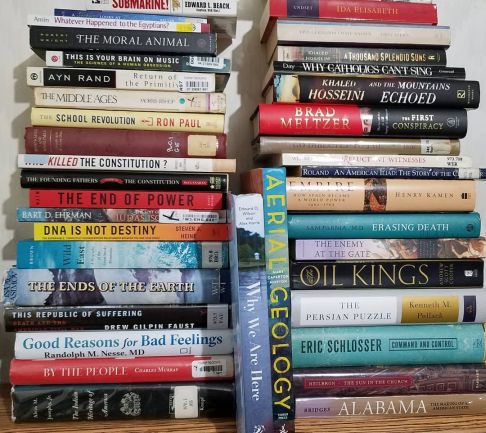
At the end of July I hit on an idea for reconciling my growing TBR Pile of Doom with my intractable hunger for more books: for every four TBR books I read, I’d allow myself to buy one book. In hopes of keeping myself driven, I’m going to take a page from Sarah’s book and do a monthly face-the-verdict, though not one as numbers-oriented as hers. I made….definite progress in August, reading TBR material almost exclusively.
TBR Scheduled for September: The Coddling of the American Mind, Jonathan Haidt and Greg Lukianoff. Purchased 2019. The School Revolution, Ron Paul. Gift from a friend in 2018.
Reward Books Purchased: Obey Little, Resist Much: Remembering Ed Abbey, ed. James Hepworth The Putin Interviews, Oliver Stone
I had to hit the ground running in August, because in September I have the Brothers Karamazov to finish — my deadline is September 21st, the date I accepted the Classics Club challenge. If I don’t make it, I’m not sure what will happen — an attack of disappointed English teachers? — but I don’t want to tempt fate.
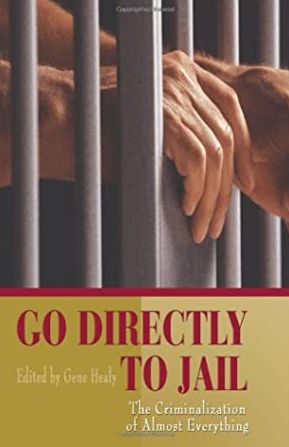
What good are laws so numerous they cannot be known, or so opaque they cannot be understood? James Madison knew enough to ask that question. Modern legislators and regulators do not. In Go Directly to Jail, Gene Healy collects several pieces criticizing the eye-opening expansion of federal crimes in the last quarter of the 20th century, and the deleterious effects of this expansion on American governance and society alike. The articles are abbreviated versions of longer policy papers, and while they’re detailed reading they’re not necessarily dry – the most challenging of them is the piece on HIPPA violations.
“Don’t make a federal case out of it” used to mean something – a warning not to exaggerate something’s importance. But federal crimes no longer concern themselves with important things: more often than not, they concern trivialities, which they treat as important. Federal crimes multiply exponentially by the year, driven by regulatory agencies which fund themselves partially through fines – who thus have every incentive to create new offenses they can bill for, creating less a system of justice and more an organized structure for looting. Four areas are considered in the included essays: the environment, healthcare, gun control, and Federal sentencing guidelines. Each article has unique lessons ; overzealous criminalization of HIPPA ‘violations’ distorts medical practice, for instance, by pushing doctors into larger collectives for protection, and skewing their prescriptions towards what’s legally safe rather than what’s needed.
More important are the general lessons. Destroyed completely are the basic conceits of Anglo-American common law: that for something to be a crime, there must have been both bad intent and bad action. To the modern state, intent is irrelevant; actual harm is irrelevant. What matter is: is there a rule you’ve broken that we can exploit to the hilt? In some of the case studies here, a man who cleared an area of industrial debris, then began filling in pits in the landscape to level it it, was fined and imprisoned for polluting. (Toxic leachants are fine; but dirt, by god, dirt is just too much.)
A state run by a multitude of laws that no one can fully understand, or even know that they’re violating, is essentially lawless. If people have no reliable way to tell what’s illegal and what’s not, and if they are tarred with the same brush as rapists and murders for bookkeeping or legalistic mistakes, why should they take the law seriously? We effectively live in a Dolores Umbridge legal system, supported only by those empowered by it: lobbyists, lawyers, and bureacrats. The law’s moral power, which is far more important than the threat of enforcement (an awake conscience is a more forbidding presence than any state), is undermined completely by an unnavigable legal system with harsh reprisals for innocent mistakes.
This is an infuriating collection of pieces, presumably much dated by now, and I suspect the trend has gone towards more criminalization instead of less — although some progress is being made on the marijuana front at the state level, at least. The highly focused aspects of several of its pieces might make casual readers spook and run: I’ve had this book five years or so and even now that I’ve fully read it, the healthcare chapter still has parts a little beyond my ken. This is an important aspect of understanding DC’s police state, though, especially in the wake of these police-inflicted homicides– the persons being killed are often swept up under odious charges like selling loose cigarettes.
Related: You Have the Right to Remain Innocent, James Duane. A lawyer’s take on the same problem, with his own solution: don’t talk to the cops, ever. Ever. Ever.






 Reading Freely